
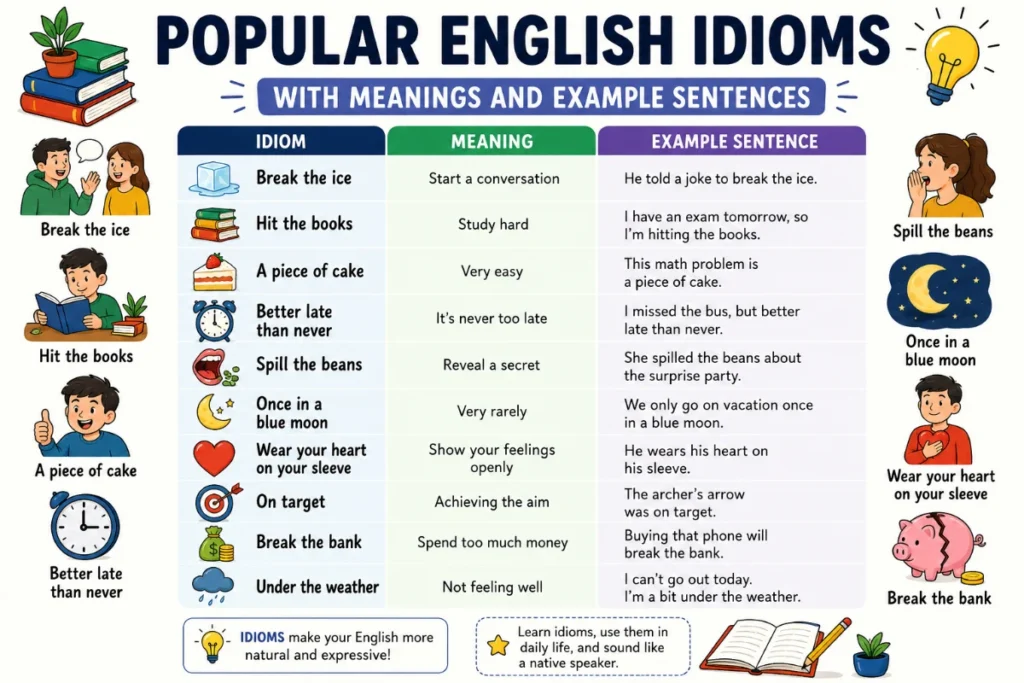
Have you ever understood every word in an English sentence but still had no idea what the speaker meant? You may have encountered an idiom. When someone says “That test was a piece of cake,” for example, they’re not talking about dessert—they mean the test was very easy.
Likewise, “break the ice” means to help people feel more comfortable when they first meet or when a situation feels awkward. Idioms are fixed expressions whose intended meaning is different from the literal meaning of the individual words, and you’ll encounter them in everyday conversations, movies, books, social media, classrooms, and workplaces.
The tricky part is that you can’t always figure out an idiom’s meaning simply by translating it word for word. That’s why this guide brings together 40+ common and useful English idioms and proverbs with simple meanings, natural example sentences, usage tips, common mistakes, and related expressions, helping you recognize these phrases in context and use them correctly in your own English.
What Is an Idiom?
An idiom is a fixed expression in which the overall meaning is different from the literal meaning of the individual words.
For example:
“It’s raining cats and dogs.”
Taken literally, this sounds as though cats and dogs are falling from the sky. But the idiomatic meaning is simply:
It is raining very heavily.
This difference between literal and figurative meaning is what makes idioms interesting—and sometimes challenging for English learners.
Idioms are commonly used in:
- Everyday conversations
- Movies and television
- Books and stories
- Social media
- Informal messages
- Workplace conversations
- Interviews and presentations
- Popular culture
How This List Was Selected
The idioms below were selected because they are widely recognized, useful in everyday English, and especially valuable for learners. The explanations focus on their common modern meanings and practical usage rather than simply giving dictionary-style definitions.
Break the Ice
Meaning: To start a conversation or activity that helps people feel more relaxed.
A Real-Life Example
Imagine walking into a party where you don’t know anyone. Everyone is standing quietly, so you tell a funny story and people begin laughing and talking.
You have broken the ice.
Example Sentences
- Sarah told a joke to break the ice at the meeting.
- Playing a quick game helped everyone break the ice.
- I asked my new colleague about his favorite movie to break the ice.
Similar Expressions
- Start a conversation
- Make people feel comfortable
- Get the conversation started
Usage Note
Break the ice is common in casual conversations, social situations, meetings, and introductions.
Tone: Neutral to informal
Formal alternative: Create a more relaxed atmosphere
A Piece of Cake
Meaning: Something that is very easy to do.
Why Does It Mean “Easy”?
The literal phrase refers to a slice of cake, but the idiomatic expression means that a task requires very little difficulty.
Example Sentences
- The math problem was a piece of cake.
- Once you understand the software, using it is a piece of cake.
- I expected the interview to be difficult, but it was a piece of cake.
Similar Expressions
- Easy as pie
- A breeze
- No sweat
- Very easy
Usage Note
This is a strongly conversational expression and works best in informal situations.
Tone: Informal
Formal alternative: Very easy or relatively straightforward
Hit the Books
Meaning: To study seriously or spend time studying.
Picture the Situation
A student has an important exam tomorrow. Instead of watching television, she opens her textbooks and starts studying.
She decides to hit the books.
Example Sentences
- I have an exam tomorrow, so I need to hit the books.
- James went home early to hit the books.
- If you want a good grade, it’s time to hit the books.
Similar Expressions
- Study hard
- Revise
- Prepare for an exam
- Get down to studying
Usage Note
This idiom is especially common among students.
Tone: Informal
Formal alternative: Study thoroughly
Spill the Beans
Meaning: To reveal secret or private information.
Example Scenario
Your friend is planning a surprise birthday party. Everyone promises to keep it secret, but one person accidentally tells you about it.
They spilled the beans.
Example Sentences
- Who spilled the beans about the surprise?
- I wasn’t going to tell anyone, but Mark spilled the beans.
- Don’t spill the beans before the announcement.
Similar Expressions
- Reveal a secret
- Give away the secret
- Let the secret out
Common Mistake
Don’t use spill the beans simply to mean “talk.” The expression specifically involves revealing information that was supposed to remain secret.
Tone: Informal
Formal alternative: Disclose the information
Once in a Blue Moon
Meaning: Something that happens very rarely.
Example Scenario
You usually cook at home and almost never eat fast food. Maybe you have a burger only a few times a year.
You could say:
“I eat fast food once in a blue moon.”
Example Sentences
- We visit that restaurant once in a blue moon.
- I only watch horror movies once in a blue moon.
- She calls her old school friends once in a blue moon.
Similar Expressions
- Very rarely
- Hardly ever
- Once in a while
Tone: Neutral to informal
Formal alternative: Very rarely or infrequently
Under the Weather
Meaning: To feel sick, tired, or generally unwell.
Example Sentences
- I’m feeling under the weather today.
- Maria stayed home because she was under the weather.
- I won’t go out tonight because I’m a little under the weather.
Important Usage Tip
This idiom usually describes mild illness or feeling unwell, rather than a serious medical condition.
Similar Expressions
- Feel unwell
- Feel sick
- Feel under par
Tone: Informal
Formal alternative: Feel unwell
Cost an Arm and a Leg
Meaning: To be extremely expensive.
Example Scenario
You find a beautiful apartment, but the rent is far beyond your budget.
You might say:
“That apartment costs an arm and a leg.”
Example Sentences
- That designer bag cost an arm and a leg.
- The vacation was amazing, but it cost us an arm and a leg.
- Buying a house in that neighborhood can cost an arm and a leg.
Similar Expressions
- Very expensive
- Cost a fortune
- Cost a small fortune
Tone: Informal
Formal alternative: Extremely expensive
Let the Cat Out of the Bag
Meaning: To reveal a secret, usually accidentally.
Example Scenario
Your sister is planning a surprise for your parents. Before the surprise happens, your brother accidentally tells them.
He let the cat out of the bag.
Example Sentences
- Tom let the cat out of the bag about the wedding.
- I wanted to keep it secret, but Anna let the cat out of the bag.
- Don’t let the cat out of the bag before Friday.
Similar Expressions
- Reveal a secret
- Give something away
- Let the secret out
Usage Tip
Spill the beans and let the cat out of the bag have very similar meanings. Both are generally informal.
Bite the Bullet
Meaning: To face a difficult, unpleasant, or uncomfortable situation with courage.
Example Scenario
You have been avoiding an important conversation for weeks. Eventually, you decide that it must happen.
You bite the bullet and have the conversation.
Example Sentences
- I was nervous about the interview, but I decided to bite the bullet.
- She finally bit the bullet and apologized.
- We need to bite the bullet and make a decision.
Similar Expressions
- Face the situation
- Confront the problem
- Deal with it
- Face the music
Tone: Informal
Usage Note:
Use this expression when someone accepts that something difficult must be faced rather than avoided.
Beat Around the Bush
Meaning: To avoid discussing the main point directly.
Example Scenario
Your friend wants to tell you that they are moving away, but instead of saying it directly, they spend ten minutes talking about unrelated subjects.
They are beating around the bush.
Example Sentences
- Stop beating around the bush and tell me what happened.
- He kept beating around the bush instead of answering my question.
- Don’t beat around the bush; just tell her the truth.
Similar Expressions
- Avoid the point
- Evade the issue
- Avoid answering directly
Tone: Informal
Usage Warning:
This expression can sound impatient or critical, so use it carefully.
Call It a Day
Meaning: To stop working or finish an activity for the day.
Example Scenario
You’ve been working since morning, you’re tired, and the remaining tasks can wait until tomorrow.
You say:
“Let’s call it a day.”
Example Sentences
- We’ve worked for eight hours. Let’s call it a day.
- I’m exhausted, so I’m going to call it a day.
- We finished the important tasks, so the manager told us to call it a day.
Similar Expressions
- Stop working
- Finish for today
- Wrap things up
Tone: Informal
Formal alternative: Conclude the work for today
Hang in There
Meaning: To remain patient and keep going during a difficult situation.
Example Scenario
A friend is struggling with a difficult course but continues studying despite the challenges.
You might tell them:
“Hang in there! You’re doing great.”
Example Sentences
- Hang in there—things will get better.
- The project is difficult, but hang in there.
- Hang in there, and don’t give up yet.
Similar Expressions
- Keep going
- Stay strong
- Don’t give up
- Keep at it
Tone: Informal and encouraging
Go the Extra Mile
Meaning: To make more effort than is normally expected.
Example Scenario
A customer-service employee notices that a customer has a problem. Instead of simply giving instructions, the employee personally helps solve it.
The employee went the extra mile.
Example Sentences
- Our teacher always goes the extra mile to help students.
- She went the extra mile to make the event successful.
- Good employees often go the extra mile for their customers.
Similar Expressions
- Make an extra effort
- Go above and beyond
- Do more than expected
Tone: Neutral
Formal alternative: Make an additional effort
The Ball Is in Your Court
Meaning: It is now your responsibility to make the next decision or take the next action.
Example Scenario
You send someone a proposal and wait for their response.
You can say:
“I’ve made my offer. The ball is in your court now.”
Example Sentences
- I’ve explained everything, so the ball is in your court.
- I sent her the documents; now the ball is in her court.
- We’ve made our proposal. The ball is in their court.
Similar Expressions
- It’s your turn
- The next move is yours
- It’s up to you
Tone: Neutral to informal
Usage Note:
This expression is common in business, negotiations, relationships, and decision-making.
Kill Two Birds With One Stone
Meaning: To accomplish two goals with one action.
Example Scenario
You need to exercise and go to the store. Instead of driving, you walk to the store.
You have killed two birds with one stone.
Example Sentences
- I’ll walk to the store and exercise at the same time, so I’ll kill two birds with one stone.
- Taking the train saves money and reduces traffic, so we’re killing two birds with one stone.
Similar Expressions
- Accomplish two things at once
- Solve two problems at once
- Get two benefits from one action
Modern Usage Note
Some speakers prefer alternatives such as “accomplish two things at once” because they sound more neutral and avoid violent imagery.
Tone: Common but conversational
Actions Speak Louder Than Words
Meaning: What someone does can reveal more than what they say.
Example Scenario
Someone repeatedly promises to help but never actually does anything. Another person quietly helps without making promises.
The situation demonstrates that actions speak louder than words.
Example Sentences
- He keeps promising to help, but actions speak louder than words.
- She never talks about being generous; she simply helps people. Actions speak louder than words.
- If you want people to trust you, remember that actions speak louder than words.
Similar Expressions
- Deeds matter more than promises
- Behavior reveals intentions
- What you do matters more than what you say
Tone: Neutral
17. Practice Makes Perfect
Meaning: Regular practice helps you improve a skill.
Example Scenario
At first, your English pronunciation feels difficult. After practicing every day for several weeks, you become more confident.
That’s why people say:
“Practice makes perfect.”
Example Sentences
- Keep practicing your pronunciation. Practice makes perfect.
- Don’t worry about mistakes. Practice makes perfect.
- She practiced the piano every day because she believed practice makes perfect.
Similar Expressions
- Practice improves performance
- Keep practicing
- Repetition builds skill
Important Note
The phrase is an encouragement rather than a literal guarantee that practice will produce absolute perfection.
Better Late Than Never
Meaning: Doing something late is better than not doing it at all.
Example Scenario
You wanted to start learning English years ago but kept postponing it. Today, you finally begin.
A friend might say:
“Better late than never!”
Example Sentences
- I finally started exercising at 40. Better late than never!
- He apologized after several weeks, but better late than never.
- We finally finished the project. Better late than never.
Similar Expressions
- It’s never too late
- Late is better than not at all
Tone: Neutral and encouraging
When Pigs Fly
Meaning: Something is extremely unlikely or probably will never happen.
Example Scenario
Your friend says:
“I’ll clean my room every morning from now on.”
If you don’t believe them, you might jokingly reply:
“Sure—when pigs fly!”
Example Sentences
- He’ll wake up at 5 a.m. every morning when pigs fly.
- “Will you lend me your new car?” “Sure, when pigs fly!”
- She said he’d apologize first, but that will happen when pigs fly.
Similar Expressions
- Not likely
- No chance
- Never going to happen
Tone: Informal and often humorous
Usage Warning:
Because this expression can sound sarcastic, avoid it when a serious or respectful response is needed.
Don’t Put All Your Eggs in One Basket
Meaning: Don’t risk everything on one plan, opportunity, or source.
Example Scenario
Imagine applying to only one university. If you aren’t accepted, you have no backup option.
A better strategy is to apply to several schools because you shouldn’t put all your eggs in one basket.
Example Sentences
- Apply to several universities. Don’t put all your eggs in one basket.
- It’s smart to have several career options instead of putting all your eggs in one basket.
- Investors often diversify because they don’t want to put all their eggs in one basket.
Similar Expressions
- Have a backup plan
- Diversify your options
- Don’t risk everything on one choice
Tone: Neutral
Usage Note:
This idiom is especially useful when talking about money, education, careers, business, and planning.
Quick Table: Idioms With Meanings
| Idiom | Simple Meaning | Tone |
|---|---|---|
| Break the ice | Start a friendly conversation | Neutral/Informal |
| A piece of cake | Very easy | Informal |
| Hit the books | Study hard | Informal |
| Spill the beans | Reveal a secret | Informal |
| Once in a blue moon | Very rarely | Neutral/Informal |
| Under the weather | Feel unwell | Informal |
| Cost an arm and a leg | Be extremely expensive | Informal |
| Let the cat out of the bag | Reveal a secret | Informal |
| Bite the bullet | Face something difficult | Informal |
| Beat around the bush | Avoid the main point | Informal |
| Call it a day | Stop working for today | Informal |
| Hang in there | Keep going | Informal |
| Go the extra mile | Make extra effort | Neutral |
| The ball is in your court | It’s your turn to act | Neutral/Informal |
| Kill two birds with one stone | Accomplish two things at once | Conversational |
| Actions speak louder than words | Actions reveal more than words | Neutral |
| Practice makes perfect | Practice improves skill | Neutral |
| Better late than never | Late is better than never | Neutral |
| When pigs fly | Very unlikely | Informal |
| Don’t put all your eggs in one basket | Don’t risk everything | Neutral |
Formal vs. Informal Idioms: When Should You Use Them?
Understanding an idiom is only half the job. You also need to know when it sounds appropriate.
| Informal Idiom | More Formal Alternative |
|---|---|
| Hit the books | Study thoroughly |
| A piece of cake | Very easy |
| Spill the beans | Reveal the information |
| Call it a day | Conclude the work |
| Beat around the bush | Avoid addressing the issue directly |
| Cost an arm and a leg | Be extremely expensive |
| Hang in there | Remain persistent |
| Go the extra mile | Make an additional effort |
Good Places to Use Idioms
Idioms can sound natural in:
- Everyday conversations
- Friendly messages
- Personal stories
- Interviews
- Informal presentations
- Movies and dialogue
- Social media
- Casual workplace conversations
Use Them Carefully In Formal Writing
Academic papers, legal documents, technical instructions, and formal reports often benefit from direct and precise language.
For example:
Informal:
The new software is a piece of cake to use.
More formal:
The new software is easy to use.
The goal isn’t to avoid idioms completely. It’s to match your language to your audience and purpose.
Why Are Idioms Difficult for English Learners?
Idioms can be confusing because the literal words often give you the wrong impression.
Consider:
“The ball is in your court.”
Literal meaning: A ball is physically on someone’s sports court.
Figurative meaning: It is that person’s responsibility to make the next move.
This is why translating an idiom word for word from one language into English often doesn’t work.
The best approach is to learn the complete expression together with its meaning, context, and typical usage.
Common Mistakes When Learning English Idioms
1. Translating Every Word Literally
If you translate an idiom word by word, you may completely miss its intended meaning.
Instead, learn:
Spill the beans = reveal a secret
as one complete unit.
2. Changing the Expression
Idioms often have fixed wording.
❌ “Break the ice cubes.”
✅ “Break the ice.”
Small changes can make an expression sound unnatural.
3. Using Too Many Idioms
Idioms can make your English colorful, but using one in every sentence can make your writing sound forced.
Natural English usually mixes:
- Ordinary vocabulary
- Phrasal verbs
- Idioms
- Precise expressions

4. Using an Informal Idiom in a Formal Context
“Hit the books” sounds natural in conversation.
In an academic paper, however, “study thoroughly” may be more appropriate.
5. Memorizing Without Context
Knowing that “once in a blue moon” = rarely is useful.
But remembering a situation such as:
“I only visit that restaurant once in a blue moon.”
makes the expression much easier to recall.
How to Learn Idioms With Meanings Effectively
You don’t need to memorize hundreds of expressions to improve your English. A small number of useful idioms, practiced repeatedly, can make a noticeable difference.
Learn Five at a Time
Start with:
- Break the ice
- A piece of cake
- Hit the books
- Spill the beans
- Once in a blue moon
Master those before adding another group.
Create Personal Examples
Instead of copying:
“The test was a piece of cake.”
Write something connected to your own life:
“My English quiz was a piece of cake today.”
Personal examples are easier to remember.
Learn Idioms in Context
Watch for idioms in:
- Movies
- Podcasts
- Interviews
- Books
- YouTube videos
- Conversations
- English-learning content
When you encounter one, record the expression + meaning + example.
Practice Speaking
Don’t only recognize idioms when you read them. Say them aloud.
For example:
“I have an exam tomorrow, so I need to hit the books.”
Using an expression actively helps move it from passive vocabulary into your everyday English.
Idioms vs. Proverbs: Are They the Same?
No. Idioms and proverbs are related but different.
An idiom is usually a fixed expression with a figurative meaning:
“Break the ice.”
A proverb is generally a short traditional saying that expresses advice, wisdom, or a general truth:
“Actions speak louder than words.”
Some expressions can overlap in function, but their purposes are not always identical.
Practice Quiz: Can You Guess the Meaning?
Test yourself before looking at the answers.
1. “The exam was a piece of cake.”
Does it mean:
A. The exam included cake
B. The exam was very easy
C. The exam was very long
Answer: B — The exam was very easy.
2. “Don’t spill the beans.”
Does it mean:
A. Don’t waste food
B. Don’t reveal the secret
C. Don’t cook dinner
Answer: B — Don’t reveal the secret.
3. “I see my old friend once in a blue moon.”
Does it mean:
A. Very often
B. Every month
C. Very rarely
Answer: C — Very rarely.
4. “The ball is in your court.”
Does it mean:
A. You need to play tennis
B. It’s your turn to take action
C. You lost the game
Answer: B — It’s your turn to take action.
5. “Hang in there!”
Does it mean:
A. Keep going
B. Go outside
C. Stop immediately
Answer: A — Keep going.
Why Learning Common English Idioms Matters
Learning idioms can help you understand English as it is actually used in real situations.
They can help you:
- Follow conversations more easily
- Understand movies and television
- Improve listening comprehension
- Expand your vocabulary
- Recognize figurative language
- Sound more natural when speaking
- Understand informal messages
- Communicate ideas more memorably
However, you don’t need to force idioms into every conversation. Natural usage is more important than using as many idioms as possible.
FAQs About Idioms With Meanings
What are idioms with meanings?
Idioms with meanings are fixed expressions explained according to their figurative meaning rather than their literal words. For example, “a piece of cake” means something is very easy.
What are five common English idioms?
Five widely recognized English idioms are break the ice, a piece of cake, hit the books, spill the beans, and once in a blue moon.
What is the easiest way to learn English idioms?
Learn a few idioms at a time, understand each one in context, create personal examples, and use them in conversation. Repeated exposure is more effective than trying to memorize a huge list at once.
Are English idioms formal or informal?
It depends on the expression. Many common idioms are conversational and informal, while others can be used in neutral or professional contexts. Always consider your audience and purpose.
Can I use idioms in academic writing?
You can, but you should use them selectively. Formal academic writing often benefits from direct and precise language instead of highly conversational idioms.
Final Thoughts: Start Using Idioms Today
Understanding idioms with meanings can transform the way you understand everyday English. Instead of wondering why someone is talking about cakes, cats, ice, or flying pigs, you’ll recognize the figurative message behind the words.
Don’t try to learn all 40+ today.
Choose five. Learn their meanings. Read the examples. Create your own sentences. Then use at least one in a real conversation.
Once those expressions become familiar, come back for the next five. With regular practice, English idioms that once sounded confusing can start feeling completely natural.
Your goal isn’t to sound complicated. Your goal is to understand English better and use the right expression naturally.

Clara Bennett writes for Meaning Match about English idioms, everyday expressions, meanings, and practical language usage, making phrases easy to understand.