
Need a stronger way to describe courage, determination, confidence, or resilience? Strong idioms are expressions that can describe inner strength, bravery, persistence, power, or the ability to stay firm during difficult situations.
Phrases such as “stand your ground,” “keep your chin up,” “go the extra mile,” and “weather the storm” can all relate to strength, but they express different ideas. “Stand your ground” emphasizes refusing to give in, while “keep your chin up” encourages someone to stay positive during a difficult time. “Go the extra mile” focuses on making an extra effort, whereas “weather the storm” describes successfully getting through a challenging period.
If you’re searching for strong idioms for writing, speeches, captions, stories, or everyday English, choosing the right expression can help you describe the exact kind of strength you mean. In this guide, you’ll discover common idioms and related expressions for courage, perseverance, confidence, determination, power, and resilience, with clear meanings and natural examples.
What Are Strong Idioms?
Strong idioms are fixed English expressions that communicate an intense feeling, situation, reaction, or idea in a vivid, nonliteral way. For example, see red means to become extremely angry, on top of the world means extremely happy, and cost an arm and a leg means extremely expensive.
The key is to use an idiom according to its meaning, intensity, grammar, and tone rather than translating its individual words literally.
Strong Idioms in English With Meanings and Examples
See Red
Meaning: To become extremely angry.
Word-by-word: “See” means perceive, and “red” is a color, but together they create a figurative expression.
Example:
I saw red when I discovered that someone had taken credit for my work.
Common error:
❌ I saw red because the coffee was slightly cold.
✅ I saw red when I found out that he had lied to me.
Usage note: This is informal and dramatic. Use it for very strong anger, not mild irritation.
Similar idioms: blow your top, hit the roof, lose your temper.
Break Someone’s Heart
Meaning: To cause someone deep emotional pain or sadness.
Example:
Losing her childhood home broke her heart.
Common error:
Do not use it for every small disappointment. It normally suggests significant emotional pain.
Usage note: Common in romantic, family, friendship, and other deeply emotional situations.
Similar expression: crush someone’s spirit can be stronger and more serious, depending on context.
Hit the Nail on the Head
Meaning: To identify or explain something exactly.
Example:
You hit the nail on the head when you said the real problem was poor communication.
Common error:
❌ Hit the nail at the head.
✅ Hit the nail on the head.
Usage note: This idiom is generally neutral and works in both conversation and professional discussion.
Grammar pattern:
hit the nail on the head
hit remains the same in the present and past form.
Go Through the Roof
Meaning: To rise dramatically or become extremely high; it can also describe becoming extremely angry.
Examples:
Grocery prices have gone through the roof.
My dad went through the roof when he saw the damage.
Common error:
Do not assume it always means anger. Context determines the meaning.
Usage note: Frequently used for prices, costs, numbers, excitement, or anger.
Cost an Arm and a Leg
Meaning: To be extremely expensive.
Example:
That designer jacket cost an arm and a leg.
Common error:
❌ It costed an arm and a leg.
✅ It cost an arm and a leg.
Usage note: Informal and often humorous. It is better suited to conversation than highly formal financial writing.
Similar expression: cost a fortune.
On Top of the World
Meaning: To feel extremely happy, successful, or confident.
Example:
I felt on top of the world after receiving my acceptance letter.
Common error:
The phrase does not simply mean being physically somewhere high.
Usage note: Positive and expressive; ideal for achievements, celebrations, and moments of great happiness.
Similar expressions: over the moon, walking on air.
Under the Weather
Meaning: To feel slightly sick or unwell.
Example:
I’m feeling under the weather, so I’m going to rest today.
Common error:
It generally refers to feeling unwell rather than describing a serious medical condition.
Usage note: Informal and friendly.
Similar expression: feeling poorly.
A Storm in a Teacup
Meaning: A lot of anger or excitement about a relatively small problem.
Example:
Their argument was just a storm in a teacup.
Common error:
Don’t use it when the problem is genuinely serious.
Usage note: Especially common in British English. In American English, a tempest in a teapot is also used.
Related expression: make a mountain out of a molehill.
Blow Your Top
Meaning: To become extremely angry or lose your temper.
Example:
She blew her top when she realized someone had deleted the files.
Common error:
It describes intense anger, not ordinary excitement.
Usage note: Informal and dramatic.
Similar idioms: see red, hit the roof.
Keep Your Cool
Meaning: To remain calm in a stressful, difficult, or angry situation.
Example:
Try to keep your cool during the interview.
Common error:
It does not mean being emotionally cold or uncaring.
Usage note: Very useful in everyday conversations, arguments, interviews, competitions, and workplace situations.
Grammar pattern:
keep your cool
kept his/her cool
keeping your cool
Bite the Bullet
Meaning: To face something difficult, unpleasant, or unavoidable with courage.
Example:
I didn’t want to make the difficult phone call, but I decided to bite the bullet.
Common error:
It does not simply mean “make a decision.” The decision usually involves something unpleasant or difficult.
Usage note: Informal but widely understood.
Similar expressions: face the music, grin and bear it.
Break the Ice
Meaning: To make people feel more comfortable in a new or awkward social situation.
Example:
The teacher told a funny story to break the ice on the first day of class.
Common error:
It is more than simply starting a conversation; it usually involves reducing awkwardness or tension.
Usage note: Common in classrooms, meetings, parties, interviews, and introductions.
Grammar pattern:
break the ice
broke the ice
breaking the ice
Add Fuel to the Fire
Meaning: To make an already difficult, angry, or problematic situation worse.
Example:
His sarcastic reply only added fuel to the fire.
Common error:
The situation should already contain some conflict, tension, or difficulty.
Usage note: Useful when discussing arguments, disagreements, rumors, or controversy.
Similar expression: make matters worse.
A Double-Edged Sword
Meaning: Something that has both significant advantages and disadvantages.
Example:
Social media can be a double-edged sword for small businesses.
Common error:
Do not use it merely because something has “two sides.” Those sides should normally include both benefits and drawbacks.
Usage note: More neutral and versatile than many conversational idioms, so it can work in discussions, essays, and professional writing.
Similar expression: a mixed blessing.
The Last Straw
Meaning: The final problem that causes someone to lose patience after a series of difficulties.
Example:
His repeated lateness was frustrating, but missing the important meeting was the last straw.
Common error:
It normally refers to the final event after earlier problems, not a single isolated inconvenience.
Usage note: Often used when someone finally decides that enough is enough.
Similar expression: the final straw.
Go the Extra Mile
Meaning: To make more effort than people normally expect.
Example:
Our customer-service team always goes the extra mile to help clients.
Common error:
❌ She went an extra mile to help me.
✅ She went the extra mile to help me.
Usage note: Positive and suitable for work, education, customer service, relationships, and personal achievement.
Similar expression: go above and beyond.
In Hot Water
Meaning: To be in trouble or facing criticism because of something you have done.
Example:
He is in hot water with his manager after missing the deadline.
Common error:
It normally refers to trouble, not literally being exposed to hot water.
Usage note: Informal and common in everyday English.
Similar expressions: in trouble, in a difficult situation.
Pull Yourself Together
Meaning: To regain emotional control and become calm enough to deal with a situation.
Example:
She took a deep breath and pulled herself together before giving the presentation.
Common error:
This phrase can sound blunt or insensitive when directed at someone experiencing serious emotional distress.
Usage note: Consider the person’s situation and your relationship before using it.
Similar expression: regain your composure is more formal.
Stand Your Ground
Meaning: To refuse to give up your position, opinion, or rights when facing pressure.
Example:
She stood her ground during the negotiation and refused to accept the unfair terms.
Common error:
It does not necessarily mean being stubborn. The context usually involves pressure or disagreement.
Usage note: Useful for discussions about confidence, boundaries, negotiation, disagreement, and determination.
Similar expression: hold your ground.
A Force to Be Reckoned With
Meaning: A person, team, organization, or group that is powerful and should not be underestimated.
Example:
After several major victories, the young team became a force to be reckoned with.
Common error:
Don’t use it for someone who is merely competent. The expression suggests noticeable strength, influence, or ability.
Usage note: It can sound complimentary, admiring, or slightly intimidating depending on context.
Similar expression: a formidable opponent.
Idioms for Good: 30+ Phrases That Go Beyond “Good”
Strong Idioms by Situation
Different situations call for different levels of intensity. Here are some of the most useful choices at a glance:
| Situation | Strong Idiom | Meaning |
|---|---|---|
| Extreme anger | See red | Become extremely angry |
| Extreme anger | Blow your top | Lose your temper |
| Staying calm | Keep your cool | Remain calm |
| Courage | Bite the bullet | Face something difficult |
| Determination | Stand your ground | Refuse to give in |
| Happiness | On top of the world | Feel extremely happy |
| Emotional pain | Break someone’s heart | Cause deep sadness |
| Expensive | Cost an arm and a leg | Be extremely expensive |
| Rising dramatically | Go through the roof | Increase greatly |
| Making a problem worse | Add fuel to the fire | Intensify a bad situation |
| Extra effort | Go the extra mile | Do more than expected |
| Trouble | In hot water | Be in difficulty |
| Minor issue exaggerated | A storm in a teacup | Make a small issue seem major |
| Powerful person/team | A force to be reckoned with | Be difficult to ignore or defeat |
Strong Idioms With Similar Meanings: What’s the Difference?
Some idioms look interchangeable but have different shades of meaning.
See Red vs. Blow Your Top
Both describe intense anger.
- See red emphasizes the feeling of extreme anger.
- Blow your top emphasizes the outward loss of temper.
He saw red when he heard the accusation.
He blew his top and started shouting.
Keep Your Cool vs. Pull Yourself Together
Both relate to emotional control, but the tone differs.
- Keep your cool = remain calm, especially under pressure.
- Pull yourself together = regain control after becoming emotionally upset.
Cost an Arm and a Leg vs. Go Through the Roof
Both can describe expensive situations, but they are not identical.
- Cost an arm and a leg = something is extremely expensive.
- Go through the roof = a price or cost rises dramatically.
Go the Extra Mile vs. Go Above and Beyond
These are very close in meaning.
Both describe making more effort than expected, although go above and beyond is often particularly common in professional contexts.
How to Use Strong Idioms Naturally
Using an idiom correctly requires more than memorizing its definition.
Match the Strength to the Situation
Don’t use see red for mild annoyance.
Compare:
“I was slightly annoyed by the delay.”
with:
“I saw red when they blamed me for their mistake.”
The second expression communicates much stronger emotion.
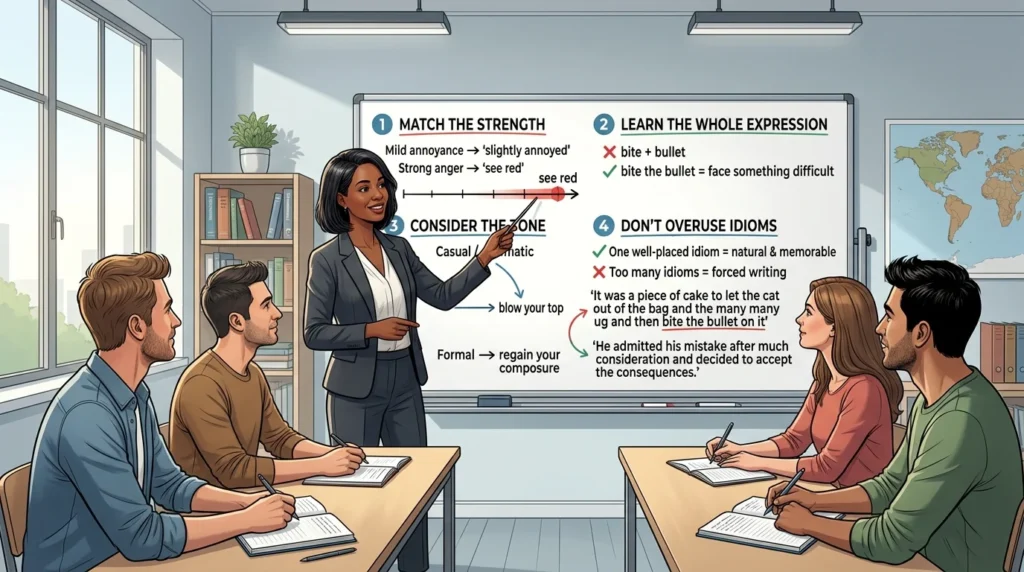
Learn the Whole Expression
Don’t memorize:
bite + bullet
as two separate words.
Memorize:
bite the bullet = face something difficult
This helps you remember both meaning and grammar.
Consider the Tone
Some expressions are casual or dramatic.
Blow your top sounds informal.
Regain your composure sounds more formal.
Choose according to your audience.
Don’t Overuse Idioms
One well-placed idiom can make a sentence memorable. Five idioms in one paragraph can make the writing sound forced.
Natural English is not about using as many idioms as possible. It is about choosing the right expression at the right time.
Idioms for Great: Better Ways to Express Excellence
Strong Idioms in Real-Life English
Here is how these expressions can appear naturally in everyday situations.
At work:
“Sarah really went the extra mile to finish the project.”
During an argument:
“Don’t add fuel to the fire by bringing up the old disagreement.”
After an achievement:
“I was on top of the world after passing my exam.”
During a difficult decision:
“I didn’t want to complain, but eventually I had to bite the bullet.”
During a negotiation:
“She stood her ground and refused the unfair offer.”
These examples show why context matters more than simply memorizing a list.
Common Mistakes When Learning Strong Idioms
Taking the Words Literally
Bite the bullet does not mean literally biting a piece of ammunition. Idioms should normally be understood as complete expressions.
Changing Fixed Expressions
❌ Hit the nail at the head
✅ Hit the nail on the head
❌ Go an extra mile
✅ Go the extra mile
Ignoring Intensity
See red is much stronger than feel annoyed. Make sure the emotional strength matches the situation.
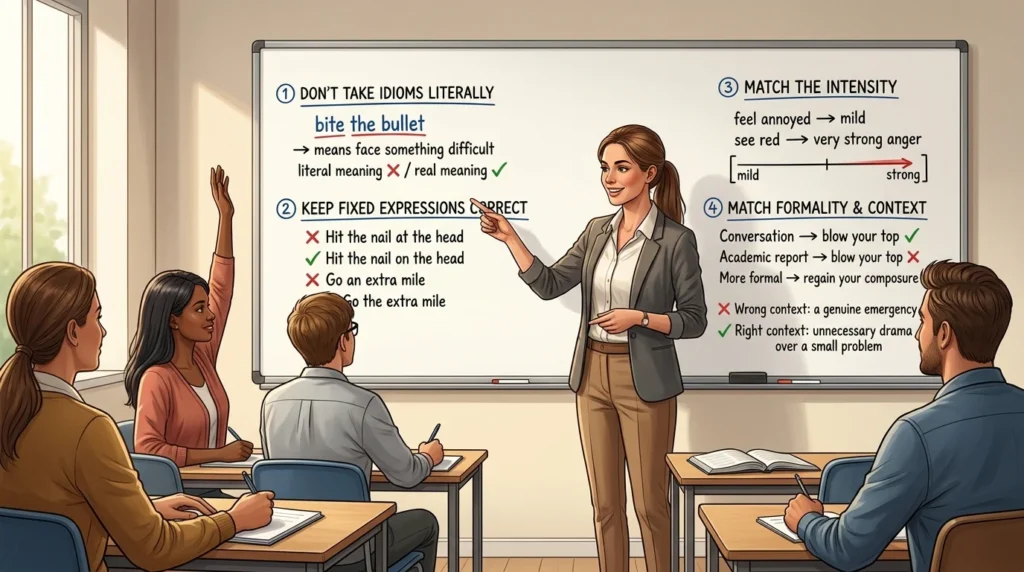
Ignoring Formality
Blow your top may sound perfectly natural in conversation but can be too informal for an academic report.
Using an Idiom in the Wrong Context
A storm in a teacup suggests that the problem is relatively minor. Using it for a genuine emergency would create the wrong impression.
FAQs About Strong Idioms
What are some strong idioms in English?
Popular strong idioms include see red, bite the bullet, keep your cool, go the extra mile, stand your ground, hit the nail on the head, and a force to be reckoned with. Each adds emphasis or vivid meaning to everyday communication.
What is a strong idiom for anger?
See red is a strong idiom for extreme anger. Blow your top and hit the roof are also useful when someone loses their temper.
What is a strong idiom for courage?
Bite the bullet is commonly used when someone faces something difficult or unpleasant with courage. Stand your ground is useful when someone refuses to give in under pressure.
Can strong idioms be used in formal writing?
Some can. Expressions such as a double-edged sword are relatively versatile, while informal phrases such as blow your top are better suited to conversation. Always consider your audience and purpose.
How can I learn strong idioms quickly?
Start with five expressions, learn their complete meanings and grammar patterns, then write sentences based on your own experiences. Using an idiom in a real situation makes it easier to remember than memorizing a definition alone.
Final Thoughts
Strong idioms can make English more vivid, expressive, and natural, but effective communication is not about using complicated phrases everywhere. The real skill is knowing which idiom fits the meaning, intensity, tone, and situation.
Start with five useful expressions—such as keep your cool, bite the bullet, go the extra mile, stand your ground, and see red. Write one sentence about your own life for each and use at least one in a real conversation today. With regular practice, these expressions will move from something you recognize while reading to language you can use naturally yourself.

Clara Bennett writes for Meaning Match about English idioms, everyday expressions, meanings, and practical language usage, making phrases easy to understand.