
Ever had a friend do something so ridiculous that “you’re funny” just doesn’t seem enough? Funny idioms for friends give you playful ways to describe teasing, jokes, silly behavior, laughter, and hilarious moments with the people you know best.
Expressions such as “pull someone’s leg,” “have a blast,” “crack someone up,” and “off the wall” can make everyday English more colorful, but they express different ideas. “Pull someone’s leg” means to tease or joke with someone, while “crack someone up” means to make someone laugh. For example, you might pull your friend’s leg about their new haircut or say, “You always crack me up.”
If you’re searching for funny idioms for friends for texts, captions, conversations, social media posts, or everyday English, choosing the right expression can make your message more playful and natural. In this guide, you’ll discover funny idioms and playful expressions, learn what they mean, see natural examples, and find out which phrases work best for different situations.
Funny Idioms for Friends
Here are 20 popular idioms and expressions you can use when talking about close friends, funny personalities, teasing, friendship, and everyday situations.
| Idiom | Meaning | Best Used For |
|---|---|---|
| Partner in crime | A friend who joins your adventures or mischief | Close friends |
| Pull someone’s leg | Tease or joke with someone | Playful teasing |
| Have a blast | Have a great time | Fun activities |
| Goof around | Act silly or play instead of being serious | Casual fun |
| A barrel of laughs | Someone or something very funny | Humorous friends |
| Thick as thieves | Extremely close | Best friends |
| Birds of a feather | People with similar qualities | Similar friends |
| Odd couple | Two very different people who get along | Unlikely friendships |
| Know someone inside out | Know someone extremely well | Long friendships |
| Hit it off | Get along immediately | New friendships |
| See eye to eye | Agree with someone | Shared opinions |
| Rub someone the wrong way | Annoy someone | Personality clashes |
| Drive someone up the wall | Annoy someone greatly | Playful frustration |
| A pain in the neck | An annoying person or thing | Teasing |
| Full of beans | Very energetic | Lively friends |
| Loose cannon | An unpredictable person | Unpredictable friends |
| Life of the party | Someone who makes gatherings exciting | Social friends |
| Go bananas | Become extremely excited or emotional | Excitement |
| Have someone’s back | Support or protect someone | Loyalty |
| Two peas in a pod | Two very similar people | Very close friends |
Partner in Crime
Word-by-Word Meaning
A partner is someone who does something with you, while a crime is an illegal act.
Idiomatic Meaning
A partner in crime is a close friend who regularly joins you in fun, silly, mischievous, or adventurous activities. It usually does not mean that either person is actually committing a crime.
Example Sentences
- “Mia is my partner in crime whenever we go shopping.”
- “I need my partner in crime for this weekend adventure.”
- “We’ve been partners in crime since college.”
Common Error
Don’t assume this expression is about real criminal activity.
Usage Note
It is informal, playful, and especially natural among close friends.
Pull Someone’s Leg
Word-by-Word Meaning
Pull means to move something toward you, while a leg is part of the body.
Idiomatic Meaning
To pull someone’s leg means to tease or joke with them by making them believe something that is not true.
Example Sentences
- “Relax! I’m just pulling your leg.”
- “He said he had met a famous actor, but he was pulling my leg.”
- “Are you serious, or are you pulling my leg?”
Common Error
Don’t use it to describe physically pulling someone’s leg.
Usage Note
This is a classic informal expression for friendly teasing.
Have a Blast
Word-by-Word Meaning
A blast can mean an explosion or a sudden burst.
Idiomatic Meaning
To have a blast means to have an extremely enjoyable or exciting time.
Example Sentences
- “We had a blast at the beach.”
- “Have a blast at the party!”
- “My friends and I had a blast last weekend.”
Common Error
It does not mean experiencing an actual explosion.
Usage Note
Use it for parties, trips, games, vacations, and other enjoyable activities.
Goof Around
Word-by-Word Meaning
Goof means to behave foolishly or make mistakes. Around suggests casual activity without a serious purpose.
Idiomatic Meaning
To goof around means to act silly, joke, or fool around instead of being serious.
Example Sentences
- “We spent the afternoon goofing around.”
- “Stop goofing around and help me!”
- “My friends always goof around when we’re together.”
Common Error
Don’t use it when someone is seriously working or behaving professionally.
Usage Note
It is casual and often describes harmless fun.
A Barrel of Laughs
Word-by-Word Meaning
A barrel is a large container, while laughs refers to things that make people laugh.
Idiomatic Meaning
A barrel of laughs describes someone or something that is very funny or entertaining.
Example Sentences
- “Jake is a barrel of laughs at every party.”
- “That comedy was a barrel of laughs.”
- “You’re such a barrel of laughs!”
Common Error
Don’t interpret the barrel literally.
Usage Note
It is playful and works especially well for describing a funny friend.
Thick as Thieves
Word-by-Word Meaning
Thick can mean closely connected, while thieves are people who steal.
Idiomatic Meaning
Thick as thieves means two or more people are extremely close and often share secrets, experiences, or activities.
Example Sentences
- “My cousins are thick as thieves.”
- “We were thick as thieves growing up.”
- “Those two are always together—they’re thick as thieves.”
Common Error
It does not mean that the people are actually thieves.
Usage Note
Use it for a strong, close friendship.
Birds of a Feather
Word-by-Word Meaning
Birds are feathered animals, and a feather is part of a bird’s covering.
Idiomatic Meaning
Birds of a feather describes people who have similar personalities, interests, habits, or attitudes.
Example Sentences
- “We both love terrible jokes. We’re birds of a feather.”
- “Those two are definitely birds of a feather.”
- “Birds of a feather often become friends.”
Common Error
The traditional proverb is “Birds of a feather flock together.”
Usage Note
It is useful when similarity is the reason two friends get along.
Odd Couple
Word-by-Word Meaning
Odd means unusual, while a couple means two people.
Idiomatic Meaning
An odd couple describes two people who seem very different but nevertheless have a close relationship.
Example Sentences
- “We’re an odd couple, but we get along perfectly.”
- “They make an odd couple because their personalities are completely different.”
- “Everyone thinks we’re an odd couple.”
Common Error
“Odd” does not necessarily mean strange in a negative way.
Usage Note
Use it playfully for unlikely friendships.
Know Someone Inside Out
Word-by-Word Meaning
Inside out literally describes something turned so its inner side is visible.
Idiomatic Meaning
To know someone inside out means to understand their personality, habits, reactions, and preferences extremely well.
Example Sentences
- “My best friend knows me inside out.”
- “After ten years, we know each other inside out.”
- “She knows me inside out, so she knew I was joking.”
Common Error
It does not describe physically turning a person inside out.
Usage Note
This is particularly natural when discussing long-term friendships.
Hit It Off
Word-by-Word Meaning
The individual words do not explain the expression’s actual meaning.
Idiomatic Meaning
To hit it off means to get along well with someone soon after meeting them.
Example Sentences
- “We met at university and hit it off immediately.”
- “I really hit it off with my new classmate.”
- “They hit it off from the moment they met.”
Common Error
It does not mean physically hitting someone.
Usage Note
Use it when describing an instant connection.
See Eye to Eye
Word-by-Word Meaning
Eye to eye literally suggests two people looking at each other at the same level.
Idiomatic Meaning
To see eye to eye means to agree with someone or have the same opinion.
Example Sentences
- “We don’t always see eye to eye, but we’re still close.”
- “My best friend and I see eye to eye on most things.”
- “We don’t see eye to eye about movies.”
Common Error
It does not simply mean making eye contact.
Usage Note
This expression can describe friendly disagreements without suggesting that the friendship is weak.
Funny Idioms Examples for Students: 25+ Fun English Expressions
Rub Someone the Wrong Way
Word-by-Word Meaning
To rub something means to move against it. The wrong way suggests an unpleasant direction.
Idiomatic Meaning
To rub someone the wrong way means to annoy or irritate them.
Example Sentences
- “His constant bragging rubs me the wrong way.”
- “I don’t know why, but that comment rubbed her the wrong way.”
- “We sometimes rub each other the wrong way.”
Common Error
It does not refer to ordinary physical rubbing.
Usage Note
This can describe a minor personality clash, but it may sound negative.
Drive Someone Up the Wall
Word-by-Word Meaning
Drive can mean cause someone to move, while up the wall describes movement toward a wall.
Idiomatic Meaning
To drive someone up the wall means to annoy or frustrate them greatly.
Example Sentences
- “Your constant jokes are driving me up the wall!”
- “My friend’s habit of being late drives me up the wall.”
- “That noise is driving everyone up the wall.”
Common Error
Don’t assume it describes literal movement.
Usage Note
Among close friends, it can be playful, but context and tone matter.
A Pain in the Neck
Word-by-Word Meaning
A pain is physical discomfort, and the neck is the part between the head and shoulders.
Idiomatic Meaning
A pain in the neck is someone or something that is annoying or troublesome.
Example Sentences
- “My little brother can be a real pain in the neck.”
- “You’re such a pain in the neck today!”
- “That assignment was a pain in the neck.”
Common Error
It does not necessarily mean actual neck pain.
Usage Note
It can be teasing among friends, but avoid it if the listener may take it personally.
Full of Beans
Word-by-Word Meaning
Beans are edible seeds, and full means containing a lot.
Idiomatic Meaning
Someone who is full of beans is energetic, enthusiastic, or lively.
Example Sentences
- “You’re full of beans today!”
- “The kids were full of beans after lunch.”
- “My friend is always full of beans.”
Common Error
It does not literally describe someone’s stomach.
Usage Note
This is a cheerful and informal way to describe energetic people.
Loose Cannon
Word-by-Word Meaning
A loose cannon would be a cannon that is not securely fixed.
Idiomatic Meaning
A loose cannon is an unpredictable person who may say or do unexpected things without thinking about the consequences.
Example Sentences
- “You never know what he’ll say. He’s a loose cannon.”
- “Every friend group has one loose cannon.”
- “She’s hilarious, but she’s also a bit of a loose cannon.”
Common Error
Don’t use it simply as another word for “funny.”
Usage Note
It can be humorous, but it may also imply that the person’s behavior creates problems.
The Life of the Party
Word-by-Word Meaning
The life of something suggests its energy or spirit, while a party is a social gathering.
Idiomatic Meaning
The life of the party is the person who makes a gathering lively, exciting, and entertaining.
Example Sentences
- “Emma is always the life of the party.”
- “Without Alex, the party wouldn’t be the same.”
- “She became the life of the party within minutes.”
Common Error
It does not mean someone literally represents the life of a party.
Usage Note
This is usually a positive description of an outgoing friend.
Go Bananas
Word-by-Word Meaning
Bananas are a type of fruit.
Idiomatic Meaning
to go wild means to become extremely excited, emotional, angry, or silly, depending on the context.
Example Sentences
- “My friends went bananas when they heard the news.”
- “The crowd went bananas after the final goal.”
- “Don’t go bananas over one tiny mistake.”
Common Error
Don’t assume it always means “happy.” Context determines the emotion.
Usage Note
It is playful and informal.
Have Someone’s Back
Word-by-Word Meaning
A person’s back is the rear part of their body.
Idiomatic Meaning
To have someone’s back means to support, defend, or help them when they need you.
Example Sentences
- “Don’t worry. I’ve got your back.”
- “Real friends have each other’s backs.”
- “She had my back when I needed help.”
Common Error
It does not mean physically holding or touching someone’s back.
Usage Note
This is one of the most useful informal expressions for loyalty and friendship.
Two Peas in a Pod
Word-by-Word Meaning
A pea is a small green seed, and a pod is the outer covering in which peas grow.
Idiomatic Meaning
Two peas in a pod describes two people who are very similar or extremely close.
Example Sentences
- “My sister and I are like two peas in a pod.”
- “Those best friends are two peas in a pod.”
- “They think alike and love the same things—they’re like two peas in a pod.”
Common Error
It does not necessarily mean two people look exactly alike.
Usage Note
This is generally affectionate and positive.
How to Choose the Right Funny Idiom for a Friend
The best idiom depends on what you want to describe.
If Your Friend Is Always With You
Try:
- Partner in crime
- Thick as thieves
- Two peas in a pod
If Your Friend Loves Joking
Try:
- Pull someone’s leg
- A barrel of laughs
- Life of the party
If Your Friend Is Always Energetic
Try:
- Full of beans
- Go bananas
If Your Friend Annoys You in a Funny Way
Try:
- A pain in the neck
- Drive someone up the wall
- Rub someone the wrong way
If You Have Just Met a New Friend
Try:
- Hit it off
If You and Your Friend Are Very Different
Try:
- Odd couple
This approach is more useful than memorizing idioms randomly because it connects each expression with a real conversational situation.
Kindness Idioms: 23+ Phrases About Compassion and Generosity
Common Mistakes When Using Funny Idioms for Friends
Don’t Take Idioms Literally
If your friend says:
“I’ve got your back.”
They are offering support, not talking about your actual back.
Similarly, “pull your leg” is about teasing, and “two peas in a pod” describes similarity or closeness.
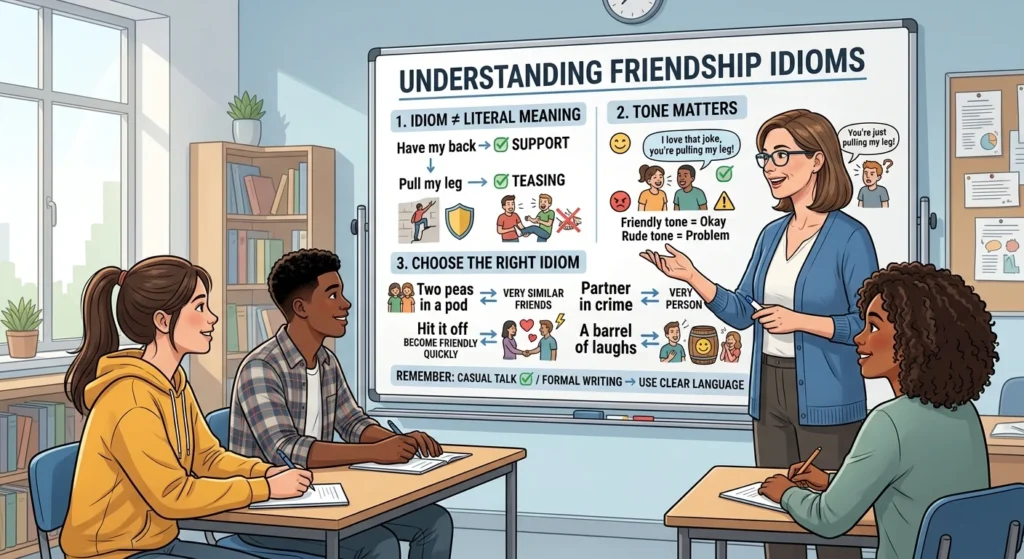
Don’t Ignore Tone
An expression can change meaning depending on how you say it.
“You’re such a pain in the neck!” may sound funny between best friends but rude when said seriously to someone you barely know.
Don’t Use Every Idiom as a Synonym for “Funny”
Not all friendship idioms describe humor.
- A barrel of laughs → very funny
- Partner in crime → adventurous or mischievous friend
- Have someone’s back → supportive friend
- Two peas in a pod → very similar friends
- Hit it off → quickly become friendly
Choosing the expression that matches the exact situation makes your English sound much more natural.
Don’t Force Idioms Into Formal Writing
Most of these expressions are conversational and informal. They are excellent for messages, conversations, social posts, and casual storytelling, but straightforward language is often better for academic or professional writing.
Are These Idioms Only for Best Friends?
No. Many can be used for classmates, siblings, coworkers you know well, or other people with whom you have a friendly relationship.
However, expressions such as partner in crime, pain in the neck, and pull someone’s leg depend more heavily on familiarity and tone. They are safest when the relationship is comfortable enough for playful language.
Funny Idioms for Friends: Quick Practice
Try completing these sentences with the correct expression:
- “Don’t believe him—he’s just __________.”
- “We became friends immediately. We really __________.”
- “My best friend always supports me. She’s always __________.”
- “We have exactly the same personality. We’re like __________.”
- “He makes everyone laugh. He’s a real __________.”
Answers:
- pulling my leg
- hit it off
- got my back
- two peas in a pod
- barrel of laughs
Practicing idioms in sentences like these is more effective than memorizing definitions alone.
FAQs About Funny Idioms for Friends
What is a funny idiom for a best friend?
“Partner in crime” is a popular playful choice for a best friend who regularly joins you in adventures, jokes, or harmless mischief.
What idiom describes two very close friends?
“Thick as thieves” emphasizes a very close bond, while “two peas in a pod” emphasizes similarity as well as closeness.
What idiom means to tease a friend?
“Pull someone’s leg” means to tease or joke with someone by making them believe something that is not true.
What is a good idiom for a funny friend?
“A barrel of laughs” is a strong choice for someone who is consistently funny and entertaining. “Life of the party” works better for someone who makes social gatherings lively.
Can I use funny idioms in formal English?
Most of these idioms are informal, so they are better suited to everyday conversations, texts, social media, and casual writing. In formal situations, choose clearer and more direct wording.
Final Thoughts
Funny idioms can make friendship conversations more expressive without making your English complicated. Instead of simply saying that your friend is funny, supportive, energetic, mischievous, or very similar to you, an idiom lets you communicate the idea with personality.
Start with a few expressions that genuinely fit your friendships. Use “partner in crime” for your adventure buddy, “pull my leg” when someone is teasing you, or “I’ve got your back” when you want to show loyalty.
The goal isn’t to use as many idioms as possible. The goal is to use the right idiom naturally, in the right situation, with the right tone.

Sophie Collins writes for Meaning Match about English idioms, American and British expressions, meanings, usage, and everyday language differences.