
Sometimes “crazy” just isn’t enough to describe something strange, wild, chaotic, or completely unexpected. Crazy idioms and phrases give you colorful ways to talk about unusual behavior, unbelievable situations, extreme excitement, or moments that seem out of control.
Expressions such as “off the wall,” “out of your mind,” “lose your marbles,” and “go bananas” can all relate to craziness, but they do not mean exactly the same thing. For example, “off the wall” can describe something unusual or unconventional, while “go bananas” suggests becoming extremely excited or losing control.
If you’re searching for crazy idioms and phrases for writing, conversations, captions, stories, or everyday English, choosing the right expression can make your language more vivid and natural. In this guide, you’ll learn their meanings, differences, tones, and natural uses with clear examples.
Crazy Idioms Phrases: What Do They Mean?
Crazy idioms phrases are funny, strange, or surprising English expressions whose literal words often mean something completely different from the intended message. For example, “when pigs fly” does not mean pigs can fly—it means something is extremely unlikely to happen.
If you have ever heard an English speaker say “spill the beans,” “hold your horses,” or “go bananas” and wondered what they were talking about, you are not alone. These expressions become much easier once you understand their figurative meaning, tone, context, and correct usage.
Quick answer: Crazy-sounding idioms are expressions with unusual or impossible literal images but established figurative meanings. They make everyday English more colorful, humorous, and expressive.
In this article, “crazy” means unusual, funny, bizarre, exaggerated, or surprising—not a reference to mental illness.
Most Famous Crazy Idioms Phrases
When Pigs Fly
Word-by-word meaning:
Pigs flying through the air.
Idiomatic meaning:
Something that is extremely unlikely or will probably never happen.
Why it sounds crazy:
The expression creates an impossible image because pigs cannot normally fly.
Example sentences:
- “You think Jake will wake up at 5 a.m.? When pigs fly!”
- “I’ll clean my room when pigs fly.”
Common error:
Don’t use it simply for something that is difficult. It suggests that the event is highly unlikely.
Usage note:
This is playful, informal, and often humorous.
Spill the Beans
Word-by-word meaning:
Accidentally spilling a container of beans.
Idiomatic meaning:
To reveal a secret or information that was supposed to remain private.
Why it sounds crazy:
There is no connection between physically spilling beans and revealing information.
Example sentences:
- “Come on, spill the beans! What happened?”
- “Mia spilled the beans about the surprise party.”
Common error:
Don’t use it for ordinary information that was never secret.
Usage note:
Very natural in casual conversation.
Let the Cat Out of the Bag
Word-by-word meaning:
Allowing a cat to escape from a bag.
Idiomatic meaning:
To accidentally reveal a secret or surprise.
Why it sounds crazy:
The literal picture is strange, while the real meaning has nothing to do with cats.
Example sentences:
- “I wasn’t supposed to tell you, but Tom let the cat out of the bag.”
- “Don’t let the cat out of the bag about the wedding.”
Common error:
It is mainly about revealing something that was meant to be kept secret.
Usage note:
Informal and useful when discussing surprises or secrets.
Raining Cats and Dogs
Word-by-word meaning:
Cats and dogs falling from the sky.
Idiomatic meaning:
It is raining very heavily.
Why it sounds crazy:
The literal image is impossible and intentionally exaggerated.
Example sentences:
- “Take an umbrella. It’s raining cats and dogs!”
- “We stayed home because it was raining cats and dogs.”
Common error:
Don’t use it for light rain.
Usage note:
Colorful and informal. “Raining heavily” is more neutral.
Go Bananas
Word-by-word meaning:
Going somewhere or becoming bananas.
Idiomatic meaning:
To become very excited, angry, or wild.
Why it sounds crazy:
A person obviously cannot literally turn into or travel as a banana.
Example sentences:
- “The crowd went bananas when the singer came on stage.”
- “My little brother went bananas when he saw the huge cake.”
Common error:
It doesn’t always mean anger. Context can indicate excitement or wild behavior.
Usage note:
Very informal and playful.
Hold Your Horses
Word-by-word meaning:
Physically stopping or holding horses.
Idiomatic meaning:
To wait, slow down, or be patient.
Why it sounds crazy:
Someone telling you to hold horses may sound completely unrelated to the conversation.
Example sentences:
- “Hold your horses! We haven’t made a decision yet.”
- “Hold your horses before you order everything.”
Common error:
Avoid it in very formal communication.
Usage note:
Friendly, informal, and sometimes humorous.
Barking Up the Wrong Tree
Word-by-word meaning:
A dog barking at the wrong tree.
Idiomatic meaning:
To look for an answer, solution, or person in the wrong place.
Why it sounds crazy:
The image comes from a dog mistakenly thinking its target is in a particular tree.
Example sentences:
- “If you think I took your phone, you’re barking up the wrong tree.”
- “We may be barking up the wrong tree with this theory.”
Common error:
It means more than simply making a mistake; it involves pursuing the wrong direction or assumption.
Usage note:
Useful when correcting someone’s assumption.
Kick the Bucket
Word-by-word meaning:
Kicking a bucket.
Idiomatic meaning:
To die.
Why it sounds crazy:
The literal action has no obvious connection to death.
Example sentences:
- “He joked that he wanted to travel the world before he kicked the bucket.”
- “The expression is sometimes used humorously.”
Common error:
Don’t use it when discussing someone’s death in a sensitive or formal situation.
Usage note:
Informal and potentially insensitive, so context matters.
Have Butterflies in Your Stomach
Word-by-word meaning:
Feeling as if butterflies are moving around inside your stomach.
Idiomatic meaning:
To feel nervous, excited, or anxious, especially before an important event.
Why it sounds crazy:
There are no actual butterflies inside the person’s stomach.
Example sentences:
- “I had butterflies in my stomach before my presentation.”
- “She always gets butterflies before an important interview.”
Common error:
It does not always mean fear. It can describe nervous excitement.
Usage note:
Common in personal and conversational English.
Cost an Arm and a Leg
Word-by-word meaning:
Giving up an arm and a leg as payment.
Idiomatic meaning:
Something is extremely expensive.
Why it sounds crazy:
The literal price is impossible and dramatically exaggerates the cost.
Example sentences:
- “That car must have cost an arm and a leg.”
- “The repairs cost us an arm and a leg.”
Common error:
Use it for something extremely expensive rather than an ordinary purchase.
Usage note:
Informal and expressive.
Pull Someone’s Leg
Word-by-word meaning:
Physically pulling someone’s leg.
Idiomatic meaning:
To tease or joke with someone, often by pretending something untrue is real.
Example sentences:
- “Relax, I’m just pulling your leg.”
- “I believed him until I realized he was pulling my leg.”
Common error:
Don’t confuse it with physically helping or pulling someone.
Usage note:
Usually playful and informal.
Piece of Cake
Word-by-word meaning:
A piece of cake.
Idiomatic meaning:
Something that is very easy to do.
Why it sounds crazy:
Eating cake and completing an easy task are unrelated literally.
Example sentences:
- “The homework was a piece of cake.”
- “Don’t worry about the test. It should be a piece of cake.”
Common error:
It means easy, not simply enjoyable or delicious.
Usage note:
Extremely common in casual English.
Bite the Bullet
Word-by-word meaning:
Biting down on a bullet.
Idiomatic meaning:
To face something difficult, unpleasant, or unavoidable with courage.
Example sentences:
- “I hate going to the dentist, but I’ll bite the bullet.”
- “She decided to bite the bullet and apologize.”
Common error:
Don’t use it simply to mean “try something new.” There should usually be some difficulty involved.
Usage note:
Suitable for many everyday situations and generally less playful than some idioms on this list.
Have a Screw Loose
Word-by-word meaning:
A screw that is not tightly fixed.
Idiomatic meaning:
To describe someone as strange, eccentric, or behaving unusually.
Example sentences:
- “You’d have to have a screw loose to attempt that stunt.”
- “My uncle has a strange sense of humor.”
Common error:
Avoid using this expression to mock or diagnose someone’s mental health.
Usage note:
Informal and potentially insulting. Use it carefully.
Hit the Nail on the Head
Word-by-word meaning:
Hitting a nail exactly on its head.
Idiomatic meaning:
To identify something accurately or express the main point exactly.
Example sentences:
- “You hit the nail on the head when you said communication was the problem.”
- “Her explanation hit the nail on the head.”
Common error:
It doesn’t simply mean “do something well.” Accuracy is the key idea.
Usage note:
Useful when agreeing with an accurate observation.
The Ball Is in Your Court
Word-by-word meaning:
A ball is on your side of a sports court.
Idiomatic meaning:
It is your turn to take action or make a decision.
Example sentences:
- “I’ve given you all the information. Now the ball is in your court.”
- “I sent him the offer, so the ball is in his court.”
Common error:
Use it when another person is expected to respond or act.
Usage note:
Common in conversations about decisions, plans, and negotiations.
Cry Over Spilled Milk
Word-by-word meaning:
Being upset because milk has already been spilled.
Idiomatic meaning:
To worry about something that has already happened and cannot be changed.
Example sentences:
- “We missed the train, but there’s no point crying over spilled milk.”
- “Don’t cry over spilled milk. Let’s find another solution.”
Common error:
Don’t use it when a problem can still realistically be corrected.
Usage note:
Often used to encourage someone to move forward.
Off the Wall
Word-by-word meaning:
Something positioned away from a wall.
Idiomatic meaning:
Something very unusual, unconventional, or unexpected.
Example sentences:
- “She had an off-the-wall idea for the school event.”
- “His off-the-wall humor makes everyone laugh.”
Common error:
It doesn’t necessarily mean something is bad or incorrect.
Usage note:
Informal and commonly used for ideas, humor, or behavior.
Once in a Blue Moon
Word-by-word meaning:
Something happening during a blue-colored moon.
Idiomatic meaning:
Something that happens very rarely.
Example sentences:
- “I eat fast food once in a blue moon.”
- “We see our old neighbors only once in a blue moon.”
Common error:
Don’t use it for something that happens regularly.
Usage note:
Natural in casual conversation and general writing.
Beat Around the Bush
Word-by-word meaning:
Moving around bushes instead of going directly toward something.
Idiomatic meaning:
To avoid saying or addressing something directly.
Example sentences:
- “Stop beating around the bush and tell me what happened.”
- “She kept beating around the bush instead of answering the question.”
Common error:
It doesn’t mean simply taking a long route. The figurative meaning involves avoiding a direct point.
Usage note:
Common in everyday conversation and can sound impatient depending on tone.
Crazy Idioms vs. Crazy Phrases: What’s the Difference?
The terms idiom and phrase are related, but they are not exactly the same.
A phrase is a group of words that functions together in a sentence. An idiom is a type of expression whose intended meaning cannot usually be understood simply by interpreting each word literally.
For example:
“Spill the beans” → idiom meaning “reveal a secret.”
The words themselves form a phrase, but the expression has a special figurative meaning.
So, while people commonly search for crazy idioms phrases as a broad term, crazy idioms or weird English idioms are more precise descriptions of the expressions in this article.
Funny Idioms for Friends: 26+ Playful Expressions to Use
Literal vs. Figurative Meaning
Understanding this difference is the key to learning unusual English expressions.
| Idiom | Literal Image | Figurative Meaning | Typical Tone |
|---|---|---|---|
| When pigs fly | Flying pigs | Very unlikely | Playful |
| Spill the beans | Spilled beans | Reveal a secret | Informal |
| Hold your horses | Holding horses | Wait | Playful |
| Piece of cake | Eating cake | Very easy | Casual |
| Kick the bucket | Kicking a bucket | Die | Humorous/informal |
| Once in a blue moon | A blue moon | Very rarely | Neutral/casual |
The literal image helps you remember the idiom, but the figurative meaning tells you how to use it.
How to Use Crazy Idioms Phrases Naturally
Learning an idiom is not just memorizing its definition. You also need to understand context, tone, grammar, and intensity.
Learn the Whole Expression
Don’t memorize individual words separately.
Learn:
spill the beans = reveal a secret
rather than trying to translate “spill” and “beans” independently.
Match the Idiom to the Situation
Use playful idioms with friends and in casual conversation, but think carefully before using them in formal or sensitive situations.
For example:
- “Hold your horses!” → casual
- “Kick the bucket” → humorous and potentially insensitive
- “The ball is in your court.” → useful in professional or everyday contexts
- “Have a screw loose.” → informal and potentially insulting
Don’t Overuse Idioms
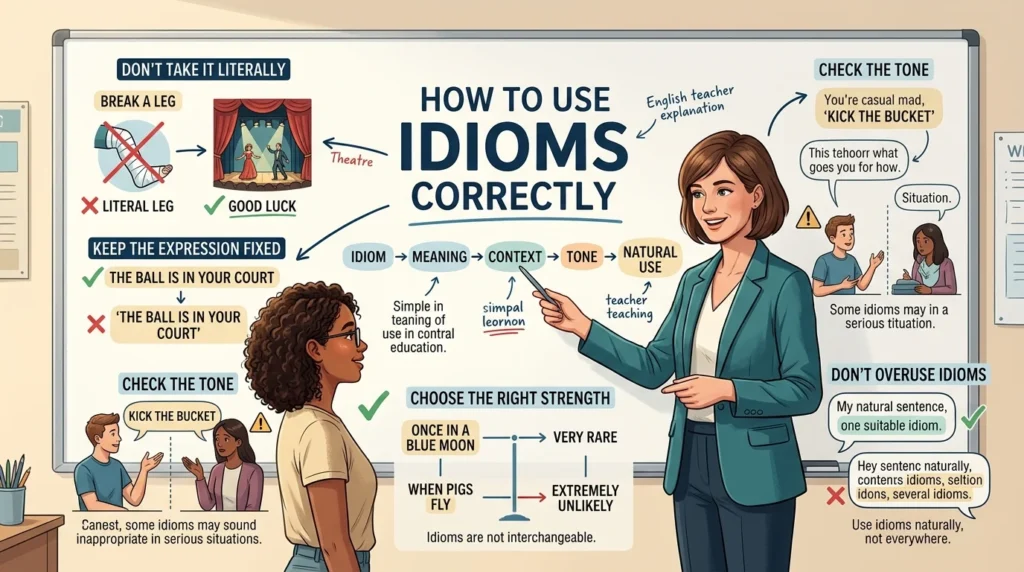
Using an idiom occasionally can make your English expressive. Using several in every sentence can make your writing sound forced.
Instead of:
“I bit the bullet, spilled the beans, went bananas, and hit the nail on the head.”
Choose the expression that actually adds meaning to the sentence.
Common Mistakes English Learners Make With Idioms
Taking Idioms Literally
If someone says “break a leg” before a performance, they are not normally asking you to injure yourself. The expression is traditionally used to wish someone good luck.
Changing Fixed Expressions
Many idioms have a set form.
Learn:
The ball is in your court.
rather than changing the expression unnecessarily.
Ignoring Tone
An idiom can be grammatically correct but socially inappropriate.
For example, “kick the bucket” may sound humorous when discussing death casually, but it can sound disrespectful when someone is grieving.
Using an Idiom That Is Too Strong
Choose an expression that matches the situation.
“Once in a blue moon” means very rarely, while “when pigs fly” suggests something is extremely unlikely.
They are not interchangeable.
Using Idioms in Every Sentence
Idioms should support communication, not replace clear language. If a simple sentence communicates the idea better, use the simple sentence.
Funny Idioms Examples for Students: 25+ Fun English Expressions
Crazy Idioms for Everyday English
The easiest way to remember these expressions is to connect them with situations you actually experience.
Before an exam:
“I have butterflies in my stomach.”
When your friend reveals a secret:
“You spilled the beans!”
When someone needs to wait:
“Hold your horses!”
When a task is easy:
“It was a piece of cake.”
When something is extremely unlikely:
“When pigs fly!”
When someone is teasing you:
“Are you pulling my leg?”
This kind of situation-based practice helps you remember not only the meaning but also when the expression sounds natural.
Are These Idioms Used in American and British English?
Most of the expressions in this list are recognizable in both American and British English, although how frequently people use particular idioms can vary by region, age, setting, and personal style.
For English learners, the safest approach is to focus first on meaning and context rather than trying to use every idiom everywhere.
If you’re unsure whether an expression fits a formal situation, a clear literal sentence is usually the safer choice.
FAQs About Crazy Idioms Phrases
What are crazy idioms phrases?
Crazy idioms phrases are unusual, funny, bizarre, or surprising expressions whose literal wording differs from their established figurative meaning. Examples include “when pigs fly,” “spill the beans,” and “go bananas.”
Why do English idioms sound so strange?
Idioms often use vivid images, exaggeration, humor, or culturally established expressions. Their literal words are not intended to describe the actual situation.
What are some funny crazy idioms?
Examples include “when pigs fly,” “go bananas,” “hold your horses,” “raining cats and dogs,” and “spill the beans.” Their literal images are unusual, which makes them memorable.
Should English learners use idioms?
Yes, when they understand the meaning, tone, and context. Start with a few common expressions and practice using them in realistic sentences instead of trying to memorize dozens at once.
Can I use idioms in formal writing?
Some idioms can work in general writing, but many are conversational or informal. Academic, technical, and highly formal writing often benefits from direct and precise language instead.
Final Thoughts
Crazy idioms phrases may sound completely ridiculous when you interpret them word by word, but that is exactly what makes them memorable. “Flying pigs,” “spilled beans,” “butterflies in your stomach,” and “holding horses” create strange mental pictures while communicating familiar ideas.
The secret to mastering them is not memorizing a long list. Learn each expression together with its figurative meaning, example, tone, and context.
Start with five idioms you are likely to use in everyday conversations. Write your own sentence for each one, then practice using them naturally. Once you stop translating idioms literally, these strange English expressions become much easier—and much more fun—to understand.

Daniel Mercer is a Meaning Match writer covering English idioms, vocabulary, expressions, and language usage with clear meanings and practical examples.