
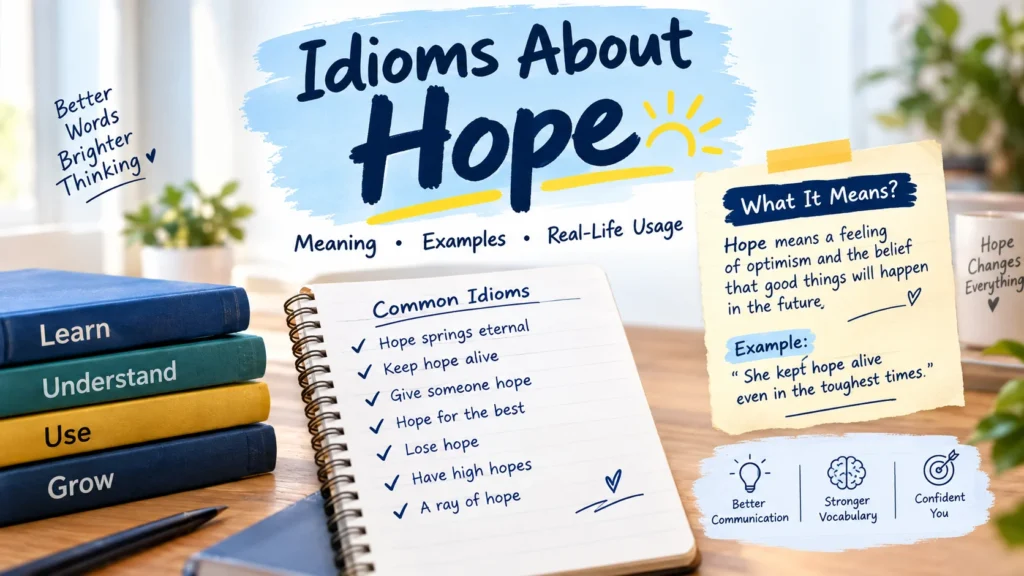
Sometimes, a few simple words can give someone hope when they need it most. Idioms about hope are expressions used to talk about staying hopeful, expecting a better outcome, or believing that difficult times can improve.
Common examples include “keep the faith,” “look on the bright side,” and “there’s light at the end of the tunnel.” However, these expressions are not exact synonyms: some emphasize hope, others suggest optimism or encouragement, and some describe the belief that a difficult situation will eventually improve.
If you’re looking for idioms about hope for writing, conversation, speeches, captions, or everyday English, knowing these differences can help you choose an expression that fits your meaning and tone. In this guide, you’ll discover common idioms about hope, learn what each one means, see natural examples, and understand when to use each expression. From staying positive during hard times to believing that better days are ahead, these idioms can make your English more expressive and meaning.
Quick Comparison
| Idiom | Short Meaning |
|---|---|
| A Ray of Hope | A small sign that a difficult situation may improve. |
| Hope Springs Eternal | People naturally keep hoping, even when disappointed. |
| A Light at the End of the Tunnel | Hope of relief after a long, difficult period. |
| Hope Against Hope | Continuing to hope when there is little reason to expect success. |
| Hold Out Hope | Continuing to believe a positive outcome is still possible. |
| Keep the Faith | Continuing to believe in a person, goal, or outcome despite difficulties. |
| Keep Your Fingers Crossed | Hoping for a positive outcome while waiting for uncertain news. |
| Hang In There | Staying strong, patient, and determined during difficulty. |
| Where There’s a Will, There’s a Way | Strong determination can help you find a solution to an obstacle. |
| Every Cloud Has a Silver Lining | Even a difficult situation may have a positive aspect. |
| Look on the Bright Side | Focusing on the positive aspects of a disappointing situation. |
| Things Are Looking Up | Circumstances are becoming better or more promising. |
| Turn the Corner | Passing the hardest stage and beginning to improve. |
| The Best Is Yet to Come | The most positive part of the future hasn’t happened yet. |
| Better Days Ahead | The future will be more positive than the present. |
| Take Heart | Becoming encouraged, hopeful, or confident after difficulty. |
| A New Lease on Life | A renewed sense of energy, purpose, or opportunity. |
| Against All Odds | Succeeding despite extremely difficult circumstances. |
| Never Say Die | Never giving up, even when a situation appears hopeless. |
| The Coast Is Clear | No obstacle or danger preventing a positive next step. |
| Keep Hope Alive | Continuing to believe something positive will happen. |
| Get Your Hopes Up | Expecting something good to happen, sometimes too much. |
| Have High Hopes | Having strong, positive expectations about the future. |
| Pin Your Hopes On | Depending on one person or thing for a good result. |
| Don’t Lose Hope | Continuing to believe that something good will happen. |
| Lose Heart | Stop believing you can succeed; becoming discouraged. |
| Have a Fighting Chance | Having a real possibility of success if you try hard. |
| Wish Upon a Star | Making a wish while hoping it will come true. |
| In the Hope of | Doing something because you hope it leads to a good result. |
| Raise Someone’s Hopes | Making someone expect something good. |
What Is the Difference Between Hope, Optimism, and Encouragement?
Before learning the expressions, it helps to understand that hope, optimism, encouragement, and perseverance are related but not identical.
Hope
Hope is a desire or expectation that something positive may happen.
I hope I get the job.
The outcome is uncertain.
Optimism
Optimism means having a generally positive expectation about the future.
She is optimistic about her new business.
Optimism is more about a positive outlook, while hope often focuses on a particular desired outcome.
Encouragement
Encouragement means giving someone confidence or motivation to continue.
Hang in there. Things will get better.
Perseverance
Perseverance means continuing despite difficulty or failure.
He never gave up, even after several setbacks.
This distinction matters because not every expression in this article means “hope” literally. Some express the attitude, action, or circumstances associated with hope.
A Ray of Hope
Word-by-word meaning
- Ray = a narrow beam of light
- Hope = a feeling that something positive may happen
Idiomatic or figurative meaning
“A ray of hope” means a small sign, opportunity, or possibility that suggests a difficult situation may improve.
It often describes a positive development when the overall situation is still uncertain or challenging.
Example sentences
- The latest test results gave the family a ray of hope.
- The new job opportunity was a ray of hope after months of unemployment.
- The peace talks offered a ray of hope to both sides.
Common learner issue
Learners sometimes change the preposition or article.
❌ It was ray for hope.
✅ It was a ray of hope.
Usage note
This expression works well in both everyday and formal English. It is especially appropriate when the positive sign is small but meaningful.
Best for: difficult situations, encouraging news, possible solutions.
Hope Springs Eternal
Word-by-word meaning
- Hope = expectation of something positive
- Springs = rises or appears
- Eternal = lasting forever
Idiomatic or figurative meaning
“Hope springs eternal” means people naturally continue to hope, even when circumstances are disappointing or success seems unlikely.
The expression is associated with Alexander Pope’s An Essay on Man.
Example sentences
- She has applied for the position three times, but hope springs eternal.
- Hope springs eternal among fans at the beginning of every new season.
- Even after several failures, hope springs eternal.
Common learner issue
The fixed expression uses eternal, not eternally.
❌ Hope springs eternally.
✅ Hope springs eternal.
Usage note
This expression can sound literary, reflective, or slightly humorous. It is less casual than “things are looking up.”
Best for: writing, commentary, reflective conversations, and situations where people continue hoping despite setbacks.
A Light at the End of the Tunnel
Word-by-word meaning
- Light = brightness
- End = final part
- Tunnel = a long passage
Idiomatic or figurative meaning
“A light at the end of the tunnel” means there is hope of relief or improvement after a long and difficult period.
The important idea is that the difficult experience is not necessarily over yet, but there are signs that it may eventually end.
Example sentences
- After months of studying, she finally saw a light at the end of the tunnel.
- The company is recovering, and management can now see the light at the end of the tunnel.
- Graduation gave him a light at the end of the tunnel during a stressful final year.
Common learner issue
The usual preposition is at, not in.
❌ I can see the light in the end of the tunnel.
✅ I can see the light at the end of the tunnel.
Usage note
This expression is particularly useful for long-term difficulties, such as studying, financial problems, stressful projects, or recovery.
Best for: hope after hardship.
Hope Against Hope
Word-by-word meaning
- Hope = desire or expectation
- Against = despite opposition or contrary circumstances
Idiomatic or figurative meaning
“Hope against hope” means to continue hoping even when there is little or no reason to expect the desired outcome.
It expresses strong, sometimes desperate hope.
Example sentences
- The family hoped against hope that the missing documents would be recovered.
- She hoped against hope that the last-minute application would succeed.
- He hoped against hope for a positive answer.
Common learner issue
Do not replace the second hope with another noun.
❌ Hope against chance.
✅ Hope against hope.
Usage note
This is stronger than simply saying “I hope.” It is useful when the chances seem very small.
Best for: uncertain or unlikely outcomes.
Hold Out Hope
Word-by-word meaning
- Hold out = continue to maintain or preserve
- Hope = belief that something positive may happen
Idiomatic or figurative meaning
To “hold out hope” means to continue believing that a positive outcome is still possible.
Example sentences
- The team is holding out hope for a successful appeal.
- Her family still holds out hope that she will recover.
- We are holding out hope that the problem can be solved.
Common learner issue
The natural pattern is:
hold out hope for + noun
or:
hold out hope that + clause
Examples:
They hold out hope for a solution.
We hold out hope that the situation will improve.
Usage note
This expression is common in news reports and serious conversations because it often refers to an uncertain but still possible outcome.
Best for: uncertain situations where hope remains.
Keep the Faith
Word-by-word meaning
- Keep = continue to maintain
- Faith = trust or belief
Idiomatic or figurative meaning
“Keep the faith” means to continue believing in a person, goal, process, or positive outcome despite difficulties.
Example sentences
- Keep the faith; your hard work is making a difference.
- The coach told the players to keep the faith after the defeat.
- We haven’t reached our goal yet, but we need to keep the faith.
Common learner issue
The expression normally uses the singular noun faith.
❌ Keep the faiths.
✅ Keep the faith.
Usage note
The phrase can have a religious meaning in some contexts, but it is also widely used as a general expression of encouragement.
Best for: motivation and reassurance.
Keep Your Fingers Crossed
Word-by-word meaning
- Keep = maintain
- Fingers = digits on your hands
- Crossed = placed one over another
Idiomatic or figurative meaning
“Keep your fingers crossed” means to hope that something will have a positive outcome, often while waiting for uncertain news.
Example sentences
- I have an interview tomorrow, so keep your fingers crossed.
- Keep your fingers crossed that the weather stays clear.
- We’re waiting for the results—fingers crossed!
Common learner issue
The expression normally refers to fingers in the plural.
❌ Keep your finger crossed.
✅ Keep your fingers crossed.
Usage note
This is informal and conversational. The shorter form “Fingers crossed!” is extremely common in casual English.
Best for: exams, interviews, competitions, applications, and uncertain results.
Hang In There
Word-by-word meaning
- Hang in = remain in a difficult situation
- There = in the current situation
Idiomatic or figurative meaning
“Hang in there” means to stay strong, patient, and determined during a difficult period.
Example sentences
- Hang in there; you’re almost finished.
- I know the course is difficult, but hang in there.
- Hang in there—things may get easier soon.
Common learner issue
Hang in there and hang on are not always interchangeable.
- Hang in there → stay strong during difficulty.
- Hang on → wait or hold something.
For example:
Hang on a minute. = Wait a minute.
Hang in there. = Stay strong.
Usage note
This is friendly and informal. It is one of the best expressions for directly encouraging someone.
Best for: supportive conversations.
Where There’s a Will, There’s a Way
Word-by-word meaning
- Will = determination
- Way = method or solution
Idiomatic or figurative meaning
“Where there’s a will, there’s a way” means that strong determination can help someone find a solution to an obstacle.
Example sentences
- She had limited resources, but where there’s a will, there’s a way.
- Don’t give up. Where there’s a will, there’s a way.
- He found another route because where there’s a will, there’s a way.
Common learner issue
The established expression uses both a will and a way.
❌ Where there’s will, there’s way.
✅ Where there’s a will, there’s a way.
Usage note
This is a proverb-like expression about determination rather than hope alone.
Best for: motivation, persistence, and overcoming obstacles.
Every Cloud Has a Silver Lining
Word-by-word meaning
- Cloud = a mass of water vapor in the sky
- Silver lining = a bright edge around a cloud
Idiomatic or figurative meaning
“Every cloud has a silver lining” means that even a difficult or disappointing situation may have a positive aspect.
Example sentences
- Losing that job was difficult, but it helped her discover a better career. Every cloud has a silver lining.
- We missed our flight, but every cloud has a silver lining—we found a beautiful little restaurant nearby.
- The setback taught him an important lesson. Every cloud has a silver lining.
Common learner issue
Do not omit the article a.
❌ Every cloud has silver lining.
✅ Every cloud has a silver lining.
Usage note
Use this expression when you want to acknowledge something negative without ignoring the positive lesson or opportunity.
Best for: disappointment, setbacks, and unexpected benefits.
Look on the Bright Side
Word-by-word meaning
- Look on = consider or view
- Bright = positive
- Side = aspect of a situation
Idiomatic or figurative meaning
“Look on the bright side” means to focus on the positive aspects of an unpleasant or disappointing situation.
Example sentences
- We missed the train, but look on the bright side—we have time for coffee.
- Look on the bright side; you learned something valuable from the experience.
- I know you’re disappointed, but try to look on the bright side.
Common learner issue
The fixed expression is:
look on the bright side
not:
look on the brighter side
Usage note
This is conversational and encouraging. However, use it sensitively because immediately telling someone to “look on the bright side” can sometimes sound dismissive if they are experiencing serious difficulty.
Best for: everyday disappointments and mild setbacks.
Things Are Looking Up
Word-by-word meaning
- Things = circumstances
- Looking up = improving
Idiomatic or figurative meaning
“Things are looking up” means circumstances are becoming better or more promising.
Example sentences
- I finally found a job, so things are looking up.
- After a difficult few months, things are looking up.
- Sales have increased, and things are looking up for the business.
Common learner issue
The natural expression is looking up, not “looking upward” in this figurative sense.
❌ Things are looking upward.
✅ Things are looking up.
Usage note
This is informal and positive, making it particularly natural in everyday conversation.
Best for: situations that are already beginning to improve.
Turn the Corner
Word-by-word meaning
- Turn = change direction
- Corner = a place where two directions meet
Idiomatic or figurative meaning
To “turn the corner” means to pass the most difficult stage of a situation and begin to improve.
Example sentences
- After months of losses, the company finally turned the corner.
- Her health has improved, and doctors believe she has turned the corner.
- I think we’re finally turning the corner after a difficult year.
Common learner issue
The idiom is turn the corner, not “turn over the corner.”
❌ We have turned over the corner.
✅ We have turned the corner.
Usage note
This expression often describes a transition from difficulty to improvement. It is especially common in discussions of health, business, finances, and long-term problems.
Best for: recovery and progress.
The Best Is Yet to Come
Word-by-word meaning
- Best = most positive or successful
- Yet = up to the present time
- To come = happening in the future
Idiomatic or figurative meaning
“The best is yet to come” expresses optimism that the most positive, exciting, or successful part of a person’s future has not happened yet.
Example sentences
- You’ve already achieved so much, but the best is yet to come.
- Don’t let one failure define your future. The best is yet to come.
- She believes the best is yet to come.
Common learner issue
Do not change to come into came.
❌ The best is yet to came.
✅ The best is yet to come.
Usage note
This expression is strongly positive and often appears in motivational messages, celebrations, speeches, and conversations about the future.
Best for: future optimism.
Better Days Ahead
Word-by-word meaning
- Better = more positive
- Days = future periods
- Ahead = in the future
Idiomatic or figurative meaning
“Better days ahead” expresses confidence or hope that the future will be more positive than the present.
Example sentences
- Keep going. There are better days ahead.
- The difficult period won’t last forever; there are better days ahead.
- She remained confident that better days were ahead.
Common learner issue
When used as a complete noun phrase, remember that days is plural.
❌ There are better day ahead.
✅ There are better days ahead.
Usage note
This is more accurately described as a hopeful expression than a traditional idiom. It is natural in supportive messages and motivational writing.
Best for: reassurance about the future.
Take Heart
Word-by-word meaning
- Take = receive or adopt
- Heart = courage or emotional strength
Idiomatic or figurative meaning
“Take heart” means to become encouraged, hopeful, or confident after disappointment or difficulty.
Example sentences
- Take heart; your progress is better than you think.
- The team can take heart from its strong second-half performance.
- Take heart from the fact that you’ve already overcome bigger challenges.
Common learner issue
The expression is normally used as take heart, not “take a heart.”
❌ Take a heart.
✅ Take heart.
Usage note
This expression is somewhat more formal or literary than “hang in there.”
Best for: encouragement after setbacks.
A New Lease on Life
Word-by-word meaning
- New = renewed or different
- Lease = an agreement allowing use for a period
- Life = existence
Idiomatic or figurative meaning
“A new lease on life” means a renewed sense of energy, purpose, opportunity, or enjoyment.
Example sentences
- Starting her new career gave her a new lease on life.
- The successful treatment gave him a new lease on life.
- After moving to a new city, she felt she had a new lease on life.
Common learner issue
The standard American English form is commonly:
a new lease on life
You may also encounter “a new lease of life,” particularly in British English.
Usage note
This expression is useful when a major positive change makes someone feel renewed or revitalized.
Best for: fresh starts, recovery, new opportunities, and renewed purpose.
Against All Odds
Word-by-word meaning
- Against = in opposition to
- Odds = chances or probabilities
Idiomatic or figurative meaning
“Against all odds” means succeeding or continuing despite extremely difficult circumstances or very low chances of success.
Example sentences
- Against all odds, she completed her degree.
- He built a successful business against all odds.
- Against all odds, the team reached the final.
Common learner issue
The plural noun odds is part of the established expression.
❌ Against all odd.
✅ Against all odds.
Usage note
This expression emphasizes difficulty and unexpected achievement more than hope itself. It is therefore best used when the outcome has seemed highly unlikely.
Best for: remarkable success and perseverance.
Inspirational Idioms: Phrases for Motivation, Hope & Perseverance
Never Say Die
Word-by-word meaning
- Never = not ever
- Say die = accept defeat or give up
Idiomatic or figurative meaning
“Never say die” means never give up, even when a situation appears hopeless.
Example sentences
- She has a never-say-die attitude.
- His never-say-die spirit helped the team recover.
- Never say die—there is still time to change the result.
Common learner issue
When the expression comes before a noun, it is usually hyphenated:
a never-say-die attitude
But when used independently:
Never say die!
Usage note
This expression emphasizes determination and refusal to accept defeat, rather than simply feeling hopeful.
Best for: sports, competition, challenges, and perseverance.
The Coast Is Clear
Word-by-word meaning
- Coast = a shoreline
- Clear = free from danger or obstruction
Idiomatic or figurative meaning
“The coast is clear” means there is no longer any obvious danger, obstacle, or person preventing you from moving forward.
Although it does not directly mean “hope,” it can express the removal of an obstacle, creating an opportunity for a positive next step.
Example sentences
- Once the storm passed, the coast was clear for the rescue team to continue.
- The manager has approved the plan, so the coast is clear to begin.
- Wait until the coast is clear before moving forward.
Common learner issue
Do not use it as a direct synonym for “everything will be fine.”
❌ I failed the exam, but the coast is clear means I’ll pass next time.
✅ The expression means there is no immediate obstacle or danger preventing action.
Usage note
This is a contextual expression, not a direct synonym for hope. It belongs in this list because removing an obstacle can create a hopeful opportunity.
Best for: situations where a barrier or danger has disappeared.
Keep Hope Alive
Word-by-word meaning
- Keep = continue to have
- Hope = expectation of something good
- Alive = active, living
Idiomatic or figurative meaning
“Keep hope alive” means to continue believing something positive will happen, even when the situation is hard.
Example sentences
- Even after the third failure, she kept hope alive.
- The doctor’s words kept hope alive for the family.
- They kept hope alive by focusing on small improvements.
Common learner issue
Use the singular noun hope, not the plural.
❌ Keep hopes alive.
✅ Keep hope alive.
Usage note
This expression is warm and encouraging. Use it to encourage others or to describe emotional strength.
Best for: encouragement and emotional strength.
Get Your Hopes Up
Word-by-word meaning
- Get = become
- Your hopes = what you want to happen
- Up = raised, higher
Idiomatic or figurative meaning
“Get your hopes up” means to expect something good to happen — sometimes too much, which can lead to disappointment.
Example sentences
- I don’t want to get my hopes up before the results come.
- Don’t get your hopes up; the tickets might be sold out.
- She got her hopes up when she heard about the job.
Common learner issue
The verb is get, not make.
❌ Make your hopes up.
✅ Get your hopes up.
Usage note
This is conversational and is often used as a warning: “Don’t get your hopes up.”
Best for: uncertain results and managing expectations.
Have High Hopes
Word-by-word meaning
- Have = possess or hold
- High = great or strong
- Hopes = expectations
Idiomatic or figurative meaning
“Have high hopes” means to have strong, positive expectations about the future.
Example sentences
- The team has high hopes for the new season.
- She has high hopes that the plan will work.
- We have high hopes for your success.
Common learner issue
The natural collocation is high hopes, not big hopes.
❌ Have big hopes.
✅ Have high hopes.
Usage note
This expression is positive and confident, and it is common in both everyday and professional English.
Best for: confidence about the future.
Pin Your Hopes On
Word-by-word meaning
- Pin = attach or fix
- Your hopes = what you want to happen
- On = connected to
Idiomatic or figurative meaning
“Pin your hopes on” means to depend on one person or thing for success or a good result.
Example sentences
- The company pinned its hopes on the new product.
- She pinned her hopes on getting the scholarship.
- Don’t pin all your hopes on one opportunity.
Common learner issue
Don’t forget the preposition on.
❌ Pin your hopes the job.
✅ Pin your hopes on the job.
Usage note
This expression is neutral and is common in news and business English.
Best for: business, news, and depending on one opportunity.
Don’t Lose Hope
Word-by-word meaning
- Don’t = do not
- Lose = stop having
- Hope = positive expectation
Idiomatic or figurative meaning
“Don’t lose hope” means to continue believing that something good will happen.
Example sentences
- Don’t lose hope — things can change quickly.
- The coach told the team not to lose hope.
- Even in hard times, don’t lose hope.
Common learner issue
Hope is uncountable here, so don’t make it plural.
❌ Don’t lose hopes.
✅ Don’t lose hope.
Usage note
This expression is encouraging and supportive, and it is often used to comfort others.
Best for: comforting and encouraging others.
Lose Heart
Word-by-word meaning
- Lose = stop having
- Heart = courage or emotional strength
Idiomatic or figurative meaning
“Lose heart” means to stop believing you can succeed; to become discouraged.
Example sentences
- Don’t lose heart after one failure.
- The team lost heart when they fell behind.
- She refused to lose heart despite the challenges.
Common learner issue
The idiom always uses the singular heart.
❌ Lose hearts.
✅ Lose heart.
Usage note
This expression is slightly formal and literary, and it is common in motivational and reflective writing.
Best for: motivation and reflection.
Have a Fighting Chance
Word-by-word meaning
- Have = possess
- Fighting = struggling or trying hard
- Chance = possibility of success
Idiomatic or figurative meaning
“Have a fighting chance” means to have a real possibility of success if you try hard.
Example sentences
- With good preparation, you have a fighting chance.
- The team has a fighting chance to win the final.
- She was given a fighting chance to prove herself.
Common learner issue
The word is chance (opportunity), not change.
❌ A fighting change.
✅ A fighting chance.
Usage note
This expression is encouraging and realistic, and it is common in sports, business, and everyday speech.
Best for: sports, competition, and realistic encouragement.
Wish Upon a Star
Word-by-word meaning
- Wish = hope for something
- Upon = on
- A star = a bright point of light in the sky
Idiomatic or figurative meaning
“Wish upon a star” means to make a wish while looking at a star, hoping it will come true. It is often used for dreams and romantic hopes.
Example sentences
- As a child, she would wish upon a star every night.
- They wished upon a star for good luck.
- He wished upon a star that she would say yes.
Common learner issue
The preposition is upon or on.
❌ Wish to a star.
✅ Wish upon a star.
Usage note
This expression is dreamy and romantic, and it comes from songs, stories, and childhood traditions.
Best for: dreams, wishes, and romantic hopes.
In the Hope of
Word-by-word meaning
- In = inside or within
- The hope = the expectation
- Of = connected to
Idiomatic or figurative meaning
“In the hope of” means doing something because you hope it will lead to a good result.
Example sentences
- She moved to the city in the hope of finding work.
- He studied hard in the hope of passing the exam.
- They invested in the hope of future profits.
Common learner issue
The standard form uses the singular hope.
❌ In the hopes of.
✅ In the hope of.
Usage note
This expression is formal and written, and it is common in academic and professional English.
Best for: formal and academic writing.
Raise Someone’s Hopes
Word-by-word meaning
- Raise = lift or increase
- Someone’s hopes = their expectations
Idiomatic or figurative meaning
“Raise someone’s hopes” means to make someone expect something good. It is often used as a warning not to disappoint them.
Example sentences
- Don’t raise her hopes before you know the results.
- The good news raised everyone’s hopes.
- I don’t want to raise your hopes, but the job looks promising.
Common learner issue
Use raise (transitive) when someone else is affected, not rise.
❌ Rise someone’s hopes.
✅ Raise someone’s hopes.
Usage note
This expression is conversational and is often used with “don’t” as gentle advice.
Best for: gentle warnings before uncertain news.
Hope Idioms by Formality
Some hope idioms sound natural everywhere, while others fit better in formal writing or casual conversation.
| Level | Examples | When to use |
|---|---|---|
| Formal | Hold out hope, in the hope of, lose heart | Essays, reports, and professional emails |
| Neutral | A ray of hope, hope springs eternal, keep hope alive, have a fighting chance | Safe for most situations |
| Casual | Get your hopes up, keep your fingers crossed, wish upon a star | Friends and conversation |
Hope vs. Wish vs. Expect: Don’t Confuse These Words
Hope: “I hope it rains tomorrow.” The outcome is uncertain but possible. Hope is about possibility.
Wish: “I wish it would rain tomorrow.” The speaker feels it probably won’t happen. Wish is often about unlikely or impossible things.
Expect: “I expect it will rain tomorrow.” The speaker believes it is likely. Expect is about probability, not desire.
Quick rule: Hope = possible. Wish = unlikely or impossible. Expect = likely.
Idioms for Hope in Different Situations
Not every hopeful expression fits every situation. Choosing the right one depends on what kind of hope you want to communicate.
When Someone Is Going Through a Difficult Time
The most natural choices include:
- Hang in there
- A light at the end of the tunnel
- Better days ahead
- Take heart
Example:
Hang in there. There’s a light at the end of the tunnel.
This combination works because the first expression offers direct encouragement, while the second suggests that the difficult period may eventually end.
When There Is a Small Sign of Improvement
Use:
- A ray of hope
- Things are looking up
- Turn the corner
Example:
The latest results are a ray of hope for the team.
Here, the positive development is still relatively small, so “a ray of hope” is more precise than saying everything is already successful.
When the Outcome Is Very Uncertain
Use:
- Hope against hope
- Hold out hope
- Keep your fingers crossed
Example:
We are holding out hope that the application will be accepted.
For casual conversation:
Fingers crossed!
For a more serious situation:
We hold out hope for a positive outcome.
When Someone Needs to Stop Giving Up
Use:
- Never say die
- Where there’s a will, there’s a way
- Against all odds
- Keep the faith
Example:
Never say die. Where there’s a will, there’s a way.
These expressions focus more on determination than passive hope.
When Talking About a Better Future
Use:
- The best is yet to come
- Better days ahead
- Things are looking up
Example:
Don’t let this setback define you. The best is yet to come.
Hope vs. Optimism: Which Expression Should You Choose?
These expressions may sound similar, but their meanings are not identical.
Use “A Ray of Hope” for a Small Positive Sign
The new treatment is a ray of hope.
The situation may still be difficult.
Use “Things Are Looking Up” When Conditions Are Improving
Business has improved, so things are looking up.
There is already evidence of progress.
Use “The Best Is Yet to Come” for Future Optimism
You’ve achieved a lot, but the best is yet to come.
The focus is on the future.
Use “Never Say Die” for Determination
She has a never-say-die attitude.
The focus is on refusing to quit.
Use “Keep Your Fingers Crossed” for an Uncertain Result
Keep your fingers crossed that I get the job.
The focus is on hoping for a favorable outcome.
This distinction makes your English more precise and prevents you from treating every positive expression as a direct synonym for hope.
How to Use Idioms About Hope Naturally
Learning an idiom means more than memorizing its definition. You also need to understand its grammar, tone, context, and emotional strength.
Learn the Whole Expression
Don’t memorize individual words separately.
For example, learn:
A ray of hope = a small sign of possibility
rather than trying to translate “ray” and “hope” independently.
The same approach works for:
Hope springs eternal
Hold out hope
Turn the corner
Take heart
Learning the complete expression helps you remember its natural structure.
Pay Attention to Tone
Some expressions are casual:
Hang in there.
Fingers crossed!
Others sound more formal or literary:
Hope springs eternal.
Take heart.
Choosing an expression that matches the situation makes your English sound much more natural.
Don’t Use Too Many Idioms Together
Idioms are useful, but too many can make your writing sound forced.
For example:
❌ Keep the faith, cross your fingers, look on the bright side, and remember that every cloud has a silver lining because the best is yet to come.
The sentence contains too many expressions competing for attention.
A more natural version would be:
Keep the faith. The best is yet to come.
Use an idiom when it adds meaning—not simply because you know it.
Learn Idioms in Context
Compare:
Hang in there.
with:
I know this semester has been difficult, but hang in there. You’re almost finished.
The second example shows how the expression naturally works in conversation.
Context teaches you:
- who can say it
- when to say it
- how strong it sounds
- whether it is formal or casual
- what grammar follows it
Common Mistakes With Hope-Related Idioms
Mixing Two Different Idioms
Don’t accidentally combine expressions.
❌ I can see the silver lining at the end of the tunnel.
This mixes:
Every cloud has a silver lining
and:
A light at the end of the tunnel
Better:
I can see the light at the end of the tunnel.
Or:
Every cloud has a silver lining.
Taking Idioms Literally
Idioms usually communicate meanings beyond their individual words.
For example:
Turn the corner
does not necessarily mean physically walking around a corner.
It can mean:
begin to improve after a difficult period
Similarly:
A ray of hope
doesn’t have to involve actual sunlight.
Using a Casual Expression in a Formal Context
Consider:
Hang in there!
This is friendly and natural in a conversation with a friend.
For formal writing, you might choose:
The recent progress provides encouragement that the situation may improve.
The message is similar, but the register is different.
Assuming Every Positive Expression Means “Hope”
This is one of the most important distinctions.
“Never say die” focuses on determination.
“Against all odds” focuses on unlikely success.
“Things are looking up” focuses on improving circumstances.
“Keep your fingers crossed” focuses on hoping for a favorable result.
Understanding these differences helps you avoid using expressions as interchangeable synonyms.
How to Practice Idioms About Hope
The best way to remember hopeful idioms is to use them actively.
Choose Five Expressions First
Don’t try to memorize all 30 at once.
Start with:
- A ray of hope
- A light at the end of the tunnel
- Hang in there
- Things are looking up
- The best is yet to come
These cover several different situations.
Write Personal Examples
Create sentences connected to situations you understand.
For example:
I didn’t get the job I wanted, but the best is yet to come.
My exams are almost finished, so I can finally see the light at the end of the tunnel.
Personal context makes vocabulary easier to remember.
Practice Short Conversations
Conversation 1
A: I’m really worried about my interview tomorrow.
B: Keep your fingers crossed!
Conversation 2
A: This project has been exhausting.
B: Hang in there. We’re almost finished.
Conversation 3
A: The business has finally started making money again.
B: That’s great. Things are looking up!
Conversation 4
A: I didn’t get into my first-choice university.
B: Look on the bright side. You have other opportunities.
Replace Basic Phrases With Natural Expressions
Instead of always saying:
“Don’t give up.”
Try:
Hang in there.
Instead of:
“Things will get better.”
Try:
There are better days ahead.
Instead of:
“Maybe something good will happen.”
Try:
There’s still a ray of hope.
This helps you make your English more varied without sounding unnatural.
Why Learning Hope-Related Idioms Improves Your English
Hope is a common topic in everyday communication. People talk about:
- exams
- careers
- relationships
- health
- business
- goals
- competitions
- personal setbacks
- future plans
Because of this, expressions connected with hope appear in conversations, books, articles, speeches, films, and social media.
Knowing these expressions helps you understand what speakers actually mean instead of translating every word literally.
For example, when someone says:
“I can finally see the light at the end of the tunnel.”
they probably aren’t talking about a physical tunnel. They are saying that a difficult period appears to be approaching its end.
That ability to understand meaning from context is an important part of natural English comprehension.
Frequently Asked Questions About Idioms About Hope
What is the best idiom for hope?
“A ray of hope” is one of the clearest expressions for hope because it describes a small sign or possibility that a difficult situation may improve. “Hope springs eternal” is another well-known expression about continuing to hope.
What idiom means “never give up”?
“Never say die” means not accepting defeat and continuing to try even when success seems unlikely. “Hang in there” is another common expression used to encourage someone to stay strong.
What idiom means things will get better?
“A light at the end of the tunnel” suggests that relief or improvement may follow a difficult period. “Better days ahead” also expresses hope that the future will be more positive.
What is an idiom for hope when success seems unlikely?
“Hope against hope” means continuing to hope even when there is little reason to expect the desired outcome. “Against all odds” can also describe achieving something despite very low chances of success, although it focuses more on achievement than hope itself.
What is a positive expression about the future?
“The best is yet to come” is a popular expression meaning that the most positive or exciting part of the future has not happened yet. “Better days ahead” is another natural choice when encouraging someone to remain hopeful.
Hope keeps us going — stay uplifted with idioms about being happy. Explore every feeling in emotional idioms, or build your vocabulary with idioms with meanings and examples. For warm expressions, see kindness idioms.
Conclusion
Idioms about hope allow you to express much more than simple optimism. They can show encouragement, uncertainty, determination, recovery, possibility, and confidence about the future.
Start with a few expressions instead of trying to memorize all 30 immediately. Learn “a ray of hope” for small positive signs, “a light at the end of the tunnel” for relief after hardship, “hang in there” for encouragement, and “the best is yet to come” for future optimism.
Then create your own sentences and use these expressions in real conversations. The goal isn’t to use as many idioms as possible—it is to choose the right expression for the right situation.
With regular practice, these hopeful expressions can make your English sound more natural, expressive, and confident.

Emily Carter writes for Meaning Match about English idioms, student-friendly expressions, and language learning, using simple explanations and helpful examples.
Pingback: Inspirational Idioms: Phrases for Motivation, Hope & Perseverance