Looking for natural and expressive ways to describe happiness? English has many colorful idioms for showing joy, excitement, delight, satisfaction, and a cheerful mood, but they don’t all express the same feeling or intensity.
Expressions such as “on cloud nine,” “over the moon,” and “walking on air” can describe someone who feels extremely happy, while “in high spirits” suggests a cheerful, upbeat mood. Other expressions can emphasize excitement, pleasure, or the feeling of being thrilled by good news or a positive experience.
Knowing these subtle differences can help you choose an idiom that sounds natural rather than using every happiness expression as if it meant exactly the same thing. This guide explains idioms about being happy, with clear meanings, example sentences, usage notes, and practical tips for choosing the right expression for conversations, informal writing, stories, and everyday situations.
What Is an Idiom for Being Happy?
An idiom for being happy is a fixed or familiar expression whose meaning is different from the literal meanings of its individual words. For example, “over the moon” does not mean physically traveling over the moon; it means extremely happy or delighted.
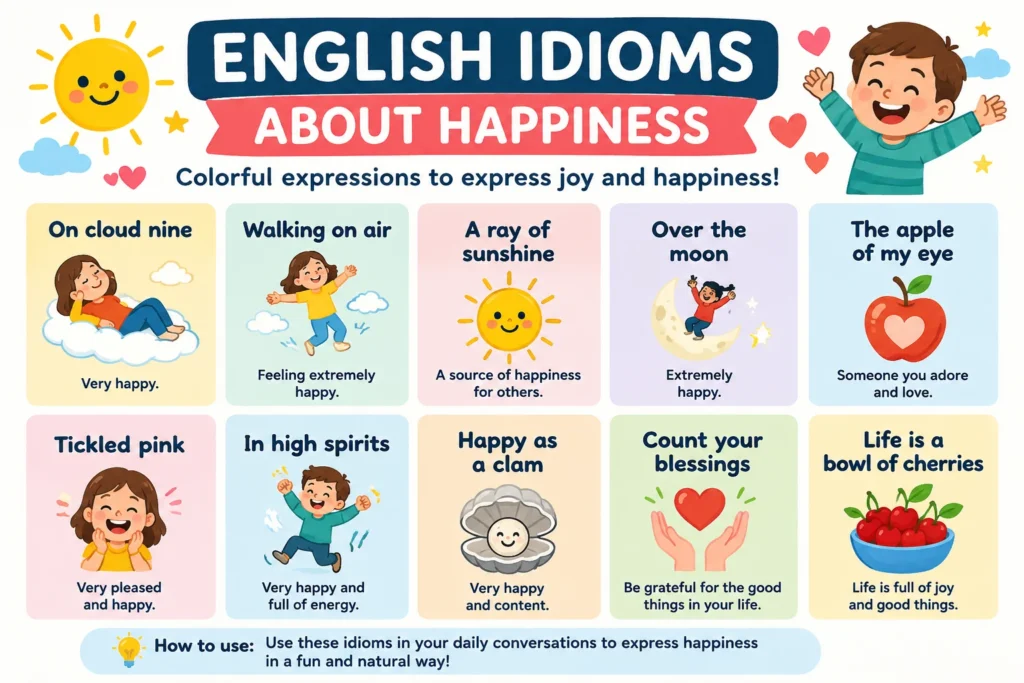
Some of the most useful English idioms for happiness include:
- On cloud nine — extremely happy
- Over the moon — extremely delighted
- Walking on air — feeling extremely happy
- On top of the world — feeling wonderful or successful
- In seventh heaven — experiencing great happiness
- Happy as a clam — very happy and content
- Tickled pink — very pleased or amused
- In high spirits — cheerful and energetic
Quick Guide: Which Happiness Idiom Should You Use?
| Situation | Natural idiom | What it emphasizes |
|---|---|---|
| You are extremely happy | On cloud nine | Extreme happiness |
| You receive wonderful news | Over the moon | Delight |
| You feel almost weightless with happiness | Walking on air | Excitement |
| You achieved something important | On top of the world | Happiness + success |
| You feel blissfully happy | In seventh heaven | Deep happiness |
| You are cheerful and satisfied | Happy as a clam | Contentment |
| Something delighted you | Tickled pink | Pleasure |
| You are cheerful and energetic | In high spirits | Positive mood |
| Someone made you happy | Made my day | Happiness caused by someone/something |
| You hear excellent news | Music to my ears | Pleasure from good news |
Most Famous Idioms About Being Happy
On Cloud Nine
Meaning: To feel extremely happy or delighted.
Word-by-word meaning:
A cloud is high above the ground, so the expression creates an image of someone being lifted high by happiness.
Idiomatic meaning:
When you are on cloud nine, you are exceptionally happy, excited, or pleased about something.
Example sentences:
- I was on cloud nine after passing my final exam.
- She has been on cloud nine since getting her dream job.
- He was on cloud nine when his team won the championship.
Common mistake:
❌ I am on the cloud nine.
✅ I am on cloud nine.
Usage:
Tone: Casual and conversational
Best for: Everyday speech, texts, informal writing
Similar expressions:
Over the moon, walking on air, on top of the world
Learner tip:
Use on cloud nine when you want to emphasize very strong happiness rather than ordinary contentment.
Over the Moon
Meaning: To be extremely happy, excited, or delighted.
Word-by-word meaning:
The literal image is someone being so joyful that they could jump over the moon.
Idiomatic meaning:
If you are over the moon, you are extremely pleased about something.
Example sentences:
- My parents were over the moon when I graduated.
- She was over the moon about her promotion.
- We were over the moon to hear the good news.
Common mistake:
❌ I am over moon.
✅ I am over the moon.
Usage:
Tone: Informal
Best for: Conversation, messages, personal writing
Similar expressions:
On cloud nine, in seventh heaven
Learner tip:
This expression works especially well when something exciting has just happened.
Walking on Air
Meaning: To feel extremely happy, excited, or pleased.
Word-by-word meaning:
Someone walking on air would appear to float instead of touching the ground.
Idiomatic meaning:
The expression describes the almost weightless feeling that can come with intense happiness.
Example sentences:
- She was walking on air after receiving the scholarship.
- He has been walking on air since his wedding.
- I felt like I was walking on air after hearing the results.
Common mistake:
❌ She is walking in air.
✅ She is walking on air.
Usage:
Tone: Informal and expressive
Best for: Conversations and personal stories
Similar expressions:
On cloud nine, over the moon
Learner tip:
This phrase is particularly effective when describing someone’s behavior after exciting news.
On Top of the World
Meaning: To feel extremely happy, successful, or confident.
Word-by-word meaning:
Being on top of the world suggests reaching the highest possible point.
Idiomatic meaning:
Someone who feels on top of the world feels wonderful, often because they have achieved something meaningful.
Example sentences:
- I felt on top of the world after completing my first marathon.
- She was on top of the world after winning the award.
- He felt on top of the world when he finally achieved his goal.
Common mistake:
❌ I felt top of the world.
✅ I felt on top of the world.
Usage:
Tone: Conversational
Best for: Achievements, successes, exciting experiences
Similar expressions:
On cloud nine, walking on air
Learner tip:
Choose this expression when happiness is connected to success or achievement.
In Seventh Heaven
Meaning: To experience a state of extreme happiness or bliss.
Word-by-word meaning:
“Heaven” is traditionally associated with an ideal or blissful state.
Idiomatic meaning:
Being in seventh heaven means feeling extraordinarily happy or content.
Example sentences:
- The children were in seventh heaven at the amusement park.
- She was in seventh heaven after receiving the surprise.
- He was in seventh heaven during his vacation.
Common mistake:
❌ He is in seven heaven.
✅ He is in seventh heaven.
Usage:
Tone: Expressive and somewhat literary
Best for: Stories, conversations, descriptive writing
Similar expressions:
Over the moon, on cloud nine
Learner tip:
Don’t confuse seventh with seven. The established expression is “in seventh heaven.”
Like a Dog With Two Tails
Meaning: To be extremely happy or pleased.
Word-by-word meaning:
The expression creates a playful image of a dog being extraordinarily excited.
Idiomatic meaning:
If someone is like a dog with two tails, they are very pleased about something.
Example sentences:
- He was like a dog with two tails when he opened the gift.
- She was like a dog with two tails after hearing the announcement.
- The children were like dogs with two tails when they saw the playground.
Common mistake:
❌ Like a dog with two tail.
✅ Like a dog with two tails.
Usage:
Tone: Informal and playful
Best for: Casual conversation and humorous writing
Learner tip:
This is more playful than “on cloud nine,” so avoid it in formal academic or professional writing.
Grin From Ear to Ear
Meaning: To smile very broadly because you are happy or pleased.
Word-by-word meaning:
A grin obviously cannot literally stretch from one ear to the other.
Idiomatic meaning:
The expression describes a very wide, obvious smile.
Example sentences:
- He was grinning from ear to ear after opening the package.
- She grinned from ear to ear when she saw her test score.
- You could tell he was happy because he was grinning from ear to ear.
Common mistake:
❌ He was grinning from ears to ears.
✅ He was grinning from ear to ear.
Usage:
Tone: Informal and descriptive
Best for: Stories and everyday conversation
Learner tip:
This expression describes a visible sign of happiness, not simply the feeling of happiness.
Happy as a Clam
Meaning: To be very happy, comfortable, or content.
Word-by-word meaning:
A clam cannot literally tell us whether it is happy.
Idiomatic meaning:
Happy as a clam describes someone who is completely satisfied or content.
Example sentences:
- The children were happy as clams at the beach.
- He is happy as a clam in his new apartment.
- She looked happy as a clam during the celebration.
Common mistake:
❌ Happy like a clam.
✅ Happy as a clam.
Usage:
Tone: Informal and slightly playful
Best for: Casual English
Learner tip:
Use this when the idea is contentment, rather than sudden excitement.
Tickled Pink
Meaning: To be very pleased, amused, or delighted.
Word-by-word meaning:
The phrase is not meant literally; being “tickled” does not actually cause the meaning of the expression.
Idiomatic meaning:
If something tickles you pink, it makes you especially pleased or amused.
Example sentences:
- Grandma was tickled pink by the children’s surprise.
- I was tickled pink when they remembered my birthday.
- She was tickled pink by the thoughtful gift.
Common mistake:
❌ She was tickled in pink.
✅ She was tickled pink.
Usage:
Tone: Informal
Best for: Friendly conversations and lighthearted writing
Learner tip:
It often sounds warmer and more playful than simply saying “pleased.”
Jump for Joy
Meaning: To show great happiness or excitement.
Word-by-word meaning:
The phrase creates the image of someone physically jumping because they are delighted.
Idiomatic meaning:
To jump for joy means to express intense happiness, whether literally or figuratively.
Example sentences:
- The children jumped for joy when school was canceled.
- She nearly jumped for joy when she got the job.
- He jumped for joy after hearing the announcement.
Common mistake:
❌ He jumped with joy.
✅ He jumped for joy.
Usage:
Tone: Informal and energetic
Best for: Exciting events and enthusiastic reactions
Learner tip:
The phrase focuses on showing happiness, rather than simply feeling it.
In High Spirits
Meaning: To be cheerful, enthusiastic, and energetic.
Word-by-word meaning:
“High spirits” suggests an elevated emotional state.
Idiomatic meaning:
Someone in high spirits is in a very cheerful and positive mood.
Example sentences:
- Everyone was in high spirits at the wedding.
- The team remained in high spirits despite the long journey.
- We were in high spirits during the celebration.
Common mistake:
❌ Everyone was in a high spirit.
✅ Everyone was in high spirits.
Usage:
Tone: Neutral to conversational
Best for: Groups, celebrations, social situations
Learner tip:
This expression is especially natural when describing a person’s mood, rather than a single moment of extreme happiness.
Have a Whale of a Time
Meaning: To have a fantastic or very enjoyable time.
Word-by-word meaning:
The word “whale” creates the idea of something unusually large or impressive.
Idiomatic meaning:
If you have a whale of a time, you have a wonderfully enjoyable experience.
Example sentences:
- We had a whale of a time at the concert.
- They had a whale of a time on vacation.
- We had a whale of a time at the party.
Common mistake:
❌ We had whale time.
✅ We had a whale of a time.
Usage:
Tone: Informal and enthusiastic
Best for: Parties, trips, events, and fun experiences
Learner tip:
This idiom describes having fun, so it is slightly different from simply feeling happy.
A Happy Camper
Meaning: A person who is satisfied, pleased, or content.
Word-by-word meaning:
A camper is someone who stays outdoors, but the expression is not really about camping.
Idiomatic meaning:
A happy camper is someone who is satisfied with a situation.
Example sentences:
- Give him some coffee, and he’ll be a happy camper.
- After finishing the project, everyone was a happy camper.
- The customers were happy campers after receiving the upgrade.
Common mistake:
❌ He is happy camping.
✅ He is a happy camper.
Usage:
Tone: Informal and humorous
Best for: Casual conversation
Learner tip:
Use it when happiness comes from being satisfied with a situation, not necessarily from an exciting event.
Have a Spring in Your Step
Meaning: To appear happy, energetic, and enthusiastic.
Word-by-word meaning:
A person with a “spring” in their step seems to walk with extra bounce.
Idiomatic meaning:
Having a spring in your step means that your happiness or energy is visible in the way you move.
Example sentences:
- She had a spring in her step after receiving the good news.
- He came home with a spring in his step.
- You can tell she’s feeling better because she has a spring in her step.
Common mistake:
❌ He has a spring on his step.
✅ He has a spring in his step.
Usage:
Tone: Conversational and descriptive
Best for: Describing someone’s mood or behavior
Learner tip:
This expression describes outward energy associated with happiness.
Music to My Ears
Meaning: Something you hear that makes you very pleased.
Word-by-word meaning:
Music is generally associated with something pleasant to hear.
Idiomatic meaning:
When information is music to your ears, you are extremely pleased to hear it.
Example sentences:
- “You got the job!” was music to my ears.
- Hearing that the project was approved was music to my ears.
- The doctor’s positive news was music to my ears.
Common mistake:
❌ That was music for my ears.
✅ That was music to my ears.
Usage:
Tone: Conversational
Best for: Good news, announcements, positive information
Learner tip:
Use this expression when the news itself creates your happiness.
Make Someone’s Day
Meaning: To make someone feel happy through something kind, helpful, thoughtful, or pleasant.
Word-by-word meaning:
The literal idea is that something improves a person’s entire day.
Idiomatic meaning:
If something makes your day, it makes you particularly happy.
Example sentences:
- Your kind message really made my day.
- Seeing my old friend made my day.
- That compliment made her day.
Common mistake:
❌ Your message made my daily.
✅ Your message made my day.
Usage:
Tone: Very common and conversational
Best for: Everyday interactions, compliments, kindness, good news
Learner tip:
This is one of the easiest happiness expressions to use naturally in everyday English.
Put a Smile on Someone’s Face
Meaning: To make someone happy.
Word-by-word meaning:
Something literally causes a smile to appear.
Idiomatic meaning:
An action, person, memory, gift, or experience that puts a smile on someone’s face makes them feel happy.
Example sentences:
- Her funny story put a smile on my face.
- The surprise gift put a smile on his face.
- Seeing the children happy put a smile on her face.
Common mistake:
❌ It put a smile in my face.
✅ It put a smile on my face.
Usage:
Tone: Neutral and warm
Best for: Everyday conversation and personal writing
Learner tip:
This expression is useful when you want to describe the effect something has on another person.
Be in Your Element
Meaning: To be completely comfortable, confident, and happy doing something that suits you.
Word-by-word meaning:
An “element” can refer to the natural environment where something belongs.
Idiomatic meaning:
When you are in your element, you are doing something that matches your abilities, interests, or personality.
Example sentences:
- She’s in her element when she’s teaching.
- He was in his element on the football field.
- I feel in my element when I’m writing.
Common mistake:
❌ She is in her elements.
✅ She is in her element.
Usage:
Tone: Neutral and conversational
Best for: Work, hobbies, talents, social situations
Learner tip:
This does not simply mean “happy.” It suggests a combination of comfort, confidence, enjoyment, and natural ability.
Nothing but Blue Skies
Meaning: A positive, hopeful, or trouble-free future.
Word-by-word meaning:
Blue skies are commonly associated with clear and pleasant weather.
Idiomatic meaning:
Nothing but blue skies suggests optimism and the expectation of better times ahead.
Example sentences:
- After years of hard work, it feels like nothing but blue skies ahead.
- She believes there are nothing but blue skies in her future.
- With the difficult period behind us, we’re hoping for nothing but blue skies.
Common mistake:
❌ Nothing but a blue sky ahead.
✅ Nothing but blue skies ahead.
Usage:
Tone: Optimistic and somewhat literary
Best for: Positive predictions, inspirational writing, encouraging conversations
Learner tip:
This is better classified as an idiom about optimism and positive times than a direct synonym for “happy.”
Overjoyed / “Jumping for Joy” in Real-Life Reactions
Meaning: This final category focuses on natural ways English speakers express visible excitement and intense happiness rather than simply stating “I am happy.”
A useful distinction:
English speakers often communicate happiness through actions and reactions, not just adjectives.
For example:
- Grinning from ear to ear → showing happiness through a smile
- Jumping for joy → showing excitement physically
- Walking on air → appearing extremely happy
- Having a spring in your step → showing cheerful energy
Example sentences:
- She was grinning from ear to ear after the announcement.
- The children were jumping for joy.
- He looked like he was walking on air.
- She had a spring in her step all morning.
Usage:
These expressions are particularly useful when describing how happiness looks or feels in real life.
Learner tip:
When writing naturally, choose an idiom based on the type of happiness you want to communicate rather than forcing an idiom into every sentence.
Translation Idioms: When Words Don’t Mean What They Say
Core Happiness Idioms vs. Related Expressions
Not every expression associated with happiness means exactly the same thing. Understanding the difference helps you sound more precise.
Idioms That Directly Mean Very Happy
These are the strongest choices when your main idea is extreme happiness:
- On cloud nine
- Over the moon
- Walking on air
- On top of the world
- In seventh heaven
Idioms That Describe Contentment
Use these when someone is comfortable, satisfied, or pleased:
- Happy as a clam
- A happy camper
- In your element
Idioms That Show Happiness
These focus on visible reactions:
- Grin from ear to ear
- Jump for joy
- Have a spring in your step
- In high spirits
Expressions That Cause or Communicate Happiness
These describe something that creates happiness:
- Make someone’s day
- Put a smile on someone’s face
- Music to my ears
Expressions Related to Optimism
These are connected to positive feelings but do not directly mean “happy”:
- Nothing but blue skies
- Blow away the cobwebs
This distinction is important because idioms for happiness are not all interchangeable.
Best Idioms for Different Situations
Choosing the right expression depends on what caused the happiness.
| Situation | Best expression | Why it works |
|---|---|---|
| You got your dream job | On cloud nine | Shows extreme happiness |
| You received wonderful news | Over the moon | Emphasizes delight |
| You won an important competition | On top of the world | Connects happiness with achievement |
| You feel wonderfully happy | In seventh heaven | Expresses bliss |
| You feel cheerful and energetic | In high spirits | Describes a positive mood |
| You are comfortable and satisfied | Happy as a clam | Emphasizes contentment |
| Someone gave you a thoughtful gift | Tickled pink | Shows delight |
| You hear excellent news | Music to my ears | The news itself is pleasing |
| Someone did something kind | Made my day | Shows personal happiness |
| Someone made you smile | Put a smile on my face | Shows the effect of an action |
| You are successful at something you love | In your element | Combines enjoyment and confidence |
| You are visibly excited | Jump for joy | Describes an enthusiastic reaction |
Idioms About Being Happy vs. Simple Ways to Say “Happy”
Sometimes a straightforward word is more natural than an idiom. The key is knowing what level and type of emotion you want to express.
| Simple word or phrase | More expressive alternative |
|---|---|
| Very happy | On cloud nine |
| Extremely delighted | Over the moon |
| Feeling wonderful | On top of the world |
| Blissfully happy | In seventh heaven |
| Feeling cheerful | In high spirits |
| Very satisfied | Happy as a clam |
| Very pleased | Tickled pink |
| Had a great time | Had a whale of a time |
| Made me happy | Made my day |
| Made me smile | Put a smile on my face |
A Simple Rule for Learners
Use an idiom when you want your English to sound more vivid, conversational, or expressive.
Use a straightforward word when precision and formality matter more.
For example:
Casual:
I was over the moon when I got the job.
More formal:
I was extremely pleased to receive the position.
Both communicate happiness, but the tone is different.
What Is the Purpose of Idioms? The Real Reason We Don’t Speak Literally
How to Use Idioms About Being Happy Naturally
Match the Idiom to the Emotion
Don’t treat all happiness idioms as interchangeable.
Extreme happiness:
→ On cloud nine
Delight after good news:
→ Over the moon
Achievement-related happiness:
→ On top of the world
Cheerful mood:
→ In high spirits
Satisfaction:
→ Happy as a clam
Happiness caused by someone:
→ Made my day
This small distinction can make your English sound much more natural.
Pay Attention to Formality
Some expressions are perfectly natural in conversation but can sound too casual in academic writing.
Very casual/playful:
- Like a dog with two tails
- Happy as a clam
- Tickled pink
- A happy camper
Generally conversational:
- On cloud nine
- Over the moon
- Walking on air
- Made my day
More neutral/descriptive:
- In high spirits
- In your element
- Put a smile on someone’s face
For formal essays, reports, and professional documents, words such as delighted, pleased, satisfied, enthusiastic, or joyful may sometimes be better.
Common Mistakes When Using Happiness Idioms
Taking an Idiom Literally
If someone says:
“I’m on cloud nine.”
They are not actually floating above the ground.
The intended meaning is:
I am extremely happy.
Changing Fixed Wording
Idioms generally have established forms.
❌ On cloud ten
✅ On cloud nine
❌ Over moon
✅ Over the moon
❌ Music for my ears
✅ Music to my ears
❌ Happy like a clam
✅ Happy as a clam
Using the Wrong Preposition
Small prepositions matter.
❌ Put a smile in my face
✅ Put a smile on my face
❌ A spring on his step
✅ A spring in his step
Using a Playful Idiom in a Formal Context
This sentence sounds natural:
I was over the moon when my friend called.
But in a formal report, this may be more appropriate:
I was extremely pleased with the outcome.
The issue isn’t that the idiom is incorrect. The issue is tone and context.
Using an Idiom Simply Because It Contains “Happy”
You don’t need an idiom in every sentence.
Instead of:
I was on cloud nine because my lunch was delicious.
A natural speaker might simply say:
I really enjoyed my lunch.
Idioms work best when they add meaning, emotion, or personality.
How to Learn English Idioms for Happiness
Learn Five at a Time
Trying to memorize all 20 expressions at once can be overwhelming.
Start with five:
- On cloud nine
- Over the moon
- Walking on air
- On top of the world
- Make my day
Once these feel familiar, add another group.
Learn the Whole Expression
Don’t memorize isolated words.
Learn:
On cloud nine = extremely happy
rather than separately memorizing:
cloud = sky
nine = number
The goal is to recognize the complete expression automatically.
Create Personal Examples
Personal sentences are easier to remember.
Instead of:
She was on cloud nine after receiving good news.
Write:
I was on cloud nine when I got my first positive review.
Now the idiom is connected to your own experience.
Learn Idioms in Context
Read, listen, and notice how native speakers use expressions in real situations.
Pay attention to:
- Who is speaking?
- Is the situation formal or casual?
- What caused the happiness?
- Is the person extremely happy or simply satisfied?
- Is the expression describing a feeling or a visible reaction?
Practice Without Overusing Them
Choose one or two expressions and use them naturally.
For example:
“I got my exam results today. I’m on cloud nine!”
That is more effective than trying to insert five idioms into one conversation.
A 5-Minute Practice Challenge
Want to make these expressions part of your active vocabulary?
Try this:
Minute 1: Choose three idioms.
Minute 2: Write one personal sentence for each.
Minute 3: Say the sentences aloud.
Minute 4: Replace “very happy” with the most suitable idiom.
Minute 5: Use one idiom in a real message or conversation.
For example:
Very happy:
I was very happy when my friend called.
More expressive:
I was over the moon when my friend called.
This simple transformation helps move idioms from passive vocabulary into active English.
FAQ
What is the best idiom for being extremely happy?
“On cloud nine” is one of the most common and recognizable idioms for extreme happiness. It means that someone feels exceptionally happy or delighted.
What idiom means “very happy and excited”?
“Over the moon” is a strong choice when someone is extremely happy or delighted, particularly because something exciting or positive has happened.
What are three idioms for being happy?
Three common examples are “on cloud nine,” “over the moon,” and “walking on air.” All three describe very strong happiness, although their usage and tone can vary.
What idiom means someone made you happy?
“Make someone’s day” means to make someone especially happy through something kind, thoughtful, exciting, or pleasant.
For example:
Your message really made my day.
What idiom means you are happy with your situation?
“A happy camper” can describe someone who is satisfied or pleased with a situation. It is informal and often slightly humorous.
What is an idiom for showing happiness?
Expressions such as “grin from ear to ear,” “jump for joy,” and “have a spring in your step” describe visible signs or energetic expressions of happiness.
Happiness looks good on everyone — explore every feeling in emotional idioms and capture excitement with idioms for excited. Stay inspired with inspirational idioms, or hold onto idioms about hope.
Final Thoughts
Learning idioms about being happy is about more than memorizing colorful phrases. The real goal is knowing which expression fits which situation.
If you are extremely happy after good news, say “I’m on cloud nine.” If you are delighted about an exciting opportunity, “I’m over the moon” may fit perfectly. If someone does something unexpectedly kind, tell them, “You made my day.”
Start with five expressions, create personal examples, and use them in real conversations. With regular practice, these phrases will move from something you simply recognize to vocabulary you can use naturally and confidently.
The next time you want to say “I’m very happy,” pause and ask yourself: What kind of happiness am I trying to express? Choose the idiom that matches it—and let your English become more vivid one expression at a time.

Daniel Mercer is a Meaning Match writer covering English idioms, vocabulary, expressions, and language usage with clear meanings and practical examples.