
Not every kind of sadness feels the same—and English has an idiom for many of those moments. Idioms about sadness can describe feeling low, carrying emotional pain, dealing with heartbreak, missing someone, or struggling after disappointment or loss.
Expressions like “feel blue,” “down in the dumps,” “a heavy heart,” and “broken-hearted” may all relate to sadness, but each one carries a different meaning and emotional tone.
That difference matters: an idiom that fits mild disappointment may sound wrong when you are describing deep sorrow. If you’re searching for idioms about sadness for writing, conversation, captions, speeches, or everyday English, this guide will help you choose words that match the feeling you want to express.
You’ll learn the meaning of each idiom, see natural examples, and discover which expressions work best for different kinds of sadness—from feeling a little down to experiencing deep emotional pain.
What Are Idioms About Sadness?
Idioms about sadness are idiomatic expressions used to describe unhappiness, sorrow, heartbreak, disappointment, emotional pain, or crying. Their meanings are often different from the literal meanings of the individual words.
For example, “feeling blue” does not mean that someone is literally blue. It means they are feeling sad or unhappy.
Some expressions in this list describe sadness directly, while others describe related emotional reactions, such as crying, heartbreak, discouragement, or showing emotions openly. This distinction matters because these expressions are not always interchangeable.
Idioms About Sadness
Quick Guide to Sadness Idioms
| Expression | Meaning | Intensity | Best Used For |
|---|---|---|---|
| Feeling blue | Feeling sad | Mild | Everyday sadness |
| Down in the dumps | Very unhappy | Moderate | Low mood or disappointment |
| Down in the mouth | Looking sad | Mild–moderate | Visible sadness |
| In low spirits | Feeling unhappy | Mild–moderate | General discouragement |
| Downhearted | Sad and discouraged | Moderate | Failure or disappointment |
| Have a heavy heart | Feel deep sadness | Strong | Sorrow or serious situations |
| Broken-hearted | Deeply emotionally hurt | Strong | Heartbreak or loss |
| My heart sank | Suddenly feel disappointed or worried | Moderate–strong | Bad news or realization |
| Cry your eyes out | Cry intensely | Strong | Intense sadness |
| Have a good cry | Cry to release emotion | Moderate–strong | Emotional relief |
| Tears well up | Tears begin forming | Mild–strong | Emotional moments |
| A lump in your throat | Feeling close to tears | Moderate | Farewells or emotional events |
| On the verge of tears | Almost crying | Moderate | Strong emotion |
| Shed tears | Cry | Varies | Formal or literary contexts |
| Bring someone down | Make someone sad | Varies | Something causing sadness |
| Take something to heart | Become deeply upset | Moderate–strong | Criticism or rejection |
| It breaks my heart | Cause deep sadness | Strong | Painful situations |
| Wear your heart on your sleeve | Show emotions openly | Not sadness-specific | Emotional honesty |
| Put on a long face | Look sad or unhappy | Mild–moderate | Visible sadness |
| In the doldrums | In a low or inactive mood | Moderate | Prolonged low spirits |
Feeling Blue
Meaning: Feeling sad, unhappy, or emotionally low.
Example:
“I’m feeling blue today because my friend moved away.”
In conversation:
A: “You seem quiet today. Everything okay?”
B: “Not really. I’m feeling a little blue.”
Usage tip: This is a common, informal way to describe mild or temporary sadness. It does not normally suggest severe emotional distress.
Down in the Dumps
Meaning: Feeling very unhappy, discouraged, or miserable.
Example:
“She has been down in the dumps since she lost her job.”
Usage tip: This is stronger than feeling blue and often suggests that something has caused a noticeably low mood.
Don’t confuse it with: A literal place. It describes an emotional condition.
Down in the Mouth
Meaning: Looking sad, disappointed, or discouraged.
Example:
“Why do you look so down in the mouth today?”
Usage tip: This expression focuses especially on someone’s appearance or visible mood. It is less common in modern everyday English than feeling blue.
In Low Spirits
Meaning: Feeling sad, discouraged, or unhappy.
Example:
“The team was in low spirits after losing the final.”
Usage tip: In low spirits can sound slightly more formal or literary than feeling blue. It works well when describing a person or group after disappointment.
Downhearted
Meaning: Sad, discouraged, or lacking confidence or hope.
Example:
“Don’t feel downhearted just because you didn’t get the job.”
Usage tip: This expression is especially appropriate when sadness is connected with failure, rejection, or disappointment.
Have a Heavy Heart
Meaning: To feel deep sadness, sorrow, or emotional pain.
Example:
“She left her hometown with a heavy heart.”
Natural use:
“I have a heavy heart after hearing what happened.”
Usage tip: This expression often sounds more serious or emotional than feeling blue. It works particularly well for grief, difficult goodbyes, or serious news.
Broken-Hearted
Meaning: Extremely sad because of emotional loss, separation, or heartbreak.
Example:
“He was broken-hearted after the relationship ended.”
Usage tip: Broken-hearted is particularly associated with romantic heartbreak, although it can also describe other painful losses.
Compare:
- Feeling blue → ordinary or temporary sadness
- Broken-hearted → intense emotional pain
My Heart Sank
Meaning: To suddenly feel disappointed, worried, or upset after realizing something bad.
Example:
“My heart sank when I saw the rejection email.”
Natural dialogue:
A: “How did you react when you heard the news?”
B: “My heart sank immediately.”
Usage tip: This expression describes a sudden emotional reaction, not necessarily ongoing sadness. It can involve disappointment, fear, or dread as well.
Cry Your Eyes Out
Meaning: To cry intensely or for a long time.
Example:
“She cried her eyes out after the breakup.”
Usage tip: This is informal and describes strong crying. It is much more intense than simply saying I’m feeling blue.
Don’t confuse it with: Tearing up, which usually means that tears are just beginning to appear.
Have a Good Cry
Meaning: To cry freely, often as a way of releasing strong emotions.
Example:
“After the difficult week, she went home and had a good cry.”
Usage tip: Here, good does not mean that sadness is enjoyable. It suggests a thorough or emotionally relieving cry.
Tears Well Up
Meaning: Tears begin to form in someone’s eyes.
Example:
“Tears welled up in her eyes during the farewell speech.”
Usage tip: Use this when someone is becoming emotional or is starting to cry. It does not necessarily mean they are crying heavily.
A Lump in Your Throat
Meaning: An emotional feeling that makes you feel close to crying or makes it difficult to speak normally.
Example:
“I had a lump in my throat when I said goodbye to my family.”
Usage tip: This expression can describe sadness, nostalgia, gratitude, or another powerful emotion. It is not limited to sadness.
On the Verge of Tears
Meaning: Almost crying.
Example:
“She was on the verge of tears after hearing the criticism.”
Usage tip: This is useful when someone has not started crying yet but is very close to it.
Compare:
- Tears well up → tears begin forming
- On the verge of tears → almost crying
- Cry your eyes out → crying intensely
Shed Tears
Meaning: To cry or produce tears.
Example:
“She shed tears as she said her final goodbye.”
Usage tip: Shed tears is more formal or literary than simply cry. It is often found in serious writing, stories, or emotional descriptions.
Bring Someone Down
Meaning: To make someone feel sad, discouraged, or less positive.
Example:
“Don’t let one negative comment bring you down.”
Usage tip: This expression has several meanings in English, so context matters. In emotional contexts, it means causing someone to feel worse.
Natural dialogue:
A: “That comment really upset me.”
B: “Try not to let it bring you down.”
Take Something to Heart
Meaning: To become deeply affected or upset by something someone says or does.
Example:
“She took the criticism to heart and became very upset.”
Usage tip: This expression is particularly useful for sadness caused by criticism, rejection, insults, or disappointing comments.
Compare:
Taking something to heart means allowing it to affect you deeply; it does not simply mean remembering it.
It Breaks My Heart
Meaning: Something causes you deep sadness or emotional pain.
Example:
“It breaks my heart to see children going through difficult times.”
Natural dialogue:
A: “Why are you upset?”
B: “It breaks my heart to see my old friend struggling.”
Usage tip: This is a strong expression. Use it when the situation causes genuine, intense emotional pain.
Wear Your Heart on Your Sleeve
Meaning: To show your emotions openly instead of hiding them.
Example:
“She wears her heart on her sleeve, so you always know how she feels.”
Important distinction: This is not specifically an idiom for sadness. It is a related emotional expression. Someone who wears their heart on their sleeve may openly show happiness, sadness, anger, excitement, or affection.
Usage tip: Include it when talking about how people express sadness or other emotions, rather than using it as a direct synonym for sad.
Put on a Long Face
Meaning: To look sad, disappointed, or unhappy.
Example:
“Why are you putting on such a long face?”
Usage tip: This expression describes visible sadness. It is informal and can sometimes sound playful.
Natural dialogue:
A: “What’s wrong?”
B: “Nothing. I’m just disappointed.”
A: “Then don’t put on such a long face!”
In the Doldrums
Meaning: In a state of low spirits, inactivity, or lack of energy or enthusiasm.
Example:
“After the project ended, the team seemed to be in the doldrums.”
Usage tip: This expression can describe a prolonged low mood, but it can also refer to a period when activity, progress, or enthusiasm is unusually low. It is less conversational than feeling blue.
Sadness Idioms by Emotional Intensity
Choosing an idiom becomes much easier when you understand how strong it sounds.
Mild Sadness
Use:
- Feeling blue
- In low spirits
- Down in the mouth
Example:
“I’m feeling a little blue today.”
Moderate Sadness or Discouragement
Use:
- Down in the dumps
- Downhearted
- Put on a long face
- In the doldrums
Example:
“He has been downhearted since he didn’t get the promotion.”
Deep Emotional Sadness
Use:
- Have a heavy heart
- Broken-hearted
- It breaks my heart
Example:
“She left with a heavy heart.”
Almost Crying
Use:
- Tears well up
- A lump in your throat
- On the verge of tears
Example:
“I had a lump in my throat during the farewell.”
Intense Crying
Use:
- Cry your eyes out
- Have a good cry
- Shed tears
Example:
“She cried her eyes out after hearing the news.”
Idioms About Hope: 30+ Ways to Express Optimism
Sadness Idioms for Different Situations
The cause of the sadness also helps you choose the right expression.
| Situation | Natural Expressions |
|---|---|
| Missing someone | Feeling blue, heavy heart |
| Breakup | Broken-hearted, cry your eyes out |
| Bad news | Heart sank, heavy heart |
| Failure | Downhearted, down in the dumps |
| Harsh criticism | Take it to heart |
| Emotional farewell | Lump in your throat, tears well up |
| Seeing someone suffer | It breaks my heart |
| Temporary low mood | Feeling blue, low spirits |
| Almost crying | On the verge of tears |
| Showing emotions openly | Wear your heart on your sleeve |
Feeling Blue vs. Down in the Dumps vs. Broken-Hearted
These expressions are related, but they are not interchangeable.
Feeling blue usually describes mild or temporary sadness.
“I’m feeling blue because the weekend is over.”
Down in the dumps suggests a stronger low mood or discouragement.
“She’s been down in the dumps since she lost her job.”
Broken-hearted describes deep emotional pain, often following romantic loss or separation.
“He was broken-hearted after the breakup.”
Using the expression that matches the emotional intensity makes your English sound much more natural.
Tearing Up vs. Crying Your Eyes Out
These two expressions describe very different levels of crying.
Tears well up / tearing up
→ Tears are beginning to form.
“I started tearing up during her speech.”
Cry your eyes out
→ You cry intensely or for a long time.
“I cried my eyes out after watching that movie.”
So, if someone has only started becoming emotional, tearing up is more appropriate. If they are crying heavily, cry your eyes out is stronger.
Other Ways to Say “I’m Sad” in English
If you want alternatives to the simple sentence “I’m sad,” choose according to the situation:
For mild sadness
- I’m feeling blue.
- I’m feeling a little down.
- I’m in low spirits.
For discouragement
- I’m down in the dumps.
- I’m feeling downhearted.
- This has really brought me down.
For deep emotional pain
- I have a heavy heart.
- I’m broken-hearted.
- This really breaks my heart.
When you are about to cry
- I’m tearing up.
- I’m on the verge of tears.
- I have a lump in my throat.
These alternatives help you express what kind of sadness you actually feel, rather than using sad for every situation.
Common Mistakes When Using Sadness Idioms
Don’t Treat Every Idiom as an Exact Synonym
Feeling blue, broken-hearted, and cry your eyes out all relate to sadness, but they describe different experiences.
Don’t Ignore Tone
Boo-hoo, for example, can sound sarcastic or mocking, so it is not appropriate for serious grief. Similarly, some expressions are informal while others sound literary.
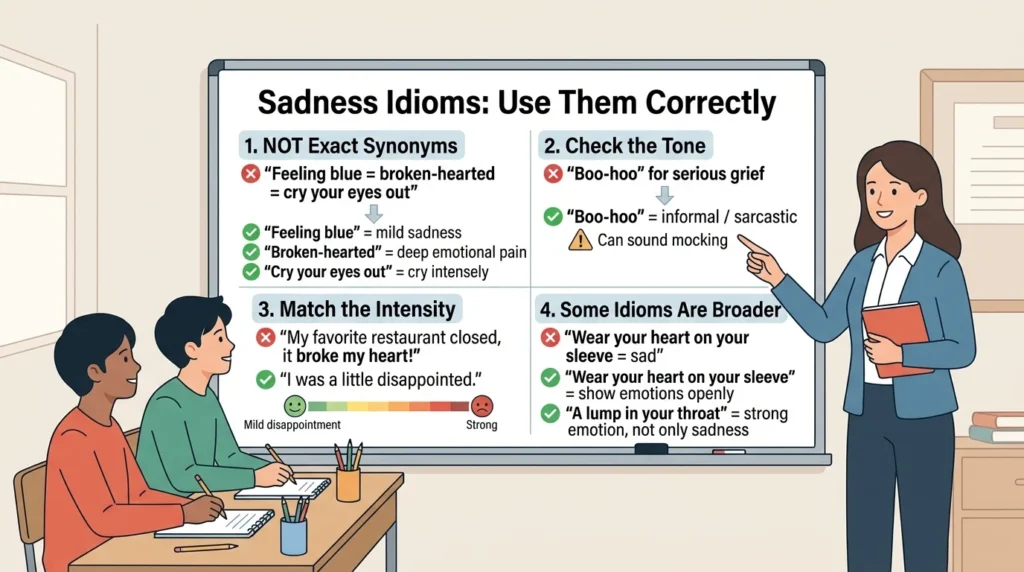
Don’t Use a Strong Idiom for a Mild Situation
If your favorite restaurant closes for one evening, saying:
“It broke my heart.”
may sound dramatically exaggerated.
For a small disappointment, something like:
“I was a little disappointed.”
is more natural.
Remember That Some Expressions Are Broader Than Sadness
Wear your heart on your sleeve means showing emotions openly, not specifically being sad.
Likewise, a lump in your throat can describe sadness, nostalgia, happiness, or another powerful emotion.
Inspirational Idioms: Phrases for Motivation, Hope & Perseverance
How to Learn Sadness Idioms Naturally
Don’t memorize 20 definitions in one sitting. Start with five expressions and connect each one to a situation.
For example:
- Feeling blue → mild sadness
- Down in the dumps → strong discouragement
- Heavy heart → deep sorrow
- Tearing up → almost crying
- Broken-hearted → emotional heartbreak
Then create your own sentences.
Instead of memorizing:
Heavy heart = sadness
learn:
“I left the hospital with a heavy heart.”
Context makes the expression easier to remember and helps you understand when it sounds natural.
You can also practice them in short conversations:
A: “You seem upset. What’s wrong?”
B: “I’m feeling a little blue today.”
This kind of practice is much more effective than memorizing isolated definitions.
FAQs About Idioms About Sadness
What is the most common idiom for sadness?
“Feeling blue” is one of the most familiar idiomatic expressions for feeling sad or unhappy. It usually describes mild or temporary sadness.
What idiom means very sad?
Expressions such as “broken-hearted,” “have a heavy heart,” and “it breaks my heart” can describe deep sadness. The best choice depends on the cause and intensity of the emotion.
What is an idiom for crying a lot?
“Cry your eyes out” means to cry intensely or for a long time. It is informal and usually suggests strong sadness.
What are some idioms for heartbreak?
“Broken-hearted,” “have a heavy heart,” “cry your eyes out,” and “it breaks my heart” can all be useful when describing emotional pain after a breakup or loss.
How can I say “I’m sad” naturally in English?
For mild sadness, try “I’m feeling blue.” For discouragement, say “I’m down in the dumps.” For deeper sorrow, “I have a heavy heart” works well. If you’re close to crying, you can say “I’m tearing up.”
Conclusion
The best idioms about sadness don’t simply replace the word sad—they help you explain what kind of sadness you feel and how strongly you feel it.
Use “feeling blue” for mild sadness, “down in the dumps” for discouragement, “broken-hearted” for deep emotional pain, and “tearing up” when you’re close to crying. Once you understand the differences, your English becomes more natural, precise, and expressive.
Start with five expressions, create your own real-life examples, and use them in conversations or writing. The goal isn’t to force an idiom into every sentence; it’s to choose the expression that naturally fits the emotion and situation.

Clara Bennett writes for Meaning Match about English idioms, everyday expressions, meanings, and practical language usage, making phrases easy to understand.