
When someone starts crying, simply saying “she cried” may not tell the whole story. Idioms for crying and related expressions give you more vivid ways to describe shedding tears, crying intensely, suddenly becoming emotional, or trying to hold back tears.
Phrases such as “cry your eyes out,” “burst into tears,” “have a good cry,” and “tears well up” describe different situations and levels of emotion, so they are not always interchangeable. For example, “burst into tears” suggests that someone suddenly starts crying, while “cry your eyes out” suggests intense or prolonged crying. You might also say, “She burst into tears when she heard the news” or “He cried his eyes out after the movie.”
If you’re searching for idioms for crying for writing, conversation, captions, stories, or everyday English, knowing these differences can help you choose the expression that fits your situation. In this guide, you’ll learn the meanings of common crying idioms and expressions, see natural examples, and discover ways to describe everything from quiet tears to uncontrollable sobbing.
What Are Idioms for Crying?
Idioms for crying are fixed expressions and common phrases used to describe tears, sadness, intense emotion, sudden crying, happy tears, or insincere emotion. Popular examples include cry your eyes out, cry me a river, burst into tears, get misty-eyed, and cry crocodile tears.
Not every expression below is a strict dictionary-defined idiom. Some are common fixed expressions that English speakers naturally use when talking about crying. Knowing the difference helps you sound more natural and choose the right expression for the situation.
Have you ever wanted to say that someone was crying without repeating “She cried” or “He was crying”? English has many more expressive ways to describe tears. The right phrase can show whether someone is quietly emotional, crying uncontrollably, about to cry, or even pretending to be upset.
Idioms and Expressions for Crying
Cry Your Eyes Out
Word-by-word meaning: Cry so much that it seems as if your eyes could be emptied of tears.
Idiomatic meaning: To cry very intensely, usually because of sadness, disappointment, or emotional pain.
Examples:
- She cried her eyes out after the breakup.
- I cried my eyes out when my dog died.
- He spent the whole night crying his eyes out over the news.
Common mistake: Don’t use this for a small amount of crying. It suggests strong or prolonged emotion.
Usage pattern:
Subject + cry + possessive + eyes out
Tone: Informal and emotionally strong.
Cry Me a River
Word-by-word meaning: Cry enough tears to make a river.
Idiomatic meaning: A sarcastic way of saying that you do not feel sorry for someone’s complaints or self-pity.
Examples:
- “My boss gave me extra work.” “Oh, cry me a river.”
- He complained about losing one game, and his friends told him to cry them a river.
Common mistake: This is usually sarcastic, so don’t use it when someone is genuinely grieving or going through serious emotional pain.
Usage note: It can sound dismissive or insensitive, even when used jokingly.
Tone: Sarcastic, humorous, or mocking.
Burst Into Tears
Word-by-word meaning: Suddenly begin crying.
Idiomatic meaning: To start crying unexpectedly and often suddenly because of strong emotion.
Examples:
- She burst into tears when she heard the news.
- The child burst into tears after falling.
- I was fine until I saw the old photograph, and then I burst into tears.
Common mistake: Don’t confuse it with prolonged crying. The expression emphasizes the sudden beginning of crying.
Usage pattern:
Subject + burst into tears
Tone: Neutral and natural in both conversation and writing.
Break Down in Tears
Word-by-word meaning: Emotionally break down and begin crying.
Idiomatic meaning: To lose emotional control and start crying, usually after experiencing stress, grief, pressure, or overwhelming emotion.
Examples:
- She broke down in tears during the interview.
- After holding everything inside for weeks, he finally broke down in tears.
- I broke down in tears when I talked about what happened.
Common mistake: It suggests more than simply having a few tears in your eyes. There is usually a sense of emotional overwhelm.
Usage note: This expression works particularly well when someone has been trying to stay strong.
Tone: Serious and emotional.
Cry Your Heart Out
Word-by-word meaning: Cry as though your heart is pouring out through your tears.
Idiomatic meaning: To cry intensely because of deep sadness, heartbreak, or emotional pain.
Examples:
- She cried her heart out after the relationship ended.
- I let myself cry my heart out instead of pretending everything was fine.
- He cried his heart out when his best friend moved away.
Common mistake: Don’t use it for mild emotion or simply becoming misty-eyed.
Usage pattern:
Subject + cry + possessive + heart out
Tone: Strong, emotional, and often sympathetic.
Bawl Your Eyes Out
Meaning: To cry very loudly and uncontrollably.
Examples:
- The baby bawled its eyes out when its mother left the room.
- He bawled his eyes out after watching the emotional movie.
Common mistake: Bawl is much stronger and louder than ordinary cry.
Usage note: This is informal and can sometimes sound slightly humorous because of its exaggerated quality.
Sob Your Heart Out
Meaning: To sob intensely and for an extended period, usually because of deep sadness.
Examples:
- She sobbed her heart out after receiving the message.
- He went home and sobbed his heart out.
Common mistake: Don’t use sob as a simple replacement for every kind of crying. Sob implies repeated, emotionally intense crying.
Tone: Strong and emotional.
Be in Floods of Tears
Meaning: To be crying heavily, with many tears.
Examples:
- She was in floods of tears after the argument.
- By the end of the film, several people were in floods of tears.
Common mistake: Avoid saying “in a flood of tears” when you mean the established expression “in floods of tears.”
Usage note: This expression is especially common in British English and can sound somewhat dramatic.
Have a Good Cry
Meaning: To cry for a while as a way of releasing strong emotions.
Examples:
- Sometimes you just need to have a good cry.
- She had a good cry and felt much better afterward.
Common mistake: This does not necessarily mean someone is emotionally out of control. It can describe a deliberate emotional release.
Tone: Informal, comforting, and conversational.
Shed Tears
Word-by-word meaning: Let tears fall.
Idiomatic meaning: To cry or produce tears, often in a more formal, literary, or emotional context.
Examples:
- He shed tears when remembering his childhood.
- The family shed tears of relief after the rescue.
Common mistake: Don’t assume shed tears always means extreme sadness. The context can indicate grief, happiness, relief, or tenderness.
Tone: Neutral to formal/literary.
Get Misty-Eyed
Meaning: To have tears forming in your eyes because you are becoming emotional.
Examples:
- I got misty-eyed watching my daughter graduate.
- She became misty-eyed when she read the old letter.
Common mistake: Misty-eyed usually suggests someone is becoming emotional, not necessarily crying heavily.
Usage note: This is ideal for mild or controlled emotion.
Intensity: Mild → moderate.
Turn on the Waterworks
Meaning: To deliberately start crying, especially in an exaggerated or manipulative way.
Examples:
- As soon as he realized he was losing the argument, he turned on the waterworks.
- She turned on the waterworks to convince her parents to let her go.
Common mistake: This expression often suggests that the crying is exaggerated, strategic, or not completely sincere.
Tone: Informal and often humorous or critical.
Cry Crocodile Tears
Word-by-word meaning: Cry tears like a crocodile.
Idiomatic meaning: To show false or insincere sadness.
Examples:
- He apologized, but I thought he was crying crocodile tears.
- Don’t be fooled by her crocodile tears; she isn’t actually sorry.
Common mistake: The usual expression is “cry crocodile tears” or “shed crocodile tears,” not simply “crocodile crying.”
Usage note: Use this when the person’s sadness appears fake or self-serving.
Tone: Critical and often sarcastic.
Bring Tears to Someone’s Eyes
Meaning: To make someone emotional enough to cry or nearly cry.
Examples:
- Her graduation speech brought tears to my eyes.
- The reunion brought tears to everyone’s eyes.
Common mistake: This does not necessarily describe sadness. A beautiful, touching, or joyful moment can also bring tears.
Grammar pattern:
Something + brings/brought + tears + to + someone’s eyes
Tone: Warm, emotional, and widely usable.
Have Tears in Your Eyes
Meaning: To have visible tears forming in your eyes.
Examples:
- She had tears in her eyes when she said goodbye.
- I had tears in my eyes during the final scene.
Common mistake: This does not necessarily mean the person is already crying heavily.
Usage note: It is useful for describing an emotional moment without exaggerating the intensity.
Tears Well Up
Meaning: Tears gradually form and rise in someone’s eyes.
Examples:
- Tears welled up in her eyes when she saw her old friend.
- I felt tears welling up as I listened to the story.
Common mistake: Don’t use this to describe loud or uncontrollable crying. It usually describes the beginning of tears.
Grammar pattern:
Tears + well up
or
Tears + well up + in someone’s eyes
Intensity: Mild to moderate.
Tears Stream Down Your Face
Meaning: Tears flow continuously down your face.
Examples:
- Tears streamed down her face as she said goodbye.
- By the end of the movie, tears were streaming down my face.
Common mistake: This is a descriptive expression rather than a phrase for every type of crying. It focuses on the visible flow of tears.
Usage note: It works particularly well in storytelling and emotional descriptions.
Be on the Verge of Tears
Meaning: To be very close to crying.
Examples:
- She was on the verge of tears during the meeting.
- I could tell he was on the verge of tears.
Common mistake: It means the person is almost crying, not necessarily already crying.
Grammar pattern:
Subject + be + on the verge of tears
Tone: Neutral and useful in both conversation and writing.
Tears of Joy
Meaning: Tears caused by happiness, relief, excitement, or another positive emotion.
Examples:
- She cried tears of joy when she received the good news.
- His parents had tears of joy in their eyes at the wedding.
Common mistake: Don’t assume every tear represents sadness.
Usage note: This expression is especially useful for weddings, reunions, achievements, births, and other emotional celebrations.
32+Idioms About Sadness: Ways to Express How You Feel
Keep the Tears at Bay
Word-by-word meaning: Keep tears away from yourself.
Idiomatic meaning: Try to prevent yourself from crying.
Examples:
- She tried to keep the tears at bay during her farewell speech.
- I struggled to keep the tears at bay when my friend moved away.
Common mistake: Keep something at bay means to keep something from approaching or affecting you. It does not mean to stop crying permanently.
Usage pattern:
Keep + noun + at bay
Tone: Natural, slightly literary, and useful for emotional situations.
Quick Guide: Which Crying Expression Should You Use?
| Situation | Best expressions |
|---|---|
| Crying intensely | Cry your eyes out, cry your heart out |
| Crying loudly | Bawl your eyes out |
| Deep emotional sobbing | Sob your heart out |
| Suddenly start crying | Burst into tears |
| Lose emotional control | Break down in tears |
| Almost crying | On the verge of tears |
| Mild emotion | Get misty-eyed, have tears in your eyes |
| Tears beginning to form | Tears well up |
| Happy crying | Tears of joy |
| Fake or insincere crying | Cry crocodile tears |
| Exaggerated crying | Turn on the waterworks |
| Trying not to cry | Keep the tears at bay |
| Something makes you emotional | Bring tears to someone’s eyes |
This distinction matters because “get misty-eyed” and “bawl your eyes out” do not communicate the same emotional intensity.
How to Choose the Right Idiom for Crying
The easiest way is to think about why the person is crying and how intensely they are crying.
For Deep Sadness
Use:
- Cry your heart out
- Cry your eyes out
- Sob your heart out
- Break down in tears
These expressions work well for heartbreak, grief, disappointment, or major emotional stress.
For Sudden Crying
Use:
- Burst into tears
- Break down in tears
Choose burst into tears when the important detail is that the crying started suddenly. Choose break down in tears when emotional pressure or loss of control is more important.
For Mild Emotion
Use:
- Get misty-eyed
- Have tears in your eyes
- Tears well up
These are better when someone is emotional but not openly sobbing.
For Happy or Touching Moments
Use:
- Tears of joy
- Bring tears to someone’s eyes
These can describe weddings, reunions, achievements, heartfelt speeches, or wonderful news.
For Fake or Dramatic Crying
Use:
- Cry crocodile tears
- Turn on the waterworks
- Cry me a river
Be careful, however. These expressions can sound mocking or insensitive.
Common Mistakes When Using Idioms for Crying
1. Treating Every Expression as a Synonym
Crying expressions have different levels of intensity.
Misty-eyed is mild.
Burst into tears emphasizes suddenness.
Sob your heart out suggests intense crying.
Choosing the wrong one can change the meaning of your sentence.
2. Using Sarcastic Expressions in Serious Situations
Cry me a river and turn on the waterworks can sound dismissive.
They may be appropriate when joking with a close friend, but they are usually inappropriate when someone is experiencing genuine grief or trauma.
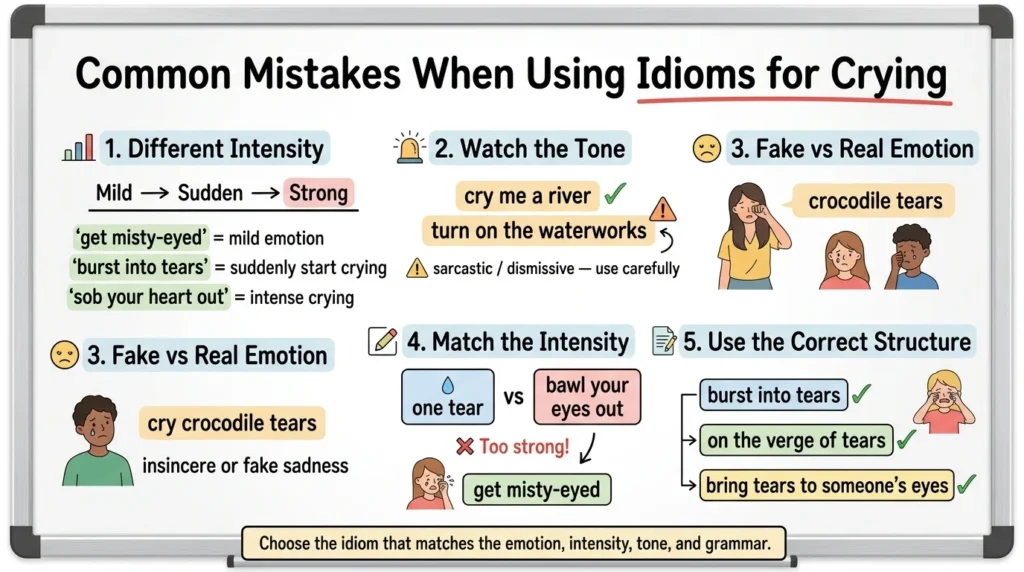
3. Confusing Fake Crying With Real Emotion
Cry crocodile tears suggests insincerity. Don’t use it simply because someone is crying dramatically.
4. Overusing Dramatic Idioms
If someone has one tear in their eye, saying they bawled their eyes out exaggerates the situation.
Choose the expression that matches the actual emotional intensity.
5. Forgetting Grammar Patterns
Some expressions have fixed structures:
- burst into tears
- on the verge of tears
- bring tears to someone’s eyes
- cry your heart out
- keep the tears at bay
Changing these structures unnecessarily can make your English sound unnatural.
Idioms About Hope: 30+ Ways to Express Optimism
How to Use Crying Idioms Naturally in Conversation
The best way to learn these expressions is to connect them with realistic situations rather than memorizing isolated definitions.
Imagine your friend has just received excellent news:
“When she found out she got the job, she burst into tears of joy.”
Now imagine someone watching an emotional movie:
“I tried to keep the tears at bay, but by the final scene, tears were streaming down my face.”
For a difficult breakup:
“She went home and cried her heart out.”
For someone pretending to be upset:
“He’s just turning on the waterworks because he doesn’t want to apologize.”
These examples show an important point: natural English depends not only on knowing an idiom’s meaning but also on understanding its tone, emotional intensity, and situation.
Are Idioms for Crying Always About Sadness?
No. Crying can express many emotions.
People may cry because they are:
- deeply sad
- relieved
- extremely happy
- emotionally overwhelmed
- touched by something beautiful
- frustrated
- shocked
- exhausted
- nostalgic
For example, tears of joy describe happiness, while get misty-eyed can describe a touching memory. Bring tears to someone’s eyes can refer to something beautiful or inspiring rather than something painful.
This is why context matters more than simply memorizing the word cry.
FAQs About Idioms for Crying
What is the most common idiom for crying?
Cry your eyes out is one of the most familiar expressions for crying intensely. It usually describes prolonged or emotional crying.
What idiom means to cry a lot?
Expressions such as cry your eyes out, cry your heart out, bawl your eyes out, and sob your heart out can all describe intense crying. The best choice depends on the level and style of crying.
What idiom means to suddenly start crying?
Burst into tears is the most natural expression when someone suddenly begins crying.
What idiom means fake crying?
Cry crocodile tears describes tears or sadness that are considered false or insincere. Turn on the waterworks can also suggest exaggerated or strategic crying.
What is a positive idiom for crying?
Tears of joy is a positive expression used when someone cries because of happiness, relief, excitement, or another joyful emotion.
Conclusion
Learning idioms for crying gives you much more precise ways to describe emotion than simply saying “someone cried.” You can show whether a person is quietly becoming emotional, suddenly starts crying, loses control, cries intensely, tries not to cry, or is even pretending to be upset.
Start with a few highly useful expressions such as cry your eyes out, burst into tears, get misty-eyed, on the verge of tears, and tears of joy. Once you understand their intensity and tone, you can use them naturally in conversations, stories, essays, and everyday English.
The key is simple: don’t just memorize the idiom—learn when it actually fits. That is what turns vocabulary knowledge into natural English.

Sophie Collins writes for Meaning Match about English idioms, American and British expressions, meanings, usage, and everyday language differences.