
Ever heard a salesperson say “get your foot in the door” or describe a popular product as selling “like hotcakes”? These expressions can sound confusing until you know what they mean. Sales idioms are figurative expressions used to describe selling products, attracting customers, negotiating deals, and achieving business goals. For example, “get your foot in the door” means gaining an initial opportunity, while “sell like hotcakes” means selling quickly and in large quantities.
Learning sales idioms can help you understand business conversations, communicate more naturally, and expand your professional English vocabulary. Some expressions relate to finding potential customers, building relationships, handling objections, closing sales, or meeting sales targets. Others are useful in everyday business discussions and marketing conversations.
In this guide, you’ll discover sales idioms and related business expressions with simple meanings and practical examples. You’ll also learn how to recognize their meanings and use them appropriately in sales meetings, negotiations, presentations, and customer conversations.
What Are Sales Idioms and Phrases?
Sales idioms and phrases are expressions people use to discuss customers, negotiations, sales results, and business opportunities. For example, “get your foot in the door” means gaining an initial opportunity, while “sweeten the deal” means making an offer more attractive. Learning these expressions helps you understand workplace conversations and communicate more naturally with customers and colleagues.
Whether you work in retail, real estate, business development, or customer service, these 20 expressions can help you describe sales situations, understand common business English, and choose words that fit the conversation.
Common Sales Idioms and Phrases With Meanings and Examples
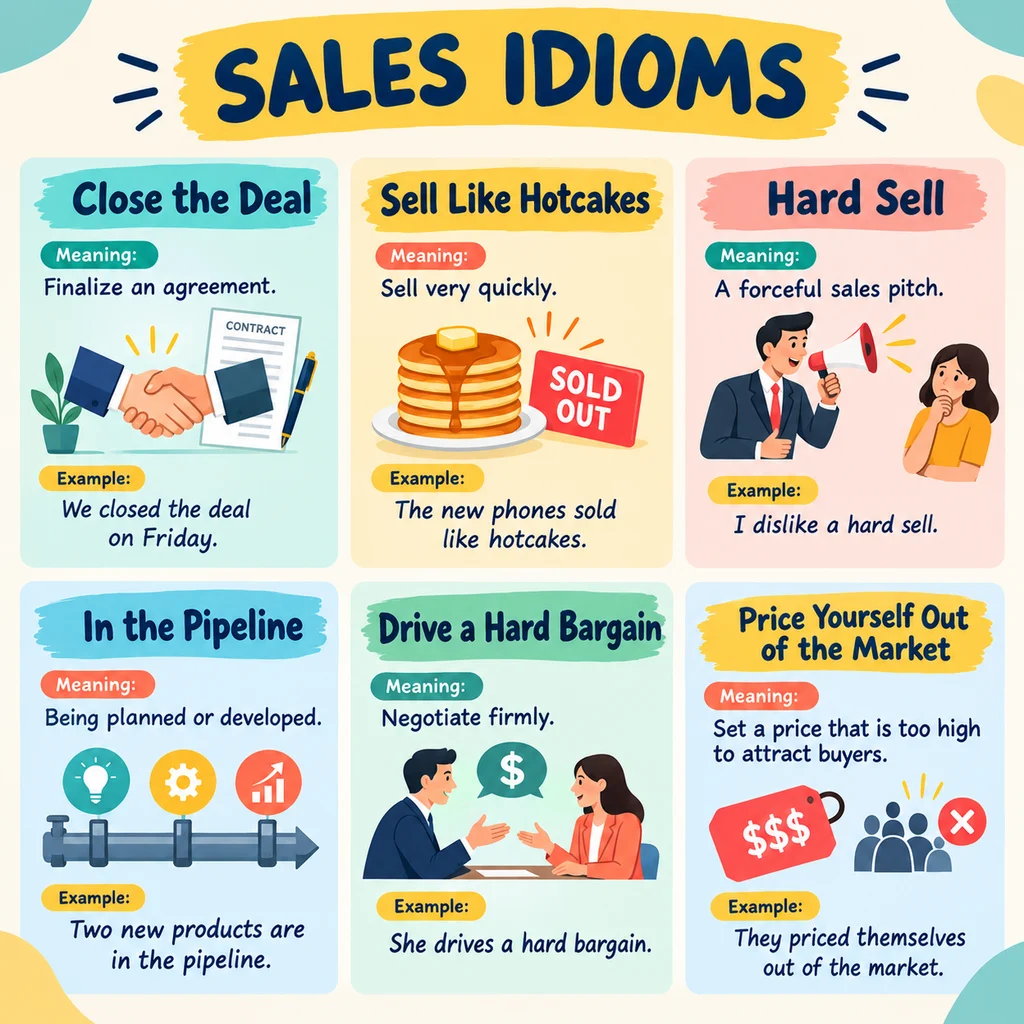
Close the Deal
Meaning: To successfully finalize a sale or agreement.
Literal vs. figurative meaning: Literally, “close” means to shut something. In business, closing a deal means reaching an agreement and completing the necessary steps to secure the sale.
Example sentences:
- After two demonstrations and a pricing discussion, Maria closed the deal with the new client.
- The sales representative answered the customer’s questions before attempting to close the deal.
Common confusion: A promising conversation is not necessarily a closed deal. The customer must agree to proceed, although the precise completion point depends on the transaction.
Usage note: This is a standard business expression used in sales, negotiations, and business development.
Get Your Foot in the Door
Meaning: To gain an initial opportunity that could lead to something bigger.
Literal vs. figurative meaning: Literally, it suggests putting a foot in a doorway. Figuratively, it means gaining access to an opportunity, client, or organization.
Example sentences:
- The small trial order helped the supplier get its foot in the door with a major retailer.
- Offering a short product demonstration can help a new salesperson get their foot in the door.
Common confusion: Getting your foot in the door does not mean securing a major contract immediately. It means establishing an initial opportunity.
Usage note: This expression is particularly useful when discussing prospecting, new customers, and first contracts.
Sell Like Hotcakes
Meaning: To sell very quickly or in large quantities.
Literal vs. figurative meaning: Hotcakes are pancakes that are often served hot. The expression compares fast-selling products to something that people eagerly buy.
Example sentences:
- The new headphones sold like hotcakes during the holiday promotion.
- Our reusable water bottles are selling like hotcakes since the launch.
Common confusion: The expression describes strong demand or rapid sales, not necessarily low prices or discounts.
Usage note: Informal and conversational. In a formal sales report, “sales increased rapidly” may be more appropriate.
Sweeten the Deal
Meaning: To make an offer more attractive by adding a benefit or improving its terms.
Literal vs. figurative meaning: Literally, “sweeten” means to make something sweeter. Figuratively, it means adding something valuable to encourage acceptance.
Example sentences:
- The supplier sweetened the deal by including free installation.
- We could sweeten the deal with a longer warranty rather than reducing the price.
Common confusion: Sweetening a deal does not always mean offering a discount. Free delivery, flexible payment terms, or an additional service may also improve an offer.
Usage note: Common in sales negotiations, promotions, and contract discussions. Make sure any additional benefit is genuinely available before offering it.
A Hard Sell
Meaning: An aggressive or forceful attempt to persuade someone to buy something; it can also describe a product that is difficult to sell.
Literal vs. figurative meaning: The word “hard” suggests difficulty or pressure. The expression can describe either a forceful sales tactic or a challenging selling proposition, depending on context.
Example sentences:
- The customer disliked the hard sell and asked for more time to decide.
- Without a clear advantage over competing products, this model may be a hard sell.
Common confusion: “A hard sell” does not always mean a product is difficult to sell. Check whether the phrase describes the selling approach or the product itself.
Usage note: The phrase can have a negative tone when it refers to pressure tactics. Respectful selling is generally more appropriate for long-term customer relationships.
A Soft Sell
Meaning: A gentle, low-pressure approach that encourages a customer to consider a product or service.
Literal vs. figurative meaning: “Soft” suggests a less forceful approach. Figuratively, a soft sell emphasizes helpful information and benefits rather than aggressive persuasion.
Example sentences:
- The consultant used a soft sell by explaining the service without pressuring the customer.
- A soft sell may work well when buyers need time to compare several options.
Common confusion: A soft sell does not automatically involve a discount or a cheaper product. It describes the approach used to encourage a purchase.
Usage note: This expression is useful when discussing consultative selling, customer trust, and longer buying decisions.
A Ballpark Figure
Meaning: A rough estimate of a number, price, cost, or amount.
Literal vs. figurative meaning: A ballpark is a place where baseball is played. In this expression, it represents an approximate range rather than an exact figure.
Example sentences:
- Can you give me a ballpark figure for the proposed advertising campaign?
- The customer requested a ballpark figure before approving a detailed quotation.
Common confusion: A ballpark figure is not a final price or guaranteed quotation. Actual costs may change when more details become available.
Usage note: Useful in early sales conversations when a customer needs an estimate before committing to a detailed proposal.
In the Red
Meaning: To have a financial deficit or operate at a loss, depending on the context.
Literal vs. figurative meaning: The expression is associated with red ink traditionally used to record negative financial figures. Figuratively, it describes an unfavorable financial position.
Example sentences:
- The store remained in the red after several months of weak sales.
- Management reviewed operating costs to help the business get out of the red.
Common confusion: Low sales alone do not necessarily mean a business is in the red. Expenses, income, and the relevant financial period also matter.
Usage note: Common when discussing company finances, expenses, and business performance.
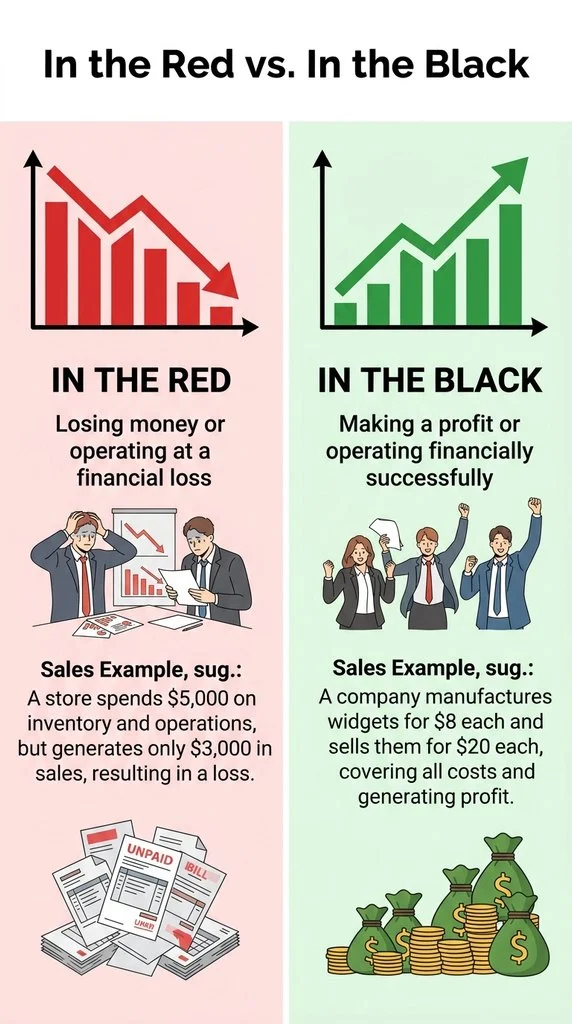
. In the Black
Meaning: To be profitable or have a positive financial position in the relevant context.
Literal vs. figurative meaning: The expression is associated with black ink traditionally used to record positive financial figures. Figuratively, it indicates a favorable financial result.
Example sentences:
- Strong holiday sales helped the store stay in the black.
- The company reduced unnecessary expenses to remain in the black.
Common confusion: Being in the black does not mean a business has no expenses or debt. It generally indicates a positive financial result or balance, depending on the context.
Usage note: Often contrasted with “in the red.” For precise financial reporting, use the specific measure, such as net profit or cash balance, when it is known.
The Bottom Line
Meaning: The most important point in a discussion or the final financial result of a business.
Literal vs. figurative meaning: The bottom line can refer to the last line of a financial statement. Figuratively, it means the essential conclusion or most important consideration.
Example sentences:
- The bottom line is that customers need a clearer explanation of the pricing.
- Higher revenue did not improve the bottom line because operating expenses also increased.
Common confusion: “The bottom line” does not always mean profit. It can refer to the main point of an argument or decision.
Usage note: Common in meetings, financial discussions, presentations, and negotiations.
Get the Ball Rolling
Meaning: To start an activity, project, or process.
Literal vs. figurative meaning: Literally, it suggests setting a ball in motion. Figuratively, it means taking the first step to make something happen.
Example sentences:
- Let’s get the ball rolling by contacting our first ten potential customers.
- The manager scheduled a kickoff meeting to get the sales campaign rolling.
Common confusion: The expression means beginning a process, not completing it.
Usage note: Suitable for sales meetings, project planning, and everyday workplace conversations.
Think Outside the Box
Meaning: To consider creative or unconventional ways to solve a problem.
Literal vs. figurative meaning: The phrase imagines thinking beyond the limits of a box. Figuratively, it means looking beyond familiar approaches to find new solutions.
Example sentences:
- The team thought outside the box and created a bundle for budget-conscious buyers.
- We need to think outside the box to reach customers in a crowded market.
Common confusion: Thinking outside the box does not mean ignoring every rule or suggesting impractical ideas. Creative solutions still need to meet customer needs and business goals.
Usage note: Common in sales strategy, marketing, product development, and problem-solving discussions.
Go the Extra Mile
Meaning: To make more effort than is normally expected.
Literal vs. figurative meaning: Literally, it suggests traveling an additional mile. Figuratively, it means doing something extra to help achieve a good result.
Example sentences:
- The sales representative went the extra mile by helping the customer set up the product.
- Our support team went the extra mile to resolve the issue before the client’s launch.
Common confusion: The phrase is about additional effort, not physical distance. However, extra work should still be reasonable and sustainable.
Usage note: Often used when discussing customer service, after-sales support, and building long-term relationships.
A Win-Win Situation
Meaning: A situation in which both sides benefit.
Literal vs. figurative meaning: “Win-win” repeats the idea of winning to emphasize that the outcome is favorable for both parties.
Example sentences:
- The buyer received flexible payment terms, and the seller secured a long-term contract—a win-win situation.
- A product subscription can be a win-win situation when it provides reliable service for the customer and sustainable revenue for the company.
Common confusion: A win-win situation does not mean both parties get everything they want. It means both receive meaningful benefits.
Usage note: Useful when describing mutually beneficial agreements, partnerships, and negotiations.
Play Hardball
Meaning: To negotiate firmly or aggressively, especially when important interests are at stake.
Literal vs. figurative meaning: The phrase comes from a form of baseball played with a hard ball. Figuratively, it describes a tough, uncompromising approach.
Example sentences:
- The buyer played hardball over the proposed price.
- The supplier played hardball during payment negotiations but eventually agreed to a compromise.
Common confusion: Playing hardball means negotiating firmly; it does not automatically mean acting dishonestly or illegally.
Usage note: Informal and potentially confrontational. Use it carefully when describing customer negotiations, particularly if maintaining a positive relationship is important.
Bring Home the Bacon
Meaning: To earn money to support yourself or your family.
Literal vs. figurative meaning: Literally, the expression refers to bringing bacon home. Figuratively, it means earning a living.
Example sentences:
- She works in sales to bring home the bacon.
- After months of training, he began earning regular commissions and bringing home the bacon.
Common confusion: This expression refers to earning money, not generating a company’s revenue in every context.
Usage note: Informal and conversational. In a formal business report, “earn an income” or “generate revenue” is usually more suitable.
Put Your Best Foot Forward
Meaning: To make a strong, positive first impression by presenting yourself or your work well.
Literal vs. figurative meaning: Literally, it suggests placing one foot forward. Figuratively, it means making your best effort to present yourself positively.
Example sentences:
- The sales representative put her best foot forward during the first client meeting.
- We should put our best foot forward when presenting the new product to potential buyers.
Common confusion: The expression is about making a good impression, not pretending to be someone you are not or making promises you cannot keep.
Usage note: Useful for sales presentations, pitches, networking, and first meetings with prospective customers.
Keep Someone in the Loop
Meaning: To keep someone informed about updates, decisions, or developments.
Literal vs. figurative meaning: The “loop” represents an ongoing flow of information. Keeping someone in it means making sure they receive relevant updates.
Example sentences:
- Please keep the customer in the loop while we investigate the delivery delay.
- I will keep the sales manager in the loop as the negotiation progresses.
Common confusion: Keeping someone in the loop does not mean sharing every message or irrelevant detail. Share information that matters to their role or decision.
Usage note: Common in customer communication, account management, and teamwork. “Keep someone informed” is a more formal alternative.
Touch Base
Meaning: To make brief contact with someone to exchange updates or discuss a matter.
Literal vs. figurative meaning: The phrase has roots in games and sports where touching a base has a specific meaning. In workplace English, it means checking in or reconnecting.
Example sentences:
- I’ll touch base with the client on Thursday to see whether they have reviewed the proposal.
- Let’s touch base after the product demonstration to discuss the customer’s feedback.
Common confusion: Touching base usually means making brief contact, not conducting a lengthy meeting or finalizing a sale.
Usage note: Common in informal workplace communication. In formal writing, “contact,” “follow up with,” or “schedule a discussion with” may be clearer.
Business Idioms and Phrases PDF: Common Expressions With Meanings and Examples
Move the Needle
Meaning: To make a noticeable difference in results or progress.
Literal vs. figurative meaning: A needle on a measuring instrument moves when a reading changes. Figuratively, moving the needle means producing a meaningful improvement.
Example sentences:
- The new customer-retention campaign helped move the needle on repeat purchases.
- More website visitors will not necessarily move the needle if they do not become qualified leads.
Common confusion: Activity alone does not mean the needle has moved. The expression refers to a meaningful change in an outcome or performance measure.
Usage note: Often used in sales strategy, marketing, and performance reviews. In formal reports, specify the measurable result whenever possible.
Quick Reference: Sales Idioms and Phrases
| Expression | Meaning |
|---|---|
| Close the deal | Finalize a sale or agreement |
| Get your foot in the door | Gain an initial opportunity |
| Sell like hotcakes | Sell very quickly |
| Sweeten the deal | Make an offer more attractive |
| A hard sell | A forceful approach or a difficult product to sell |
| A soft sell | A low-pressure selling approach |
| A ballpark figure | An approximate estimate |
| In the red | In a financial deficit or at a loss |
| In the black | In a positive financial position |
| The bottom line | The key point or final financial result |
| Get the ball rolling | Start a process |
| Think outside the box | Think creatively |
| Go the extra mile | Make additional effort |
| A win-win situation | An outcome that benefits both sides |
| Play hardball | Negotiate firmly |
| Bring home the bacon | Earn a living |
| Put your best foot forward | Make a strong first impression |
| Keep someone in the loop | Keep someone informed |
| Touch base | Make brief contact |
| Move the needle | Make a meaningful difference |
How to Use Sales Idioms Naturally
Knowing an expression’s meaning is not enough. You also need to understand its tone, context, and suitability for the person you are speaking to.
1. Match the expression to your audience.
“Sell like hotcakes” is informal, while “sales volume increased substantially” may be better for a formal report.
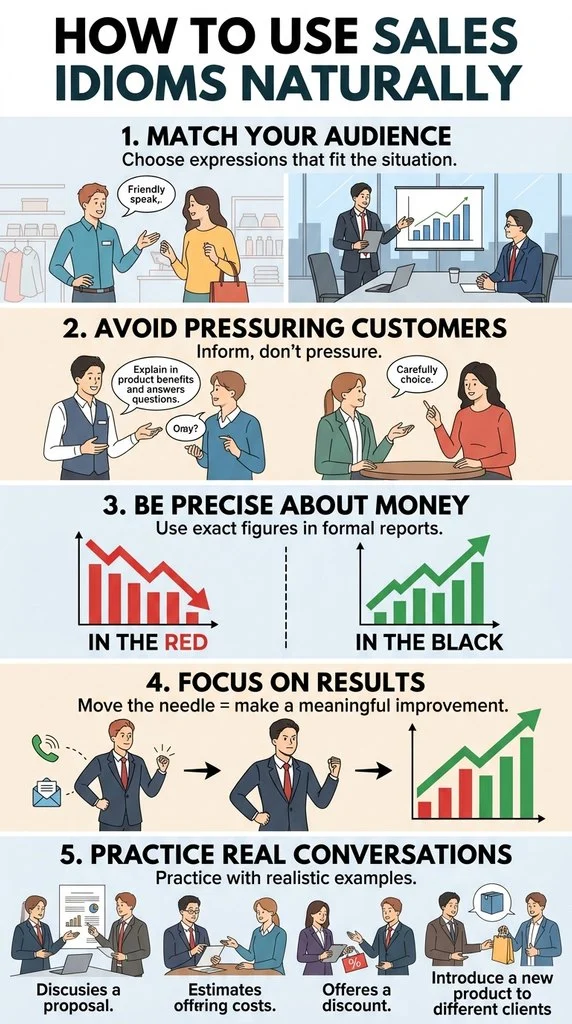
2. Avoid pressuring customers.
“A hard sell” can suggest aggressive persuasion. In customer-facing conversations, explain the benefits and allow buyers to make informed decisions.
3. Use precise language for financial matters.
“In the red” and “in the black” are useful conversational expressions, but financial reports should specify the relevant figure or measure when possible.
4. Do not confuse activity with results.
Making calls, sending emails, and arranging meetings are activities. “Move the needle” refers to a meaningful improvement in results.
5. Practice with realistic sales conversations.
Try using expressions in situations such as following up on a proposal, estimating a project cost, discussing a discount, or introducing a new product.
Practice Quiz: Test Your Knowledge
Choose the expression that best completes each sentence.
1. The customer requested an approximate cost before asking for a formal quotation. Could you provide a ______?
2. The new product became extremely popular and began to ______.
3. The supplier added free installation to make the proposal more attractive and ______.
4. The account manager promised to send the client updates throughout the negotiation and keep them ______.
5. The new campaign produced a noticeable increase in qualified leads. It helped ______.
Answers and Explanations
- Ballpark figure — an approximate estimate rather than a final price.
- Sell like hotcakes — sell quickly or in large quantities.
- Sweetened the deal — improved the offer by adding a benefit.
- In the loop — kept the client informed about relevant developments.
- Move the needle — produced a meaningful improvement in results.
Teamwork Idioms: 35+ Expressions for Stronger Teams
Frequently Asked Questions
What are the most common sales idioms and phrases?
Common examples include “close the deal,” “get your foot in the door,” “sell like hotcakes,” “sweeten the deal,” and “a ballpark figure.” They describe different parts of selling, from gaining opportunities to discussing prices and finalizing agreements.
What is the difference between an idiom and a sales phrase?
An idiom often has a figurative meaning that cannot be understood fully from its individual words. For example, “sell like hotcakes” means selling quickly. A sales phrase may be more literal or function as standard business terminology, such as “make a sale.” Both can be useful for learning workplace English.
What does “close the deal” mean in sales?
“Close the deal” means successfully finalizing a sale or agreement. For example, a salesperson may close the deal after the customer accepts the proposal and agrees to the terms.
What is the difference between a hard sell and a soft sell?
A hard sell involves a forceful approach to persuading someone to buy, while a soft sell uses a gentler, lower-pressure approach. A hard sell can also describe a product that is difficult to sell. A soft sell does not necessarily mean offering a discount.
How can I learn sales idioms quickly?
Start with five expressions and write one realistic sentence for each. Practice them in sample customer conversations, review their usage notes, and pay attention to how they appear in workplace discussions. Focus on understanding the context instead of memorizing definitions alone.
Conclusion:
Sales idioms and phrases can help you understand business conversations, explain customer situations, and communicate more naturally at work. From “get your foot in the door” to “move the needle,” each expression describes a different aspect of sales, negotiation, or customer relationships.
You do not need to memorize all expressions at once. Choose three, write your own examples, and practice using them in realistic sales conversations. As your understanding grows, you will find it easier to recognize these phrases, choose the right wording, and communicate with confidence.

Emily Carter writes for Meaning Match about English idioms, student-friendly expressions, and language learning, using simple explanations and helpful examples.