
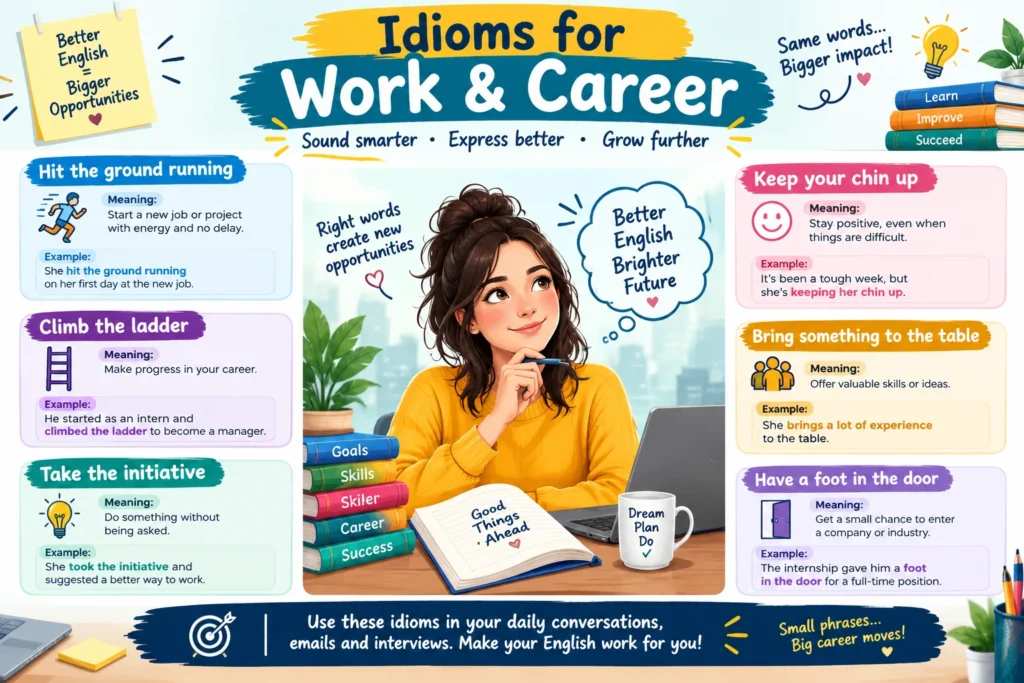
Have you ever heard a work idiom like “hit the ground running” or “climb the corporate ladder” and wondered what it really means? You’re not alone. Work idioms are figurative expressions used to talk about jobs, effort, teamwork, success, career growth, workplace problems, and everyday professional situations. Their meaning cannot always be understood by taking the words literally, which can make them confusing for English learners and even fluent speakers.
For example, “hit the ground running” means to start a job or task with energy and make quick progress, while “burn the midnight oil” means to work late into the night. Some work idioms are professional and widely used, while others are casual, humorous, or better suited to conversation.
This guide explains popular work idioms with simple meanings, natural examples, and usage notes so you can understand workplace idioms, business expressions, and career-related phrases and know when to use them naturally.
What Are Work Idioms and Expressions?
Work idioms are fixed expressions commonly used when discussing professional life, responsibilities, teamwork, success, and workplace challenges. Their literal words may create one picture, while their intended meaning communicates something completely different.
For example:
- Go the extra mile → make an additional effort
- Hit the ground running → start something with energy and effectiveness
- On the same page → have the same understanding
- Pull your weight → contribute your fair share
Not every expression on this list is a strict dictionary-defined idiom. Some are fixed phrases or common expressions frequently used in workplace situations. For English learners, the important point is knowing what they mean, when they sound natural, and how to use them correctly.
Common Work Idioms and Expressions
Pull Your Weight
Word-by-word meaning: Carry your fair share of a load.
Idiomatic meaning: Do your fair share of the work or responsibility.
Example sentences:
- Everyone needs to pull their weight to finish the project.
- She always pulls her weight during team assignments.
Common error: Saying “pull your weights.”
Usage tip: This can sound critical when directed at one person. For a softer tone, say, “Everyone needs to contribute their share.”
Best used in: Teamwork discussions and informal workplace conversations.
Go the Extra Mile
Word-by-word meaning: Travel farther than necessary.
Idiomatic meaning: Make more effort than people normally expect.
Example sentences:
- Our support team always goes the extra mile for customers.
- He went the extra mile to help his new colleague.
Common error: Saying “go an extra mile” when using the fixed idiom.
Usage tip: This is usually positive and works especially well when praising someone’s effort or service.
Best used in: Customer service, teamwork, performance discussions, and everyday professional conversations.
Learn the Ropes
Word-by-word meaning: Learn how to handle ropes.
Idiomatic meaning: Learn how a job, system, or activity works.
Example sentences:
- It took me a few weeks to learn the ropes.
- Give the new employee some time to learn the ropes.
Usage tip: The expression is particularly natural when discussing someone new to a position or workplace.
Best used in: New-job situations, training, onboarding, and casual workplace conversations.
Get the Ball Rolling
Word-by-word meaning: Start a ball moving.
Idiomatic meaning: Start a project, process, meeting, or activity.
Example sentences:
- Let’s get the ball rolling on the new campaign.
- She organized a meeting to get the ball rolling.
Common error: Saying “make the ball rolling.”
Usage tip: It is informal but extremely useful when talking about starting something.
Best used in: Meetings, projects, planning, and everyday work conversations.
On the Same Page
Word-by-word meaning: Looking at the same page.
Idiomatic meaning: Have the same understanding, information, goals, or expectations.
Example sentences:
- Let’s meet tomorrow so we’re all on the same page.
- The two departments need to get on the same page.
Common error: Saying “in the same page.”
Usage tip: This is one of the most useful workplace expressions because it emphasizes communication and shared understanding.
Best used in: Meetings, teamwork, project planning, and professional conversations.
Think Outside the Box
Word-by-word meaning: Think beyond a physical box.
Idiomatic meaning: Think creatively or consider an unconventional solution.
Example sentences:
- We need to think outside the box to solve this problem.
- Her team found an outside-the-box solution.
Usage tip: It means more than simply having an idea; it suggests moving beyond traditional or expected approaches.
Best used in: Brainstorming, problem-solving, marketing, design, and business discussions.
Hit the Ground Running
Word-by-word meaning: Begin running immediately after reaching the ground.
Idiomatic meaning: Start a new job, role, or project with energy and effectiveness.
Example sentences:
- The new manager hit the ground running.
- She hit the ground running on her first day.
Usage tip: This expression often describes someone who needs little time to become productive.
Best used in: Hiring, onboarding, new projects, and career conversations.
Back to the Drawing Board
Word-by-word meaning: Return to a place where plans are drawn.
Idiomatic meaning: Start planning again because an earlier idea or attempt failed.
Example sentences:
- The first design didn’t work, so we’re back to the drawing board.
- The proposal was rejected, sending the team back to the drawing board.
Usage tip: Use it when a plan needs major reconsideration, not merely a tiny adjustment.
Best used in: Projects, product development, planning, and problem-solving.
Meet a Deadline
Literal meaning: Complete something by an established time limit.
Meaning in work: Finish required work on time.
Example sentences:
- We worked together to meet the deadline.
- Can you meet the Friday deadline?
Usage tip: Technically, this is a common workplace expression rather than a strongly figurative idiom. It is included because it is highly relevant to everyday work English.
Best used in: Emails, meetings, reports, project management, and formal professional communication.
Climb the Career Ladder
Word-by-word meaning: Move upward on a ladder.
Idiomatic meaning: Progress toward higher positions, responsibilities, or professional status.
Example sentences:
- She hopes to climb the career ladder over the next few years.
- Training can help employees climb the career ladder.
Usage tip: It usually describes gradual career advancement rather than one immediate promotion.
Best used in: Career advice, interviews, professional development, and workplace discussions.
Burn the Midnight Oil
Word-by-word meaning: Burn oil late at night.
Idiomatic meaning: Work or study late into the night.
Example sentences:
- We were burning the midnight oil to finish the report.
- He burned the midnight oil before the presentation.
Usage tip: This expression emphasizes unusually late or intensive work. It does not describe ordinary daytime work.
Best used in: Deadlines, studying, major projects, and informal conversations.
Call It a Day
Word-by-word meaning: Declare that the day is finished.
Idiomatic meaning: Stop working for the day.
Example sentences:
- We’ve finished the important tasks, so let’s call it a day.
- I’m exhausted. I’m going to call it a day.
Common error: Thinking it means quitting a job permanently.
Usage tip: It normally means ending work for the current day, not leaving the profession.
Best used in: Casual workplace conversations and team discussions.
In the Same Boat
Word-by-word meaning: Share the same boat.
Idiomatic meaning: Be in the same situation, especially a difficult one.
Example sentences:
- We’re all in the same boat with this tight deadline.
- Don’t worry—we’re in the same boat.
Common error: Saying “on the same boat” when using the idiom.
Usage tip: It is useful for showing solidarity when several people face the same challenge.
Best used in: Team conversations, workplace problems, and supportive discussions.
Keep Your Nose to the Grindstone
Word-by-word meaning: Keep your nose close to a grinding stone.
Idiomatic meaning: Continue working hard and remain focused.
Example sentences:
- Keep your nose to the grindstone and you’ll finish soon.
- She kept her nose to the grindstone throughout the busy season.
Usage tip: This emphasizes sustained effort and concentration rather than simply being busy.
Best used in: Informal conversations about hard work, study, and long-term goals.
A Piece of Cake
Word-by-word meaning: A portion of cake.
Idiomatic meaning: Something that is very easy to do.
Example sentences:
- Once you learn the software, using it is a piece of cake.
- The first task was a piece of cake.
Usage tip: This is a general everyday idiom rather than a workplace-specific expression. At work, it is best kept for casual conversations.
Best used in: Informal workplace chats and friendly conversations.
Get Your Act Together
Word-by-word meaning: Organize your actions or behavior.
Idiomatic meaning: Become organized, prepared, or more effective.
Example sentences:
- We need to get our act together before the presentation.
- He got his act together and completed the project.
Usage tip: Be careful with tone. Directed at another person, it can sound impatient or critical. In formal feedback, use a softer alternative such as “become more organized.”
Best used in: Casual conversations, teamwork, and informal advice.
Work Around the Clock
Word-by-word meaning: Work continuously around a clock.
Idiomatic meaning: Work for very long hours or continuously.
Example sentences:
- The team worked around the clock before the launch.
- Emergency workers sometimes work around the clock.
Usage tip: It often emphasizes intense or continuous effort and does not necessarily mean literally working 24 uninterrupted hours.
Best used in: Major deadlines, emergencies, launches, and news-style workplace descriptions.
Take the Bull by the Horns
Word-by-word meaning: Grab a bull by its horns.
Idiomatic meaning: Deal with a difficult situation directly and confidently.
Example sentences:
- She decided to take the bull by the horns and address the problem.
- It’s time to take the bull by the horns and improve the process.
Common error: Saying “take the bull by the horn.”
Usage tip: The established expression uses “horns.” It has a confident, decisive tone.
Best used in: Problem-solving, leadership, decision-making, and motivational conversations.
Put in the Hours
Word-by-word meaning: Spend hours doing something.
Idiomatic meaning: Spend a considerable amount of time working or practicing.
Example sentences:
- He put in the hours to prepare for the presentation.
- If you want to improve, you have to put in the hours.
Common error: Leaving out “in” and saying “put the hours.”
Usage tip: It can suggest dedication, but it may also emphasize long working hours.
Best used in: Discussions about effort, practice, preparation, and professional development.
A Tough Act to Follow
Word-by-word meaning: Follow an impressive performance or achievement.
Idiomatic meaning: Be in a position where matching someone’s previous success is difficult.
Example sentences:
- Her presentation was excellent and will be a tough act to follow.
- The previous manager was highly respected, so he was a tough act to follow.
Usage tip: It is not limited to entertainment. It can describe employees, managers, projects, presentations, or achievements.
Best used in: Leadership changes, presentations, promotions, and discussions of previous success.
Teamwork Idioms
| Idiom | Meaning |
|---|---|
| Many Hands Make Light Work | A large task becomes easier when shared. |
| Pull Together | Cooperate; work as a united team. |
| Two Heads Are Better Than One | Two people solve problems better than one. |
| Team Up | Join together to work on something. |
| Join Forces | Combine efforts toward a shared goal. |
| Put Your Heads Together | Collaborate to solve a problem. |
| Divide and Conquer | Split a task to handle it more easily. |
| Lend a Hand | Help someone. |
| Shoulder to Shoulder | Working closely together; united. |
| Back Someone Up | Support a teammate. |
| All for One and One for All | Everyone supports each other. |
| The More the Merrier | More people make a task more enjoyable. |
| Meet Someone Halfway | Compromise. |
| Give and Take | Mutual compromise; exchange. |
| Pool Your Resources | Combine assets or efforts. |
| United We Stand, Divided We Fall | Unity brings strength; division brings failure. |
| Win-Win Situation | An outcome beneficial to everyone. |
Leadership Idioms
| Idiom | Meaning |
|---|---|
| Lead by Example | Demonstrate the behavior you expect from others. |
| Call the Shots | Make the decisions; be in charge. |
| Rise to the Occasion | Perform well when challenged. |
| Take the Initiative | Act first; don’t wait to be told. |
| Keep Your Eye on the Ball | Stay focused on the goal. |
| A Level Playing Field | A fair situation for everyone. |
| Weather the Storm | Survive a difficult period. |
| Put Your Foot Down | Take a firm stand; refuse to compromise. |
| Build Bridges | Create connections; improve relationships. |
| Steer the Ship | Lead an organization; be in control. |
| Hold the Reins | Be in charge; have control. |
| Pass the Baton | Hand over responsibility to someone else. |
| Take the Lead | Assume leadership; go first. |
Business Idioms
| Idiom | Meaning |
|---|---|
| Touch Base | Make brief contact; check in. |
| Cut Corners | Do something cheaply or hastily, sacrificing quality. |
| In the Red | Losing money; in debt. |
| In the Black | Profitable; making money. |
| A Ballpark Figure | An approximate number or estimate. |
| The Bottom Line | The most important factor; the final result. |
| Move the Goalposts | Change the rules unfairly. |
| Get Down to Business | Start working seriously. |
| Raise the Bar | Set higher standards. |
| Keep Someone in the Loop | Keep someone informed. |
| Bring Something to the Table | Contribute something valuable. |
| Get the Green Light | Receive approval to proceed. |
| Circle Back | Return to a topic later. |
Harry Potter Idioms: 27+ Magical Phrases Fans Still Love
Quick Reference: Work Idioms at a Glance
| Work Idiom | Simple Meaning | Typical Workplace Use |
|---|---|---|
| Pull your weight | Do your fair share | Teamwork |
| Go the extra mile | Make extra effort | Service, performance |
| Learn the ropes | Learn how something works | New jobs |
| Get the ball rolling | Start something | Meetings, projects |
| On the same page | Share an understanding | Communication |
| Think outside the box | Think creatively | Problem-solving |
| Hit the ground running | Start effectively | New roles |
| Back to the drawing board | Rethink a failed plan | Projects |
| Meet a deadline | Finish on time | Professional work |
| Climb the career ladder | Advance professionally | Career growth |
| Burn the midnight oil | Work late | Deadlines |
| Call it a day | Stop working | Casual conversations |
| In the same boat | Share a situation | Team challenges |
| Keep your nose to the grindstone | Stay focused | Hard work |
| A piece of cake | Very easy | Casual talk |
| Get your act together | Become organized | Informal advice |
| Work around the clock | Work continuously | Urgent projects |
| Take the bull by the horns | Face a problem directly | Leadership |
| Put in the hours | Spend lots of time working | Effort/practice |
| A tough act to follow | Hard to match | Success/leadership |
5 Work Idioms to Learn First
If you don’t want to memorize all 20 at once, start with these five:
- Go the extra mile — make more effort than expected.
- On the same page — have the same understanding or goals.
- Pull your weight — do your fair share.
- Get the ball rolling — start something.
- Hit the ground running — begin effectively and energetically.
These five cover some of the most common workplace situations: effort, communication, teamwork, starting projects, and beginning new roles.
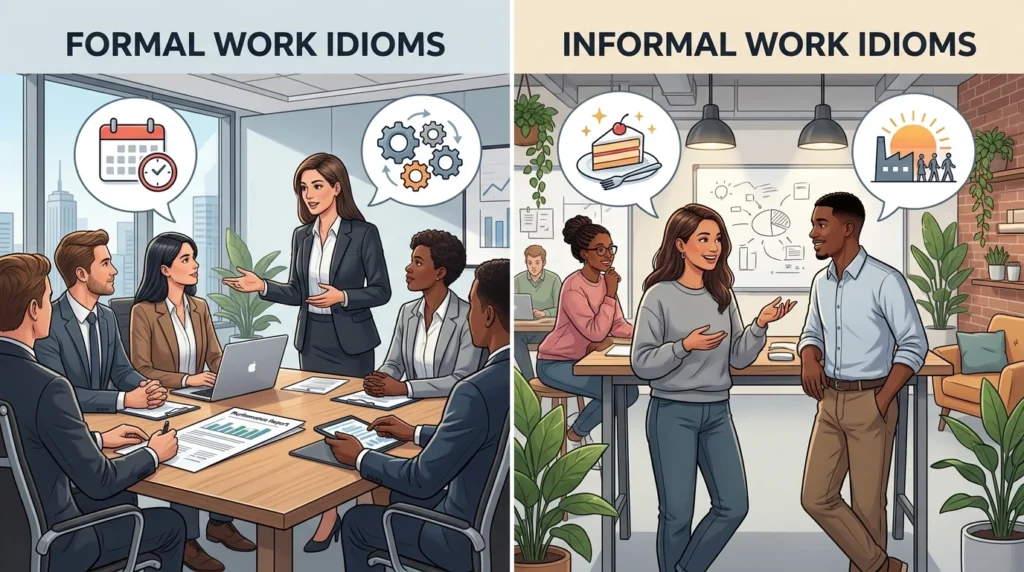
Formal vs. Informal Work Idioms
Not every idiom fits every professional situation. Choosing the right tone is just as important as knowing the meaning.
| Expression | Tone | Best Choice For |
|---|---|---|
| Meet a deadline | Neutral/formal | Emails, reports, meetings |
| On the same page | Neutral | Meetings and teamwork |
| Go the extra mile | Neutral | Praise and performance |
| Get the ball rolling | Informal/neutral | Meetings and projects |
| Think outside the box | Neutral | Brainstorming |
| A piece of cake | Informal | Friendly conversation |
| Get your act together | Informal/direct | Casual advice |
| Call it a day | Informal | End-of-day conversations |
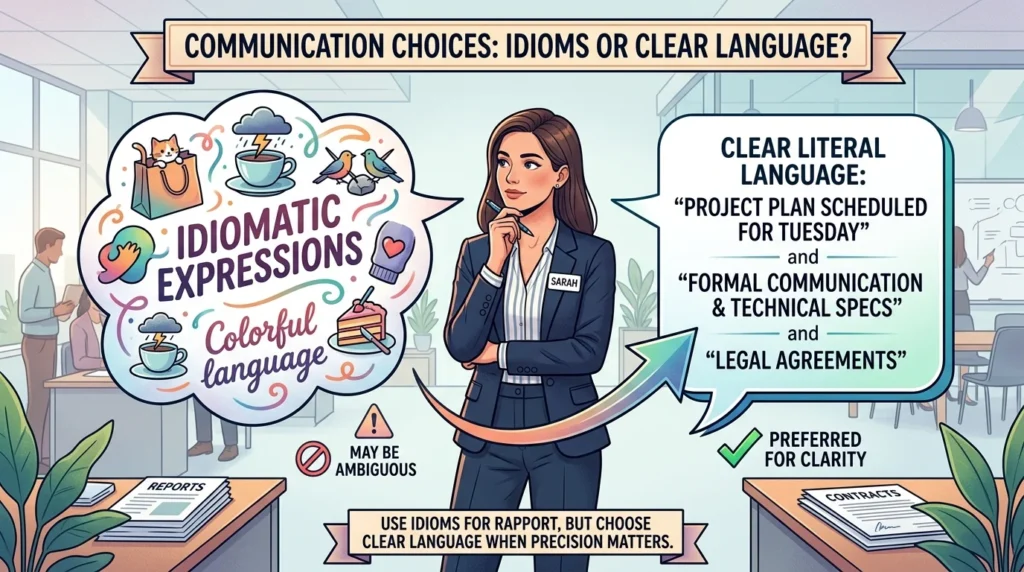
Rule of thumb: In a formal report, contract, or official business communication, clear literal language is often safer. In conversations, meetings, presentations, and friendly emails, familiar idioms can make your English sound more natural.
How to Use Work Idioms Naturally
Memorizing definitions isn’t enough. You need to know when an expression fits the situation.
Before using an idiom, ask:
- Is the situation formal or casual?
- Does the expression have a positive, neutral, or critical tone?
- Does the idiom accurately describe what I mean?
- Would a literal expression be clearer?
- Am I using the fixed wording correctly?
For example, “You need to pull your weight” may sound harsh when criticizing one coworker. But “Let’s make sure everyone is pulling their weight” can sound more natural when discussing team responsibility.
Likewise, saying “We need to think outside the box” makes sense during brainstorming, but it may sound unnecessary if you’re simply asking someone to follow an established procedure.
When Should You Avoid Work Idioms?
Idioms are useful, but they are not appropriate everywhere.
Consider avoiding them when:
- Writing legal or highly technical documents.
- Giving instructions that must be completely unambiguous.
- Communicating with someone who may not understand English idioms.
- The expression could sound overly casual or critical.
- A simple literal sentence communicates the idea more clearly.
Good communication isn’t about using the most idioms possible. It’s about choosing the clearest expression for the situation.
Frequently Asked Questions About Work Idioms
What are some common work idioms?
Common work idioms and expressions include “go the extra mile,” “pull your weight,” “on the same page,” “think outside the box,” “get the ball rolling,” and “hit the ground running.”
What idiom means working hard?
Several work-related expressions describe hard work. “Put in the hours” means spending significant time working, “keep your nose to the grindstone” means staying focused, and “burn the midnight oil” means working late into the night.
What idiom means teamwork?
“Pull your weight” means doing your fair share of the work, while “on the same page” means having the same understanding, goals, or expectations.
What idiom means starting a project?
“Get the ball rolling” means to start a project, process, meeting, or activity. It is a common expression in everyday workplace conversations.
Are work idioms appropriate in professional communication?
Yes, but it depends on the expression and context. Neutral expressions such as “meet a deadline,” “on the same page,” and “go the extra mile” can work well professionally. More casual expressions such as “a piece of cake” and “get your act together” are better suited to informal conversations.
Conclusion
Work idioms help you understand and participate in everyday professional English more naturally. From “pull your weight” and “go the extra mile” to “get the ball rolling” and “hit the ground running,” these expressions describe situations you are likely to encounter at work, school, or during career development.
You don’t need to learn all 20 at once. Start with five, create sentences based on your own experiences, and pay attention to how native speakers use them in real conversations. The goal isn’t to sound overly idiomatic—it’s to know which expression fits, what it really means, and when to use it.

Emily Carter writes for Meaning Match about English idioms, student-friendly expressions, and language learning, using simple explanations and helpful examples.