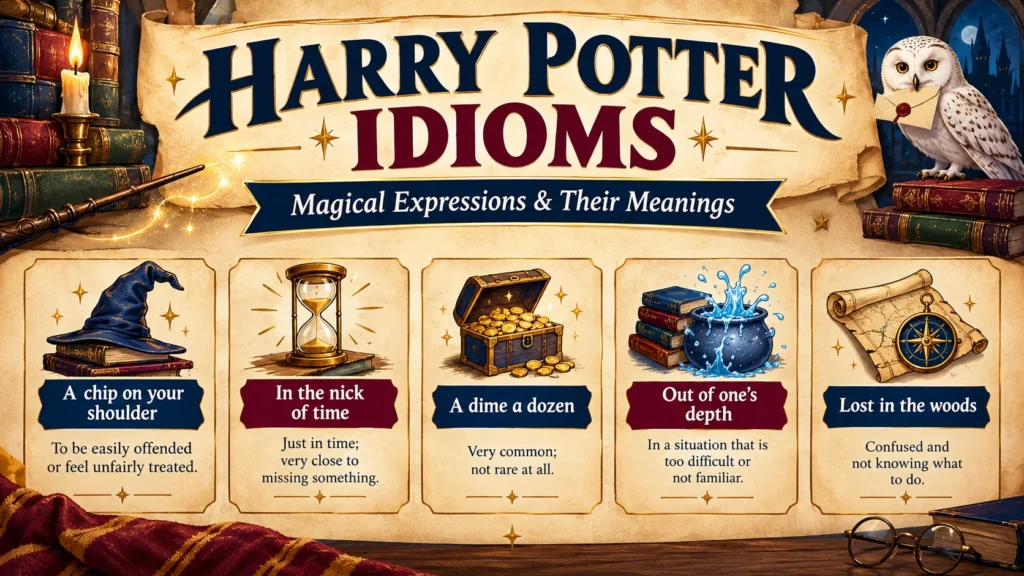
Have you ever come across a Harry Potter idiom or expression and wondered what it means—or whether it is even a real English idiom? You’re not alone. The Harry Potter books and movies contain familiar English idioms alongside figurative expressions, wizarding terms, magical phrases, and memorable sayings. Some can be understood in everyday English, while others make sense mainly within the magical world of Hogwarts.
For example, “break the ice” is a common English idiom meaning to make people feel more comfortable, and it is not unique to Harry Potter. By contrast, expressions and terms connected to spells, Hogwarts, or wizarding culture may have meanings specific to the fictional universe. Knowing this difference is important if you want to understand the language without mistakenly treating every Harry Potter phrase as an idiom.
This guide explores popular Harry Potter idioms and expressions, with simple meanings, examples, context, and notes explaining which are true English idioms and which are unique to the wizarding world.
What Are Harry Potter Idioms, Phrases, and Expressions?
The phrase “Harry Potter idioms” can mean several things, so one distinction is important: not every memorable Harry Potter expression is a traditional English idiom.
The series contains a mixture of:
- Harry Potter-specific phrases and titles, such as “the Chosen One”
- Wizarding-world terminology, such as “Muggle”
- Literary or figurative expressions, such as “the Boy Who Lived”
- Traditional English idioms that can be used when discussing Harry Potter, such as “break the ice” and “in hot water”
An idiom has a meaning that is different from the literal meanings of its individual words. For example, “in hot water” does not usually mean standing in heated water—it means being in trouble.
The list below brings these categories together while clearly explaining what each expression means and how you can use it.
Famous Harry Potter Idioms, Phrases & Expressions
The Chosen One
Type: Harry Potter-specific title
Meaning:
A person believed to have been specially selected for an important purpose or destiny.
In Harry Potter, “the Chosen One” refers to Harry because of the prophecy connecting his future with Voldemort.
Example:
- Everyone expected Maya to become the chosen one who would lead the team.
Common error:
Do not assume it always means someone who simply won a competition.
Usage note:
This phrase suggests destiny, exceptional importance, or a major responsibility.
The Boy Who Lived
Type: Harry Potter-specific title
Meaning:
A famous title given to Harry because he survived Voldemort’s attack as a baby.
Figuratively, it can also describe someone who survives an extremely dangerous or unlikely situation.
Example:
- After surviving the disaster, the journalist called him the boy who lived.
Common error:
It is not a standard English idiom meaning that every surviving boy has this title.
Usage note:
Use it mainly when discussing Harry Potter or when making a deliberate literary reference.
He Who Must Not Be Named
Type: Harry Potter-specific expression
Meaning:
A deliberately indirect way of referring to someone considered frightening, dangerous, or too unpleasant to name directly.
In Harry Potter, the expression refers to Voldemort.
Example:
- The children jokingly called their strict teacher “he who must not be named.”
Common error:
It is not a general synonym for every disliked person.
Usage note:
The expression can be used humorously in everyday situations, but its strongest association is with Harry Potter.
You-Know-Who
Type: Harry Potter-specific euphemistic expression
Meaning:
A name used instead of saying someone’s actual name.
In the wizarding world, “You-Know-Who” is another way characters refer to Voldemort.
Example:
- Nobody wanted to mention You-Know-Who during the frightening discussion.
Common error:
Do not assume the phrase has one universal person attached to it outside its context.
Usage note:
In everyday English, people can use “you-know-who” playfully when the listener already knows who is being discussed.
Mischief Managed
Type: Harry Potter-specific phrase
Meaning:
A playful expression meaning that mischief, trouble, or a prank has come to an end.
In Harry Potter, it is associated with the Marauder’s Map and the end of its magical use.
Example:
- After finishing the prank, the children laughed and said, “Mischief managed.”
Common error:
Do not treat it as a normal formal way to say that a problem has been solved.
Usage note:
It has a playful, humorous, mischievous tone.
Muggle
Type: Wizarding-world term
Meaning:
A person who does not possess magical abilities.
In the Harry Potter universe, “Muggle” is one of the most recognizable terms for a non-magical person.
Example:
- In the story, Harry initially has to learn about the difference between the wizarding world and Muggle life.
Common error:
“Muggle” is not simply another word for a beginner.
Usage note:
Outside Harry Potter discussions, the word is sometimes used informally for someone unfamiliar with a particular technology or activity.
The Golden Trio
Type: Harry Potter-associated expression
Meaning:
A popular name for Harry Potter, Ron Weasley, and Hermione Granger as a group.
The phrase highlights their close friendship and their central role in the story.
Example:
- Fans often discuss how the Golden Trio worked together to overcome difficult challenges.
Common error:
The phrase refers specifically to the famous trio, not every group of three friends.
Usage note:
This is a fandom expression rather than a traditional English idiom.
Once in a Blue Moon
Type: Traditional English idiom
Meaning:
Something that happens very rarely.
Although this expression did not originate as a Harry Potter phrase, it fits naturally into conversations about magical events.
Example:
- I visit the old bookstore once in a blue moon.
Common error:
Do not use it for something that happens every week.
Usage note:
It is a common, informal English idiom.
Break the Ice
Type: Traditional English idiom
Meaning:
To make people feel more comfortable when a situation is awkward or when people have just met.
Harry Potter context:
A new Hogwarts student could use a friendly joke to break the ice with classmates.
Example:
- I told a funny story to break the ice at the meeting.
Common error:
It usually does not refer to literally breaking ice.
Usage note:
Common in social, school, workplace, and casual situations.
In Hot Water
Type: Traditional English idiom
Meaning:
To be in trouble or facing criticism.
Harry Potter context:
A student who breaks an important school rule might find themselves in hot water.
Example:
- He was in hot water after missing the deadline.
Common error:
Do not confuse its figurative meaning with actual hot water.
Usage note:
This is an informal and widely understood expression.
In the Nick of Time
Type: Traditional English idiom
Meaning:
Just before it becomes too late.
Harry Potter context:
Harry and his friends often face situations where help arrives at the last possible moment.
Example:
- We reached the station in the nick of time.
Common error:
The standard form is “in the nick of time,” not “on the nick of time.”
Usage note:
Use it when timing is extremely close.
A Wild-Goose Chase
Type: Traditional English idiom
Meaning:
A search or pursuit that is confusing, fruitless, or unlikely to succeed.
Harry Potter context:
Searching through countless places for a hidden magical object could become a wild-goose chase if there is no reliable clue.
Example:
- Looking for that missing file without knowing where it was kept became a wild-goose chase.
Common error:
It does not simply mean any search.
Usage note:
The expression often suggests wasted effort.
Keep Your Wits About You
Type: Traditional English idiom
Meaning:
To remain calm, alert, and able to think clearly in a difficult situation.
Harry Potter context:
Facing a dangerous magical challenge would require someone to keep their wits about them.
Example:
- You need to keep your wits about you during the interview.
Common error:
“Wits” here refers to mental awareness and good judgment, not jokes.
Usage note:
It is especially useful for situations involving pressure, danger, or confusion.
A Blessing in Disguise
Type: Traditional English idiom
Meaning:
Something that first appears bad but eventually produces a positive result.
Harry Potter context:
A disappointing event might unexpectedly lead a character toward an important discovery.
Example:
- Missing the bus was a blessing in disguise because I met an old friend while waiting for the next one.
Common error:
The phrase requires an initially negative or disappointing situation that later proves beneficial.
Usage note:
Use it when a bad-looking situation has an unexpected positive side.
Bite the Bullet
Type: Traditional English idiom
Meaning:
To face something difficult, painful, or unpleasant with courage.
Harry Potter context:
A frightened student may have to bite the bullet and face a difficult challenge instead of running away.
Example:
- I decided to bite the bullet and finally apologize.
Common error:
It is normally figurative, not a suggestion to literally bite a bullet.
Usage note:
It is informal and often describes accepting something unpleasant.
Go the Extra Mile
Type: Traditional English idiom
Meaning:
To make more effort than people normally expect.
Harry Potter context:
Hermione’s willingness to spend extra time researching a difficult problem is a good example of someone going the extra mile.
Example:
- My teacher went the extra mile to help me understand the lesson.
Common error:
Simply completing your basic responsibility does not necessarily mean going the extra mile.
Usage note:
This is a positive expression associated with effort, dedication, and helpfulness.
Face the Music
Type: Traditional English idiom
Meaning:
To accept the consequences of your actions.
Harry Potter context:
A student who breaks school rules may eventually have to face the music and accept the consequences.
Example:
- After making the mistake, I knew I had to face the music.
Common error:
It does not mean attending a musical performance.
Usage note:
Use it when someone must accept responsibility for what they have done.
A Piece of Cake
Type: Traditional English idiom
Meaning:
Something that is very easy to do.
Harry Potter context:
A simple classroom task could be described as a piece of cake by a confident student.
Example:
- The first part of the test was a piece of cake.
Common error:
In figurative use, it does not mean an actual piece of dessert.
Usage note:
This is casual and works especially well in everyday conversation.
Shakespeare Idioms and Phrases: 35+ Expressions We Still Use Today
Have a Change of Heart
Type: Traditional English idiom
Meaning:
To change your feelings, opinion, or decision.
Harry Potter context:
A character who initially refuses to help but later decides to do the right thing could be said to have a change of heart.
Example:
- She had a change of heart and decided to help her friend.
Common error:
It does not describe a physical change to the heart.
Usage note:
Use it when someone’s attitude or decision changes.
The Last Straw
Type: Traditional English idiom
Meaning:
The final problem that makes someone unable or unwilling to tolerate a situation any longer.
Harry Potter context:
If a student has already faced several punishments and then breaks another major rule, the latest incident might be the last straw.
Example:
- Being late again was the last straw for my manager.
Common error:
It normally comes after a series of problems rather than being the first problem.
Usage note:
Use it when frustration has reached its breaking point.
Harry Potter Phrases vs. Traditional English Idioms
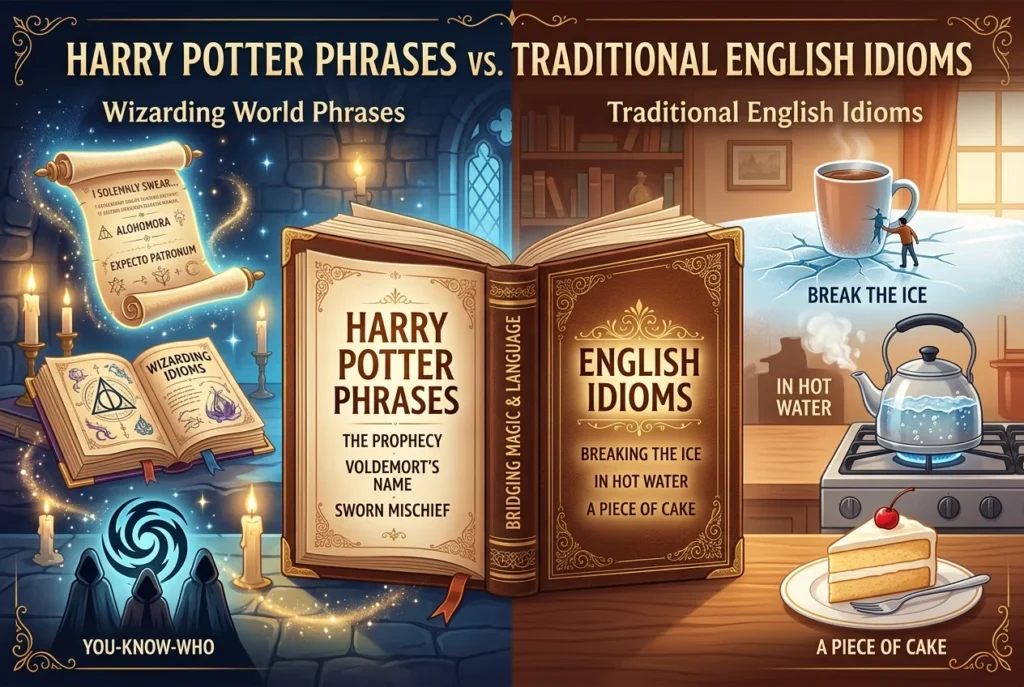
This distinction makes the list much easier to understand.
| Category | Examples | What They Are |
|---|---|---|
| Harry Potter-specific | The Chosen One, The Boy Who Lived | Titles or story-specific expressions |
| Wizarding terminology | Muggle | Fictional-world vocabulary |
| Fandom expressions | Golden Trio | Names used by fans to describe characters |
| Traditional idioms | Break the Ice, In Hot Water | Established English expressions |
So, “Harry Potter idioms” is a useful search term, but it should not be interpreted as meaning that all 20 expressions were created by Harry Potter.
Some belong specifically to the wizarding world, while others are ordinary English idioms that can be understood and practiced through Harry Potter-themed examples.
Why Are Harry Potter Expressions Useful for Learning English?
Harry Potter can be a surprisingly useful way to learn figurative English because stories provide context.
Consider:
“He was in hot water.”
A literal translation can make the sentence confusing. But if the surrounding scene shows a student facing punishment, the meaning becomes obvious: he was in trouble.
Learning expressions in context helps you:
- Understand figurative language
- Improve vocabulary
- Read English fiction more confidently
- Recognize informal expressions
- Understand character dialogue
- Remember phrases more easily
The key is not to memorize every phrase mechanically. Instead, connect each expression with a situation, emotion, or image.
How to Learn Harry Potter Idioms Naturally
Try this simple five-step method:

1. Learn the real meaning
Do not memorize only the individual words. Learn what the complete expression communicates.
2. Connect it to a scene
Imagine a character or situation that demonstrates the meaning.
3. Create your own example
For instance:
“I had to bite the bullet and tell my parents about the mistake.”
4. Notice the tone
Some expressions are casual, humorous, dramatic, or literary. Knowing the tone helps you use them correctly.
5. Practice instead of cramming
Choose five expressions and use each one in your own sentences. Once they become familiar, move on to another five.
Theater Idioms: 25+ Stage Expressions & What They Mean
Frequently Asked Questions
What are the most famous Harry Potter idioms?
Some well-known Harry Potter-associated expressions include “the Chosen One,” “the Boy Who Lived,” “You-Know-Who,” “He Who Must Not Be Named,” and “Mischief Managed.” The series can also be used to explain traditional English idioms such as “break the ice” and “in hot water.”
Are Harry Potter phrases the same as English idioms?
No. Harry Potter contains fictional terms, titles, memorable phrases, and traditional English idioms. For example, “the Chosen One” is a story-specific title, while “break the ice” is a traditional English idiom.
Did Harry Potter invent these idioms?
No. Most traditional English idioms existed independently of Harry Potter. The series created or popularized many memorable fictional expressions and terms, but that does not make every phrase an English idiom.
What does “the Chosen One” mean in Harry Potter?
“The Chosen One” refers to Harry Potter because a prophecy identifies a child whose future is connected to Voldemort. More generally, the phrase describes someone believed to have a special destiny or important purpose.
Can I use Harry Potter expressions in everyday English?
Some can. Traditional idioms such as “a piece of cake,” “go the extra mile,” “face the music,” and “in hot water” are commonly useful in everyday English. Harry Potter-specific terms are better reserved for discussions, jokes, or references connected with the series.
Keep the magic going after this guide: explore idioms in books for more literary expressions, Hollywood idioms for big-screen phrases, and funny idioms for friends when you want a good laugh. Teachers can bring these expressions into class with our guide to teaching English idioms.
Conclusion
Harry Potter idioms, phrases, and expressions are most useful when you understand the difference between fictional wizarding language and genuine English idioms. Some expressions belong directly to Harry’s world, while others are established phrases that become easier to learn when connected to familiar characters and situations.
Instead of trying to memorize all at once, choose a few, understand their context, and create your own sentences. Once you learn to look beyond the literal words, figurative English becomes easier to recognize—and a lot more fun to use.

Clara Bennett writes for Meaning Match about English idioms, everyday expressions, meanings, and practical language usage, making phrases easy to understand.