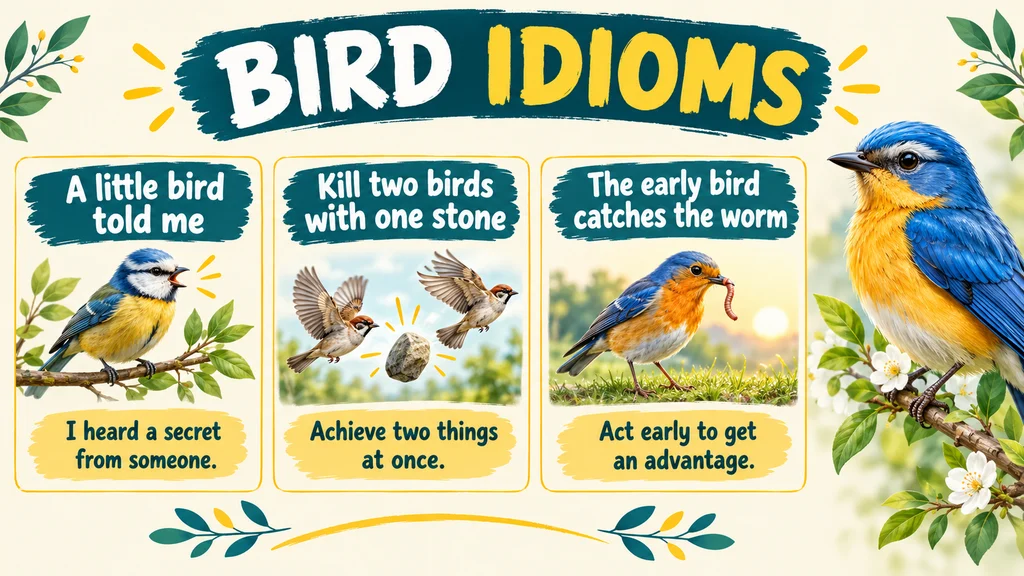
Bird idioms can turn ordinary English into expressions full of meaning—but what do these phrases actually mean? A bird idiom is an expression involving birds that communicates an idea beyond its literal words. For example, “the early bird catches the worm” means that acting early can give you an advantage, while “a little bird told me” means you learned something from someone whose identity you aren’t revealing.
Another familiar expression, “birds of a feather flock together,” describes people with similar interests or qualities who tend to spend time together. These bird idioms and sayings appear in everyday conversations, books, and creative writing, so understanding them can help you recognize figurative language and express yourself more naturally.
Whether you’re learning English or looking for expressions to improve your writing, exploring their meanings, usage, and real-life examples will help you choose the right phrase for the right situation.
Common Bird Idioms and Sayings
Kill Two Birds with One Stone
Type: Idiom
Word-by-word meaning: “Kill” means to end life, “two birds” refers to two separate targets, and “one stone” means a single action or object.
Idiomatic meaning: To accomplish two things with one action.
Example sentences:
- I listened to an educational podcast while exercising, killing two birds with one stone.
- We can visit Grandma and pick up the groceries on the same trip.
Common error: Saying “kill two birds with one rock” instead of the established expression “kill two birds with one stone.”
Usage note: Use this expression when one action serves two purposes. A less violent alternative is “get two things done at once.”
A Little Bird Told Me
Type: Idiom
Word-by-word meaning: “A little bird” refers to an imaginary messenger, and “told me” means shared information with me.
Idiomatic meaning: You learned a secret or piece of information but do not want to reveal your source.
Example sentences:
- “How did you know it was my birthday?” “A little bird told me!”
- A little bird told me that you’re planning a surprise for your sister.
Common error: Taking the expression literally or assuming that it always refers to gossip.
Usage note: This expression is often playful and friendly, but it can also be used when someone wants to keep an informant anonymous.
Birds of a Feather Flock Together
Type: Proverb
Word-by-word meaning: “Birds of a feather” refers to birds with similar feathers, while “flock together” means gather as a group.
Figurative meaning: People with similar interests, personalities, or habits tend to spend time together.
Example sentences:
- Both friends love adventure, so they quickly became close. Birds of a feather flock together.
- Most members of the club share a passion for photography.
Common error: Saying “birds with feathers flock together.” The established proverb is “birds of a feather flock together.”
Usage note: This saying can describe positive similarities or suggest that people share questionable habits. Context determines the tone.
The Early Bird Catches the Worm
Type: Proverb
Word-by-word meaning: An early bird reaches a worm before other birds do.
Figurative meaning: People who act early or prepare in advance often gain an advantage.
Example sentences:
- We arrived before the store opened to get the best deals. The early bird catches the worm!
- She applied for the scholarship early because the early bird catches the worm.
Common error: Treating this as a guarantee that the earliest person will always succeed.
Usage note: Use it to encourage prompt action, preparation, and taking advantage of opportunities.
A Bird’s-Eye View
Type: Idiomatic expression
Word-by-word meaning: “Bird’s-eye” describes the viewpoint of a bird looking down, and “view” means what can be seen.
Figurative meaning: A broad overview of a place, situation, or subject.
Example sentences:
- The rooftop gave us a bird’s-eye view of the city.
- Before discussing the details, the manager gave us a bird’s-eye view of the project.
Common error: Using it only for literal aerial views. It also describes a general overview of an idea or situation.
Usage note: This expression works well in travel writing, presentations, reports, and everyday conversation.
Free as a Bird
Type: Simile and figurative expression
Word-by-word meaning: “Free” means unrestricted, while “as a bird” compares a person’s freedom with a bird’s ability to fly.
Figurative meaning: Completely free from responsibilities, restrictions, or worries.
Example sentences:
- After finishing her final exams, Maya felt free as a bird.
- Once the contract ended, he was free as a bird to explore new opportunities.
Common error: Assuming it always means legal freedom. It often describes an emotional feeling of freedom.
Usage note: This expression is usually positive and informal, especially when describing relief or independence.
For the Birds
Type: Idiom
Word-by-word meaning: Literally, something is intended for birds.
Idiomatic meaning: Something is useless, foolish, unimportant, or not worth taking seriously.
Example sentences:
- I think these outdated rules are for the birds.
- “This broken printer is for the birds,” Sam complained.
Common error: Using the expression to praise something as attractive or enjoyable.
Usage note: It is informal and often expresses annoyance or dismissiveness. Avoid it in formal writing unless you are deliberately using a conversational tone.
Spread Your Wings
Type: Idiom
Word-by-word meaning: “Spread” means open outward, and “wings” are the body parts birds use to fly.
Figurative meaning: To become more independent, explore opportunities, or develop new abilities.
Example sentences:
- Moving to another city helped Aisha spread her wings.
- The internship gave him a chance to spread his wings professionally.
Common error: Assuming it refers only to travel or moving away from home.
Usage note: Use it for personal growth, career development, education, and gaining independence.
A Bird in the Hand Is Worth Two in the Bush
Type: Proverb
Word-by-word meaning: One bird already in your hand is compared with two birds still out of reach in the bush.
Figurative meaning: A certain benefit is often more valuable than a larger but uncertain opportunity.
Example sentences:
- I accepted the confirmed job offer rather than risk losing it for a possible promotion elsewhere.
- Keep your current reliable client while exploring new leads; a bird in the hand is worth two in the bush.
Common error: Using the proverb to suggest that every risk is foolish.
Usage note: It emphasizes the value of certainty, but the best decision still depends on the potential reward and risk.
Like a Sitting Duck
Type: Idiomatic simile
Word-by-word meaning: A “sitting duck” is a duck resting in one place, appearing easy to approach.
Figurative meaning: Someone or something that is vulnerable, exposed, or an easy target.
Example sentences:
- Without proper security, the business was like a sitting duck for cyberattacks.
- Standing alone in the open made the team an easy target.
Common error: Using “sitting duck” for anyone who is merely sitting down.
Usage note: This expression often suggests danger or unfair vulnerability. It is common in discussions of security, competition, and conflict.
Bull Idioms: What These Phrases Really Mean
Water Off a Duck’s Back
Type: Idiom
Word-by-word meaning: Water rolls off a duck’s feathers instead of soaking in.
Idiomatic meaning: Criticism, insults, or other unpleasant comments have little or no effect on someone.
Example sentences:
- The coach’s criticism was like water off a duck’s back; Leo kept practicing.
- She refuses to let online insults upset her, treating them like water off a duck’s back.
Common error: Saying “water over a duck’s back” when you intend to use the established idiom.
Usage note: It usually describes resilience or indifference to criticism. It does not necessarily mean the criticism was harmless or unimportant.
Wild Goose Chase
Type: Idiom
Word-by-word meaning: A “wild goose” is a goose that is difficult to catch; a “chase” is an attempt to pursue something.
Idiomatic meaning: A pointless, confusing, or unsuccessful search that wastes time and effort.
Example sentences:
- Searching for the missing document without checking the correct folder sent us on a wild goose chase.
- The false address led the delivery driver on a wild goose chase.
Common error: Using it for every search, even when the search is productive.
Usage note: Use it when the effort is fruitless or based on misleading information.
The Ugly Duckling
Type: Literary allusion and figurative expression
Word-by-word meaning: The phrase refers to the young bird in Hans Christian Andersen’s famous fairy tale who is rejected for looking different before becoming a beautiful swan.
Figurative meaning: A person or thing initially overlooked or judged negatively that later becomes admired or successful.
Example sentences:
- The quiet student who was once overlooked became the school’s most confident speaker—the ugly duckling who blossomed.
- The neglected building was once considered the ugly duckling of the neighborhood, but its renovation made it a local landmark.
Common error: Assuming the expression always refers to physical appearance or that someone must literally transform.
Usage note: It often conveys a story of growth, hidden potential, or a surprising change in how others perceive someone or something.
Feather Your Nest
Type: Idiom
Word-by-word meaning: Birds collect feathers to make their nests comfortable.
Idiomatic meaning: To improve your own financial position or personal circumstances, often at the expense of others or through questionable means.
Example sentences:
- The official was accused of using public funds to feather his own nest.
- The investigation revealed that the executive had feathered his nest through secret payments.
Common error: Using it as a completely neutral synonym for saving money or planning responsibly.
Usage note: The phrase frequently carries a negative implication of selfish gain or corruption, although context can affect its force.
Watch Someone Like a Hawk
Type: Idiomatic simile
Word-by-word meaning: A hawk is a bird known for its keen eyesight and ability to spot movement.
Figurative meaning: To watch someone or something very carefully.
Example sentences:
- The teacher watched the students like a hawk during the science experiment.
- Because the equipment was expensive, the supervisor watched it like a hawk.
Common error: Assuming the expression always means spying on someone secretly.
Usage note: It can suggest careful supervision, suspicion, or vigilance. The surrounding context determines which meaning is intended.
Chicken Out
Type: Idiom
Word-by-word meaning: “Chicken” is used figuratively to suggest fear, and “out” indicates withdrawing from an action.
Idiomatic meaning: To decide not to do something because you are afraid or nervous.
Example sentences:
- He wanted to ride the roller coaster but chickened out at the last moment.
- I nearly chickened out before my first public speech.
Common error: Saying “chicken off” instead of the standard phrasal expression “chicken out.”
Usage note: This is informal. It can sound teasing or critical, so use it carefully when discussing someone else’s fears.
Chicken Feed
Type: Idiom
Word-by-word meaning: Literally, it means food given to chickens.
Idiomatic meaning: A very small amount of money or an amount considered insignificant.
Example sentences:
- For a company of that size, the fine was chicken feed.
- He refused the offer because the salary was chicken feed compared with the work required.
Common error: Using it to describe a large sum of money.
Usage note: It is informal and relative: an amount that seems like chicken feed to one person may be significant to another.
Fly the Coop
Type: Idiom
Word-by-word meaning: “Fly” means to travel through the air, and a “coop” is an enclosure for poultry.
Idiomatic meaning: To leave a place or home, often to become independent or escape a restrictive situation.
Example sentences:
- After graduating from college, Nina was ready to fly the coop and live on her own.
- The teenagers planned to fly the coop as soon as they could afford their own apartment.
Common error: Assuming the expression always refers to escaping from prison or fleeing danger.
Usage note: It is informal and often refers to young adults leaving their family home, although it can describe other departures.
Get Your Ducks in a Row
Type: Idiom
Word-by-word meaning: It imagines arranging ducks neatly in a row.
Idiomatic meaning: To organize everything and prepare carefully before taking action.
Example sentences:
- Let’s get our ducks in a row before launching the new website.
- She got her ducks in a row by preparing the documents, budget, and schedule before the meeting.
Common error: Using it to mean merely tidying a room. The expression usually involves organizing plans, details, or responsibilities.
Usage note: It is common in workplace conversations and planning. It can be used in both casual and professional settings.
Take Someone Under Your Wing
Type: Idiom
Word-by-word meaning: It imagines a bird sheltering or protecting another bird beneath its wing.
Idiomatic meaning: To guide, protect, support, or mentor someone who needs help or experience.
Example sentences:
- The experienced designer took the new employee under her wing.
- My older cousin took me under his wing and helped me adjust to university life.
Common error: Using “under your wings” when referring to the established expression “under your wing.”
Usage note: This phrase is usually positive and suggests personal support, guidance, and encouragement.
Quick Comparison: Bird Idioms and Sayings
| Expression | Simple meaning | Type |
|---|---|---|
| Kill two birds with one stone | Achieve two goals with one action | Idiom |
| A little bird told me | Keep the source of information secret | Idiom |
| Birds of a feather flock together | Similar people associate with each other | Proverb |
| The early bird catches the worm | Acting early can bring an advantage | Proverb |
| A bird’s-eye view | A broad overview | Figurative expression |
| Free as a bird | Completely free | Simile |
| For the birds | Useless or foolish | Idiom |
| Spread your wings | Become independent | Idiom |
| A bird in the hand is worth two in the bush | Value certainty over uncertain gains | Proverb |
| Like a sitting duck | Vulnerable or an easy target | Idiomatic simile |
| Water off a duck’s back | Criticism has little effect | Idiom |
| Wild goose chase | A pointless search | Idiom |
| The ugly duckling | Someone or something that later blossoms | Literary allusion |
| Feather your nest | Benefit yourself, often selfishly | Idiom |
| Watch someone like a hawk | Observe very carefully | Idiomatic simile |
| Chicken out | Withdraw because of fear | Idiom |
| Chicken feed | An insignificant amount of money | Idiom |
| Fly the coop | Leave home or a restrictive place | Idiom |
| Get your ducks in a row | Organize and prepare | Idiom |
| Take someone under your wing | Mentor or protect someone | Idiom |
How to Use Bird Idioms Naturally in English
Bird expressions sound most natural when they match the situation and tone.
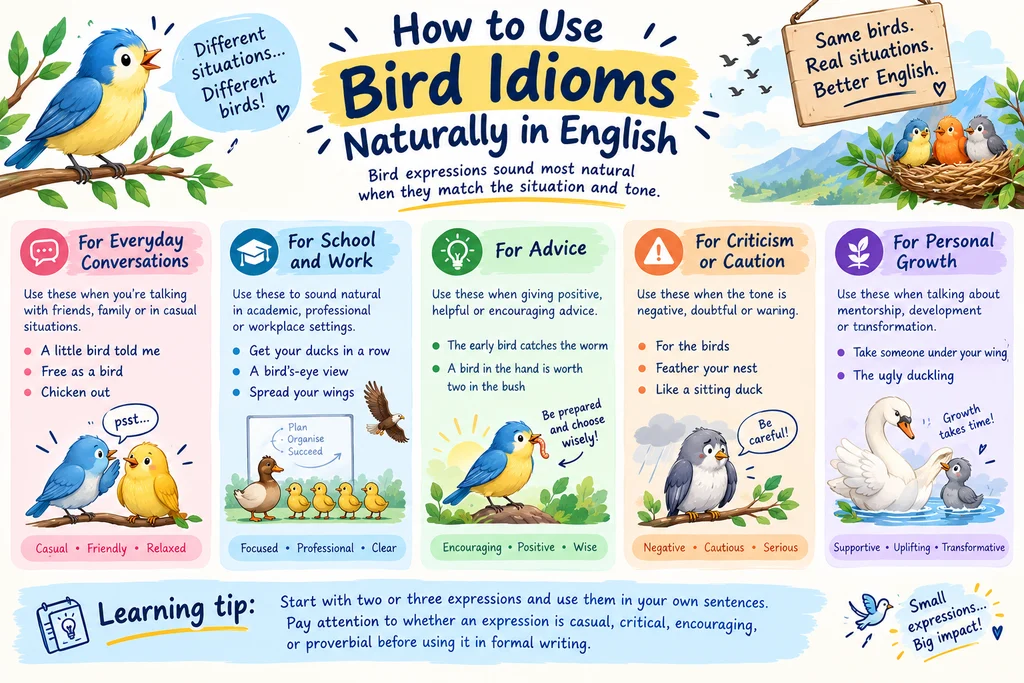
- For everyday conversations: Use “a little bird told me,” “free as a bird,” or “chicken out.”
- For school and work: Use “get your ducks in a row,” “a bird’s-eye view,” or “spread your wings.”
- For advice: Use “the early bird catches the worm” when encouraging preparation, or “a bird in the hand is worth two in the bush” when discussing a reliable opportunity.
- For criticism or caution: Use “for the birds,” “feather your nest,” or “like a sitting duck” when the context supports their negative tone.
- For personal growth: Use “take someone under your wing” for mentorship and “the ugly duckling” for a transformation in how someone or something is perceived.
Learning tip: Start with two or three expressions and use them in your own sentences. Pay attention to whether an expression is casual, critical, encouraging, or proverbial before using it in formal writing.
Bee Idioms: Meanings, Origins, and Real-Life Examples
Frequently Asked Questions
What are the most common bird idioms?
Common bird idioms include “kill two birds with one stone,” “a little bird told me,” “free as a bird,” “for the birds,” “spread your wings,” and “get your ducks in a row.” These expressions describe everyday situations involving efficiency, freedom, independence, and preparation.
What is a bird idiom for working hard or acting early?
“The early bird catches the worm” is a proverb that encourages people to act early to improve their chances of success. It is useful when discussing preparation, deadlines, opportunities, and getting an early start.
What does “birds of a feather flock together” mean?
It means people with similar interests, attitudes, or behaviors often spend time together. Depending on the context, it can describe a positive friendship or suggest that people share the same questionable habits.
Are bird idioms and bird sayings the same thing?
Not exactly. An idiom has a meaning that differs from its literal wording, such as “water off a duck’s back.” A proverb expresses a general lesson or piece of advice, such as “a bird in the hand is worth two in the bush.” Everyday lists often include both, along with related figurative expressions.
How can I learn bird idioms easily?
Learn each expression through its meaning, an example sentence, and the situation in which it is appropriate. Practice using a few expressions in conversation or writing, and review the examples until their meanings feel natural.
Conclusion
Bird idioms and sayings add color to everyday English and help you express ideas more naturally. Whether you’re describing a fresh start with “spread your wings,” explaining a pointless search as a “wild goose chase,” or encouraging someone to prepare with “get your ducks in a row,” each expression has a distinct purpose.
Learn the meaning, notice the tone, and practice each phrase in context. With regular use, these expressions can help make your English clearer, more engaging, and more confident.

Sophie Collins writes for Meaning Match about English idioms, American and British expressions, meanings, usage, and everyday language differences.