
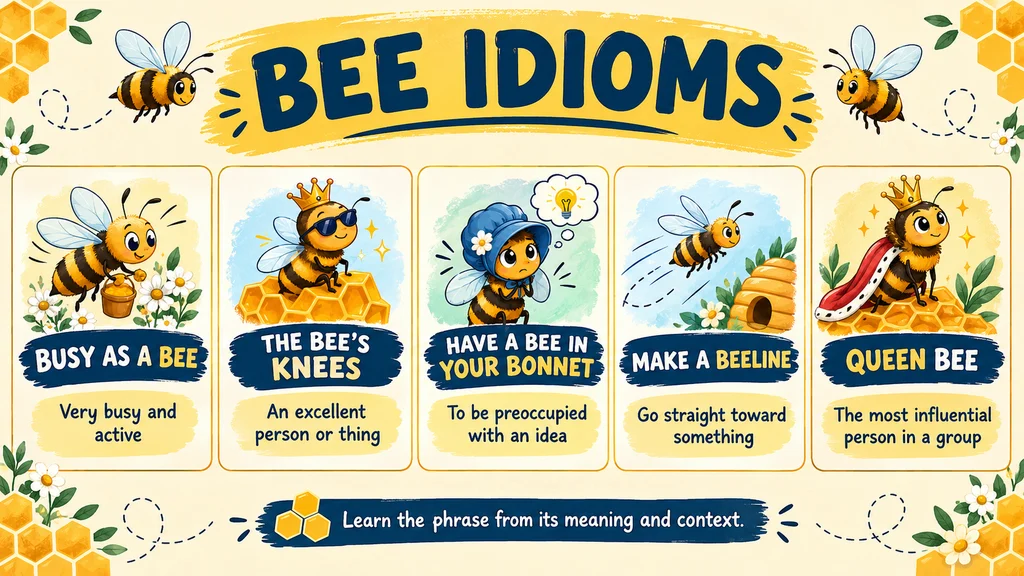
What does it mean when someone calls you “the bee’s knees” or says they’ll “make a beeline” for the door? These expressions aren’t about bees alone—they use familiar images to communicate ideas in a memorable way.
Bee idioms are figurative expressions associated with bees, beehives, or honey that convey meanings beyond their literal words. For example, busy as a bee describes someone who is very busy, the bee’s knees means something excellent, and make a beeline for means to head directly toward a person or place.
Whether you’re learning English, improving your writing, teaching vocabulary, or looking for expressive phrases for everyday conversation, understanding bee idioms can help you communicate more naturally. Different expressions describe hard work, excellence, direct movement, or a place filled with activity.
However, not every phrase involving bees or honey is a recognized idiom, so knowing which expressions are commonly used matters. In this guide, you’ll explore 30+ bee idioms and related expressions, with clear meanings and practical example sentences to help you understand how and when to use them correctly.
Common Bee Idioms and Expressions
These are among the most recognizable expressions associated with bees. Some are established idioms, while others are familiar expressions or figurative metaphors.
As Busy as a Bee
Meaning: Extremely busy and active, especially when working on several tasks.
Example sentences:
- My mother has been as busy as a bee preparing for the family reunion.
- The students were as busy as bees finishing their science projects.
Usage note: This is a common simile that compares someone’s activity to a busy bee. It usually sounds positive or affectionate, although it can also describe someone who has too much to do.
Common mistake: The standard expression is “as busy as a bee,” not “as busy like a bee.”
Busy Bee
Meaning: A person who is always active, productive, or occupied with tasks.
Example sentences:
- Sarah is a busy bee who always finds something useful to do.
- Our little busy bee helped decorate the classroom before the event.
Usage note: “Busy bee” is a familiar expression rather than a complete idiom in the same grammatical form as “as busy as a bee.” It is often friendly and complimentary, but context matters.
Common mistake: Do not assume that a busy bee is always happy or never tired. The phrase describes activity, not someone’s emotional state.
Make a Beeline for Something
Meaning: To go directly toward a person, place, or thing without stopping or getting distracted.
Example sentences:
- As soon as the doors opened, the children made a beeline for the toy section.
- I made a beeline for the coffee machine after a long meeting.
Usage note: This is a well-established idiom suitable for casual conversations and many everyday written contexts. It can describe a literal movement or a figurative rush toward something desirable.
Common mistake: The usual construction is “make a beeline for,” not “make a bee line to” when using the established idiom.
The Bee’s Knees
Meaning: Someone or something considered excellent, impressive, or especially desirable.
Example sentences:
- My grandfather thinks his new vintage car is the bee’s knees.
- Everyone says the bakery’s chocolate cake is the bee’s knees.
Usage note: This informal expression is often playful or old-fashioned in tone. It can express genuine admiration or gentle humor, depending on the speaker.
Common mistake: It does not refer to the actual knees of a bee. It is figurative language meaning something is excellent.
Have a Bee in Your Bonnet
Meaning: To be preoccupied with an idea, concern, or subject, often in a way that makes you unusually persistent or agitated about it.
Example sentences:
- He has a bee in his bonnet about keeping the neighborhood streets clean.
- My aunt has a bee in her bonnet about everyone arriving exactly on time.
Usage note: This idiom is especially associated with British English and may sound old-fashioned or humorous. It can suggest that someone is fixated on a particular issue.
Common mistake: The expression is “have a bee in your bonnet.” It does not simply mean being busy or having a good idea.
Other Bee-Related Expressions
The following expressions are connected with bees, beehives, or bee behavior. Some are established figurative expressions, while others are descriptive terms rather than traditional idioms.
A Hive of Activity
Meaning: A place where many people are working or moving around energetically.
Example sentences:
- The school kitchen was a hive of activity before the annual fair.
- The market became a hive of activity early on Saturday morning.
Usage note: This metaphor emphasizes the activity of a group or place, rather than one individual’s workload.
The Queen Bee
Meaning: The dominant, influential, or most prominent woman in a particular group.
Example sentences:
- Everyone looked to Maya as the queen bee of the school dance committee.
- In the office drama, she was portrayed as the queen bee who controlled the social circle.
Usage note: The phrase can be complimentary, neutral, or critical. It may suggest leadership and influence, but it can also imply controlling behavior or social dominance.
Common mistake: A queen bee in a human group is figurative; it does not mean that the person has an official leadership position.
Worker Bee
Meaning: A person who does a great deal of practical work, often as part of a team.
Example sentences:
- James is the team’s worker bee, making sure the daily tasks get completed.
- The event’s worker bees arrived early to arrange the tables and chairs.
Usage note: This expression can praise someone as dependable and hardworking. In some contexts, it can also imply that the person’s contribution is behind the scenes.
None of Your Beeswax
Meaning: A playful way of saying that something is none of another person’s business.
Example sentences:
- “Where are you going?” “None of your beeswax!”
- I asked my brother about his surprise, but he laughed and said, “None of your beeswax.”
Usage note: This is an informal, humorous expression often used with children, friends, or family. It is not suitable for formal or serious conversations.
Common mistake: The conventional expression is “none of your business.” “None of your beeswax” is a playful variation, not a formal substitute.
Put a Bee in Someone’s Bonnet
Meaning: To give someone an idea or concern that they become focused on, sometimes persistently.
Example sentences:
- The documentary put a bee in his bonnet about reducing household waste.
- Her friend’s suggestion put a bee in her bonnet about starting a small business.
Usage note: This related expression is commonly used in the form “put a bee in someone’s bonnet.” It focuses on introducing an idea, while “have a bee in your bonnet” describes being preoccupied with one.
Shark Idioms: Meanings, Origins, and Examples
Related Honey Expressions
Honey is closely associated with bees, but expressions containing “honey” are not automatically bee idioms. These phrases are included because they are useful related expressions in English.
Sweet as Honey
Meaning: Extremely sweet in taste or, figuratively, very kind, charming, or pleasant.
Example sentences:
- The ripe peaches were sweet as honey.
- Her grandmother was sweet as honey to every child who visited.
Usage note: This is a descriptive comparison, not necessarily a fixed idiom. The meaning depends on whether the speaker is describing taste or personality.
Honey-Tongued
Meaning: Speaking in a smooth, flattering, or persuasive way.
Example sentences:
- The honey-tongued salesman made the offer sound irresistible.
- Be careful of a honey-tongued promise that comes without evidence.
Usage note: The term can be complimentary when someone speaks charmingly, but it often carries a negative suggestion of manipulation or insincerity.
Honeyed Words
Meaning: Words that sound sweet, flattering, or pleasing, sometimes with an insincere purpose.
Example sentences:
- She was not convinced by his honeyed words and asked for proof.
- The politician’s honeyed words failed to reassure the skeptical audience.
Usage note: “Honeyed” describes the pleasant sound or tone of speech. It can suggest that the speaker is trying to influence someone through flattery.
The Birds and the Bees
Meaning: An informal expression for basic explanations of reproduction and human sexuality, often given to children.
Example sentences:
- His parents decided it was time to talk to him about the birds and the bees.
- The teacher answered the student’s questions about the birds and the bees in an age-appropriate way.
Usage note: This expression is not specifically a bee idiom; it is a familiar phrase involving both birds and bees. It is usually used as a gentle or indirect reference to the topic.
Honey Trap
Meaning: A scheme in which someone uses romantic or sexual attraction to deceive, manipulate, or obtain information from another person.
Example sentences:
- The spy suspected that the invitation was part of a honey trap.
- The investigation revealed that the businessman had been targeted by a honey-trap scheme.
Usage note: This expression often appears in discussions of espionage, scams, blackmail, or manipulation. It does not simply mean flirting or trying to impress someone.
Honey-Do List
Meaning: An informal list of household jobs or errands, often given by one partner to another.
Example sentences:
- My Saturday honey-do list includes fixing the shelf and mowing the lawn.
- He finished his honey-do list before meeting his friends.
Usage note: This is a humorous, informal North American expression. It is often used in domestic contexts and may sound stereotypical depending on how it is used.
A Honey of a Deal
Meaning: A very good or attractive deal.
Example sentences:
- We found a honey of a deal on a secondhand bicycle.
- The store offered a honey of a deal on its clearance items.
Usage note: This is an informal expression, particularly associated with American English, and is less common than “a great deal” or “a fantastic bargain.” Use it when a conversational, playful tone fits.
A Honeypot
Meaning: A person, place, or thing that attracts people because it offers something appealing; in cybersecurity, a decoy system designed to attract and detect attackers.
Example sentences:
- The tourist town became a honeypot for visitors during the summer.
- The security team installed a honeypot to observe suspicious network activity.
Usage note: The meaning depends on context. In everyday use, it can describe an attractive destination or opportunity. In cybersecurity, it has a specific technical meaning.
Common mistake: Do not confuse the cybersecurity meaning with an ordinary attractive place. In technical writing, explain the security context clearly.
Land of Milk and Honey
Meaning: A place imagined as rich, fertile, prosperous, or full of opportunities.
Example sentences:
- The newcomers hoped the new country would be a land of milk and honey.
- He soon realized that the city was not the land of milk and honey he had imagined.
Usage note: The expression has biblical associations and is often used figuratively to describe a place of abundance. It can be used sincerely or ironically.
A Honeyed Smile
Meaning: A sweet, charming, or flattering smile that may sometimes hide a person’s true intentions.
Example sentences:
- He greeted the visitors with a honeyed smile.
- Her honeyed smile made the criticism that followed even more surprising.
Usage note: This is a descriptive phrase rather than a widely established idiom. It can create a literary tone and may suggest charm, artificial sweetness, or hidden motives.
How to Use Bee Idioms Naturally
Bee-related language can make everyday English more vivid, but the best expression depends on the situation.
- For someone who works hard: Use “as busy as a bee” or “busy bee.”
Example: “I’ve been as busy as a bee preparing for the exam.” - For heading straight somewhere: Use “make a beeline for.”
Example: “We made a beeline for the exit when the show ended.” - For something excellent: Use “the bee’s knees” in an informal conversation.
Example: “That new restaurant is the bee’s knees.” - For someone fixated on an issue: Use “have a bee in your bonnet.”
Example: “She’s got a bee in her bonnet about recycling.” - For a lively place: Use “a hive of activity.”
Example: “The library was a hive of activity during exam week.”
Avoid These Common Usage Mistakes
- Do not treat every bee-related phrase as an idiom. “Worker bee” is a figurative label, “sweet as honey” is a comparison, and “a honeyed smile” is a descriptive phrase.
- Choose the right tone. “None of your beeswax” is playful and informal, while “the birds and the bees” is a euphemism for a sensitive topic.
- Use the correct phrase structure. Say “make a beeline for the door” and “have a bee in your bonnet.”
- Consider the implied meaning. “Honeyed words” may suggest insincerity, and “queen bee” can imply social dominance rather than admirable leadership.
- Avoid forcing bee expressions into formal writing. In a business report, “highly productive” may be clearer than “busy as a bee.”
Dog and Animal Idioms: Meanings and Real-Life Examples
Frequently Asked Questions
What are the most common bee idioms?
Some of the best-known expressions are “as busy as a bee,” “make a beeline for,” “the bee’s knees,” and “have a bee in your bonnet.” “A hive of activity” is also a familiar bee-related metaphor.
What does “as busy as a bee” mean?
It means being very busy and active. For example, “I’ve been as busy as a bee getting ready for my exams.”
What is the difference between “have a bee in your bonnet” and “put a bee in someone’s bonnet”?
“Have a bee in your bonnet” means to be preoccupied with an idea or concern. “Put a bee in someone’s bonnet” means to introduce an idea or concern that the person then focuses on.
Are bee idioms appropriate for formal writing?
Some can be used in general writing, but many are informal or conversational. “Make a beeline for” and “a hive of activity” may work in accessible articles, while “none of your beeswax” is usually too playful for formal communication.
Are “honey” expressions the same as bee idioms?
No. Honey expressions are related to bees, but they form a broader group. For example, “honey trap” describes a deceptive scheme, while “honeyed words” refers to flattering or persuasive speech. They should not all be classified as traditional bee idioms.
Conclusion
Bee idioms and related expressions add color to English by describing hard work, direct movement, excellence, persistent ideas, and lively environments. Start with common phrases such as “as busy as a bee,” “make a beeline for,” and “the bee’s knees,” then learn related expressions as you encounter them.
The key is to understand each phrase’s meaning, tone, and context. Use these expressions naturally when they make your message clearer or more engaging, rather than inserting them simply because they sound interesting.

Daniel Mercer is a Meaning Match writer covering English idioms, vocabulary, expressions, and language usage with clear meanings and practical examples.
Pingback: Bull Idioms: What These Phrases Really Mean