
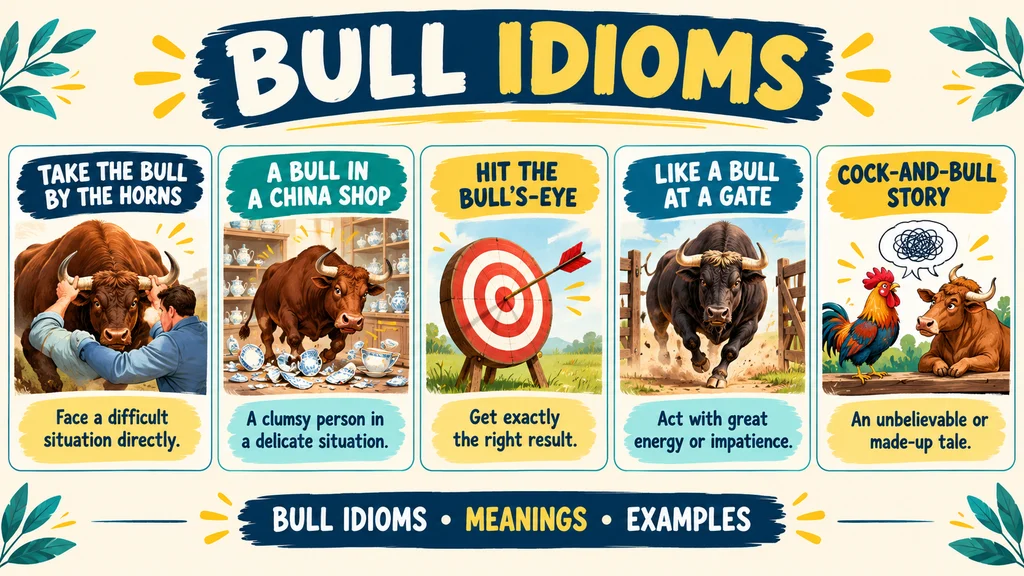
Ever heard someone say “take the bull by the horns” and wondered what a bull has to do with facing a challenge? Bull idioms are expressions that use bull-related words to communicate ideas beyond their literal meanings.
They can describe courage, stubbornness, clumsy behavior, honesty, or difficult situations, depending on the expression. For example, take the bull by the horns means to confront a problem directly, while a bull in a china shop describes someone who behaves clumsily or carelessly.
These expressions appear in everyday conversations, books, informal writing, and popular culture, making them useful for English learners and confident speakers alike. However, similar-sounding expressions can have very different meanings. This guide explores 30+ bull idioms with clear definitions and practical example sentences to help you understand their meanings and use them naturally.
Common Bull Idioms and Their Meanings
Take the Bull by the Horns
Word-by-word meaning: To grasp a bull by its horns.
Idiomatic meaning: To confront a difficult situation directly and take decisive action.
Example sentences:
- I decided to take the bull by the horns and discuss the problem with my manager.
- Instead of avoiding her debt, she took the bull by the horns and made a repayment plan.
Common error: Saying “take the bull by its head” instead of the established expression.
Usage note: Use this idiom when someone takes responsibility and tackles a problem with determination. It works in everyday and professional English.
Like a Bull in a China Shop
Word-by-word meaning: A bull moving around inside a shop filled with delicate china.
Idiomatic meaning: To behave clumsily, carelessly, or insensitively in a situation that requires tact.
Example sentences:
- He entered the negotiation like a bull in a china shop and offended everyone.
- I felt like a bull in a china shop at my first formal dinner.
Common error: Replacing “china shop” with “glass shop” and treating it as the standard expression.
Usage note: This idiom can describe physical clumsiness or a lack of social sensitivity. It is often critical, so use it thoughtfully when describing people.
A Red Rag to a Bull
Word-by-word meaning: A red piece of cloth presented to a bull.
Idiomatic meaning: Something that provokes someone or makes them extremely angry.
Example sentences:
- Mentioning his failed promotion is like a red rag to a bull.
- The accusation was a red rag to a bull for the already frustrated coach.
Common error: Using it for something that merely attracts attention without provoking anger.
Usage note: This expression is particularly associated with British English. It describes something that triggers a strong reaction, usually anger.
Hit the Bull’s-Eye
Word-by-word meaning: To strike the exact center of a target.
Idiomatic meaning: To achieve precisely the intended result or make an accurate point.
Example sentences:
- Your explanation hit the bull’s-eye and cleared up everyone’s confusion.
- The advertisement hit the bull’s-eye with its intended audience.
Common error: Confusing the expression with simply hitting a target when the intended meaning is precision or exact success.
Usage note: Use it when a suggestion, answer, decision, or result is exactly right.
Bullheaded
Word-by-word meaning: An adjective formed from “bull” and “headed.”
Figurative meaning: Stubborn and unwilling to listen to reason or consider other opinions.
Example sentences:
- He was too bullheaded to admit that his plan needed changes.
- Don’t be bullheaded; consider the feedback before making your decision.
Common error: Assuming “bullheaded” means brave or confident. It usually suggests unreasonable stubbornness.
Usage note: This is an adjective rather than a multiword idiom. It is generally negative, so “determined” may be more appropriate when you want to express praise.
Bee Idioms: Meanings, Origins, and Real-Life Examples
Related Bull Expressions
The following phrases are useful to learn alongside bull idioms. They include comparisons, informal expressions, and technical terms—not all are traditional idioms.
Strong as a Bull
Word-by-word meaning: As strong as a bull.
Figurative meaning: Extremely strong or physically powerful.
Example sentences:
- After years of farm work, my grandfather was strong as a bull.
- The weightlifter is strong as a bull and trains every morning.
Common error: Assuming it necessarily describes intelligence or emotional strength.
Usage note: This is a simile, or comparison, rather than a fixed idiom. It usually conveys physical strength in an informal, positive way.
Shoot the Bull
Word-by-word meaning: The words refer literally to shooting a bull, but the expression has a different conversational meaning.
Idiomatic meaning: To chat casually, often about everyday topics.
Example sentences:
- We sat outside and shot the bull for an hour after dinner.
- My coworkers like to shoot the bull during their lunch break.
Common error: Using this informal expression in a formal report or professional email without considering the tone.
Usage note: This phrase is associated particularly with informal American English. “Chat” or “talk casually” are more neutral alternatives.
Full of Bull
Word-by-word meaning: A figurative expression rather than a literal description.
Idiomatic meaning: Talking nonsense, exaggerating, or being dishonest.
Example sentences:
- He promised to finish the entire project in ten minutes, but I think he’s full of bull.
- The salesperson sounded full of bull when making promises without evidence.
Common error: Using this expression in a formal situation where it may sound rude.
Usage note: This phrase is informal and can be offensive. In polite conversation, use “talking nonsense” or “being dishonest.”
Bull Session
Word-by-word meaning: A phrase whose meaning is not derived literally from an animal.
Idiomatic meaning: An informal, extended conversation among friends or colleagues.
Example sentences:
- The students had a bull session about their plans after graduation.
- We stayed up late having a bull session about work and relationships.
Common error: Assuming that a bull session must involve a disagreement or argument.
Usage note: This informal expression is particularly associated with American English and may sound dated to some speakers. “A long chat” is a simpler alternative.
Bull Market
Word-by-word meaning: A financial term using “bull” as a market-related symbol.
Meaning: A market in which prices are generally rising or investors expect them to rise.
Example sentences:
- Investors became more optimistic during the bull market.
- The company expanded during a period of strong market growth.
Common error: Assuming that every stock rises during a bull market.
Usage note: This is a financial term, not an everyday idiom. It is useful when discussing investing and market trends.
Bull Run
Word-by-word meaning: The meaning depends on whether the phrase is used in finance or for an actual event.
Meaning: In financial contexts, a period of significant price increases. Literally, it can also refer to an event involving running bulls.
Example sentences:
- The cryptocurrency experienced a bull run as investor demand increased.
- Tourists gathered to watch the annual bull run.
Common error: Assuming that the phrase always refers to financial markets.
Usage note: In finance-related writing, specify the market or asset being discussed to keep the meaning clear.
Bull’s-Eye
Word-by-word meaning: The exact center of a target.
Figurative meaning: The precise point someone is aiming for or the exact result they want.
Example sentences:
- Her dart landed directly in the bull’s-eye.
- His analysis identified the bull’s-eye of the problem.
Common error: Treating “bull’s-eye” as an entirely separate idiom from “hit the bull’s-eye.”
Usage note: “Bull’s-eye” is a noun that can be used literally or figuratively. It is closely related to the expression in entry 4, so these two can be combined if you prefer a shorter list.
Bullshit
Word-by-word meaning: A vulgar term that includes the word “bull.”
Idiomatic meaning: Nonsense, deception, or claims considered dishonest.
Example sentences:
- She called the unrealistic promise bullshit.
- He was tired of the excuses and said the explanation was bullshit.
Common error: Using this profanity in formal communication or around people who may find it offensive.
Usage note: This is vulgar slang rather than a polite idiom. Depending on context, use “nonsense,” “rubbish,” or “dishonest claims” instead.
Bull Session Talk
Word-by-word meaning: Talk during an informal conversation.
Meaning: A less natural, redundant variation of “bull session,” which already means an informal discussion.
Example sentences:
- The friends had a bull session after their exams.
- Their informal conversation continued long after dinner.
Common error: Treating “bull session talk” as a distinct, established idiom.
Usage note: Prefer “bull session” or “casual conversation.” This entry is a related wording note, not a separate famous idiom.
How to Use Bull Idioms Naturally
Choose the expression that fits the situation and the tone you want.

- For facing a difficult problem: “Take the bull by the horns.”
Example: “We need to take the bull by the horns and resolve the scheduling issue.” - For clumsy or insensitive behavior: “Like a bull in a china shop.”
Example: “He handled the delicate conversation like a bull in a china shop.” - For something that provokes anger: “A red rag to a bull.”
Example: “That accusation was a red rag to a bull.” - For a precise answer or successful result: “Hit the bull’s-eye.”
Example: “Your answer hit the bull’s-eye.” - For casual conversation: “Shoot the bull.”
Example: “We shot the bull while waiting for the train.” - For unreasonable stubbornness: “Bullheaded.”
Example: “He was too bullheaded to consider another solution.”
Shark Idioms: Meanings, Origins, and Examples
Common Mistakes to Avoid
- Confusing idioms with literal phrases. “Take the bull by the horns” is an established idiom, while “bull run” can be literal or financial.
- Repeating one expression under different names. “Bull’s-eye” and “hit the bull’s-eye” are closely related and should not be presented as two completely unrelated idioms.
- Ignoring formality. “Shoot the bull” is informal, while “bullshit” is vulgar.
- Treating technical terms as everyday idioms. “Bull market” is financial terminology.
- Using “bullheaded” as praise. The adjective usually implies unreasonable stubbornness rather than admirable determination.
Frequently Asked Questions
What are the most common bull idioms?
The best-known bull idioms include “take the bull by the horns,” “like a bull in a china shop,” and “a red rag to a bull.” “Hit the bull’s-eye” is another familiar expression associated with precision and success.
What does “take the bull by the horns” mean?
It means to confront a difficult problem directly rather than avoid it. For example, a manager might take the bull by the horns by addressing a serious team conflict.
What does “like a bull in a china shop” mean?
It describes someone who behaves clumsily or without enough sensitivity in a situation that requires care. It can refer to physical actions or social interactions.
Can you use bull idioms in professional writing?
Some, such as “take the bull by the horns,” can work in professional writing. Informal expressions such as “shoot the bull” may suit casual workplace conversation, while vulgar slang should generally be avoided.
What does “bullheaded” mean?
“Bullheaded” means stubborn and unwilling to consider other people’s opinions or reasonable advice. It usually carries a negative meaning.
Conclusion
Bull idioms and related expressions can make English more vivid by describing courage, stubbornness, provocation, and precision. Start with widely recognized expressions such as “take the bull by the horns,” “like a bull in a china shop,” and “a red rag to a bull.”
Try writing one original sentence for each phrase and pay attention to its meaning and tone. Remember that not every phrase containing “bull” is a traditional idiom. Understanding the difference will help you communicate more naturally and confidently.

Emily Carter writes for Meaning Match about English idioms, student-friendly expressions, and language learning, using simple explanations and helpful examples.
Pingback: Bird Idioms: From “A Little Bird Told Me” to “Swan Song”