
Have you ever heard an English phrase that sounded completely strange when taken literally? Weird idioms in English are expressions that may seem funny, unusual, or even confusing at first, but their real meanings are usually figurative rather than literal.
Phrases such as “spill the beans,” “kick the bucket,” “raining cats and dogs,” and “let the cat out of the bag” can sound bizarre if you picture the words exactly as they are said. However, each has a different meaning in everyday English. Some weird idioms are humorous, while others describe surprising situations, mistakes, emotions, or ordinary experiences in an unusual way.
If you’re searching for weird idioms in English for schoolwork, writing, conversations, captions, or simply to learn unusual expressions, this guide will make them easy to understand. You’ll discover their meanings, origins, examples, and natural uses.
What Are Weird Idioms in English?
A weird idiom is a fixed expression whose overall meaning cannot always be understood by translating each word literally. The phrase may create a funny, impossible, or unexpected mental picture, but native speakers understand its figurative meaning from context.
For example:
- Spill the beans → reveal a secret
- When pigs fly → something will probably never happen
- The elephant in the room → an obvious issue nobody wants to discuss
- Piece of cake → something very easy
Idiom vs. Slang: Are They the Same?
No. Idioms are established expressions with meanings that often differ from their literal words. Slang is informal vocabulary or expressions commonly associated with particular groups, situations, or generations.
An idiom can be informal, but not every slang expression is an idiom.
Weird Idioms in English You Should Know
Spill the Beans
Literal image: Someone accidentally drops a pile of beans.
Figurative meaning: To reveal a secret or confidential information.
Example: “Don’t spill the beans about the surprise party.”
Common mistake: Using it when someone simply drops food.
Tone & usage: Informal; common in everyday conversation.
Why it sounds weird: The beans have nothing to do with the secret. The phrase is memorable because the literal image is so unrelated to the actual meaning.
When Pigs Fly
Literal image: Pigs somehow flying through the sky.
Figurative meaning: Something is extremely unlikely or probably will never happen.
Example: “He’ll clean his room when pigs fly.”
Common mistake: Treating it as a serious prediction.
Tone & usage: Humorous and informal; often used sarcastically.
Why it works: Flying pigs represent an impossible or highly unlikely event.
It’s Raining Cats and Dogs
Literal image: Cats and dogs falling from the sky.
Figurative meaning: It is raining very heavily.
Example: “Take an umbrella. It’s raining cats and dogs outside.”
Common mistake: Using it for light rain.
Tone & usage: Informal and playful. It is widely recognized, although speakers may simply say “raining heavily” in ordinary conversation.
Have Butterflies in Your Stomach
Literal image: Butterflies flying around inside your stomach.
Figurative meaning: To feel nervous, excited, or both.
Example: “I had butterflies in my stomach before my first presentation.”
Common mistake: Assuming it only means fear.
Tone & usage: Informal and very natural for situations such as exams, dates, interviews, and performances.
The Elephant in the Room
Literal image: A huge elephant standing inside a room while everyone ignores it.
Figurative meaning: An obvious and important problem that people avoid discussing.
Example: “The company’s falling sales were the elephant in the room during the meeting.”
Common mistake: Using it for any small problem.
Tone & usage: Neutral to informal; useful in conversations, meetings, and discussions.
Have a Frog in Your Throat
Literal image: A frog stuck inside someone’s throat.
Figurative meaning: To have difficulty speaking because your voice is rough, weak, or temporarily affected.
Example: “Sorry, I have a frog in my throat this morning.”
Common mistake: Assuming it literally describes an illness.
Tone & usage: Informal and often humorous.
Go Down a Rabbit Hole
Literal image: A person entering a rabbit’s underground tunnel.
Figurative meaning: To become deeply involved in researching or exploring a subject, often much further than originally planned.
Example: “I searched for one historical fact and ended up going down a rabbit hole for three hours.”
Common mistake: Assuming the phrase is always negative.
Tone & usage: Informal; especially common when talking about online research or complicated interests.
Bite the Bullet
Literal image: Someone literally biting a bullet.
Figurative meaning: To face something difficult or unpleasant instead of avoiding it.
Example: “I hate public speaking, but I decided to bite the bullet and give the presentation.”
Common mistake: Using it for every situation involving courage.
Tone & usage: Informal to neutral; usually suggests accepting an unpleasant task or situation.
Break a Leg
Literal image: Someone breaking their leg.
Figurative meaning: A way of wishing someone good luck, especially before a performance.
Example: “Your audition starts in five minutes—break a leg!”
Common mistake: Thinking the speaker is wishing someone harm.
Tone & usage: Informal and strongly associated with theater and performances.
Kick the Bucket
Literal image: Someone literally kicking a bucket.
Figurative meaning: A humorous or informal way to say that someone has died.
Example: “The character kicks the bucket at the end of the film.”
Common mistake: Using it casually when discussing a person’s recent death.
Tone & usage: Informal and potentially insensitive. Avoid it in serious conversations about someone’s loss.
Pull Someone’s Leg
Literal image: Physically pulling another person’s leg.
Figurative meaning: To joke with someone or playfully trick them.
Example: “Don’t panic—I was only pulling your leg.”
Common mistake: Confusing it with deliberately hurting or bullying someone.
Tone & usage: Informal and usually playful.
Cost an Arm and a Leg
Literal image: Paying for something with your body parts.
Figurative meaning: To be extremely expensive.
Example: “That apartment costs an arm and a leg.”
Common mistake: Using it for something that is only slightly expensive.
Tone & usage: Informal; useful when emphasizing a surprisingly high price.
Under the Weather
Literal image: Someone standing underneath bad weather.
Figurative meaning: Feeling slightly ill or unwell.
Example: “I’m feeling under the weather, so I’m going to stay home today.”
Common mistake: Using it to describe bad weather itself.
Tone & usage: Informal and common in everyday conversation.
Hit the Nail on the Head
Literal image: Striking a nail exactly on its head.
Figurative meaning: To describe something accurately or identify the main point.
Example: “You hit the nail on the head when you said communication was the real problem.”
Common mistake: Thinking it is only a construction expression.
Tone & usage: Neutral and conversational; useful when agreeing with an accurate observation.
Hold Your Horses
Literal image: Physically holding horses to stop them from moving.
Figurative meaning: Slow down, wait, or be patient.
Example: “Hold your horses! We haven’t decided where we’re going yet.”
Common mistake: Using it in a formal situation where a direct “Please wait” would be more appropriate.
Tone & usage: Informal, playful, and sometimes mildly impatient.
Put a Sock in It
Literal image: Putting a sock inside something to block it.
Figurative meaning: A humorous but sometimes rude way of telling someone to be quiet.
Example: “Put a sock in it!” Jake joked after his brother kept singing.
Common mistake: Using it with strangers, customers, teachers, or professional colleagues.
Tone & usage: Informal and potentially impolite; best used only when the relationship and context make it appropriate.
Piece of Cake
Literal image: A piece or slice of cake.
Figurative meaning: Something very easy.
Example: “The first part of the test was a piece of cake.”
Common mistake: Assuming it means something enjoyable in every situation.
Tone & usage: Informal and common.
Go Cold Turkey
Literal image: The phrase sounds like it describes a cold bird.
Figurative meaning: To stop a habit or substance suddenly and completely.
Example: “She quit smoking cold turkey.”
Common mistake: Using it simply as another word for “stop.”
Tone & usage: Informal; it emphasizes sudden and complete cessation.
Funny Idioms for Friends: 26+ Playful Expressions to Use
Take the Bull by the Horns
Literal image: Grabbing a dangerous bull by its horns.
Figurative meaning: To deal with a difficult situation directly and confidently.
Example: “She decided to take the bull by the horns and solve the problem herself.”
Common mistake: Using it for an ordinary task that requires no particular challenge.
Tone & usage: Informal to neutral; suggests direct action and determination.
Cat Got Your Tongue?
Literal image: A cat somehow has someone’s tongue.
Figurative meaning: A playful way to ask why someone is unusually quiet or unable to respond.
Example: “Cat got your tongue? You haven’t said a word since we arrived.”
Common mistake: Using it when someone is genuinely unable to speak or has a medical problem.
Tone & usage: Informal and playful; context matters because it can sound teasing.
Literal Meaning vs. Real Meaning
One of the easiest ways to understand weird idioms is to compare their literal image with their actual meaning.
| Idiom | Literal Image | Real Meaning |
|---|---|---|
| Spill the beans | Dropping beans | Reveal a secret |
| When pigs fly | Flying pigs | Probably never |
| Butterflies in your stomach | Butterflies inside you | Nervous or excited |
| Elephant in the room | Elephant indoors | Obvious unaddressed issue |
| Piece of cake | A slice of cake | Very easy |
| Under the weather | Standing beneath weather | Feeling unwell |
| Cat got your tongue? | Cat holding a tongue | Why are you quiet? |
| Go down a rabbit hole | Entering a rabbit tunnel | Become deeply involved in something |
The important lesson is: learn the idiom as one expression rather than translating every word separately.
Common Mistakes English Learners Make With Idioms
Taking Idioms Literally
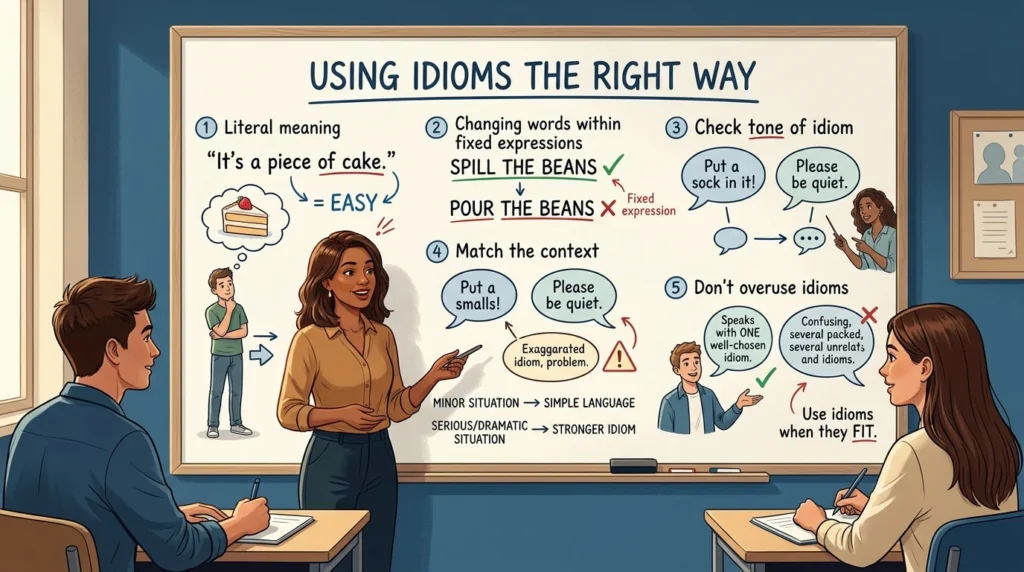
If someone says, “It’s a piece of cake,” they aren’t necessarily offering dessert. They mean that something is easy.
Changing the Words
Idioms are usually fixed expressions. Say “spill the beans,” not “pour the beans,” when you mean “reveal a secret.”
Ignoring Tone
An idiom can be humorous, informal, sarcastic, or potentially rude. “Put a sock in it” is very different in tone from “Please be quiet.”
Using an Idiom in the Wrong Context
A dramatic idiom may sound strange when the situation is minor. Choose expressions according to the seriousness and setting.
Using Too Many Idioms
Idioms can make speech colorful, but putting several into every sentence can sound unnatural. Use them when they genuinely fit.
Are These Idioms Still Common?
Not every idiom has exactly the same level of everyday use. Some are extremely familiar, while others are more humorous, traditional, regional, or context-dependent.
A useful rule is:
- Common: “piece of cake,” “under the weather,” “spill the beans”
- Humorous: “when pigs fly,” “hold your horses”
- Context-sensitive: “kick the bucket,” “put a sock in it”
- Especially conversational: “pull someone’s leg,” “cat got your tongue?”
Learning the meaning is only half the job. You should also learn when it sounds natural to say it.
American and British Idioms Can Differ
English idioms are not always identical across English-speaking regions.
For example:
- American English: “Throw a wrench in the works”
- British English: “Throw a spanner in the works”
Both mean that something has disrupted a plan or process.
This is why learners should pay attention not only to meaning but also to regional usage.
How to Learn Weird Idioms Faster
Don’t memorize twenty definitions at once. Learn each idiom through a simple five-step process:
- See the literal image.
- Learn the figurative meaning.
- Read a natural example.
- Notice its tone and context.
- Create your own sentence.
For example:
Idiom: Spill the beans
Meaning: Reveal a secret
Your sentence: “I almost spilled the beans about her birthday gift.”
You can also practice idioms through short conversations:
Friend: “Are you nervous about the interview?”
You: “A little. I have butterflies in my stomach.”
This makes the expression easier to remember because you learn how people actually use it, not just what it means.
Crazy Idioms Phrases: 27+ Unusual Phrases With Unexpected Meanings
FAQs About Weird Idioms in English
What are some weird idioms in English?
Examples include “when pigs fly,” “spill the beans,” “have a frog in your throat,” “the elephant in the room,” “go down a rabbit hole,” and “cat got your tongue?”
Why do English idioms sound so strange?
Many idioms developed from older customs, occupations, stories, cultural references, and everyday experiences. Their original contexts may no longer be obvious, which makes their literal wording sound strange today.
Should English learners use weird idioms?
Yes, but naturally. Understanding common idioms can make conversations easier to follow and can help your English sound more natural. Always learn the expression’s tone and context before using it.
Are weird idioms appropriate in formal writing?
Not always. Many are conversational or informal. In academic and professional writing, choose expressions that match the required level of formality.
What is the difference between a literal and figurative meaning?
A literal meaning describes exactly what the words say. A figurative meaning expresses the idea the complete phrase is intended to communicate. For example, “when pigs fly” literally describes flying pigs, but figuratively means something is extremely unlikely.
Final Thoughts
Weird idioms in English can look ridiculous when translated word for word, but that unusual imagery is what makes them memorable. The key is to learn more than the definition: understand the literal image, figurative meaning, tone, context, and natural usage.
Pick five idioms from this guide, write your own sentences, and use them in conversation. Once you stop trying to translate every word literally, even the strangest English expressions become much easier to understand and remember.

Emily Carter writes for Meaning Match about English idioms, student-friendly expressions, and language learning, using simple explanations and helpful examples.