
Have you ever heard a song lyric that sounds unusual if you take the words literally but becomes clear once you know the expression behind it? Idioms in songs allow songwriters to express ideas, situations, and feelings through familiar expressions with meanings that go beyond their individual words.
For example, “break the ice” means to make people feel more comfortable, while “on cloud nine” means to feel extremely happy. When used in lyrics, idioms can create a natural conversational voice, communicate an idea quickly, and give familiar experiences a memorable or expressive form. They can appear in songs about love, heartbreak, happiness, conflict, hope, and everyday life. However, not every figurative phrase in a song is an idiom.
A metaphor, simile, or other figurative expression may sound similar but works differently from a conventional idiom. If you’re looking for examples of idioms in songs, this guide explains common examples, their meanings, how idioms work in lyrics, and how to distinguish them from other types of figurative language.
What Are Idioms in Songs?
An idiom is an established expression whose intended meaning cannot always be understood by translating each word literally.
For example, “hit the road” does not mean physically hitting a road. It means to leave or begin a journey.
Songwriters use idioms because familiar expressions can communicate an emotion or idea quickly. A listener may recognize the expression immediately while also connecting it with the story or feeling of the song.
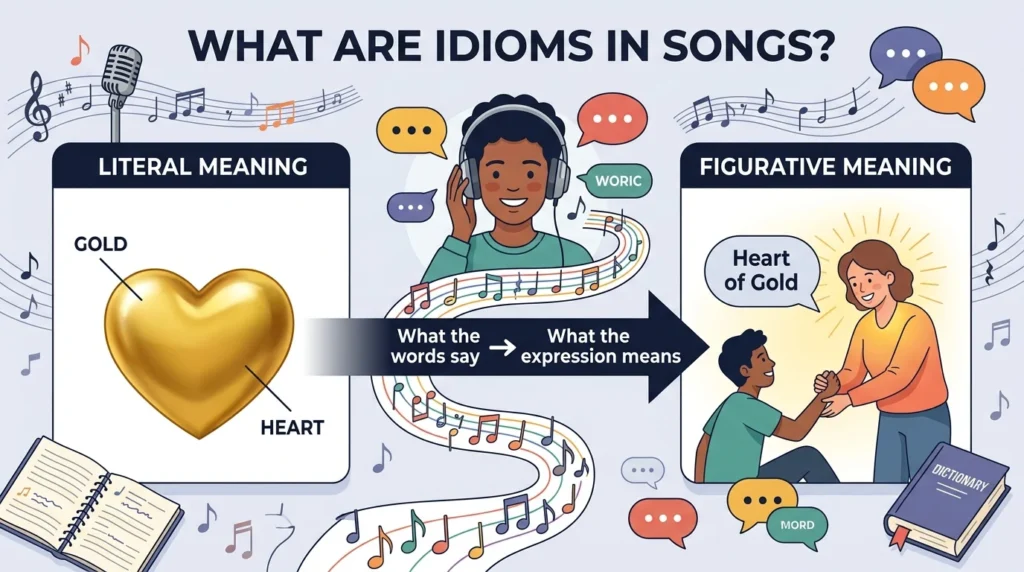
Idiom vs. Figurative Expression
This distinction is important when learning from music.
| Type | Example | Meaning |
|---|---|---|
| Idiom | Hit the road | Leave or begin a journey |
| Idiom | Heart of gold | A very kind nature |
| Idiom | Against all odds | Despite very difficult circumstances |
| Metaphorical expression | Burning love | Extremely intense love |
| Simile | Cold as ice | Emotionally cold or distant |
| Phrasal expression | Let it go | Stop holding on to something |
So, this article focuses mainly on established idioms used in or represented by song titles, while also identifying closely related figurative expressions separately.
“Hit the Road” — Hit the Road Jack by Ray Charles
Meaning:
Hit the road means to leave a place or start a journey.
Literal meaning:
To physically strike a road.
Figurative meaning:
To leave or get going.
Example sentence:
We should hit the road before traffic gets worse.
How it works in the song:
The expression gives the song a direct, conversational sense of telling someone to leave.
Common error:
Do not interpret “hit” literally. The expression is about leaving, not striking a road.
Usage note:
It is informal and works naturally in everyday conversation.
“Best of Both Worlds” — Best of Both Worlds by Hannah Montana
Meaning:
The best of both worlds means enjoying the advantages of two different situations.
Literal meaning:
Having the best parts of two worlds.
Figurative meaning:
Getting benefits from two different choices or lifestyles.
Example sentence:
Working from home gives me the best of both worlds: flexibility and comfort.
How it works in the song:
The expression describes having access to different experiences and enjoying advantages from both.
Common error:
It does not refer to two literal planets or worlds.
Usage note:
Use it when two different options each offer something valuable.
“Heart of Gold” — Heart of Gold by Neil Young
Meaning:
A person with a heart of gold is exceptionally kind, caring, or generous.
Literal meaning:
A heart made from gold.
Figurative meaning:
A warm and generous character.
Example sentence:
My grandmother has a heart of gold and always helps people in need.
How it works in the song:
The phrase turns an abstract quality—goodness—into a memorable image.
Common error:
Do not use it to describe someone’s actual physical heart.
Usage note:
It is a positive idiom commonly used to praise someone’s character.
“Against All Odds” — Against All Odds (Take a Look at Me Now) by Phil Collins
Meaning:
Against all odds means succeeding or continuing despite very difficult circumstances.
Literal meaning:
Going against expected probabilities.
Figurative meaning:
Achieving something even though success seems unlikely.
Example sentence:
Against all odds, the small team reached the final.
How it works in the song:
The expression emphasizes the difficulty of a situation and the emotional struggle involved.
Common error:
The phrase is not limited to gambling or mathematical probability.
Usage note:
It works well when describing determination, unexpected success, or difficult circumstances.
“Head Over Heels” — Head Over Heels by Tears for Fears
Meaning:
Head over heels means deeply or suddenly in love.
Literal meaning:
Having your head physically above your heels.
Figurative meaning:
Being intensely emotionally involved, especially in love.
Example sentence:
She fell head over heels for him.
How it works in the song:
The expression captures the overwhelming feeling of romantic attraction.
Common error:
Do not confuse it with the literal movement of doing a somersault.
Usage note:
It is usually used in romantic contexts.
“Break the Ice” — Break the Ice by Britney Spears
Meaning:
Break the ice means to make people feel more comfortable when a situation initially feels awkward or tense.
Literal meaning:
Breaking a sheet or block of ice.
Figurative meaning:
Starting interaction and reducing social tension.
Example sentence:
The teacher told a joke to break the ice before the discussion.
How it works in the song:
The familiar expression uses the image of breaking ice to suggest removing emotional or social barriers.
Common error:
It does not usually mean physically breaking ice.
Usage note:
It is especially common when meeting people or starting conversations.
“On Top of the World” — On Top of the World by Imagine Dragons
Meaning:
On top of the world means extremely happy, successful, or confident.
Literal meaning:
Physically standing above the world.
Figurative meaning:
Feeling exceptionally positive or successful.
Example sentence:
After receiving the scholarship, she felt on top of the world.
How it works in the song:
The expression creates a strong image of achievement and happiness.
Common error:
It does not normally describe someone’s physical location.
Usage note:
Use it for moments of excitement, success, or great happiness.
“Time After Time” — Time After Time by Cyndi Lauper
Meaning:
Time after time means repeatedly or again and again.
Literal meaning:
One time following another.
Figurative meaning:
Something happening repeatedly.
Example sentence:
He made the same mistake time after time.
How it works in the song:
The repeated structure reinforces the idea of consistency and repetition.
Common error:
Do not use it when you mean simply “later.”
Usage note:
It is common in both everyday English and storytelling.
“Back to Square One” — Back to Square One
Meaning:
Back to square one means returning to the beginning after an attempt has failed or a plan has been abandoned.
Example sentence:
The experiment failed, so we are back to square one.
Literal meaning:
Returning to the first square on a board.
Figurative meaning:
Starting over from the beginning.
Common error:
The expression is about progress, not necessarily a physical square.
Usage note:
It is useful when discussing plans, projects, problems, and failed attempts.
“Go the Extra Mile” — An Idiom Frequently Used in Music
Meaning:
Go the extra mile means to make more effort than is normally expected.
Example sentence:
She always goes the extra mile to help her students.
Literal meaning:
Traveling an additional mile.
Figurative meaning:
Making exceptional effort.
How it works in songs:
When used in musical or motivational language, the expression communicates dedication, loyalty, or determination.
Common error:
It does not necessarily involve physical travel.
Usage note:
It is common in motivational, professional, and everyday English.
“Ring a Bell” — A Common Idiomatic Expression in English Music
Meaning:
Ring a bell means that something sounds familiar.
Example sentence:
That name rings a bell, but I cannot remember where I heard it.
Literal meaning:
Making a bell produce a sound.
Figurative meaning:
Triggering a feeling of recognition.
How it works in songs:
The expression can connect a sound, memory, person, or experience with something familiar.
Common error:
It does not always mean physically ringing a bell.
Usage note:
It is especially useful when something feels familiar but you cannot remember the exact source.
“Out of the Blue” — Out of the Blue by Debbie Gibson
Meaning:
Out of the blue means unexpectedly or without warning.
Literal meaning:
Something coming out of a blue space or sky.
Figurative meaning:
Something happening suddenly and unexpectedly.
Example sentence:
She called me out of the blue after several years.
How it works in the song:
The expression gives an event a sense of surprise and sudden emotional change.
Common error:
It does not simply mean “from the sky.”
Usage note:
Use it when something happens unexpectedly.
“Let It Go” — Frozen
Important classification: Let it go is better described as a common phrasal expression rather than a classic idiom.
Meaning:
To stop holding on to a problem, emotion, memory, or situation.
Example sentence:
You cannot change the past, so try to let it go.
Why it matters:
This is a good example of why learners should not label every memorable song phrase an idiom. It is figurative and highly useful, but its meaning is more transparent than that of a classic idiom such as “hit the road.”
“Cold as Ice” — Cold as Ice by Foreigner
Classification: Simile / figurative expression
Meaning:
Calling someone cold as ice can suggest that the person is emotionally distant, unfriendly, or lacking warmth.
Example sentence:
He seemed cold as ice when I tried to apologize.
Why it matters:
This is a simile rather than a classic idiom because it explicitly compares one thing with another using as.
Usage note:
It shows how songs frequently combine idioms with other types of figurative language.
“Walking on Sunshine” — Walking on Sunshine by Katrina and the Waves
Classification: Metaphorical expression
Meaning:
Feeling extremely happy, energetic, and optimistic.
Example sentence:
After hearing the good news, I was walking on sunshine all day.
Why it works:
The impossible image of literally walking on sunshine communicates an intense feeling of happiness.
Usage note:
It is a useful example of figurative language, even though it is not best classified as a traditional idiom.
“Burning Love” — Burning Love by Elvis Presley
Classification: Metaphorical expression
Meaning:
Extremely strong or passionate romantic love.
Example sentence:
The novel describes their relationship as a burning love.
Why it works:
Fire and heat are used metaphorically to represent emotional intensity.
Usage note:
This illustrates how songwriters often use metaphor alongside established idioms.
“Piece of My Heart” — Piece of My Heart by Janis Joplin
Classification: Figurative expression
Meaning:
A piece of my heart can represent a deeply emotional or meaningful part of someone’s love, memories, or personal life.
Example sentence:
That old photograph still holds a piece of my heart.
Why it works:
The heart symbolizes emotion, while a “piece” represents something personally meaningful.
Usage note:
Its exact meaning depends heavily on context.
“Under Pressure” — Under Pressure by Queen and David Bowie
Classification: Fixed figurative expression
Meaning:
Being under pressure means experiencing stress, demands, or difficult expectations.
Example sentence:
Students often feel under pressure before important exams.
Why it works:
Pressure is used figuratively to describe the emotional or mental weight of a situation.
Common error:
It does not necessarily refer to physical pressure.
Usage note:
This expression is extremely common in everyday English.
“Ain’t No Mountain High Enough” — Marvin Gaye and Tammi Terrell
Classification: Figurative expression / hyperbolic language
Meaning:
The expression communicates that no obstacle is large enough to prevent someone from reaching or supporting another person.
Example sentence:
No challenge is too great when you are determined to help someone you love.
Why it works:
The mountain represents an obstacle, while its enormous height emphasizes determination.
Usage note:
This is better understood as figurative and hyperbolic language rather than a conventional dictionary idiom.
“The Best of Both Worlds” — Why Songwriters Love Familiar Expressions
The phrase the best of both worlds deserves special attention because it demonstrates how an established idiom can become a song title and then become even more memorable through music.
Meaning:
Enjoying the advantages of two different situations.
Example sentence:
The hybrid schedule gives me the best of both worlds.
Why it works in music:
Listeners already understand the expression, so the songwriter can use it as a compact way to communicate a larger idea.
Common error:
Do not assume every phrase used in a song is automatically an idiom. Classification depends on how the expression functions in English.
Idioms in Stories: Understand Their Meaning in Context
Why Do Songwriters Use Idioms and Figurative Language?
Idioms and figurative expressions are useful in songs because they can:
- Express emotions quickly
- Create memorable mental images
- Make lyrics sound conversational
- Connect with familiar everyday language
- Add emotional depth
- Make abstract ideas easier to visualize
- Support storytelling without lengthy explanations
For example, “heart of gold” communicates kindness through an image, while “against all odds” immediately suggests difficulty and determination.
How to Recognize an Idiom in a Song
When you hear an unfamiliar expression, use this simple process:
1. Check the literal meaning
Ask yourself: Does the phrase make sense literally in this context?
If not, it may be figurative.
2. Look at the surrounding context
The lines and story around the expression often reveal what the songwriter means.
3. Check whether the phrase is established
A true idiom is generally a recognized expression used beyond one particular song.
4. Identify the emotion
Is the singer expressing love, sadness, excitement, confidence, frustration, or hope?
Emotion can help reveal figurative meaning.
5. Learn the whole expression
Do not memorize isolated words. Learn:
heart of gold = very kind and generous
rather than memorizing heart and gold separately.
Common Mistakes When Learning Idioms From Songs
Taking Lyrics Too Literally
A heart of gold is not an actual metallic heart. The phrase describes someone’s character.
Calling Every Metaphor an Idiom
A creative phrase can be figurative without being an established idiom.
Ignoring Context
The same expression can have different shades of meaning depending on the surrounding song or conversation.
Copying Song Language Without Checking Tone
Some expressions are informal, emotional, old-fashioned, or strongly associated with particular contexts.
Confusing Similar Expressions
For example:
- Hit the road → leave
- Go the extra mile → make additional effort
- Against all odds → despite very difficult circumstances
- Out of the blue → unexpectedly
Learning the exact meaning and usage prevents awkward sentences.
Idioms in Books: 29 Examples and What They Really Mean
How to Learn English Idioms Through Songs
Music can make English expressions easier to remember because you encounter them in a memorable context.
Try this five-step method:
- Choose a familiar song.
- Identify an idiom or figurative expression.
- Write its literal and intended meanings.
- Create your own sentence.
- Use the expression in a conversation or writing exercise.
For example:
Idiom: Heart of gold
Meaning: A very kind and generous person
Your sentence: My aunt has a heart of gold.
This turns passive listening into active vocabulary practice.
Idioms vs. Metaphors in Songs
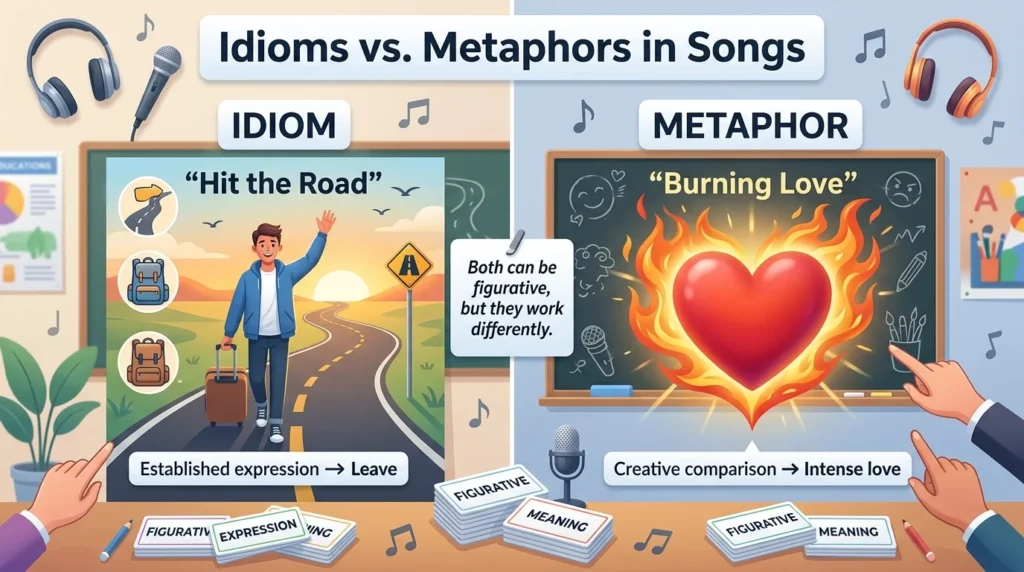
| Feature | Idiom | Metaphor |
|---|---|---|
| Meaning | Established figurative meaning | Creates a comparison |
| Example | Hit the road | Burning love |
| Literal interpretation | Usually misleading | Usually intentionally imaginative |
| Main purpose | Communicate a familiar idea | Create imagery or emotional impact |
Songs often combine both. That is why identifying the type of figurative language can make lyric analysis much more interesting.
FAQs About Examples of Idioms in Songs
What are some examples of idioms in songs?
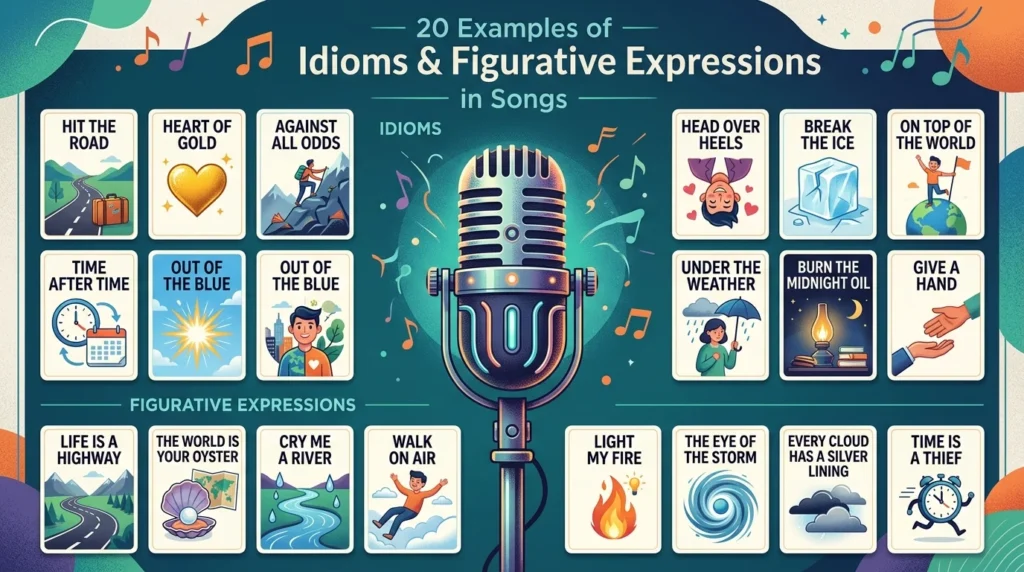
Examples include hit the road, heart of gold, against all odds, head over heels, break the ice, best of both worlds, time after time, and out of the blue.
Are all figurative phrases in songs idioms?
No. Songs also use metaphors, similes, hyperbole, phrasal expressions, and other forms of figurative language. For example, “cold as ice” is a simile, while “heart of gold” is an established idiomatic expression.
Why do songwriters use idioms?
Idioms help songwriters communicate emotions and ideas in familiar, memorable language. They can also create strong images without requiring lengthy explanations.
Can songs help me learn English idioms?
Yes. Songs provide context, repetition, emotion, and memorable examples. However, learners should check the meaning and usage of an expression rather than assuming every unusual lyric is a standard idiom.
How can I tell whether a phrase is an idiom?
Ask whether it has an established figurative meaning that is recognized beyond the particular song. If it is a creative comparison invented for the lyric, it may be a metaphor rather than an idiom.
Conclusion
Examples of idioms in songs show how English can communicate powerful ideas through short, familiar expressions. Phrases such as “hit the road,” “heart of gold,” “against all odds,” and “head over heels” become even easier to remember when you encounter them in meaningful musical contexts.
The key is not to label every figurative lyric an idiom. Learn to distinguish idioms, metaphors, similes, and other expressions, then study how each one works in context. Choose a few songs you already enjoy, identify the expressions you hear, and turn them into your own sentences. That simple habit can make both your English vocabulary and your understanding of figurative language much stronger.

Emily Carter writes for Meaning Match about English idioms, student-friendly expressions, and language learning, using simple explanations and helpful examples.