
The right idiom can make a character’s words feel natural, expressive, and full of personality. Idioms in stories are familiar expressions whose intended meaning is different from the literal meaning of the words, such as “spill the beans” for revealing a secret or “hit the books” for studying hard.
Writers can use idioms in dialogue and narration to show emotion, reveal a character’s personality, create a conversational voice, or make a scene feel more natural. For example, instead of simply saying that a character was nervous, a story might describe them as having “butterflies in their stomach.”
However, an idiom is most effective when it fits the character, audience, setting, genre, and tone. Too many unfamiliar or poorly chosen expressions can distract readers or make the writing feel forced. If you’re searching for idioms in stories, this guide explains what they are, why writers use them, how they work in dialogue and narration, and how to use them naturally with clear examples.
What Are Idioms in Stories?
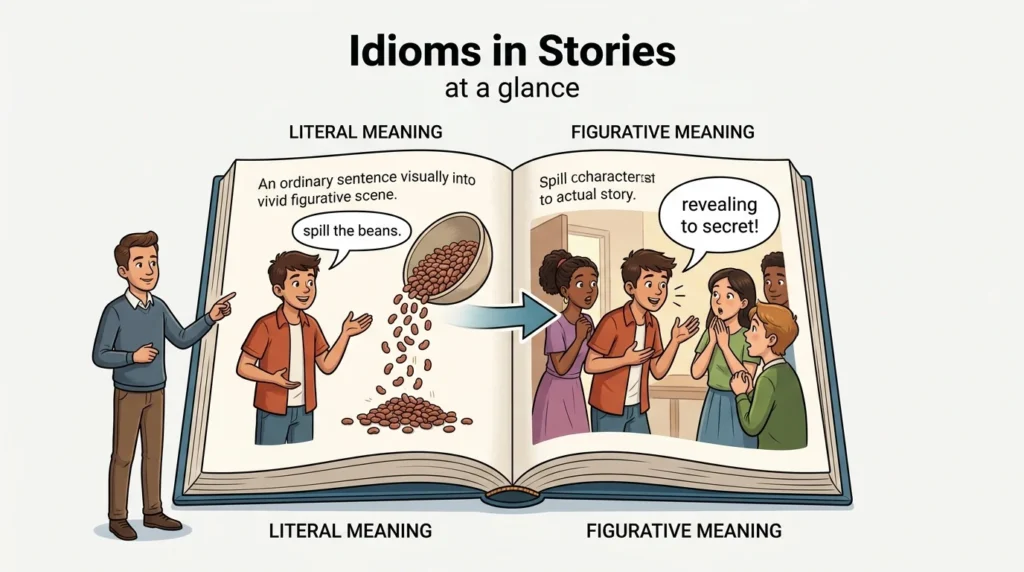
Idioms in stories are fixed expressions used for their figurative meaning rather than their literal meaning. Writers use expressions such as “spill the beans,” “break the ice,” and “on cloud nine” to make characters, emotions, conversations, and situations more vivid.
For example, in a story, “Mia spilled the beans about the surprise party” means Mia revealed the secret—not that she dropped a container of beans.
Why Do Writers Use Idioms in Stories?
A good idiom can communicate an idea quickly while adding personality and imagery to a scene.
Writers use idioms to:
- Make dialogue sound natural
- Show a character’s personality
- Express emotions vividly
- Add humor or warmth
- Make conversations feel realistic
- Create memorable descriptions
- Reflect everyday language
- Give readers cultural and conversational context
However, idioms work best when they fit the character and situation. A story does not become better simply because it contains more idioms.
Popular Idioms for Storytelling
A Piece of Cake
Word-by-word meaning:
A piece of cake is literally a portion of a cake.
Figurative meaning:
Something that is very easy to do.
Story example:
“Don’t worry about the math puzzle,” Leo said. “It’s a piece of cake.”
Common error:
Don’t write “a piece of cakes” when using the idiom.
Usage note:
This informal expression works well in friendly conversations, school stories, and humorous scenes.
Best story situation: A character wants to reassure someone that a task is easy.
Spill the Beans
Word-by-word meaning:
To spill beans literally means to drop them from a container.
Figurative meaning:
To reveal a secret, often accidentally.
Story example:
“I wasn’t going to tell anyone,” Sam whispered, “but Emma spilled the beans about the surprise.”
Common error:
The standard idiom is “spill the beans,” not “spill the bean.”
Usage note:
It is informal and especially natural in dialogue involving secrets or surprises.
Best story situation: A character accidentally reveals important information.
Break the Ice
Word-by-word meaning:
To break ice literally means to crack or break frozen water.
Figurative meaning:
To make people feel more comfortable when a situation is awkward or unfamiliar.
Story example:
Everyone sat quietly at the new student’s table. Then Noah told a joke to break the ice.
Common error:
Don’t assume it means physically breaking ice when the surrounding context is social.
Usage note:
Excellent for stories about first meetings, classrooms, parties, and new friendships.
Best story situation: Characters meet for the first time and feel uncomfortable.
On Cloud Nine
Word-by-word meaning:
The literal image is someone sitting high on a cloud.
Figurative meaning:
To feel extremely happy.
Story example:
When Sara discovered that she had won the competition, she was on cloud nine.
Common error:
It describes very strong happiness, not merely feeling fine or slightly pleased.
Usage note:
Use it for celebrations, exciting news, achievements, and joyful moments.
Best story situation: A character receives wonderful news.
Once in a Blue Moon
Word-by-word meaning:
A blue moon sounds like a rare type of moon.
Figurative meaning:
Something that happens very rarely.
Story example:
We visited our old family cottage once in a blue moon, but every visit felt special.
Common error:
Don’t use it for something that happens every week or month.
Usage note:
This informal expression is useful when a narrator wants to emphasize rarity.
Best story situation: A character describes an unusual event or rare visit.
Under the Weather
Word-by-word meaning:
The literal picture is of someone being physically underneath the weather.
Figurative meaning:
Feeling sick or unwell.
Story example:
Lily stayed home from school because she was feeling under the weather.
Common error:
Don’t use it simply to describe rainy or unpleasant weather.
Usage note:
It is informal and common in everyday dialogue.
Best story situation: A character is sick, tired, or not feeling well.
Cost an Arm and a Leg
Word-by-word meaning:
The literal expression refers to losing an arm and a leg.
Figurative meaning:
Something is extremely expensive.
Story example:
The little house looked affordable, but repairing its old roof cost an arm and a leg.
Common error:
The phrase is normally figurative when discussing prices.
Usage note:
Its informal and slightly exaggerated tone makes it useful in casual storytelling.
Best story situation: A character discovers that something costs far more than expected.
Let the Cat Out of the Bag
Word-by-word meaning:
The literal image is a cat escaping from a bag.
Figurative meaning:
To reveal a secret, usually unintentionally.
Story example:
“Who told Grandma about the party?”
“Tom let the cat out of the bag.”
Common error:
Don’t use it merely to mean telling ordinary information.
Usage note:
It is especially effective in stories involving surprises, plans, and secrets.
Best story situation: A surprise is ruined because someone reveals the secret.
Beat Around the Bush
Word-by-word meaning:
The literal image suggests moving or hitting around a bush instead of going directly toward something.
Figurative meaning:
To avoid discussing the main subject directly.
Story example:
“Stop beating around the bush,” Maya said. “Just tell me what happened.”
Common error:
The usual expression is “beat around the bush,” not “beat around the bushes.”
Usage note:
This is particularly useful in tense or frustrated dialogue.
Best story situation: One character wants another character to tell the truth.
Bite the Bullet
Word-by-word meaning:
Literally, it describes biting a bullet.
Figurative meaning:
To face something difficult, painful, or unpleasant with courage.
Story example:
Daniel was afraid to apologize, but he decided to bite the bullet and knock on the door.
Common error:
Don’t use it as though the character literally needs to bite something unless the context deliberately creates that meaning.
Usage note:
It works well when a character finally confronts a difficult situation.
Best story situation: A character must do something unpleasant but necessary.
Call It a Day
Word-by-word meaning:
The phrase sounds as though someone is giving the day a name.
Figurative meaning:
To stop working or finish an activity for the day.
Story example:
The students had worked for hours. “Let’s call it a day,” their teacher said.
Common error:
It generally means ending the activity, not ending the entire day.
Usage note:
It fits school, workplace, travel, and adventure stories.
Best story situation: Characters are tired after completing a day’s work.
In Hot Water
Word-by-word meaning:
Literally being in hot water means standing or sitting in heated water.
Figurative meaning:
To be in trouble.
Story example:
When Jack realized he had broken the window, he knew he was in hot water.
Common error:
Don’t confuse the figurative meaning with physical temperature.
Usage note:
This informal idiom works well in stories about mistakes and consequences.
Best story situation: A character has done something wrong and expects trouble.
Pull Someone’s Leg
Word-by-word meaning:
Literally pulling someone’s leg means physically tugging it.
Figurative meaning:
To tease or joke with someone by pretending something untrue is real.
Story example:
“You really believe there’s a monster in the garden?” Ava laughed. “I’m just pulling your leg.”
Common error:
It does not normally mean physically grabbing someone’s leg.
Usage note:
This informal expression is ideal for humorous conversations between friends.
Best story situation: One character playfully tricks another.
Go the Extra Mile
Word-by-word meaning:
Literally going an extra mile means traveling farther than necessary.
Figurative meaning:
To make an additional effort to help someone or achieve something.
Story example:
Mrs. Ali went the extra mile to help her student prepare for the competition.
Common error:
It is not limited to physical travel.
Usage note:
Use it when showing kindness, dedication, effort, or determination.
Best story situation: A character does more than others expect.
Barking Up the Wrong Tree
Word-by-word meaning:
The literal image is of a dog barking at the wrong tree while looking for something.
Figurative meaning:
To follow the wrong idea, person, or explanation.
Story example:
“You think I stole the necklace?” Ben asked. “You’re barking up the wrong tree.”
Common error:
The established idiom is “bark up the wrong tree.”
Usage note:
It works especially well in mystery and detective stories.
Best story situation: A character suspects the wrong person or follows the wrong clue.
Keep an Eye On
Word-by-word meaning:
The literal expression suggests keeping an eye on something.
Figurative meaning:
To watch or monitor someone or something carefully.
Story example:
“Please keep an eye on my bag while I buy the tickets,” Sara said.
Common error:
Don’t leave out “on.” The common structure is keep an eye on + person/thing.
Usage note:
This flexible expression fits everyday stories and conversations.
Best story situation: A character asks someone to watch something carefully.
Through Thick and Thin
Word-by-word meaning:
“Thick” and “thin” literally describe differences in thickness.
Figurative meaning:
To remain loyal through both good and difficult times.
Story example:
The two friends had supported each other through thick and thin since childhood.
Common error:
Don’t confuse the figurative expression with a literal description of thickness.
Usage note:
It is particularly useful in friendship and family stories.
Best story situation: Characters remain loyal during a difficult period.
The Ball Is in Your Court
Word-by-word meaning:
In a game, a ball can literally be on one player’s side of the court.
Figurative meaning:
It is now another person’s responsibility or turn to act or make a decision.
Story example:
“I’ve apologized,” Daniel said. “Now the ball is in her court.”
Common error:
Don’t use it as a literal sports expression unless that is actually what the story means.
Usage note:
It works naturally in stories involving decisions, disagreements, negotiations, or relationships.
Best story situation: One character has acted and is waiting for another person’s response.
Hit the Nail on the Head
Word-by-word meaning:
Literally hitting a nail on the head means striking it exactly where intended.
Figurative meaning:
To identify or describe something exactly.
Story example:
“You hit the nail on the head,” Amir said. “The real problem is that nobody communicated clearly.”
Common error:
It means more than simply being right; it often suggests pinpointing the exact point, cause, or problem.
Usage note:
This expression is useful when one character makes an accurate observation.
Best story situation: A character correctly identifies the real reason behind a problem.
When Pigs Fly
Word-by-word meaning:
The literal picture is of pigs flying through the sky.
Figurative meaning:
Something is extremely unlikely or will probably never happen.
Story example:
“Will Jake clean his room without being asked?” Mia laughed. “Sure—when pigs fly!”
Common error:
It is generally humorous or sarcastic rather than a serious prediction.
Usage note:
Use it in playful dialogue and lighthearted stories.
Best story situation: A character jokingly rejects an unlikely possibility.
Idioms in Books: 29 Examples and What They Really Mean
How to Use Idioms Naturally in a Story
Learning an idiom’s meaning is not enough. The real skill is knowing when it belongs in a story.
Put Idioms in Dialogue
Idioms often sound especially natural when characters speak.
Compare:
“I am extremely happy about the result.”
with:
“I’m on cloud nine!”
The second version can reveal the character’s emotion and make the conversation sound more natural.

Use Idioms to Show Character Personality
Different characters may naturally use different expressions.
A playful character might say:
“I’m just pulling your leg!”
A frustrated character might say:
“Stop beating around the bush.”
A determined character might say:
“I’ll bite the bullet and do it.”
This makes idioms part of character voice, rather than decoration.
Match the Idiom to the Scene
Ask yourself:
What is happening? What emotion is present? Who is speaking? Is the expression natural for that character?
For example:
- A secret is revealed → spill the beans
- A difficult situation → bite the bullet
- A first meeting → break the ice
- Great happiness → on cloud nine
- A rare event → once in a blue moon
- Wrong suspicion → bark up the wrong tree
Don’t Force an Idiom Into Every Sentence
A common mistake is thinking that more idioms automatically make better writing.
They don’t.
Compare:
“Jake was under the weather, but he bit the bullet, broke the ice, and was on cloud nine while he called it a day.”
The sentence contains several idioms, but they compete for attention.
Natural storytelling is usually stronger:
“Jake was under the weather, but he decided to bite the bullet and attend the meeting.”
The two expressions have a clear purpose and fit the situation.
Idioms in Dialogue vs. Narration
Idioms can work differently depending on where they appear.
In Dialogue
Idioms are often excellent for casual conversation:
“Stop beating around the bush and tell me what happened.”
The expression helps the character sound direct and conversational.
In Narration
An idiom can add personality to narration, but it should fit the narrator’s voice:
The detective had been barking up the wrong tree for days.
This gives the narration a conversational feel.
For formal or highly serious writing, a direct expression may sometimes be more appropriate.
When Should You Avoid Idioms?
Idioms are useful, but they are not suitable for every sentence or every audience.
Consider avoiding or limiting them when:
- The writing needs to be highly formal.
- The audience may not understand common English expressions.
- The meaning could become ambiguous.
- The scene requires very precise language.
- The idiom clashes with the character’s personality.
- Several idioms are already crowded into the same paragraph.
If an idiom makes the sentence less clear, replace it with straightforward language.
Literal vs. Figurative Meaning
Understanding the difference between literal and figurative meaning is essential when learning idioms.
| Idiom | Literal Image | Figurative Meaning | Useful Story Situation |
|---|---|---|---|
| A piece of cake | A piece of dessert | Something easy | Reassuring a character |
| Spill the beans | Beans being dropped | Reveal a secret | Surprise ruined |
| Break the ice | Cracking ice | Make people comfortable | First meeting |
| Under the weather | Beneath the weather | Feel unwell | Sick character |
| On cloud nine | Sitting on a cloud | Extremely happy | Great news |
| Bite the bullet | Biting a bullet | Face difficulty | Difficult decision |
| In hot water | In hot liquid | In trouble | Character makes a mistake |
| When pigs fly | Flying pigs | Very unlikely | Humorous response |
Three Mini-Story Ideas Using Idioms
A School Story
A new student joins a class and feels nervous. Another student tells a joke to break the ice. Later, the teacher gives everyone an easy assignment, and someone says, “It’s a piece of cake.”
A Mystery Story
A detective believes the wrong person took a valuable object. His partner tells him, “You’re barking up the wrong tree.” Eventually, another character spills the beans and reveals the truth.
A Friendship Story
Two friends experience an argument but eventually apologize. One says they have supported each other through thick and thin, showing that their friendship is stronger than one disagreement.
These examples show an important principle: the story situation should create a natural reason for the idiom to appear.
Books With Idioms: Fun Reads That Make Idioms Easy to Learn
Common Mistakes When Using Idioms in Stories
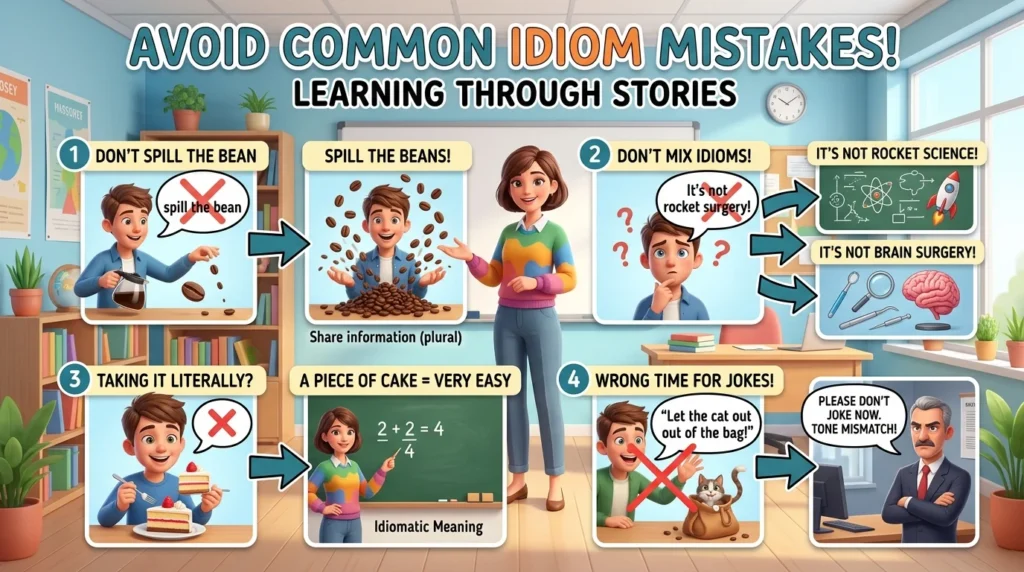
Taking an Idiom Literally
If a character says:
“This exam is a piece of cake.”
the reader should understand that the exam is easy.
Changing a Fixed Expression
Idioms generally have established wording.
Incorrect: She spilled the bean.
Correct: She spilled the beans.
Mixing Two Idioms
Don’t accidentally combine expressions.
Incorrect: He was barking up the wrong beans.
Correct: He was barking up the wrong tree.
Using the Wrong Tone
An idiom can sound playful, informal, dramatic, or conversational. Make sure that tone fits the scene.
For example, “when pigs fly” may work perfectly in a humorous conversation but feel out of place in a solemn scene.
Overusing Idioms
If every character speaks in idioms, the story can sound artificial. Choose expressions because they add something—not simply because you know them.
How to Learn Idioms Through Stories
The easiest way to turn passive vocabulary into active vocabulary is to study idioms in context.
Try this five-step method:
- Choose three idioms.
- Learn their figurative meanings.
- Read examples in a story or conversation.
- Write your own short scene.
- Read it aloud and remove any idiom that feels forced.
For example, choose break the ice, spill the beans, and on cloud nine. Write a short birthday-party scene and use each expression naturally.
This teaches you not only what the idiom means, but also how it sounds when real characters use it.
Frequently Asked Questions About Idioms in Stories
How do you put an idiom into a story?
Choose an idiom that matches the situation, character, and tone. Introduce it naturally through dialogue or narration and provide enough context for readers to understand its figurative meaning.
What is an example of an idiom used in a story?
For example: “Tom spilled the beans about the surprise party.” Here, “spilled the beans” means Tom revealed the secret.
Why do authors use idioms in stories?
Authors use idioms to make dialogue more natural, express emotions efficiently, create vivid imagery, and give characters a recognizable voice.
Are idioms suitable for children’s stories?
Yes. Simple expressions such as a piece of cake, break the ice, and on cloud nine can introduce children to figurative language in an engaging way. The story context helps explain the meaning.
Should I use many idioms in one story?
Not necessarily. A few well-chosen idioms are usually more effective than filling every paragraph with expressions. Natural usage is more important than quantity.
Conclusion
Idioms in stories can make characters sound more natural and help readers experience emotions, humor, conflict, and relationships more vividly. Expressions such as “spill the beans,” “break the ice,” “bite the bullet,” and “on cloud nine” can say a lot in just a few words.
The key is context. Don’t add an idiom simply to make your writing sound clever. Choose one because it fits the character, situation, tone, and purpose of the scene.
Start with three idioms, write a short conversation, and see how naturally you can make them fit. With regular practice, idioms can become a useful part of your storytelling vocabulary rather than something you simply memorize.

Daniel Mercer is a Meaning Match writer covering English idioms, vocabulary, expressions, and language usage with clear meanings and practical examples.