
Have you ever read a book and come across a phrase that seems strange because its words do not mean exactly what they say? Idioms in books can make stories more colorful and natural, but they can also confuse readers who are unfamiliar with their figurative meanings.
An idiom is a phrase whose meaning is different from the literal meaning of its individual words. For example, when a character says “break a leg,” they usually are not talking about an actual injury; the expression is commonly used to wish someone good luck, especially before a performance. Authors use idioms in dialogue, narration, and descriptions to make language sound more natural and expressive.
For students and English learners, finding idioms in books is also a useful way to see how these expressions work in context. In this guide, you’ll discover common idioms in books, their meanings, examples, and tips for understanding figurative language while reading.
What Are Idioms in Books?
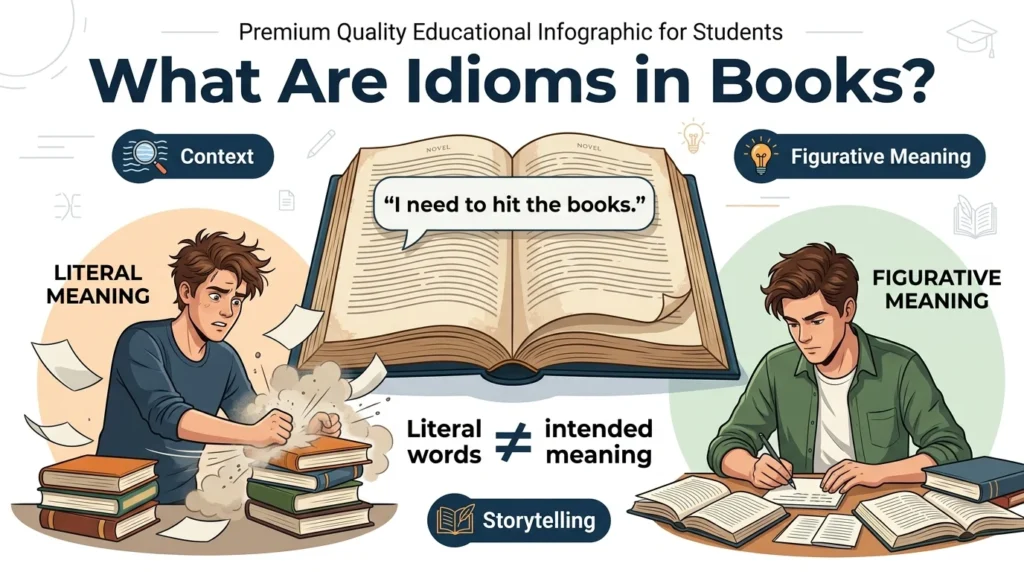
Idioms in books are familiar expressions used in novels, stories, children’s books, memoirs, and other writing where the figurative meaning is different from the literal meaning of the individual words.
For example, “spill the beans” does not mean dropping beans on the floor. It means revealing a secret.
Books use many of the same idioms people use in everyday English. They commonly appear in character dialogue, but authors can also use them in narration to create a particular voice, mood, or style.
Why Are Idioms Used in Books?
Authors use idioms to make dialogue sound natural, express ideas quickly, reveal character personality, add emotion, and make storytelling more vivid. Readers can usually understand an unfamiliar idiom by examining the surrounding context, the speaker’s situation, and the overall meaning of the scene.
Why Do Authors Use Idioms in Stories and Novels?
An idiom can communicate an idea more naturally than a plain statement.
Compare:
She was very nervous.
with:
She was on edge.
The second expression creates a stronger sense of tension.
Idioms can also tell readers something about a character. A casual character might say “piece of cake,” while a serious narrator may choose more formal language.
Authors also use idiomatic expressions to:
- Make conversations sound realistic
- Show personality and emotion
- Add humor or emphasis
- Create a familiar conversational tone
- Reflect culture or time period
- Make descriptions more memorable
- Help readers understand relationships between characters
Common and Famous Idioms You May Find in Books
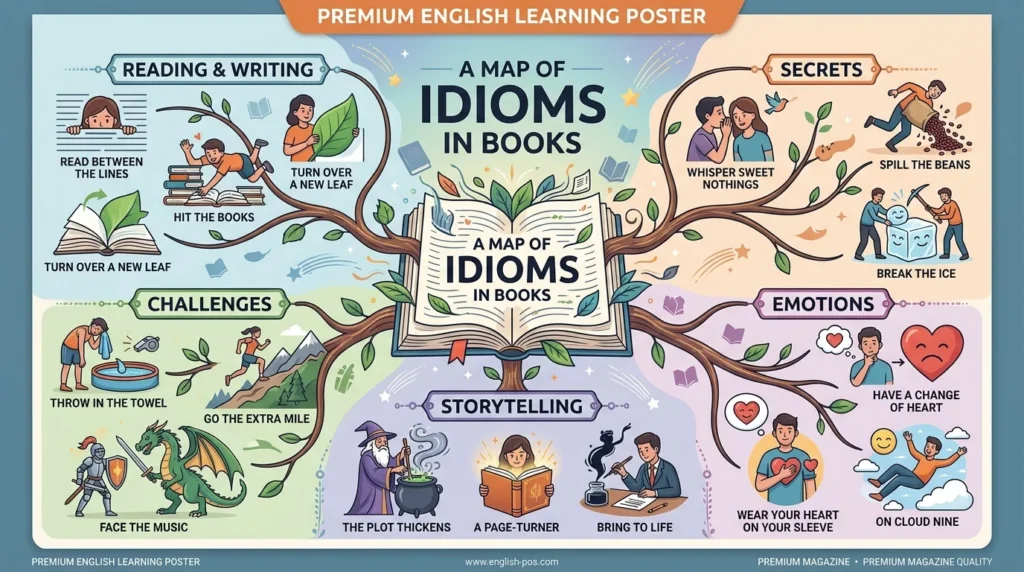
These are widely recognized English idioms that can naturally appear in stories, novels, dialogue, and other written contexts.
Read Between the Lines
Word-by-word meaning: Look between written lines.
Idiomatic meaning: Look for an implied or hidden meaning rather than accepting only the obvious words.
Example in a book context:
The detective told Mia to read between the lines of the mysterious letter.
Common error: It doesn’t simply mean “read carefully.” It suggests looking beyond the literal message.
Usage note: This idiom is particularly useful in mysteries, literary analysis, messages, and conversations containing hidden meaning.
Hit the Books
Word-by-word meaning: Physically strike books.
Idiomatic meaning: Study seriously.
Example in a book context:
Before the final exam, the young character decided to hit the books instead of going out.
Common error: Don’t use it in formal academic writing when a straightforward phrase such as “study” would be more appropriate.
Usage note: It is informal and especially common in conversations about school and exams.
Turn Over a New Leaf
Word-by-word meaning: Turn to a new page or leaf.
Idiomatic meaning: Make a fresh start and change your behavior.
Example in a book context:
After years of trouble, the character promised to turn over a new leaf.
Common error: It does not literally describe turning a page.
Usage note: This expression works especially well in stories about personal growth, second chances, and change.
The Plot Thickens
Word-by-word meaning: A plot becomes thicker.
Idiomatic meaning: A situation becomes more complicated or interesting.
Example in a book context:
Another clue appeared, and suddenly the plot thickened.
Common error: Don’t use it for every small development. It normally suggests increasing complexity or intrigue.
Usage note: It fits mysteries, suspense, detective stories, and complicated situations particularly well.
A Page-Turner
Word-by-word meaning: Something that makes you turn pages.
Idiomatic meaning: A book that is so engaging that you want to keep reading.
Example in a book context:
The mystery was such a page-turner that I finished it in one night.
Common error: A page-turner describes an engaging book, not simply any book with pages.
Usage note: This is useful when discussing or recommending exciting fiction.
Open a Can of Worms
Word-by-word meaning: Open a container of worms.
Idiomatic meaning: Create a complicated or troublesome situation by dealing with a particular issue.
Example in a book context:
Asking about the family’s past opened a can of worms.
Common error: Don’t use it merely to describe an interesting topic. It usually suggests unwanted complications.
Usage note: This informal expression works naturally in dialogue.
Once in a Blue Moon
Word-by-word meaning: Something occurring during a blue moon.
Idiomatic meaning: Very rarely.
Example in a book context:
The old friends met once in a blue moon, but their friendship remained strong.
Common error: It doesn’t mean something happens regularly.
Usage note: Use it to emphasize that an event is unusual or infrequent.
A Piece of Cake
Word-by-word meaning: A portion of cake.
Idiomatic meaning: Something very easy.
Example in a book context:
For the experienced detective, solving the simple puzzle was a piece of cake.
Common error: The phrase is not about food when it describes the difficulty of a task.
Usage note: It is informal and best suited to conversational contexts.
Spill the Beans
Word-by-word meaning: Drop or scatter beans.
Idiomatic meaning: Reveal a secret.
Example in a book context:
“Who spilled the beans about the surprise?” Sarah asked.
Common error:
- ❌ Spill the bean
- ✅ Spill the beans
Usage note: This informal idiom is especially natural in dialogue involving secrets or surprises.
Break the Ice
Word-by-word meaning: Break ice.
Idiomatic meaning: Make people feel more comfortable in a new or awkward social situation.
Example in a book context:
His joke helped break the ice when the two strangers first met.
Common error: It does not simply mean destroying ice.
Usage note: Authors often use it when introducing characters or showing an awkward first meeting.
Cost an Arm and a Leg
Word-by-word meaning: Cost someone’s arms and legs.
Idiomatic meaning: Be extremely expensive.
Example in a book context:
The rare first edition cost an arm and a leg.
Common error: Use it for something extremely expensive, not merely something that costs a little more than expected.
Usage note: It is an informal expression used for strong emphasis.
Bite the Bullet
Word-by-word meaning: Bite a bullet.
Idiomatic meaning: Face something difficult or unpleasant with courage.
Example in a book context:
The hero had to bite the bullet and admit the truth.
Common error: It doesn’t literally describe biting something.
Usage note: It suits scenes involving difficult decisions, challenges, or unavoidable situations.
Keep an Eye On
Word-by-word meaning: Keep one eye looking at something.
Idiomatic meaning: Watch or monitor someone or something.
Example in a book context:
“Keep an eye on the door,” the detective whispered.
Common error: The usual expression is keep an eye on, not “keep an eye to” in this meaning.
Usage note: It is common in everyday dialogue and informal storytelling.
In the Same Boat
Word-by-word meaning: Be in the same boat.
Idiomatic meaning: Be in the same situation, especially a difficult one.
Example in a book context:
“We’re in the same boat, so we need to help each other,” she said.
Common error: It does not have to involve an actual boat.
Usage note: The idiom emphasizes shared circumstances or problems.
Go the Extra Mile
Word-by-word meaning: Travel an additional mile.
Idiomatic meaning: Make more effort than is normally expected.
Example in a book context:
The librarian went the extra mile to find the missing manuscript.
Common error: Completing an ordinary responsibility is not necessarily “going the extra mile.”
Usage note: Use it when someone makes an additional effort to help or achieve something.
A Blessing in Disguise
Word-by-word meaning: A blessing hidden by a disguise.
Idiomatic meaning: Something that initially seems unfortunate but eventually has a positive result.
Example in a book context:
Missing the train seemed terrible, but it became a blessing in disguise when the accident occurred later.
Common error: It doesn’t mean every bad event will eventually turn out well.
Usage note: This idiom is effective in stories involving unexpected consequences or second chances.
Throw in the Towel
Word-by-word meaning: Throw a towel into a place.
Idiomatic meaning: Give up or stop trying.
Example in a book context:
Even after several failures, the young inventor refused to throw in the towel.
Common error: Don’t use it simply for taking a break.
Usage note: It is informal and often appears in stories involving challenges, competitions, or struggles.
Barking Up the Wrong Tree
Word-by-word meaning: A dog is barking at the wrong tree.
Idiomatic meaning: Follow the wrong idea, suspect the wrong person, or pursue the wrong course of action.
Example in a book context:
“If you think Daniel stole the manuscript, you’re barking up the wrong tree,” the detective said.
Common error: It means more than simply “making a mistake”; it suggests choosing the wrong target or assumption.
Usage note: It works particularly well in mystery and detective stories.
Put Two and Two Together
Word-by-word meaning: Combine two and two.
Idiomatic meaning: Connect pieces of information and reach a conclusion.
Example in a book context:
After examining the clues, the detective put two and two together.
Common error: It is not normally used for a literal arithmetic problem.
Usage note: This is especially useful when a character finally understands how several clues or events are connected.
Have a Change of Heart
Word-by-word meaning: Experience a change in the heart.
Idiomatic meaning: Change your feelings, attitude, or decision, often because of an emotional realization.
Example in a book context:
The villain had a change of heart and decided to protect the child.
Common error: It usually involves an emotional or moral change, not just changing your mind about a minor choice.
Usage note: This idiom works well in stories involving character development, forgiveness, or redemption.
Books With Idioms: Fun Reads That Make Idioms Easy to Learn
How Idioms Work in Different Types of Books
Idioms can have different effects depending on the kind of book and the people using them.
Fiction and Novels
In general fiction, idioms make conversations feel natural and help establish character voice.
Mystery and Detective Books
Expressions such as “put two and two together” and “barking up the wrong tree” can fit scenes involving clues, suspects, and investigation.
Children’s Books
Simple idioms can introduce young readers to figurative language while making stories playful and memorable.
Historical Fiction
Authors need to consider the historical setting. A modern expression may sound unnatural if it does not fit the period being portrayed.
Memoirs and Contemporary Stories
Everyday idioms can create a personal, conversational tone and make the narrator sound approachable.
How to Understand an Idiom While Reading
You don’t have to stop reading every time you encounter an unfamiliar expression. Use the surrounding story as a set of clues.
Try This 6-Step Method
- Read the complete sentence.
- Read the sentences before and after it.
- Ask whether the literal meaning makes sense.
- Notice the speaker’s emotion and situation.
- Guess the figurative meaning from context.
- Check the definition and create your own example.
For example, if a character says, “That car cost an arm and a leg,” and the surrounding paragraph discusses an extremely high price, the context helps you understand that the expression means very expensive.
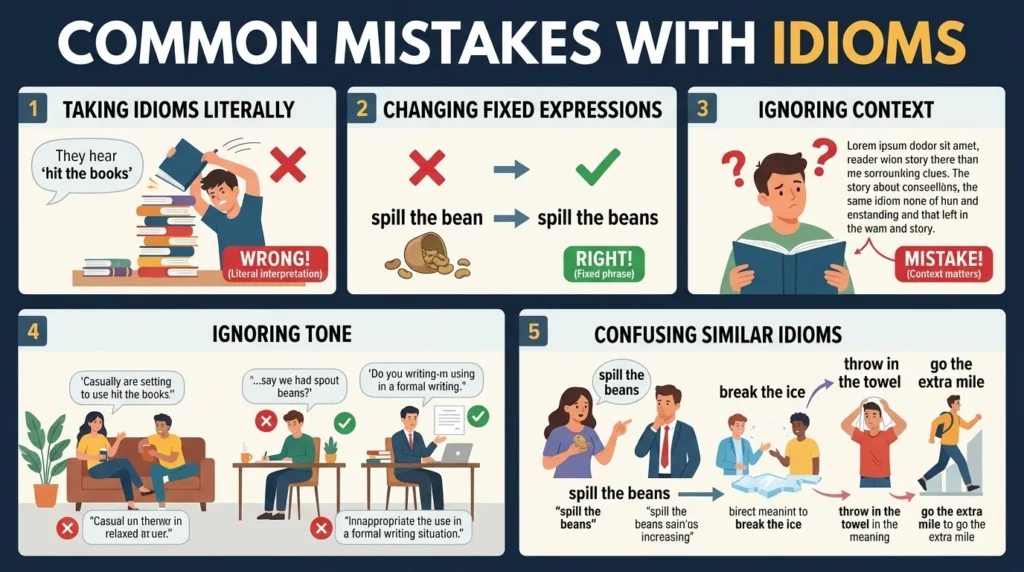
Common Mistakes With Idioms in Books
Taking Idioms Literally
If a character says “hit the books,” the character is probably studying—not attacking textbooks.
Changing Fixed Expressions
Idioms usually have established forms.
- ❌ Spill the bean
- ✅ Spill the beans
- ❌ Break the ice cubes
- ✅ Break the ice
Ignoring Context
An idiom can have a figurative meaning that only becomes clear from the surrounding scene. Always consider what the characters are discussing.
Ignoring Tone
Some idioms are informal. “Piece of cake” sounds natural in casual dialogue but may not fit a formal academic statement.
Confusing Similar Idioms
Related expressions are not automatically interchangeable.
- Spill the beans → reveal a secret
- Break the ice → make a social situation more comfortable
- Throw in the towel → give up
- Go the extra mile → make extra effort
Idioms in Dialogue vs. Narration
Idioms often appear in dialogue because real people naturally use familiar expressions.
“Don’t worry. It’s a piece of cake,” Tom said.
But authors can also use them in narration:
Solving the final puzzle was a piece of cake for the experienced detective.
The same idiom can therefore contribute to either a character’s voice or the narrator’s style.
Idioms and Figurative Language: What’s the Difference?
Idioms are a type of established figurative expression, but not every example of figurative language is an idiom.
For example:
- Idiom: “Turn over a new leaf”
- Simile: “Her voice was like music.”
- Metaphor: “The classroom was a zoo.”
- Personification: “The wind whispered through the trees.”
The important difference is that an idiom has a recognized expression and meaning that cannot normally be understood simply by adding together the literal meanings of its words.
Idioms Anchor Chart 3rd Grade: Make Tricky Idioms Easy
How Students Can Learn Idioms From Books
Reading idioms in context is often more useful than memorizing isolated lists.
When you find a new expression, record four things:
| What to Note | Example |
|---|---|
| Idiom | Spill the beans |
| Meaning | Reveal a secret |
| Context | A character reveals surprise-party information |
| Your example | Don’t spill the beans before Friday. |
Then look for the same idiom again while reading. Seeing an expression in several contexts can make its meaning, tone, and usage easier to remember.
FAQs About Idioms in Books
What are idioms in books?
Idioms in books are established expressions whose figurative meaning differs from their literal words. Authors use them in dialogue and narration to make writing natural and expressive.
Why do authors use idioms in books?
Authors use idioms to create realistic dialogue, express ideas efficiently, reveal character personality, add emotion, and make storytelling more engaging.
How can I identify an idiom while reading?
Look for expressions that seem strange or confusing when interpreted literally. Then use the surrounding sentences, characters, emotions, and situation to work out the figurative meaning.
Are idioms and metaphors the same?
No. Both can use figurative language, but an idiom is a recognized expression with an established figurative meaning. A metaphor generally creates a comparison without necessarily being a fixed expression.
How can students learn idioms from books?
Write down unfamiliar idioms with their meanings and the context in which they appear. Then create your own sentence and notice how the expression is used in other stories or conversations.
Final Thoughts
Idioms in books give readers more than unfamiliar phrases to memorize—they offer clues about characters, emotions, culture, tone, and the deeper meaning of a scene.
The next time a sentence sounds strange when you interpret every word literally, pause before moving on. Read the surrounding passage, consider the situation, and ask what the writer or character is really trying to communicate.
Start with these expressions, notice them during your reading, and practice using a few in your own sentences. Once you learn to recognize idioms in context, both books and everyday English can become much easier and more enjoyable to understand.

Clara Bennett writes for Meaning Match about English idioms, everyday expressions, meanings, and practical language usage, making phrases easy to understand.