
Ever read something twice and still have no idea what it means? Idioms for confused give you more natural ways to describe being unsure, unable to understand something, mentally foggy, or stuck over a decision. Expressions such as “at a loss,” “in a fog,” “all mixed up,” and “can’t make heads or tails of it” are related to confusion, but they are not interchangeable.
“At a loss” often means not knowing what to say or do, while “can’t make heads or tails of it” means you cannot understand something. For example, you might be at a loss when you do not know how to respond, but you might not be able to make heads or tails of it when a confusing explanation makes no sense.
If you’re searching for idioms for confused for writing, conversation, captions, stories, or everyday English, choosing the right expression can help you describe the exact kind of confusion you mean. In this guide, you’ll learn common idioms and expressions for confusion, see clear examples, and discover which phrases work best for mental fog, uncertainty, misunderstanding, and indecision.
What Are the Best Idioms for Confused?
The best expression depends on why you are confused:
- In a fog — you cannot think clearly.
- Stumped — you cannot find an answer or solve a problem.
- Mixed up — you have confused people, details, or information.
- All at sea — you feel generally lost or uncertain.
- Can’t make head or tail of it — you cannot understand something.
- Can’t get your head around it — you cannot understand or accept something.
- My head is spinning — you feel overwhelmed by too much information.
- In two minds — you cannot decide between options.
- At a loss — you do not know what to say or do.
- Clear as mud — something is extremely unclear, often said sarcastically.
These expressions are related to confusion, but they are not exact synonyms. Choosing the one that matches your situation makes your English sound much more natural.
Idioms and Expressions for Confused
In a Fog
Meaning:
To feel unable to think clearly or understand what is happening.
Example sentences:
- I was in a fog after studying all night.
- She seemed in a fog during the meeting.
Common mistake:
Don’t assume it only means physical tiredness. It can describe mental confusion or unclear thinking.
Usage note:
This is a natural everyday expression when your thoughts feel unclear. It can also suggest tiredness, stress, or mental overload.
Stumped
Meaning:
To be unable to answer a question or solve a problem.
Example sentences:
- That last question really stumped me.
- The entire team was stumped by the unexpected problem.
Common mistake:
Stumped usually refers to a specific problem, question, or challenge. It is less suitable when you simply feel generally confused.
Usage note:
Use it when you have tried to find an answer but cannot.
Best for: Questions, puzzles, exams, problems, and challenges.
Mixed Up
Meaning:
To confuse people, things, facts, dates, or information with one another.
Example sentences:
- I got the two appointments mixed up.
- Sorry, I mixed up your name with your sister’s.
Common mistake:
Don’t use mixed up as a universal replacement for confused. It often involves confusing one thing with another.
Usage note:
This is one of the easiest and most useful expressions for everyday English.
Can’t Make Head or Tail of Something
Meaning:
To be unable to understand something at all.
Example sentences:
- I can’t make head or tail of these instructions.
- She couldn’t make head or tail of the complicated report.
Common mistake:
Don’t use it simply because something is difficult. It suggests that you cannot understand what something means or how it fits together.
Usage note:
This is especially useful for confusing instructions, documents, explanations, or messages.
All at Sea
Meaning:
To feel completely lost, confused, or uncertain about what to do.
Example sentences:
- I felt all at sea during my first week at university.
- She was all at sea after the manager changed the entire plan.
Common mistake:
It does not mean ordinary mild confusion. It usually suggests feeling lost or uncertain about a situation.
Usage note:
This expression has a vivid nautical image and is especially useful when someone lacks direction.
Scratch Your Head
Meaning:
To feel puzzled and wonder how something can be explained or solved.
Example sentences:
- The strange result left everyone scratching their heads.
- I was scratching my head over his unusual answer.
Common mistake:
It does not necessarily describe serious confusion. It can describe mild puzzlement too.
Usage note:
This is informal and very natural in conversation.
My Head Is Spinning
Meaning:
To feel mentally overwhelmed or confused because there is too much information, activity, or emotion to process.
Example sentences:
- There were so many choices that my head was spinning.
- After reading all those instructions, my head is spinning.
Common mistake:
The phrase can describe physical dizziness in some contexts, so the surrounding situation determines the meaning.
Usage note:
Use it when confusion comes from information overload or too much happening at once.
In a Muddle
Meaning:
To be confused, disorganized, or unable to put your thoughts or plans in order.
Example sentences:
- My notes are in a muddle, so I can’t find anything.
- I’m in a muddle about what to do next.
Common mistake:
A muddle can describe either mental confusion or a disorganized situation.
Usage note:
This expression is particularly common in British English.
Go Round in Circles
Meaning:
To keep thinking, talking, or working without making progress.
Example sentences:
- We’ve been going round in circles for an hour.
- I’m going round in circles trying to solve this problem.
Common mistake:
This does not directly mean “confused.” It describes lack of progress, often because the person doesn’t know how to move forward.
Usage note:
Use it when confusion or uncertainty keeps a discussion or task from reaching a solution.
In Two Minds
Meaning:
To be unable to decide because you are considering two different choices.
Example sentences:
- I’m in two minds about accepting the job.
- She was in two minds about moving to another city.
Common mistake:
It does not mean that someone literally has two minds or is generally confused.
Usage note:
This expression is best for indecision, not ordinary misunderstanding.
Up in the Air
Meaning:
Something is uncertain, unsettled, or not yet decided.
Example sentences:
- Our travel plans are still up in the air.
- The final decision is up in the air.
Common mistake:
It doesn’t directly mean that a person is confused. It describes an uncertain situation or outcome.
Usage note:
Use it when the future of a plan or decision has not been settled.
Can’t Get Your Head Around Something
Meaning:
To be unable to understand, accept, or mentally process something.
Example sentences:
- I can’t get my head around how this machine works.
- She couldn’t get her head around the sudden change.
Common mistake:
It usually suggests difficulty understanding or accepting an idea, rather than simply forgetting a fact.
Usage note:
This is an excellent everyday expression when something seems difficult to comprehend.
Best for: Complicated ideas, unexpected situations, rules, systems, or changes.
Lost the Plot
Meaning:
To lose track of what is happening or become confused about a situation.
Example sentences:
- I lost the plot halfway through the explanation.
- With all those changes, I completely lost the plot.
Common mistake:
It does not only refer to films or books.
Usage note:
This is informal and particularly common in British English. Depending on context, it can also suggest that someone has started behaving irrationally.
Draw a Blank
Meaning:
To be unable to remember or think of an answer when you need it.
Example sentences:
- I drew a blank when the interviewer asked me the question.
- I know her name, but I’m drawing a blank right now.
Common mistake:
It normally describes a temporary failure to remember or produce an answer, not permanent ignorance.
Usage note:
Use this when the answer seems to have disappeared from your mind.
32+Idioms About Sadness: Ways to Express How You Feel
Out of Your Depth
Meaning:
To be in a situation that is too difficult or unfamiliar for your current knowledge or experience.
Example sentences:
- I felt out of my depth in the advanced programming class.
- She was out of her depth during the complicated negotiation.
Common mistake:
Don’t use it for every small mistake. It suggests that the situation is significantly beyond your experience or ability.
Usage note:
This expression combines uncertainty, difficulty, and lack of experience rather than simply meaning “confused.”
Clear as Mud
Meaning:
Something is extremely unclear or difficult to understand.
Example sentences:
- His explanation was clear as mud.
- The instructions are as clear as mud.
Common mistake:
This is usually sarcastic. It does not genuinely mean that something is clear.
Usage note:
Use it informally when an explanation, instruction, or message has made something more confusing rather than less.
Don’t Know Which Way Is Up
Meaning:
To feel extremely confused, disoriented, or overwhelmed.
Example sentences:
- After moving to a completely new city, I didn’t know which way was up.
- With three deadlines approaching, I don’t know which way is up.
Common mistake:
It usually describes figurative confusion rather than literal physical disorientation.
Usage note:
This expression is stronger than simply saying “I’m confused.”
Bamboozled
Meaning:
To be completely confused, puzzled, or sometimes tricked.
Example sentences:
- I was completely bamboozled by the complicated instructions.
- The unusual question bamboozled everyone.
Common mistake:
Bamboozled can mean confused, but it can also imply that someone has been fooled or deceived.
Usage note:
This is informal and often playful or humorous. It is useful in casual conversation but may sound too light for serious or formal situations.
At a Loss
Meaning:
To have no idea what to say, do, or think in a particular situation.
Example sentences:
- I was at a loss for words after hearing the news.
- When the computer suddenly stopped working, I was at a loss about what to do.
Common mistake:
At a loss does not necessarily mean you don’t understand something. It often means you don’t know how to respond or what action to take.
Usage note:
This expression is versatile and can work in both everyday and relatively formal contexts.
Perplexed
Meaning:
To be very puzzled or confused because something is difficult to understand.
Example sentences:
- I was perplexed by the strange instructions.
- The unexpected result left the researchers perplexed.
Common mistake:
Perplexed is not normally used for simple mistakes such as forgetting an appointment.
Usage note:
It is more formal than bamboozled or mixed up, making it useful in more polished writing.
Which Idiom for Confused Should You Use?
The easiest way to choose the right expression is to identify the type of confusion you are experiencing.
| Situation | Best Expression | What It Means |
|---|---|---|
| You can’t think clearly | In a fog | Your thoughts aren’t clear |
| You can’t solve a problem | Stumped | You can’t find an answer |
| You confuse two things | Mixed up | You mistake one thing for another |
| You can’t understand something | Can’t make head or tail of it | You cannot understand it |
| You feel generally lost | All at sea | You don’t know what to do |
| You’re mildly puzzled | Scratch your head | You wonder how something works |
| Too much information overwhelms you | My head is spinning | Your mind feels overloaded |
| Your thoughts or plans are disorganized | In a muddle | Things are confused or messy |
| You’re making no progress | Go round in circles | You keep repeating the same process |
| You can’t decide | In two minds | You’re uncertain between choices |
| A decision isn’t settled | Up in the air | The outcome remains uncertain |
| You can’t understand an idea | Can’t get your head around it | You struggle to comprehend it |
| You lose track of a situation | Lost the plot | You no longer understand what’s happening |
| You can’t remember an answer | Draw a blank | Your memory fails temporarily |
| Something is beyond your experience | Out of your depth | You lack the knowledge or skill |
| An explanation is terrible | Clear as mud | Something is very unclear |
| You’re extremely disoriented | Don’t know which way is up | You’re completely lost |
| You’re completely puzzled | Bamboozled | You’re very confused |
| You don’t know what to do | At a loss | You have no idea how to respond |
| Something puzzles you deeply | Perplexed | You’re seriously puzzled |
Idioms for Different Levels of Confusion
Not every expression describes the same intensity.
Mild Confusion or Puzzlement
Use:
- Scratch your head
- Perplexed
- Stumped
These can describe a specific question or unusual situation.
Moderate Confusion
Use:
- In a fog
- Mixed up
- In a muddle
- Bamboozled
These work when you cannot think clearly or organize information.
Strong Confusion or Disorientation
Use:
- All at sea
- My head is spinning
- Don’t know which way is up
These suggest that the situation feels overwhelming or difficult to manage.
Confusion Caused by a Decision
Use:
- In two minds
- Up in the air
These are better for uncertainty and indecision than ordinary confusion.
Idioms About Hope: 30+ Ways to Express Optimism
Confused vs. Puzzled, Uncertain, and Overwhelmed
These words and expressions overlap, but they are not identical.
Confused vs. Puzzled
Confused usually means you don’t understand something clearly.
Puzzled often describes a milder feeling when something seems strange or difficult to explain.
I’m confused about these instructions.
I’m puzzled by his sudden reaction.
Confused vs. Uncertain
Confused often involves a lack of understanding.
Uncertain means you aren’t sure about a decision, result, or future event.
I’m confused by the instructions.
I’m uncertain about which option to choose.
This is why in two minds and up in the air are related to confusion but should not be treated as direct synonyms.
Confused vs. Overwhelmed
Overwhelmed means you feel unable to cope because there is too much to handle.
For example:
I have six assignments due tomorrow. I’m overwhelmed.
In this situation, you might naturally add:
My head is spinning.
The first describes the emotional state, while the second emphasizes the mental overload.
How to Use Idioms for Confused Naturally
Learning an idiom is not just about memorizing its definition. You also need to understand context, tone, grammar, and intensity.
Learn the Situation, Not Just the Definition
Instead of memorizing:
stumped = confused
learn:
That question really stumped me.
Instead of:
in two minds = confused
learn:
I’m in two minds about accepting the offer.
This helps you remember when the expression actually belongs in a sentence.
Pay Attention to Tone
Some expressions are neutral or fairly standard:
- Perplexed
- At a loss
- In a fog
Others are informal or playful:
- Bamboozled
- Clear as mud
- Lost the plot
Don’t use a playful expression when discussing a serious situation unless the tone allows it.
Don’t Force an Idiom Into Every Sentence
Native speakers do not use idioms constantly.
Sometimes:
I’m confused.
is better than:
I’m completely bamboozled and don’t know which way is up.
Use an idiom when it adds useful meaning, personality, or emphasis.
Think About the Reason for Your Confusion
Before choosing an expression, ask:
Can’t understand?
→ Can’t make head or tail of it.
Can’t solve it?
→ Stumped.
Can’t decide?
→ In two minds.
Too much information?
→ My head is spinning.
Confused two things?
→ Mixed up.
This simple method makes your word choice much more precise.
Common Mistakes When Using Confusion Idioms
Treating Every Idiom as an Exact Synonym
In two minds, stumped, and mixed up all relate to confusion, but they describe different situations.
Ignoring Tone
Bamboozled can sound humorous, while perplexed sounds more formal.
Using “Up in the Air” for Personal Confusion
If you don’t understand your homework, don’t say:
“My homework is up in the air.”
Say:
“I can’t make head or tail of my homework.”
Up in the air is better for an unresolved plan or decision.
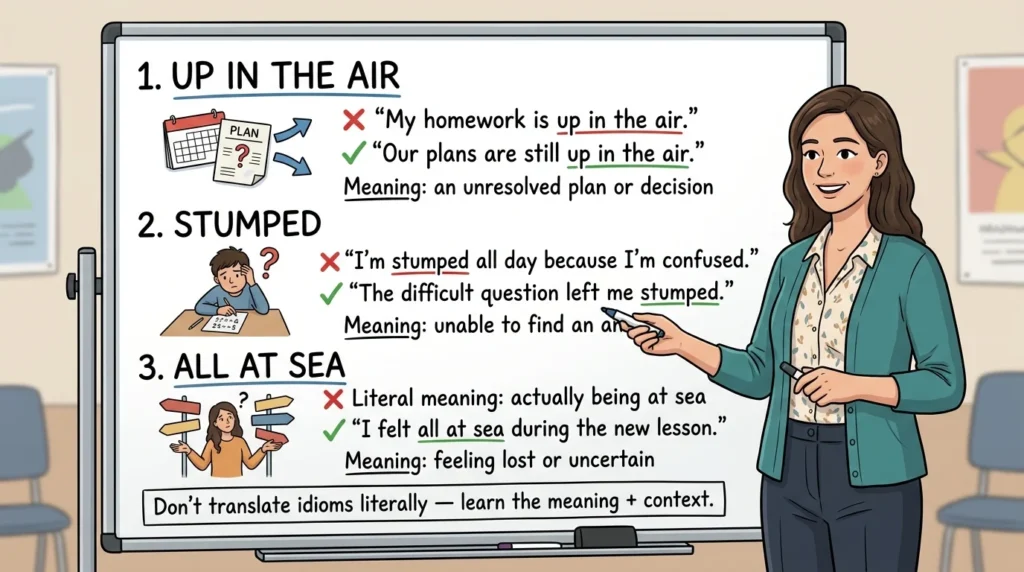
Using “Stumped” for General Confusion
If you feel confused throughout an entire meeting, in a fog may be more appropriate.
If one difficult question stops you from finding the answer, stumped is better.
Taking Expressions Literally
When someone says:
“I’m all at sea.”
they usually aren’t actually on a boat. The expression means they feel lost or uncertain.
Understanding the figurative meaning is essential.
FAQs About Idioms for Confused
What is the best idiom for confused?
There is no single best idiom because different expressions describe different types of confusion. In a fog works for unclear thinking, stumped for unsolved problems, and can’t make head or tail of it for something you cannot understand.
What is an idiom for being very confused?
All at sea, my head is spinning, and don’t know which way is up can describe strong confusion or disorientation.
What idiom means confused and unable to decide?
In two minds is a common expression for being unable to decide between two choices.
What idiom means you cannot understand something?
Can’t make head or tail of something and can’t get your head around something are excellent choices when something is difficult to understand.
What is a funny idiom for confused?
Bamboozled can sound playful and humorous. Clear as mud is also a funny, usually sarcastic way to describe an explanation that is extremely unclear.
Conclusion
The best idioms for confused depend on the exact situation. If you cannot understand something, say you can’t make head or tail of it or can’t get your head around it. If a difficult question has you stuck, you are stumped. If you have too much information to process, your head is spinning. And if you cannot decide between two choices, you may be in two minds.
Don’t try to memorize all 20 expressions at once. Start with five that match situations you actually experience, write your own sentences, and use them in conversation. Once you understand the difference between each expression, your English will sound more precise, natural, and confident.

Sophie Collins writes for Meaning Match about English idioms, American and British expressions, meanings, usage, and everyday language differences.