
Sometimes “I’m excited” just doesn’t feel strong enough to describe how you feel. Idioms for excited give you more vivid ways to express eager anticipation, joyful excitement, intense enthusiasm, or the feeling that you can hardly wait for something to happen.
Expressions such as “jump for joy,” “can’t wait,” “on cloud nine,” and “walking on air” are often used when people feel highly positive emotions, but they are not exact synonyms. “Jump for joy” emphasizes a burst of happiness, while “can’t wait” focuses on eagerly looking forward to something. Similarly, “on cloud nine” and “walking on air” usually describe extreme happiness or elation rather than excitement alone.
For example, you might say, “She jumped for joy when she won the prize,” or “I can’t wait to see the new movie.” If you’re searching for idioms for excited for writing, conversation, captions, stories, or everyday English, choosing the right expression can help you show the exact feeling and intensity you mean.
In this guide, you’ll discover common idioms and expressions for excitement, learn their meanings, see natural examples, and find phrases for everything from eager anticipation to overwhelming enthusiasm.
What Are Idioms and Expressions for Excitement?
Idioms and expressions for excitement are phrases that communicate enthusiasm, anticipation, happiness, eagerness, nervousness, or intense emotional energy.
Some are traditional idioms, while others are common fixed expressions or informal phrases. For accuracy, it is better to treat this list as idioms and expressions for excitement rather than claiming every expression is a traditional idiom.
For example:
I’m on cloud nine!
This doesn’t mean you’re literally sitting on a cloud. It means you’re extremely happy and excited.
Common Idioms and Expressions for Excited Feelings
On Cloud Nine
Meaning: Extremely happy or delighted.
Word-by-word image: Being “on cloud nine” creates the image of being high above the ordinary world.
Example:
I was on cloud nine after getting my dream job.
Common mistake: Don’t use it for ordinary or mild happiness.
Usage note: One of the best choices when something wonderful has happened.
Over the Moon
Meaning: Extremely happy and excited about something.
Example:
She was over the moon when she found out she had been accepted.
Common mistake: It describes strong happiness, not simply being interested.
Usage note: Particularly common in British English, although widely understood elsewhere.
. Jumping for Joy
Meaning: Extremely happy and excited.
Example:
The children were jumping for joy when they heard the news.
Common mistake: Don’t use it for a small positive reaction.
Usage note: Best for energetic, obvious happiness, especially after exciting news.
On Top of the World
Meaning: Feeling extremely happy, successful, or confident.
Example:
After winning the competition, Maya felt on top of the world.
Common mistake: It doesn’t literally refer to being physically above the world.
Usage note: Excellent when excitement comes from an achievement or success.
Walking on Air
Meaning: Feeling extremely happy, excited, or delighted.
Example:
He has been walking on air since receiving the award.
Common mistake: Don’t confuse it with literal flying.
Usage note: Often suggests a light, dreamy feeling of happiness.
Thrilled to Bits
Meaning: Extremely pleased or excited.
Example:
My parents were thrilled to bits when I graduated.
Common mistake: It is not normally used for negative or neutral reactions.
Usage note: Informal and especially associated with British English.
Can’t Wait
Meaning: To be extremely eager for something to happen.
Example:
I can’t wait for the concert tomorrow.
Common mistake: It doesn’t literally mean that waiting is impossible.
Usage note: One of the most natural everyday expressions for anticipation.
Raring to Go
Meaning: Very eager and ready to start something.
Example:
The players are raring to go before the final match.
Common mistake: Don’t use it when someone is excited but not actually ready to begin.
Usage note: Perfect for activities, trips, competitions, projects, and new experiences.
Chomping at the Bit
Meaning: Extremely eager or impatient to do something.
Literal image: The expression comes from a horse biting or working against the bit in its mouth.
Example:
The students were chomping at the bit to open their presents.
Common mistake: It emphasizes eagerness and impatience more than happiness.
Usage note: Traditionally written “champing at the bit” as well; “chomping at the bit” is very common in modern usage.
Buzzing with Excitement
Meaning: Full of energetic excitement or anticipation.
Example:
The classroom was buzzing with excitement before the school trip.
Common mistake: “Buzzing” has other meanings, so context matters.
Usage note: Works particularly well for groups, crowds, places, and events.
Pumped Up
Meaning: Very excited, energetic, or enthusiastic.
Example:
I’m pumped up for the game tonight.
Common mistake: Avoid it in highly formal writing.
Usage note: Very common in casual American English, especially around sports, entertainment, and challenges.
Fired Up
Meaning: Very enthusiastic, motivated, or emotionally energized.
Example:
The coach’s speech got the whole team fired up.
Common mistake: Depending on context, “fired up” can also suggest anger.
Usage note: Use context to show whether you mean enthusiasm, motivation, or anger.
Have Butterflies in Your Stomach
Meaning: Feel nervous and excited before an important event.
Example:
I had butterflies in my stomach before giving my presentation.
Common mistake: It does not usually mean pure happiness.
Usage note: Excellent for first dates, interviews, performances, exams, competitions, and public speaking.
On the Edge of Your Seat
Meaning: Extremely interested, excited, or tense about what will happen next.
Example:
The final scene kept us on the edge of our seats.
Common mistake: This expression can describe suspense, so it isn’t always connected to happiness.
Usage note: Especially useful for movies, sports, competitions, and dramatic events.
Going Wild
Meaning: Reacting with extreme excitement or enthusiasm.
Example:
The fans went wild when the singer walked onto the stage.
Common mistake: It can also mean behaving in an uncontrolled way.
Usage note: Most natural when describing excited crowds or dramatic reactions.
Full of Beans
Meaning: Very energetic, lively, and active.
Example:
The kids were full of beans after breakfast.
Common mistake: It does not specifically mean “extremely excited.”
Usage note: This is better understood as a related expression for energetic enthusiasm rather than a direct synonym for excited.
In High Spirits
Meaning: Cheerful, lively, and in a very positive mood.
Example:
Everyone was in high spirits after the successful event.
Common mistake: It describes a positive mood more generally, not necessarily intense excitement.
Usage note: Useful when talking about groups, celebrations, trips, and social occasions.
Tickled Pink
Meaning: Extremely pleased or delighted.
Example:
Grandma was tickled pink by the surprise visit.
Common mistake: The phrase has nothing to do with actually being colored pink.
Usage note: Informal, playful, and often used for pleasant surprises.
Excited as a Kid at Christmas
Meaning: Extremely excited and full of anticipation.
Example:
He was excited as a kid at Christmas when the package arrived.
Common mistake: This is a comparison rather than a traditional fixed idiom.
Usage note: Great for casual conversations when someone is eagerly anticipating something enjoyable.
Blow Your Mind
Meaning: To amaze, astonish, or impress someone greatly.
Example:
Wait until you see the final performance—it will blow your mind.
Common mistake: It doesn’t directly mean “be excited.”
Usage note: This is best treated as a related expression for amazement, often associated with excitement or surprise.
Idioms for Confusion: 30+ Expressions to Describe Feeling Confused
Which Idiom Should You Use?
The easiest way to choose an expression is to identify why you are excited.
| Situation | Best Expression | What It Emphasizes |
|---|---|---|
| You received wonderful news | On cloud nine | Extreme happiness |
| You are extremely delighted | Over the moon | Strong happiness |
| You are eagerly waiting | Can’t wait | Anticipation |
| You are ready to begin | Raring to go | Eagerness |
| You are excited and nervous | Butterflies in your stomach | Nervous excitement |
| You are highly energized | Pumped up | Energy and enthusiasm |
| You are motivated for a challenge | Fired up | Motivation |
| A crowd reacts intensely | Going wild | Collective excitement |
| You are watching suspenseful action | On the edge of your seat | Suspense |
| You feel cheerful after success | On top of the world | Happiness and achievement |
Excited vs. Happy: What’s the Difference?
Happy and excited overlap, but they are not identical.
Happy usually describes a positive emotional state.
Excited often includes energy, anticipation, eagerness, or heightened emotion.
For example:
I’m happy that you visited me.
This expresses pleasure.
I’m excited about our trip tomorrow.
This suggests anticipation and enthusiasm about something coming up.
You can also experience both at the same time:
I’m on cloud nine because I got the job!
The right idiom depends on the emotional detail you want to communicate.
Other Ways to Say “Excited”
Sometimes a synonym is more appropriate than an idiom.
Neutral
- excited
- enthusiastic
- eager
- pleased
Stronger
- thrilled
- delighted
- exhilarated
- overjoyed
- ecstatic
Informal
- pumped
- fired up
- buzzing
- psyched
Choose according to your audience and situation. A phrase such as pumped up sounds natural with friends but may be less suitable in a formal report.
Formal vs. Informal Expressions
Not every expression works equally well in every situation.
Casual Conversation
Use expressions such as:
- can’t wait
- pumped up
- fired up
- going wild
Example:
I can’t wait for the concert!
Neutral or General English
Expressions such as these are broadly useful:
- thrilled
- eager
- on cloud nine
- on top of the world
More Formal Writing
In academic or professional writing, direct vocabulary is often clearer:
- enthusiastic
- eager
- delighted
- highly motivated
Instead of:
The employees were pumped up about the project.
A formal version could be:
The employees were highly enthusiastic about the project.
American and British English Usage
Some expressions are more strongly associated with particular varieties of English.
Often associated with British English:
- over the moon
- thrilled to bits
Common in informal American English:
- pumped up
- fired up
Many expressions, including on cloud nine, can’t wait, jumping for joy, and butterflies in your stomach, are widely understood across English-speaking regions.
Regional preference does not mean other speakers won’t understand the expression.
Idioms for Crying: 30+ Ways to Describe Crying
Idioms for Excited in Real Conversations
Seeing an expression in context makes it easier to remember.
After getting a new job:
A: How do you feel about the offer?
B: I’m on cloud nine!
Before a vacation:
A: Are you ready for Friday?
B: Absolutely. I can’t wait!
Before a competition:
A: Nervous?
B: A little. I have butterflies in my stomach, but I’m ready.
Before starting an activity:
A: Want to get started?
B: Definitely. I’m raring to go!
After a winning goal:
The fans went wild when the final goal was scored.
Common Mistakes When Using Excitement Idioms
Don’t Treat Every Expression as an Exact Synonym
On cloud nine means extreme happiness, while raring to go means eagerness to start.
Match the Strength
Don’t say you’re jumping for joy when you only feel mildly pleased.
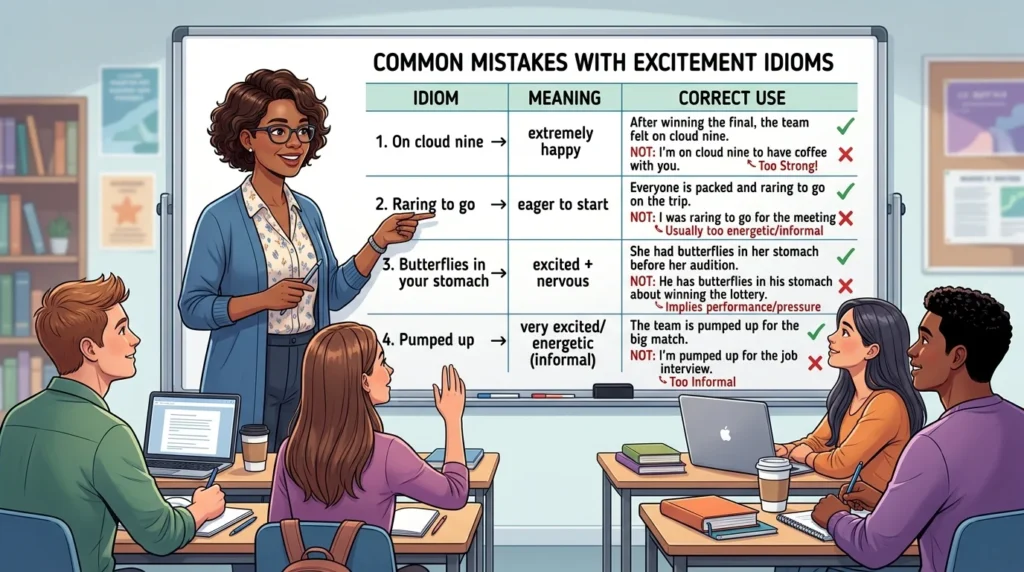
Pay Attention to Tone
Pumped up and going wild are informal. They may sound unnatural in formal academic writing.
Remember That Excitement Can Include Nervousness
Butterflies in your stomach is ideal when anticipation and nervousness happen together.
Don’t Force an Idiom Into Every Sentence
Sometimes the simple word excited is the clearest choice. Natural English is not about replacing every ordinary word with an idiom.
How to Learn These Expressions Naturally
Don’t try to memorize all 20 at once.
Start with five:
- on cloud nine = extremely happy
- can’t wait = very eager for something to happen
- raring to go = ready and eager to start
- pumped up = highly energized
- butterflies in your stomach = nervous and excited
Then create one personal sentence for each.
For example:
I’m on cloud nine because I passed my exam.
Personal examples are easier to remember because you connect the expression with a real situation rather than memorizing an isolated definition.
FAQs About Idioms for Excited
What is the best idiom for being very excited?
On cloud nine and over the moon are excellent choices when excitement comes from extreme happiness or wonderful news.
What idiom means excited and ready to start?
Raring to go means being very eager and ready to begin an activity.
What is an idiom for nervous excitement?
Have butterflies in your stomach describes the nervous, excited feeling you may experience before a presentation, date, interview, exam, or performance.
What is an informal way to say “very excited”?
Depending on the situation, you can say pumped up, fired up, buzzing, or can’t wait.
What is a good idiom for extreme happiness?
On cloud nine, over the moon, on top of the world, and walking on air all express strong happiness, although their nuances differ slightly.
Conclusion
The best idioms for excited depend on the feeling behind your excitement. Use on cloud nine for extreme happiness, can’t wait for anticipation, raring to go for eagerness, pumped up for energetic enthusiasm, and butterflies in your stomach when excitement comes with nerves.
Instead of memorizing every expression at once, choose five, learn their meanings and situations, and use them in your own sentences. With regular practice, these expressions will start sounding natural rather than memorized

Sophie Collins writes for Meaning Match about English idioms, American and British expressions, meanings, usage, and everyday language differences.