
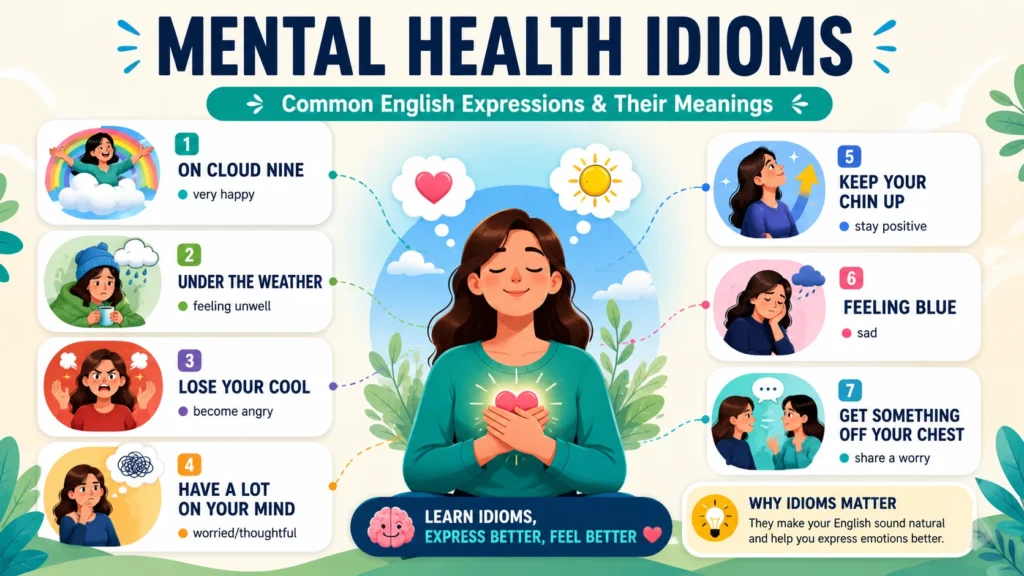
Ever struggled to describe feeling stressed, overwhelmed, emotionally drained, or mentally exhausted without using the same words again and again? Mental health idioms are figurative expressions people use to describe emotional and mental experiences, difficult situations, stress, pressure, and relief in everyday language.
For example, “at the end of my rope” can describe feeling unable to cope, while “a weight off my shoulders” expresses the relief that comes when a burden is lifted.
If you’re searching for mental health idioms, you likely want to find expressions for stress, anxiety, sadness, emotional exhaustion, coping, resilience, and well-being, along with their meanings and real-life examples.
These idioms describe experiences in everyday language; they are not medical terms or diagnoses. In this guide, you’ll discover useful expressions, natural examples, and context tips to help you talk about difficult feelings clearly and thoughtfully.
What Are Mental Health Idioms?
Mental health idioms are figurative expressions connected with emotions, stress, emotional reactions, pressure, and everyday well-being. They are especially common in conversations, books, movies, interviews, and informal writing.
Some expressions describe an emotion directly:
- Feel blue = feel sad
- Be on edge = feel tense or nervous
- Get cold feet = suddenly become afraid
Others describe how people respond to difficult emotions:
- Bottle up your feelings = hide your emotions
- Get something off your chest = talk about something troubling you
- Blow off steam = release frustration or strong feelings
Important: These are everyday language expressions, not medical diagnoses. For example, saying someone “feels blue” does not mean that person has clinical depression.
Mental Health Idioms and Expressions
Feel Blue
Meaning: To feel sad, down, or unhappy.
Example: “I’ve been feeling blue since my friend moved away.”
Common mistake:
❌ “I feel blues.”
✅ “I feel blue.”
Usage note: This is an informal expression for ordinary sadness or low mood, not a diagnosis.
Be Down in the Dumps
Meaning: To feel very sad, discouraged, or unhappy.
Example: “She was down in the dumps after failing the exam.”
Common mistake:
❌ “I am down at the dumps.”
✅ “I am down in the dumps.”
Usage note: It is informal and usually describes a temporary low mood.
Be in a Funk
Meaning: To be in a period when you feel unusually low, unmotivated, or unhappy.
Example: “I’ve been in a funk lately and haven’t felt very motivated.”
Usage note: This is useful for describing a general emotional slump.
Have Butterflies in Your Stomach
Meaning: To feel nervous or excited, especially before an important event.
Example: “I had butterflies in my stomach before my presentation.”
Common mistake:
❌ “Butterflies on my stomach.”
✅ “Butterflies in my stomach.”
Usage note: The feeling can be positive, negative, or a mixture of excitement and nervousness.
Get Cold Feet
Meaning: To suddenly become nervous or afraid about something you planned to do.
Example: “He got cold feet before giving his speech.”
Common mistake:
❌ “I got a cold foot.”
✅ “I got cold feet.”
Usage note: Use it when fear or doubt causes someone to hesitate.
Be on Edge
Meaning: To feel tense, nervous, worried, or easily irritated.
Example: “The uncertainty about her job left her on edge.”
Common mistake:
❌ “I am in edge.”
✅ “I am on edge.”
Usage note: This expression is especially natural when describing ongoing tension.
Have a Lot on Your Mind
Meaning: To be thinking about many worries, problems, or responsibilities.
Example: “I’m quiet today because I have a lot on my mind.”
Usage note: This is one of the most natural expressions for describing mental preoccupation.
Have a Lot on Your Plate
Meaning: To have many responsibilities, tasks, or problems to handle.
Example: “She has a lot on her plate at work this week.”
Usage note: It is mainly about workload or responsibility, but it can naturally describe situations that create stress.
Feel Overwhelmed
Meaning: To feel that demands, responsibilities, or emotions are becoming difficult to manage.
Example: “I felt overwhelmed by all the deadlines.”
Usage note: Overwhelmed is an emotion-related word, not technically an idiom. It is included because it is a highly useful expression for talking about everyday emotional pressure.
Blow Off Steam
Meaning: To release built-up frustration, strong feelings, or energy.
Example: “I went for a walk to blow off some steam after work.”
Common mistake:
❌ “Blow the steam.”
✅ “Blow off steam.”
Usage note: You may also hear “let off steam.” Both expressions describe releasing pent-up feelings.
Lose Your Cool
Meaning: To become angry or lose emotional control.
Example: “Try not to lose your cool during the discussion.”
Usage note: This is informal and often describes anger caused by frustration or pressure.
Keep a Level Head
Meaning: To remain calm and sensible during a difficult situation.
Example: “She kept a level head when everyone else was panicking.”
Usage note: This expression highlights emotional control and clear thinking.
Keep It Together
Meaning: To remain emotionally controlled instead of becoming extremely upset.
Example: “He was nervous, but he tried to keep it together.”
Common mistake:
❌ “Keep yourself together up.”
✅ “Keep it together.”
Usage note: It can describe staying composed during sadness, stress, fear, or pressure.
Get a Grip
Meaning: To regain control of your emotions or behavior.
Example: “Take a breath and get a grip before making a decision.”
Usage note: Be careful with tone. It can sound supportive in some contexts but harsh or dismissive when someone is genuinely struggling.
Get Something Off Your Chest
Meaning: To talk about something that has been worrying, upsetting, or troubling you.
Example: “I need to get something off my chest.”
Usage note: This expression often suggests that talking brings emotional relief.
Pour Your Heart Out
Meaning: To openly and emotionally talk about your feelings or personal experiences.
Example: “She poured her heart out to her best friend.”
Usage note: This is more emotionally intense than simply “talking about a problem.”
Bottle Up Your Feelings
Meaning: To keep your emotions inside instead of expressing them.
Example: “He tends to bottle up his feelings instead of talking about them.”
Common mistake:
❌ “Bottle your feelings inside up.”
✅ “Bottle up your feelings.”
Usage note: The expression often carries a negative suggestion because it describes suppressing emotions rather than communicating them.
Wear Your Heart on Your Sleeve
Meaning: To show your feelings openly and easily.
Example: “She wears her heart on her sleeve, so you always know how she feels.”
Usage note: This can describe someone who is emotionally open and expressive.
Put on a Brave Face
Meaning: To appear strong or confident even when you are worried, sad, or struggling.
Example: “She put on a brave face for her family.”
Usage note: This expression is useful when someone’s outward behavior does not fully show their inner feelings.
At the End of Your Rope
Meaning: To feel that you have no patience, energy, or options left.
Example: “After weeks of dealing with problems, he felt at the end of his rope.”
Usage note: This is a strong expression. It suggests intense frustration or emotional exhaustion, so use it when the situation genuinely feels overwhelming.
Emotional Idioms: 30+ Ways to Put Feelings Into Words
Mental Health Idioms by Emotion
Idioms for Stress and Pressure
- Have a lot on your mind
- Have a lot on your plate
- Feel overwhelmed
- Be on edge
- At the end of your rope
Idioms for Sadness
- Feel blue
- Be down in the dumps
- Be in a funk
Idioms for Nervousness
- Have butterflies in your stomach
- Get cold feet
- Be on edge
Idioms for Expressing Feelings
- Get something off your chest
- Pour your heart out
- Wear your heart on your sleeve
Idioms for Emotional Control
- Lose your cool
- Keep a level head
- Keep it together
- Get a grip
Idioms vs. Mental Health Terms
Everyday idioms can describe feelings without identifying a mental health condition.
| Everyday expression | Everyday meaning | Clinical diagnosis? |
|---|---|---|
| Feel blue | Feel sad | No |
| Be on edge | Feel tense or nervous | No |
| Feel overwhelmed | Struggle to manage demands | Not necessarily |
| Get cold feet | Become nervous or afraid | No |
| In a funk | Experience a low period | No |
This distinction matters. “Feel blue” describes sadness in ordinary conversation; it should not automatically be interpreted as depression. Similarly, “on edge” can describe temporary nervousness without indicating an anxiety disorder.
Common Mistakes When Learning Mental Health Idioms
Translating Idioms Literally
“Have butterflies in your stomach” does not mean that actual butterflies are inside your body. Learn the figurative meaning as one complete expression.
Changing Fixed Expressions
Idioms usually have established wording.
❌ “Get something from your chest.”
✅ “Get something off your chest.”
❌ “Keep your chin upward.”
✅ “Keep your chin up.”
Using Informal Idioms Everywhere
Expressions such as “blow off steam” and “get a grip” are conversational. In formal writing, clearer alternatives such as “manage stress,” “express emotions,” or “remain calm” may be more appropriate.
Using an Idiom at the Wrong Intensity
Feel blue can describe mild sadness, while at the end of your rope suggests much stronger frustration or exhaustion. Choose an expression that matches the situation.
How to Learn Mental Health Idioms Naturally
Don’t memorize 20 definitions at once. Start with five expressions and connect each one to a realistic situation.
For example:
“I had butterflies in my stomach before my interview, but I tried to keep a level head.”
Then create your own sentences using situations from school, work, friendships, or everyday life.
A useful learning method is:
Meaning → Context → Example → Practice
When watching English videos or reading articles, notice how native speakers use these expressions. Learning the complete phrase in context will help you remember both its meaning and tone.
Frequently Asked Questions
What are some common mental health idioms?
Common expressions include feel blue, be on edge, get cold feet, blow off steam, lose your cool, get something off your chest, pour your heart out, and keep it together.
What is an idiom for feeling stressed?
“Have a lot on your mind,” “be on edge,” “have a lot on your plate,” and “feel overwhelmed” can describe different forms of everyday stress and pressure.
What idiom means to express your feelings?
“Get something off your chest” means talking about something that has been troubling you. “Pour your heart out” means sharing your feelings very openly and emotionally.
What is an idiom for hiding your emotions?
“Bottle up your feelings” means keeping emotions inside instead of expressing them. “Put on a brave face” means appearing strong even when you may be struggling emotionally.
What is an idiom for staying calm?
“Keep a level head” means remaining calm and sensible during a difficult situation. “Keep it together” means maintaining emotional control.
Language shapes wellbeing — explore calm idioms for peaceful moments. Find light in idioms about sadness and hope in idioms about hope. For warm expressions, see kindness idioms.
Final Thoughts
Mental health idioms make English more expressive because they allow you to describe stress, sadness, nervousness, pressure, emotional control, and personal feelings in natural ways.
Start with a few expressions rather than memorizing the entire list. Write your own examples, notice these phrases in real conversations, and practice using them in the right context. Most importantly, remember that idioms describe everyday experiences—they are not substitutes for professional mental-health terminology or diagnosis.
The more naturally you use these expressions, the easier it becomes to understand and communicate real emotions in English.

Emily Carter writes for Meaning Match about English idioms, student-friendly expressions, and language learning, using simple explanations and helpful examples.