Staying calm is easy to describe with one word, but the right idiom can make your English sound far more natural and expressive. Calm idioms describe staying composed, controlling your emotions, thinking clearly under pressure, or remaining peaceful during difficult situations.
Expressions such as “keep your cool,” “keep a level head,” “keep your head,” and “keep your wits about you” can all relate to calmness, but each has a slightly different meaning or emphasis. For example, “keep your cool” focuses on controlling your emotions, while “keep a level head” emphasizes clear, sensible thinking.
If you’re searching for calm idioms, you may want expressions for stress, anger, pressure, patience, relaxation, emotional control, or peaceful situations. This guide covers 50+ idioms and related expressions with clear meanings, natural examples, and useful usage tips.
What Do Calm Idioms Mean?
Calm idioms are expressions connected with calmness, relaxation, emotional control, patience, peace, and resilience.
However, not every expression describes exactly the same kind of calm.
For example:
Keep your cool = control your emotions under pressure.
Take it easy = relax or avoid unnecessary stress.
Sit tight = wait patiently.
At peace = experience a deep sense of emotional calm.
Weather the storm = get through a difficult period.
Cool as a cucumber = remain extremely calm.
This distinction matters because using an idiom naturally depends on the situation, tone, and intended meaning.
Language-learning note: Some expressions in this list are traditional idioms, while others are fixed idiomatic phrases commonly used to express calmness or related ideas. This distinction keeps the list accurate while still covering the expressions learners actually encounter.
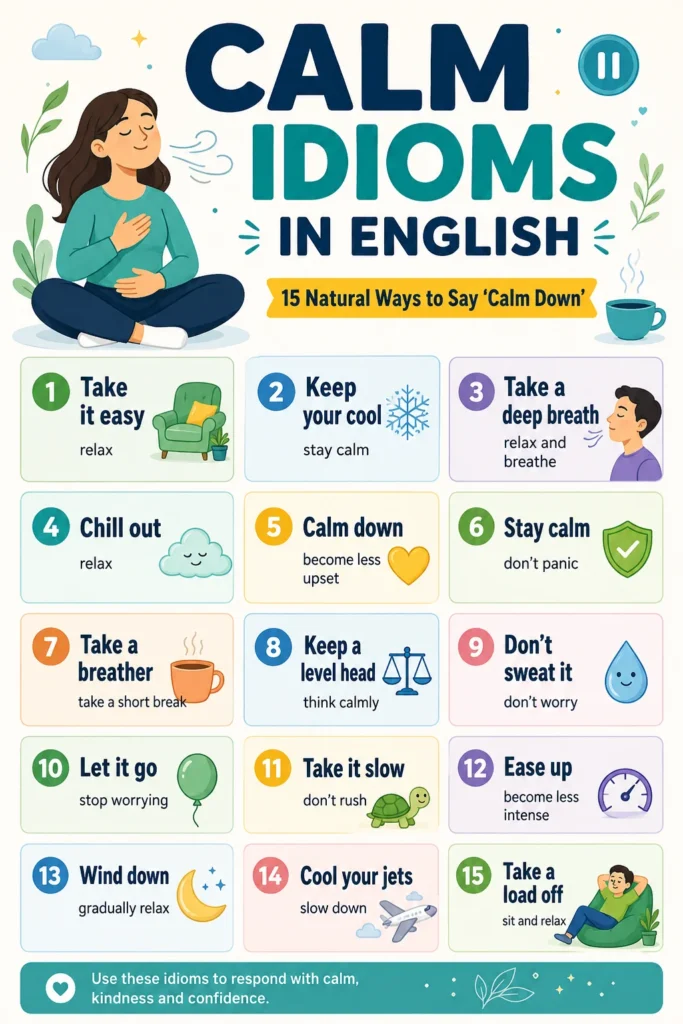
Calm Idioms and Expressions
#
Idiom or Expression
Core Meaning
Best For
1
Keep your cool
Stay calm under pressure
Conflict and stress
2
Cool as a cucumber
Extremely calm
Nervous situations
3
Keep a level head
Think calmly and rationally
Decisions
4
Keep your head
Stay calm in difficulty
Emergencies
5
Cool, calm, and collected
Completely composed
Formal or neutral situations
6
Take it easy
Relax or slow down
Everyday situations
7
Chill out
Relax or stop getting upset
Informal conversation
8
Go with the flow
Adapt without overreacting
Unexpected changes
9
Sit tight
Wait patiently
Waiting
10
Keep your wits about you
Stay alert and composed
Difficult situations
11
Don’t sweat it
Don’t worry
Casual reassurance
12
Put your feet up
Relax and rest
After work
13
Take a load off
Sit down and relax
Informal relaxation
14
Rest easy
Feel reassured or free from worry
Reassurance
15
Peace of mind
A feeling of calm or security
Worry and reassurance
16
At peace
In a calm emotional state
Inner calm
17
Let it roll off your back
Don’t let criticism upset you
Emotional resilience
18
Weather the storm
Survive a difficult period
Challenges
19
Calm before the storm
Peace before trouble
Situations
20
Keep a stiff upper lip
Remain emotionally controlled
Difficult circumstances
Keep Your Cool
Word-by-word meaning
Keep means to maintain something, while cool literally describes a lower temperature.
Idiomatic meaning
Keep your cool means to remain calm and control your emotions, especially when you’re angry, nervous, frustrated, or under pressure.
The image behind the expression is simple: instead of allowing your emotional “temperature” to rise, you keep it under control.
Example sentences
I was angry, but I tried to keep my cool.
She kept her cool when the customer started shouting.
If the interview becomes difficult, remember to keep your cool.
Common mistake
❌ Keep your cold ✅ Keep your cool
Usage note
Register: Neutral to informal Best for: Arguments, interviews, stressful situations, work, and pressure.
Formal alternative: Maintain your composure.
Real-life example
Your coworker blames you for a mistake you didn’t make. Instead of immediately arguing, you calmly explain what happened. You keep your cool.
Cool as a Cucumber
Word-by-word meaning
A cucumber is a cool, fresh vegetable.
Idiomatic meaning
Cool as a cucumber means extremely calm and relaxed, especially in a situation where other people might feel nervous.
Example sentences
Everyone was nervous before the exam, but Maya was as cool as a cucumber.
He was as cool as a cucumber during the interview.
Even when the alarm went off, she remained cool as a cucumber.
Common mistake
❌ Cool like a cucumber ❌ Cool as cucumber ✅ Cool as a cucumber
Usage note
Register: Informal and colorful Best for: Describing someone who stays unusually calm.
Why it is different from “keep your cool”
Keep your cool describes the action of controlling yourself.
Cool as a cucumber describes a person’s calm state.
Keep a Level Head
Word-by-word meaning
A level head suggests something balanced and steady.
Idiomatic meaning
Keep a level head means to remain calm, sensible, and rational instead of allowing emotions to control your decisions.
Example sentences
You need to keep a level head when making an important decision.
Sarah always keeps a level head during a crisis.
His ability to keep a level head makes him an excellent manager.
Common mistake
❌ Keep a level mind ✅ Keep a level head
Usage note
Register: Neutral Best for: Leadership, decision-making, work, conflict, and emergencies.
Formal alternative: Remain rational and composed.
Keep Your Head
Word-by-word meaning
Literally, keep your head means not losing your head.
Idiomatic meaning
It means to remain calm and think clearly when something difficult, frightening, or confusing happens.
Example sentences
Keep your head and follow the safety instructions.
She kept her head when everyone else started panicking.
If you keep your head, you’ll be able to solve the problem.
Common mistake
❌ Keep your mind ✅ Keep your head
Usage note
Register: Neutral Best for: Emergencies, pressure, confusion, and difficult situations.
Difference from “keep your cool”
Keep your cool focuses more on emotional control.
Keep your head emphasizes staying calm enough to think clearly.
Cool, Calm, and Collected
Word-by-word meaning
Cool = emotionally controlled
Calm = not agitated
Collected = composed and self-controlled
Idiomatic meaning
Cool, calm, and collected describes someone who is completely composed and in control of their emotions, particularly during a difficult situation.
Example sentences
The speaker remained cool, calm, and collected throughout the debate.
She looked cool, calm, and collected before going on stage.
Good leaders often need to stay cool, calm, and collected.
Common mistake
❌ Cool, quiet, and collected ✅ Cool, calm, and collected
Usage note
Register: Neutral Best for: Professional situations, presentations, interviews, leadership, and stressful events.
This is one of the most useful choices when you want to describe composure rather than simple relaxation.
Take It Easy
Word-by-word meaning
Easy suggests something without difficulty, pressure, or strain.
Idiomatic meaning
Take it easy means to relax, slow down, or avoid putting too much pressure on yourself.
Example sentences
You’ve been working all day. Take it easy tonight.
Take it easy and don’t worry about the deadline yet.
I decided to take it easy over the weekend.
Common mistake
❌ Take easy ✅ Take it easy
Usage note
Register: Informal to neutral Best for: Relaxation, everyday conversations, and friendly advice.
Formal alternative: Try to relax or avoid unnecessary stress.
Chill Out
Word-by-word meaning
Chill is associated with coldness.
Idiomatic meaning
Chill out means to relax or become less angry, nervous, or stressed.
Example sentences
Just chill out; everything is going to be fine.
We spent the evening chilling out at home.
You need to chill out before making a decision.
Common mistake
❌ Chill down ✅ Chill out
Usage note
Register: Very informal Best for: Friends, casual conversations, texting, and relaxed settings.
Avoid using “chill out” in formal business writing.
Formal alternative: Relax or try to remain calm.
Go With the Flow
Word-by-word meaning
Water naturally moves with the direction of its flow.
Idiomatic meaning
Go with the flow means to accept circumstances and adapt instead of becoming overly worried or trying to control everything.
Example sentences
We didn’t have a detailed plan, so we decided to go with the flow.
When travel plans change, I usually go with the flow.
Sometimes the best way to stay calm is to go with the flow.
Common mistake
❌ Go by the flow ❌ Go along the flow ✅ Go with the flow
Usage note
Register: Informal to neutral Best for: Unexpected changes, flexible plans, travel, and everyday situations.
Important distinction
This idiom doesn’t mean doing nothing. It suggests adapting calmly to circumstances.
Sit Tight
Word-by-word meaning
The word tight suggests staying firmly in one place.
Idiomatic meaning
Sit tight means to wait patiently and avoid leaving or taking action until you receive further information.
Example sentences
Sit tight while I check your appointment.
Please sit tight; someone will help you shortly.
We were told to sit tight until the manager arrived.
Common mistake
❌ Sit tightly ✅ Sit tight
Usage note
Register: Informal to neutral Best for: Waiting for instructions, information, assistance, or an update.
Keep Your Wits About You
Word-by-word meaning
Wits refers to mental ability, awareness, and quick thinking.
Idiomatic meaning
To keep your wits about you means to stay alert, think clearly, and remain composed in a difficult or unexpected situation.
Example sentences
Keep your wits about you when you’re walking through a crowded area.
She kept her wits about her during the emergency.
You need to keep your wits about you when making a quick decision.
Common mistake
❌ Keep your wit about you ✅ Keep your wits about you
Usage note
Register: Neutral Best for: Emergencies, unfamiliar situations, travel, and moments requiring awareness.
This expression is about calmness + alertness, not simply relaxation.
Don’t Sweat It
Word-by-word meaning
Sweat literally refers to perspiration.
Idiomatic meaning
Don’t sweat it means don’t worry about it because the problem is not serious.
Example sentences
You forgot your pen? Don’t sweat it. I have an extra one.
Don’t sweat it—we can fix the mistake.
You don’t need to apologize. Don’t sweat it.
Common mistake
❌ Don’t sweat about it ✅ Don’t sweat it
Usage note
Register: Informal Best for: Casual reassurance.
Formal alternative: Don’t worry about it / There’s no need for concern.
Put Your Feet Up
Word-by-word meaning
It literally means raising or resting your feet while sitting.
Idiomatic meaning
Put your feet up means to sit down and relax, especially after working or doing something tiring.
Example sentences
You’ve had a long day. Put your feet up.
I like to put my feet up and read after work.
We ordered dinner and put our feet up.
Common mistake
❌ Put your foot up ✅ Put your feet up
Usage note
Register: Informal Best for: Home, family, friends, and relaxing after work.
Take a Load Off
Word-by-word meaning
A load can mean something heavy that you’re carrying. Taking it off suggests removing that burden.
Idiomatic meaning
Take a load off means to sit down and relax, especially after standing, working, or being busy.
Example sentences
Come in and take a load off.
You’ve been standing all morning. Take a load off.
We sat down to take a load off after the hike.
Common mistake
❌ Take the load away ✅ Take a load off
Usage note
Register: Informal and conversational.
It’s particularly natural when inviting someone to sit and relax.
Rest Easy
Word-by-word meaning
Rest means to relax, while easy suggests being free from difficulty or worry.
Idiomatic meaning
Rest easy means to feel reassured, safe, or free from worry.
Example sentences
You can rest easy knowing that everything is under control.
Rest easy; I’ll take care of the problem.
She could finally rest easy after receiving the good news.
Common mistake
❌ Rest easily ✅ Rest easy
Usage note
Register: Neutral Best for: Reassurance and situations involving worry.
Peace of Mind
Word-by-word meaning
Peace suggests freedom from disturbance, while mind refers to your thoughts and mental state.
Idiomatic meaning
Peace of mind means a feeling of calm, security, reassurance, or freedom from worry.
Example sentences
Having a backup plan gives me peace of mind.
Insurance can provide peace of mind.
Knowing my family is safe gives me peace of mind.
Common mistake
❌ Peace in mind ❌ Peaceful mind ✅ Peace of mind
Usage note
Register: Neutral Best for: Security, decisions, safety, planning, and reassurance.
Important distinction
Peace of mind is not simply another way to say “calm person.”
It describes a feeling of being free from worry.
At Peace
Word-by-word meaning
Peace means freedom from conflict or disturbance.
Idiomatic meaning
Being at peace means feeling deeply calm, emotionally settled, or free from inner conflict.
Example sentences
After making the decision, I finally felt at peace.
She felt at peace while walking through the quiet garden.
He is at peace with his choice.
Common mistake
❌ In peace ✅ At peace
Usage note
Register: Neutral Best for: Emotional well-being, acceptance, reflection, and inner calm.
This expression usually suggests a deeper form of calmness than simply being relaxed.
Let It Roll Off Your Back
Word-by-word meaning
Something that rolls off your back doesn’t stay there.
Idiomatic meaning
To let something roll off your back means to avoid allowing criticism, insults, embarrassment, or minor problems to upset you deeply.
Example sentences
Don’t take every negative comment personally; let it roll off your back.
She has learned to let criticism roll off her back.
Try to let small mistakes roll off your back.
Common mistake
❌ Let it fall off your back ✅ Let it roll off your back
Usage note
Register: Informal Best for: Criticism, insults, minor problems, and emotional resilience.
Calmness connection
This isn’t simply “being relaxed.” It describes the ability to stay emotionally unaffected by things that might otherwise bother you.
Weather the Storm
Word-by-word meaning
To weather a storm literally means to survive difficult weather.
Idiomatic meaning
Weather the storm means to endure and survive a difficult period or challenging situation.
Example sentences
The company managed to weather the storm.
We need to stay positive and weather the storm together.
She remained strong while weathering the storm.
Common mistake
❌ Weather the rain ❌ Survive the storm weather ✅ Weather the storm
Usage note
Register: Neutral Best for: Financial difficulties, crises, setbacks, personal challenges, and long periods of difficulty.
Important distinction
Weather the storm doesn’t directly mean “stay calm.”
It means get through a difficult situation, often while maintaining strength and composure.
Calm Before the Storm
Word-by-word meaning
A calm is a peaceful period; a storm represents severe weather.
Idiomatic meaning
The calm before the storm describes a quiet or peaceful period immediately before a difficult, chaotic, or exciting event.
Example sentences
The office was unusually quiet—it felt like the calm before the storm.
Everyone was relaxed before the big announcement, but it was just the calm before the storm.
The peaceful morning was the calm before the storm.
Common mistake
❌ Calm after the storm ✅ Calm before the storm
Usage note
Register: Neutral Best for: Work deadlines, arguments, major events, conflicts, and dramatic changes.
Keep a Stiff Upper Lip
Word-by-word meaning
A stiff upper lip suggests keeping the upper lip firm rather than showing strong emotion.
Idiomatic meaning
Keep a stiff upper lip means to remain emotionally controlled and avoid openly showing distress, especially during a difficult situation.
Example sentences
She kept a stiff upper lip despite the disappointing news.
He tried to keep a stiff upper lip during the difficult period.
The team kept a stiff upper lip after the unexpected loss.
Common mistake
❌ Keep a strong upper lip ✅ Keep a stiff upper lip
Usage note
Register: Idiomatic, somewhat old-fashioned, and often associated with British English.
It is useful when the focus is on emotional restraint during adversity, rather than simply feeling relaxed.
The complete phrase is easier to recognize and use correctly.
Learn Each Idiom With a Situation
Connect the expression with an image or situation.
Exam tomorrow + friend panicking
→ “Take it easy.”
Angry customer
→ “Keep your cool.”
Unexpected change of plans
→ “Go with the flow.”
Waiting for an important update
→ “Sit tight.”
Negative comment
→ “Let it roll off your back.”
Notice the Register
Ask yourself:
Would I say this to a friend, teacher, customer, or manager?
For example:
Friend: “Chill out.”
Manager: “Let’s remain calm and look at the situation.”
Create Your Own Examples
After learning an idiom, make one sentence connected to your real life.
For example:
“I had an important presentation today, but I kept my cool.”
Personal examples are easier to remember than dictionary sentences.
A Simple Calm Idiom Practice Quiz
Test yourself before moving on.
1. Your friend is panicking before an interview. What could you say?
A. Weather the storm B. Take it easy C. Sit tight D. At peace
Answer: B — Take it easy
2. Someone remains calm while everyone else is nervous.
A. Cool as a cucumber B. Take a load off C. Sit tight D. Don’t sweat it
Answer: A — Cool as a cucumber
3. Your customer is angry, but you remain emotionally controlled.
A. Put your feet up B. Go with the flow C. Keep your cool D. Rest easy
Answer: C — Keep your cool
4. Your plans suddenly change, and you decide not to worry about it.
A. Go with the flow B. Keep your head C. Sit tight D. Keep a stiff upper lip
Answer: A — Go with the flow
5. Someone tells you not to worry about a small mistake.
A. Don’t sweat it B. Weather the storm C. Cool as a cucumber D. At peace
Answer: A — Don’t sweat it
How Strong Is Each Calm Expression?
If you’re wondering which expressions describe the strongest form of calmness, this simple scale can help.
Level
Expression
What It Suggests
1
Take it easy
Relaxation
2
Chill out
Casual relaxation
3
Sit tight
Patient waiting
4
Keep your cool
Emotional control
5
Keep a level head
Calm + rational thinking
6
Cool as a cucumber
Exceptional calmness
7
At peace
Deep inner calm
This isn’t a strict linguistic ranking. It is a learner-friendly guide to the typical feeling each expression communicates.
Real-Life Examples of Calm Idioms
At Work
Your manager announces an unexpected deadline.
Instead of panicking:
“Let’s keep our cool and figure out what needs to be done first.”
During an Argument
Someone becomes angry with you.
You respond calmly:
“I’m going to keep my cool and explain my side.”
Before an Exam
Your friend is extremely nervous.
You say:
“Take it easy. You’ve prepared for this.”
When Plans Change
Your restaurant reservation is unexpectedly canceled.
Instead of becoming frustrated:
“Let’s go with the flow and find another place.”
After a Long Day
You finish work and finally get home.
You say:
“I’m going to put my feet up and relax.”
After Criticism
Someone makes a negative comment about your work.
Instead of obsessing over it:
“I’ll let it roll off my back and focus on improving.”
These scenarios show why context is more important than simply memorizing definitions.
Frequently Asked Questions About Calm Idioms
What is the best idiom for staying calm?
“Keep your cool” is one of the most useful idioms for staying calm when you’re angry, nervous, frustrated, or under pressure.
What idiom means “very calm”?
“Cool as a cucumber” means someone is extremely calm, particularly when other people might be nervous or stressed.
What idiom means “don’t worry”?
“Don’t sweat it” means “don’t worry about it.” It is informal and works best in casual conversation.
What is an idiom for relaxing?
“Take it easy,” “chill out,” “put your feet up,” and “take a load off” can all describe relaxing, although their levels of formality and context differ.
What idiom means staying calm during a difficult situation?
“Keep your cool,” “keep your head,” and “cool, calm, and collected” all describe emotional control. “Weather the storm” is related but focuses more on surviving a difficult period.
Learning calm idioms gives you more precise ways to describe relaxation, patience, emotional control, inner peace, and resilience. Instead of repeatedly saying “stay calm” or “don’t worry,” you can choose an expression that matches the exact situation.
Start with five useful expressions:
Keep your cool — stay calm under pressure.
Cool as a cucumber — be extremely calm.
Take it easy — relax.
Go with the flow — adapt to change.
Peace of mind — feel free from worry.
Then practice each one in a sentence about your own life.
The goal isn’t to memorize 20 expressions in one sitting. Learn the meaning, understand the context, notice the tone, and use the idiom in a real sentence. With regular practice, these expressions will move from your vocabulary list into your everyday English.
Clara Bennett writes for Meaning Match about English idioms, everyday expressions, meanings, and practical language usage, making phrases easy to understand.
1 thought on “Calm Idioms: Expressions for Staying Cool & Keeping Composure”




Pingback: Mental Health Idioms: 37+ Ways to Describe Your State of Mind