
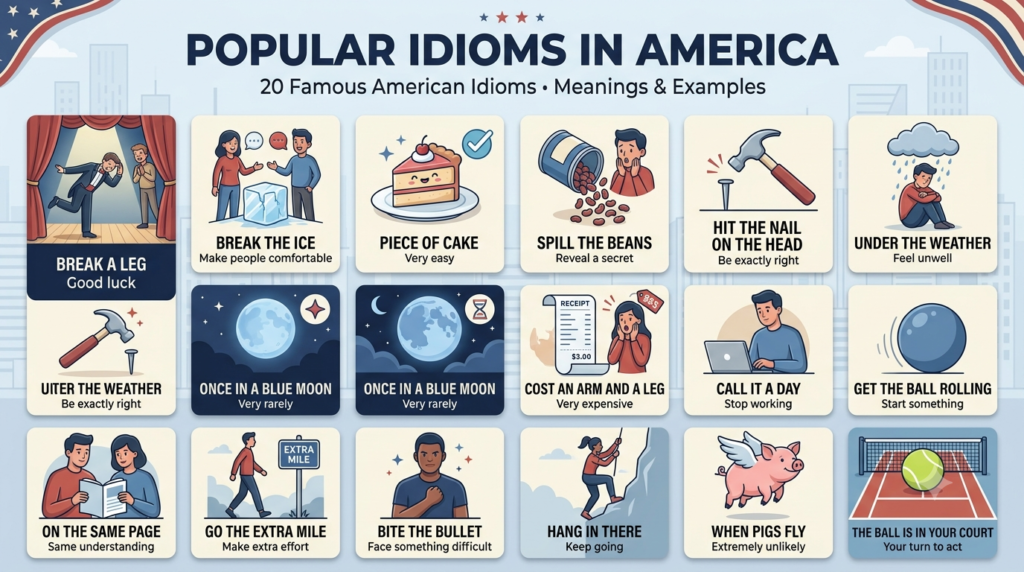
Imagine hearing an American say, “It’s a piece of cake,” “Break the ice,” or “Hit the sack” for the first time. If you took those phrases literally, none of them would make any sense—and that’s exactly what makes American idioms so fascinating.
Millions of English learners misunderstand these expressions every day because their real meanings have little or nothing to do with the individual words. In short, American idioms are everyday expressions whose meanings can’t be understood through literal translation, making them essential for anyone who wants to understand native English naturally and communicate with confidence. From Hollywood movies and Netflix shows to YouTube videos, podcasts, social media, workplaces, classrooms, and everyday conversations, idioms appear everywhere in American English.
This guide explores the most popular idioms in America, their meanings, origins, real-life examples, and practical usage, so you’ll finally understand what native speakers actually mean—and start using these expressions like a fluent English speaker.


What Is an American Idiom?
An American idiom is a fixed or commonly established expression used in American English whose figurative meaning differs from its literal wording.
For example:
“Let’s call it a day.”
Literally, the sentence sounds as if someone is naming the day. In everyday American English, however, it usually means:
“Let’s stop working for today.”
Idioms are a type of figurative language. They can make speech more colorful, concise, humorous, and natural, but they can also be confusing for English learners because their meanings are not always obvious.
Idiom vs. Literal Meaning
Consider this example:
Literal:
“She spilled the beans on the kitchen floor.”
Idiomatic:
“She spilled the beans about the surprise.”
The first sentence describes an actual mess. The second means she revealed a secret.
This difference between literal and figurative meaning is the key to understanding American idioms.
20 Most Popular Idioms in America and Their Meanings
Below are 20 widely recognized idioms commonly encountered in American English. Each includes its meaning, a natural example, a short dialogue where useful, and a usage tip.
1. Break a Leg
Meaning: Good luck, especially before a performance or important event.
Literal meaning: To physically break a leg.
Idiomatic meaning: A traditional way of wishing someone good luck before a performance.
Example:
“You have your audition tonight? Break a leg!”
Mini dialogue:
Maya: “I’m really nervous about my play tonight.”
Alex: “You’ll do great. Break a leg!”
Common error:
Do not assume that “break a leg” is an insult or an actual wish for injury.
Usage note:
This expression is especially associated with theater and performances. It is informal and culturally specific enough that learners should understand the context before using it.
2. Break the Ice
Meaning: To make people feel more relaxed and comfortable when they first meet.
Literal meaning: To break frozen water.
Idiomatic meaning: To start a friendly conversation or reduce awkwardness.
Example:
“The teacher told a funny story to break the ice.”
Mini dialogue:
Sam: “Everyone was so quiet at the meeting.”
Lena: “Yeah, so I asked everyone an easy question to break the ice.”
Common error:
Do not say “break the ice” when you simply mean “start anything.” The expression usually involves making a social situation more comfortable.
Usage note:
Common in meetings, parties, classrooms, interviews, networking events, and introductions.
3. Piece of Cake
Meaning: Something that is very easy.
Literal meaning: A portion of cake.
Idiomatic meaning: A task that requires little effort or is easier than expected.
Example:
“The driving test was a piece of cake.”
Mini dialogue:
Jake: “Was the assignment difficult?”
Emma: “Not at all. It was a piece of cake.”
Common error:
“Piece of cake” is informal. Avoid using it when highly formal language is expected.
Usage note:
It is one of the most recognizable casual expressions in American English.
4. Hit the Nail on the Head
Meaning: To be exactly right about something.
Literal meaning: To strike a nail directly on its head.
Idiomatic meaning: To identify the exact problem, point, or answer.
Example:
“You hit the nail on the head when you said the project needs better planning.”
Mini dialogue:
Manager: “Why are we behind schedule?”
Alex: “We didn’t set realistic deadlines.”
Manager: “You hit the nail on the head.”
Common error:
The correct expression is “hit the nail on the head,” not “hit the nail in the head.”
Usage note:
Useful when agreeing with someone who has identified a situation accurately.
5. Under the Weather
Meaning: Feeling sick or unwell.
Literal meaning: Being physically underneath the weather.
Idiomatic meaning: Feeling ill, tired, or generally not well.
Example:
“I’m feeling a little under the weather today.”
Mini dialogue:
Chris: “Are you coming to dinner?”
Taylor: “I don’t think so. I’m a little under the weather.”
Common error:
The expression does not simply mean that someone dislikes rainy or cold weather.
Usage note:
It is a casual way to tell someone that you are not feeling well.
6. Spill the Beans
Meaning: To reveal a secret.
Literal meaning: To accidentally spill beans from a container.
Idiomatic meaning: To disclose information that was supposed to remain secret.
Example:
“Don’t spill the beans about the surprise party.”
Mini dialogue:
Nina: “Did you tell Mark about the surprise?”
Tom: “No! I promise I won’t spill the beans.”
Common error:
Don’t use it merely as a synonym for “tell.”
Usage note:
It is informal and often used when someone reveals a surprise or secret.
7. Once in a Blue Moon
Meaning: Very rarely.
Literal meaning: A blue-colored moon.
Idiomatic meaning: Something that happens only occasionally or almost never.
Example:
“I eat fast food once in a blue moon.”
Mini dialogue:
Ben: “Do you still visit your old school?”
Ryan: “Only once in a blue moon.”
Common error:
Don’t use this expression for something that happens regularly.
Usage note:
It emphasizes rarity and is usually casual.
8. Cost an Arm and a Leg
Meaning: To be extremely expensive.
Literal meaning: To give up an arm and a leg as payment.
Idiomatic meaning: Something costs a very large amount of money.
Example:
“That new car cost an arm and a leg.”
Mini dialogue:
Sara: “How much was the phone?”
Mike: “It cost an arm and a leg!”
Common error:
Use it for something that is very expensive, not merely something that costs more than expected.
Usage note:
This is informal and often used for emphasis.
9. Let the Cat Out of the Bag
Meaning: To reveal a secret, often accidentally.
Literal meaning: To allow a cat to escape from a bag.
Idiomatic meaning: To disclose information that was supposed to remain secret.
Example:
“I accidentally let the cat out of the bag about the promotion.”
Mini dialogue:
Amy: “Who told you about the party?”
Josh: “Daniel let the cat out of the bag.”
Common error:
It is not simply a replacement for “tell someone something.”
Usage note:
It is commonly used when information is revealed before the intended time.
10. Beat Around the Bush
Meaning: To avoid getting directly to the point.
Literal meaning: To move around a bush instead of approaching it directly.
Idiomatic meaning: To avoid saying what you really mean or discussing the main issue.
Example:
“Stop beating around the bush and tell me what happened.”
Mini dialogue:
Boss: “There’s something we need to discuss.”
Employee: “Please don’t beat around the bush. Just tell me.”
Common error:
The standard expression is “beat around the bush,” not “beat around the tree.”
Usage note:
It can sound impatient or critical, so use it carefully, particularly with someone senior.
11. A Blessing in Disguise
Meaning: Something that initially seems bad but eventually has a positive result.
Literal meaning: A blessing hidden by a disguise.
Idiomatic meaning: A difficult or disappointing event that later turns out to be beneficial.
Example:
“Missing that flight was a blessing in disguise because I found a better route.”
Mini dialogue:
Liam: “I was disappointed when I didn’t get that job.”
Noah: “Maybe it was a blessing in disguise. You found an even better opportunity.”
Common error:
It does not mean every negative event will automatically have a positive outcome.
Usage note:
Often used when looking back on an experience and recognizing an unexpected benefit.
12. Kill Two Birds with One Stone
Meaning: To accomplish two things with one action.
Literal meaning: To kill two birds with one stone.
Idiomatic meaning: To solve two problems or achieve two goals at the same time.
Example:
“I’ll go to the bank while I’m downtown and kill two birds with one stone.”
Mini dialogue:
Lisa: “Why are you walking to the store?”
Mark: “I need groceries and exercise, so I can kill two birds with one stone.”
Common error:
The expression is about efficiency, not literal violence.
Usage note:
Some speakers prefer alternatives such as “accomplish two things at once” because the traditional expression contains violent imagery.
13. Call It a Day
Meaning: To stop working for the day.
Literal meaning: To officially declare something a day.
Idiomatic meaning: To finish an activity, especially work, until another time.
Example:
“We’ve finished the urgent tasks. Let’s call it a day.”
Mini dialogue:
Sarah: “Anything else we need to finish?”
David: “No, we’re good. Let’s call it a day.”
Common error:
It does not necessarily mean that the entire day is over.
Usage note:
Very common in workplaces and casual conversations.
14. Get the Ball Rolling
Meaning: To start something.
Literal meaning: To make a ball begin moving.
Idiomatic meaning: To begin a project, process, conversation, or activity.
Example:
“Let’s get the ball rolling on the new project.”
Mini dialogue:
Manager: “When should we start?”
Designer: “Let’s get the ball rolling today.”
Common error:
It refers to starting a process, not finishing it.
Usage note:
Frequently used in workplaces, meetings, projects, and team discussions.
15. On the Same Page
Meaning: To have the same understanding, expectations, or goals.
Literal meaning: To be looking at the same page of a book or document.
Idiomatic meaning: To agree about what is happening or what should happen next.
Example:
“Before we begin, let’s make sure we’re all on the same page.”
Mini dialogue:
Manager: “Are we all clear about the deadline?”
Team: “Yes.”
Manager: “Great. We’re on the same page.”
Common error:
Being “on the same page” does not necessarily mean agreeing about every issue.
Usage note:
Extremely useful in professional, educational, and collaborative situations.
16. Go the Extra Mile
Meaning: To make more effort than is normally expected.
Literal meaning: To travel an additional mile.
Idiomatic meaning: To do more than what is required or expected.
Example:
“The customer service representative went the extra mile to solve my problem.”
Mini dialogue:
Customer: “They even called me afterward to make sure everything was fixed.”
Friend: “Sounds like they really went the extra mile.”
Common error:
It does not have to involve physical travel.
Usage note:
Often used to praise employees, students, colleagues, friends, or businesses for exceptional effort.
17. Bite the Bullet
Meaning: To face something difficult or unpleasant with courage.
Literal meaning: To bite a bullet.
Idiomatic meaning: To accept and deal with something difficult instead of avoiding it.
Example:
“I don’t enjoy public speaking, but I’ll bite the bullet and give the presentation.”
Mini dialogue:
Anna: “I’m nervous about calling the client.”
James: “Just bite the bullet and make the call.”
Common error:
It does not simply mean “try something.”
Usage note:
Usually used when someone accepts an unavoidable or unpleasant task.
18. Hang in There
Meaning: Stay patient, hopeful, or determined.
Literal meaning: To continue hanging onto something.
Idiomatic meaning: Keep going despite difficulty.
Example:
“Hang in there. You’re almost finished.”
Mini dialogue:
Friend: “This week has been exhausting.”
You: “Hang in there. The weekend is almost here.”
Common error:
It is normally an expression of encouragement rather than a literal instruction.
Usage note:
Friendly, informal, and common in supportive conversations.
19. When Pigs Fly
Meaning: Something is extremely unlikely or probably will never happen.
Literal meaning: A time when pigs fly.
Idiomatic meaning: Used humorously to say that something is very unlikely.
Example:
“He’ll clean his room when pigs fly.”
Mini dialogue:
Mom: “Do you think he’ll wake up early tomorrow?”
Dad: “Sure—when pigs fly!”
Common error:
Don’t use it for something that is merely possible but uncertain.
Usage note:
Humorous and informal; it can sometimes sound sarcastic.
20. The Ball Is in Your Court
Meaning: It is now your responsibility to make the next decision or take the next action.
Literal meaning: A ball is on your side of a sports court.
Idiomatic meaning: The next move or decision belongs to you.
Example:
“I’ve sent you the proposal. Now the ball is in your court.”
Mini dialogue:
Client: “What happens next?”
Consultant: “We’ve given you all the options. The ball is in your court now.”
Common error:
It does not mean someone literally has a ball.
Usage note:
Common in business, negotiations, relationships, and decision-making.
More American Idioms Worth Knowing
These additional expressions are just as common in everyday American English — from joking with friends to handling difficult decisions at work.
21. Pull Someone’s Leg
Meaning: To tease or joke with someone by telling them something untrue.
Literal meaning: To physically tug someone’s leg.
Idiomatic meaning: To joke with someone, often playfully.
Example: “Don’t worry. I’m just pulling your leg.”
Common error: Don’t use it to mean physically grabbing someone’s leg.
Usage note: Usually friendly and informal; best with people you know.
22. Hit the Sack
Meaning: To go to bed or go to sleep.
Literal meaning: To strike a sack — an old informal reference to a bed.
Idiomatic meaning: Go to bed.
Example: “I’m exhausted. I’m going to hit the sack.”
Common error: It’s casual — in formal writing, simply say “go to bed.”
Usage note: Very informal; natural with friends and family.
23. Get Cold Feet
Meaning: To become nervous or hesitant about something you planned to do.
Literal meaning: Feet that feel cold.
Idiomatic meaning: To become anxious or uncertain before an important event or decision.
Example: “I was excited about moving, but I got cold feet at the last minute.”
Common error: It describes emotional hesitation, not actual temperature.
Usage note: Casual; best for decisions, commitments, and major changes.
24. Cut Corners
Meaning: To take shortcuts that may reduce quality, safety, or effectiveness.
Literal meaning: To take a shorter route around a corner.
Idiomatic meaning: To save time, money, or effort by skipping proper steps.
Example: “Don’t cut corners when preparing the report.”
Common error: This idiom is usually negative — it isn’t simply “working efficiently.”
Usage note: Neutral to critical; used when discussing work quality, safety, and procedures.
25. Cut to the Chase
Meaning: To get to the main point without wasting time.
Literal meaning: Originally evoked moving directly to the exciting part of a film.
Idiomatic meaning: Get directly to the important information.
Example: “Let’s cut to the chase. How much will it cost?”
Common error: It doesn’t mean physically cutting anything.
Usage note: Casual to neutral; great for meetings and discussions.
American Idioms vs. American Slang
Idioms and slang both make American English colorful, but they aren’t the same thing. Idioms are established expressions with figurative meanings, while slang is informal language often tied to particular groups, generations, or online communities. Slang can change quickly, while traditional idioms tend to stay stable for decades.
8 American Slang Expressions to Recognize
These informal expressions appear constantly in casual conversation, social media, and entertainment. Learn to recognize them — but use them only in the right company.
Awesome
Meaning: Excellent, impressive, exciting, or very good.
Example: “That concert was awesome!”
Usage note: Informal; can sound too casual in professional or academic contexts.
Cool
Meaning: Good, impressive, acceptable, or fashionable, depending on context.
Example: “That’s a cool idea.”
Usage note: Informal; don’t confuse it with the temperature meaning.
Hang Out
Meaning: To spend relaxed, informal time with someone.
Example: “Do you want to hang out this weekend?”
Usage note: Informal; don’t confuse with “hang in there” (don’t give up).
No Biggie
Meaning: “It’s not a big problem” or “It’s not important.”
Example: “Sorry I’m late.” — “No biggie.”
Usage note: Very casual; avoid it in formal correspondence.
Ghost (verb)
Meaning: To suddenly stop communicating with someone without explanation.
Example: “He ghosted me after our first date.”
Usage note: Informal modern slang; common in dating, friendships, and messaging.
Lit
Meaning: Extremely exciting, energetic, or entertaining.
Example: “The party was lit!”
Usage note: Very informal; popularity varies by age group and community.
Salty
Meaning: Annoyed, bitter, or resentful about something.
Example: “He’s still salty about losing the game.”
Usage note: Informal slang; context matters (“the soup is salty” is literal).
GOAT
Meaning: Acronym for “Greatest of All Time” — someone exceptionally talented in a field.
Example: “Many fans consider her the GOAT of tennis.”
Usage note: Informal; common in sports, music, gaming, and pop culture.
Quick Practice Quiz
Test yourself on the expressions in this guide:
- Your new coworkers don’t know each other. You tell a joke to ______.
Answer: break the ice - Your friend accidentally reveals a surprise. Which idiom fits?
Answer: spill the beans - Your new laptop is extremely expensive. “It cost ______.”.
Answer: an arm and a leg - Your coworker identifies the exact reason for a problem. “You ______.”.
Answer: hit the nail on the head - Your friend is going through a difficult time. A supportive response is “______.”
Answer: hang in there
A 7-Day American Idiom Practice Plan
Want to make these expressions stick? Try this simple routine:
- Day 1: Learn 3 idioms.
- Day 2: Write one personal sentence for each.
- Day 3: Review meanings without looking.
- Day 4: Listen for the idioms in real English — movies, podcasts, conversations.
- Day 5: Practice saying them aloud.
- Day 6: Use 2–3 naturally in conversation or writing.
- Day 7: Review all the idioms and test yourself.
Five idioms you can actually use are more valuable than fifty you can only recognize.
What Are the 10 Most Common Idioms?
If you’re asking “What are the 10 most common idioms?”, a useful group to learn first is:
- Break the ice — make people feel comfortable
- Piece of cake — very easy
- Under the weather — feeling unwell
- Spill the beans — reveal a secret
- Hit the nail on the head — be exactly right
- Call it a day — stop working
- Get the ball rolling — start something
- On the same page — share the same understanding
- Go the extra mile — make extra effort
- Hang in there — remain patient and hopeful
There is no single universally accepted ranking of the “10 most common” idioms because frequency varies by age, region, profession, situation, and type of English. This list is therefore best viewed as a practical starting point for learners rather than a strict statistical ranking.
What Are Some Very American Sayings?
If you’re wondering “What are some very American sayings?”, you’ll encounter expressions such as:
- Break a leg — good luck before a performance
- Piece of cake — something very easy
- Call it a day — stop working for the day
- Get the ball rolling — begin a process
- Go the extra mile — make additional effort
- The ball is in your court — it is your turn to act
- Hang in there — stay hopeful
- When pigs fly — something is extremely unlikely
- Spill the beans — reveal a secret
- Under the weather — feel unwell
Are These Idioms Unique to American English?
Not necessarily.
This is an important distinction for English learners: many idioms commonly heard in the United States are also used in other varieties of English.
An expression appearing in American English does not automatically mean that it originated in the United States or is exclusive to Americans.
For example, “break the ice,” “piece of cake,” “once in a blue moon,” and several other expressions can be understood outside the United States as well.
What makes them relevant to this article is their common use and recognition in American English, not necessarily exclusive American ownership.
American Idioms With Meaning: Quick Reference
| Idiom | Figurative Meaning | Example |
|---|---|---|
| Break a leg | Good luck | Break a leg at your audition! |
| Break the ice | Make people comfortable | She told a joke to break the ice. |
| Piece of cake | Very easy | The test was a piece of cake. |
| Hit the nail on the head | Be exactly right | You hit the nail on the head. |
| Under the weather | Feel unwell | I’m under the weather today. |
| Spill the beans | Reveal a secret | Don’t spill the beans. |
| Once in a blue moon | Very rarely | I eat there once in a blue moon. |
| Cost an arm and a leg | Be extremely expensive | The car cost an arm and a leg. |
| Call it a day | Stop working | Let’s call it a day. |
| Get the ball rolling | Start something | Let’s get the ball rolling. |
| On the same page | Share an understanding | We’re on the same page. |
| Go the extra mile | Make extra effort | She went the extra mile. |
| Bite the bullet | Face difficulty | I’ll bite the bullet and do it. |
| Hang in there | Stay hopeful | Hang in there! |
| When pigs fly | Very unlikely | I’ll believe it when pigs fly. |
| The ball is in your court | Your turn to act | The ball is in your court. |
American Idioms and Phrases With Meanings and Examples
Idioms are only one part of conversational American English. You’ll also hear many common phrases whose meaning depends on context.
“What’s up?”
Meaning: A casual greeting or question about what is happening.
Example:
“Hey, what’s up?”
It can mean something like “How are you?”, “What are you doing?”, or “What’s happening?”, depending on context.
“No big deal”
Meaning: Something is not very important or serious.
“Don’t worry about being five minutes late. It’s no big deal.”
“Sounds good”
Meaning: An informal way to express agreement or approval.
“Let’s meet at 6 p.m.”
“Sounds good.”
“My bad”
Meaning: A casual way of admitting a mistake.
“I sent you the wrong file. My bad.”
“Give me a hand”
Meaning: Help me.
“Can you give me a hand with these boxes?”
“Hang on”
Meaning: Wait for a short time.
“Hang on a second. I’ll be right back.”
These expressions aren’t all technically idioms, but learning them alongside idiomatic expressions can make everyday American conversations easier to understand.
American Idioms in Real-Life Conversations
One of the best ways to learn idioms is to see them in natural conversations rather than memorizing isolated definitions.
At Work
Manager: “Are we all on the same page about the deadline?”
Employee: “Yes. I’ll get the ball rolling this afternoon.”
Manager: “Great. If you need anything, let me know.”
Here, on the same page means everyone has the same understanding, while get the ball rolling means start the process.
With Friends
A: “How was the exam?”
B: “Honestly, it was a piece of cake.”
A: “Seriously? I thought it was difficult.”
This shows how piece of cake is naturally used in casual conversation.
Before a Performance
A: “I’m so nervous about going on stage.”
B: “You’ve practiced for weeks. Break a leg!”
Here, break a leg is a conventional way of wishing someone good luck before a performance.
Why Are American Idioms Difficult for English Learners?
Idioms can be challenging because their meanings often cannot be predicted from individual words.
Consider:
“The ball is in your court.”
A learner who translates every word literally may imagine a sports game. In context, however, the speaker is saying:
“It is your turn to make a decision or take action.”
Three common difficulties are especially important.
1. Literal Translation
Translating every word separately can produce a confusing or incorrect interpretation.
2. Context
The same words can have a literal meaning in one sentence and an idiomatic meaning in another.
3. Register and Tone
Some idioms are casual, humorous, encouraging, sarcastic, or business-oriented. Knowing the definition is not enough; learners also need to know when the expression sounds natural.
How to Learn Popular Idioms in America Naturally
Instead of memorizing a long list, learn idioms in context.
Step 1: Learn the Figurative Meaning
Start with what the expression actually means.
Step 2: Study a Real Sentence
Notice how native speakers use it.
Step 3: Identify the Situation
Ask yourself:
- Is it casual?
- Is it professional?
- Is it humorous?
- Is it appropriate for writing?
- Is it usually used in conversation?
Step 4: Create Your Own Sentence
For example:
“I finished all my work, so I’m going to call it a day.”
Step 5: Use It in Conversation
Using an expression yourself makes it easier to remember.
Step 6: Learn a Few at a Time
You don’t need to memorize all 20 idioms today. Start with five and gradually add more.
Common Mistakes When Using American Idioms
Taking an Idiom Literally
When someone says:
“It was a piece of cake.”
They are usually talking about difficulty, not food.
Changing the Fixed Expression
Idioms often have established wording.
❌ “Hit the nail in the head.”
✅ “Hit the nail on the head.”
Using the Wrong Tone
An informal idiom may not fit a formal business report or academic paper.
Overusing Idioms
Using an idiom in every sentence can make speech sound forced.
Natural speakers don’t usually fill every sentence with idiomatic expressions. They use them when they fit the situation.
Assuming Every Idiom Is Exclusively American
Many expressions used frequently in the United States are also used elsewhere. Always distinguish “commonly used in American English” from “originated in America.”
American Idioms vs. Literal Expressions
Understanding the contrast can make idioms much easier to learn.
| Expression | Literal Interpretation | Actual Meaning |
|---|---|---|
| Piece of cake | A piece of dessert | Very easy |
| Spill the beans | Drop beans | Reveal a secret |
| Break the ice | Break frozen water | Make people comfortable |
| Bite the bullet | Bite metal ammunition | Face something difficult |
| Call it a day | Name the day | Stop working |
| Hit the nail on the head | Strike a nail | Be exactly right |
| Under the weather | Be beneath weather | Feel unwell |
| Go the extra mile | Travel farther | Make extra effort |
This is why idioms are often easier to understand as whole expressions rather than as individual words.
Can You Find Popular Idioms in America in a PDF?
If you’re searching for a popular idioms in America PDF, a useful study resource should ideally include more than a list of expressions.
A good PDF study sheet can contain:
- The idiom
- Literal meaning
- Figurative meaning
- Example sentence
- Common usage
- Common mistake
- Space for your own sentence
For example:
Idiom: Break the ice
Meaning: Make people feel more comfortable
Example: “She told a joke to break the ice.”
My sentence: ______________________
This format can be turned into flashcards or a printable study guide.
If your website offers a downloadable PDF, make the resource genuinely useful rather than creating a PDF solely to target the keyword.
Professional and Everyday Uses of American Idioms
Not every idiom fits every situation.
Professional Settings
These are generally useful in workplace conversations:
- On the same page
- Get the ball rolling
- Go the extra mile
- The ball is in your court
- Hit the nail on the head
- Call it a day
Casual Conversations
These are more conversational:
- Piece of cake
- Spill the beans
- Hang in there
- When pigs fly
- Break the ice
Performance and Entertainment
One particularly recognizable expression is:
- Break a leg
Understanding register helps you avoid sounding unnatural even when you know the correct definition.
Are Idioms Appropriate in Formal Writing?
It depends on the type of writing.
Idioms can work well in:
- Blog posts
- Personal essays
- Speeches
- Interviews
- Informal emails
- Conversational writing
- Creative writing
However, academic, scientific, legal, or highly formal writing often benefits from more precise and literal wording.
For example:
Conversational:
“Let’s get the ball rolling.”
More formal:
“Let’s begin the process.”
Neither is inherently better. The appropriate choice depends on the audience and purpose.
Frequently Asked Questions About Popular Idioms in America
What are the 10 most common idioms?
Commonly encountered idioms include break the ice, piece of cake, under the weather, spill the beans, hit the nail on the head, call it a day, get the ball rolling, on the same page, go the extra mile, and hang in there. There is no single official ranking because idiom frequency varies by context and speaker.
What are some very American sayings?
Expressions frequently heard in American English include break a leg, piece of cake, call it a day, get the ball rolling, go the extra mile, hang in there, and the ball is in your court. Many are also understood in other English-speaking varieties.
What is an American idiom?
An American idiom is an established expression used in American English whose figurative meaning differs from its literal wording. For example, “spill the beans” means to reveal a secret.
What is the difference between an idiom and a phrase?
A phrase is simply a group of words that functions together in a sentence, while an idiom has a conventional meaning that often cannot be understood literally. For example, “in the morning” is a phrase, while “spill the beans” is an idiomatic expression meaning “reveal a secret.”
Why are American idioms difficult to understand?
Their meanings are often figurative rather than literal. A learner who translates each word separately may miss the intended meaning. Context, examples, and repeated exposure make idioms easier to understand.
How can I remember American idioms?
Learn each idiom as a complete expression, study it in a realistic sentence, identify the situation where it is used, and then create your own example. Learning five idioms at a time is usually more manageable than memorizing a huge list.
To keep exploring, compare these American expressions with British expressions and idioms, browse a wider collection of idioms with meanings, see how Hollywood idioms appear in movies, and discover idioms in song lyrics.
Conclusion
Learning popular idioms in America can make everyday American English much easier to understand. Expressions such as “break the ice,” “piece of cake,” “spill the beans,” “on the same page,” and “go the extra mile” appear in conversations, workplaces, entertainment, classrooms, and online communication.
The key is not to memorize idioms as random vocabulary. Learn the meaning, context, tone, example, and situation in which each expression naturally appears.
Start with five idioms today. Write one sentence for each, listen for them in real conversations, and gradually add more. With regular exposure and practice, expressions that once sounded confusing can become a natural part of your American English vocabulary.

Daniel Mercer is a Meaning Match writer covering English idioms, vocabulary, expressions, and language usage with clear meanings and practical examples.