
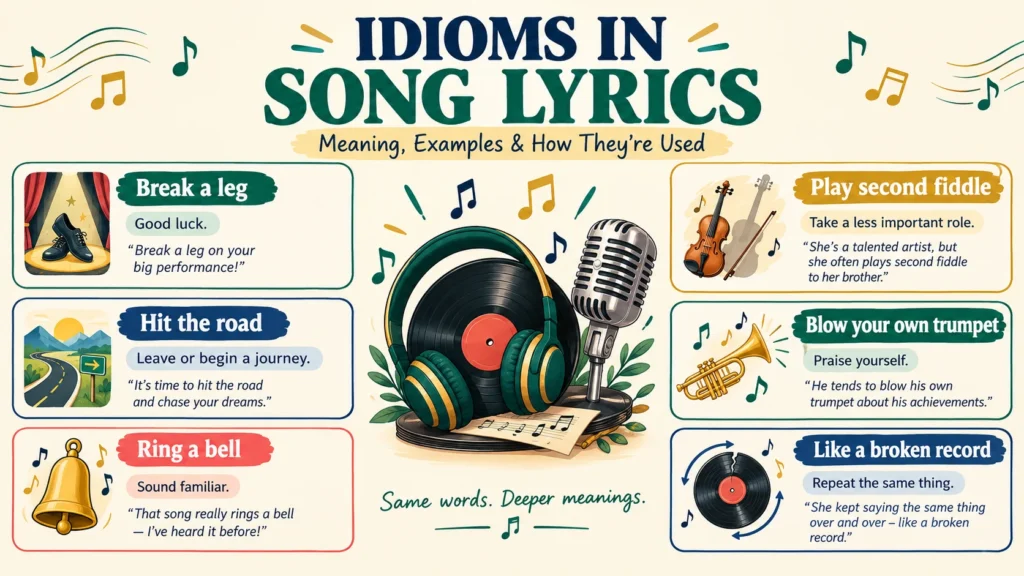
Ever heard a song lyric that makes little sense when you take the words literally, but becomes clear once you understand the expression? Idioms in song lyrics are familiar phrases whose intended meaning may differ from the literal meaning of their individual words. Songwriters use idioms to express emotions, relationships, struggles, dreams, and everyday experiences in a vivid and memorable way.
For example, “break the ice” means to make people feel more comfortable, while “hit the road” means to leave or begin a journey. These expressions can appear in songs, but not every figurative phrase in a lyric is technically an idiom. Songs also use metaphors, symbolism, similes, slang, and other forms of figurative language. Context matters because the surrounding lyrics can help reveal what an expression means.
This guide explains common idioms used in songs, their simple meanings, and how to recognize the difference between an idiom and other types of figurative language.
Why Do Songwriters Use Idioms?
Idioms are especially useful in music because a short expression can communicate an entire idea without a long explanation.
Songwriters may use idiomatic expressions to:
- Express strong emotions quickly
- Create memorable mental images
- Make lyrics sound natural and conversational
- Connect personal experiences with familiar language
- Add personality and storytelling
- Make an idea easier for listeners to recognize
- Support the rhythm or flow of a lyric when appropriate
An idiom can also make a lyric feel more relatable. Saying someone has a “heart of gold,” for example, immediately communicates kindness without needing a lengthy description.
Break the Ice
Word-by-word meaning: To break ice literally means to crack or separate frozen water.
Idiomatic meaning: To make people feel more comfortable when they first meet or when a situation feels awkward.
In song lyrics: A songwriter might use this expression when describing the beginning of a friendship, romance, or conversation.
Example:
Her first joke helped break the ice between them.
Common error: Don’t change it to “break the frozen water” when using the idiomatic expression.
Usage note: Informal and common in conversations.
Hit the Road
Word-by-word meaning: To hit means to strike, while a road is a route for travel.
Idiomatic meaning: To leave or begin a journey.
In song lyrics: It can suggest freedom, departure, adventure, or moving away from a difficult situation.
Example:
We packed our bags and hit the road before sunrise.
Common error: It does not normally mean physically striking a road.
Usage note: Casual and conversational.
On Top of the World
Word-by-word meaning: Being above everything else in the world.
Idiomatic meaning: Feeling extremely happy, successful, or confident.
In song lyrics: This expression works well for lyrics about love, achievement, excitement, or emotional highs.
Example:
After hearing the good news, she felt on top of the world.
Common error: It describes an emotional state, not a literal location.
Usage note: Positive and expressive.
Piece of Cake
Word-by-word meaning: A piece or portion of a cake.
Idiomatic meaning: Something that is very easy.
In song lyrics: It can add a playful or confident tone when a character describes an easy task or situation.
Example:
Once I learned the rules, the test was a piece of cake.
Common error: Don’t confuse the idiom with a literal dessert.
Usage note: Informal.
Heart of Gold
Word-by-word meaning: A heart made of gold.
Idiomatic meaning: A very kind, generous, and caring nature.
In song lyrics: This idiom is particularly effective for describing love, friendship, admiration, or someone who consistently helps others.
Example:
Everyone trusts Maya because she has a heart of gold.
Common error: It is not a literal description of someone’s heart.
Usage note: Warm, positive, and complimentary.
Let the Cat Out of the Bag
Word-by-word meaning: Allowing a cat to escape from a bag.
Idiomatic meaning: Accidentally revealing a secret.
In song lyrics: It can fit stories involving surprises, hidden relationships, secrets, or unexpected revelations.
Example:
I wanted to keep the trip secret, but my brother let the cat out of the bag.
Common error: The standard expression is “let the cat out of the bag.”
Usage note: Informal.
Spill the Beans
Word-by-word meaning: Accidentally scattering beans from a container.
Idiomatic meaning: To reveal secret information.
In song lyrics: It can describe someone revealing a secret about love, friendship, plans, or betrayal.
Example:
Who spilled the beans about the surprise party?
Common error: Say “spill the beans,” not “pour the beans.”
Usage note: Informal and conversational.
Go the Extra Mile
Word-by-word meaning: Travel an additional mile.
Idiomatic meaning: Make more effort than is normally expected.
In song lyrics: It can express devotion, sacrifice, determination, or commitment to another person.
Example:
She went the extra mile to help her friend succeed.
Common error: It should describe additional effort, not simply completing an ordinary task.
Usage note: Suitable for both everyday and professional contexts.
In the Same Boat
Word-by-word meaning: Sharing the same boat.
Idiomatic meaning: Being in the same situation, especially a difficult one.
In song lyrics: It can emphasize shared struggles, friendship, solidarity, or understanding.
Example:
We’re all in the same boat, so let’s support one another.
Common error: It does not necessarily mean traveling together.
Usage note: Common and conversational.
Under the Weather
Word-by-word meaning: Being physically below the weather.
Idiomatic meaning: Feeling slightly ill or unwell.
In song lyrics: It may be used to create a figurative connection between physical discomfort and a difficult emotional state, depending on context.
Example:
I’m feeling under the weather, so I’ll stay home tonight.
Common error: Rainy weather alone does not mean someone is “under the weather.”
Usage note: Informal.
Once in a Blue Moon
Word-by-word meaning: Refers literally to a blue moon.
Idiomatic meaning: Something that happens very rarely.
In song lyrics: It can emphasize a rare meeting, unusual event, or unusual emotional experience.
Example:
We see each other once in a blue moon.
Common error: Don’t use it for something that happens frequently.
Usage note: Conversational and expressive.
Burn the Midnight Oil
Word-by-word meaning: Burning oil late at night for light.
Idiomatic meaning: Staying up late working or studying.
In song lyrics: It can communicate exhaustion, ambition, dedication, or determination.
Example:
I burned the midnight oil to finish my project.
Common error: The phrase is figurative in modern use.
Usage note: Often used for work or study.
A Dime a Dozen
Word-by-word meaning: Twelve things costing a dime.
Idiomatic meaning: Something extremely common or easy to find.
In song lyrics: It can describe ordinary experiences, people, objects, or situations that are not particularly rare.
Example:
Cheap souvenirs are a dime a dozen in that market.
Common error: It doesn’t necessarily state an item’s actual price.
Usage note: Informal; sometimes implies that something is ordinary or lacking uniqueness.
Cost an Arm and a Leg
Word-by-word meaning: Paying with an arm and a leg.
Idiomatic meaning: Something is extremely expensive.
In song lyrics: It can add humor or exaggeration when describing money, luxury, or an expensive experience.
Example:
That concert ticket cost an arm and a leg.
Common error: Don’t interpret the expression literally.
Usage note: Informal and exaggerated.
Keep Your Chin Up
Word-by-word meaning: Hold your chin in a raised position.
Idiomatic meaning: Stay hopeful, positive, or confident during a difficult time.
In song lyrics: It can express encouragement, resilience, and hope after disappointment.
Example:
Keep your chin up; tomorrow may bring better news.
Common error: It is usually about emotional encouragement, not posture.
Usage note: Friendly and encouraging.
Through Thick and Thin
Word-by-word meaning: Through both thick and thin conditions.
Idiomatic meaning: Remaining loyal through good and difficult times.
In song lyrics: This is particularly useful for themes of lasting love, friendship, loyalty, and commitment.
Example:
They stayed together through thick and thin.
Common error: Don’t use it only for pleasant experiences.
Usage note: Warm and emotional.
Back to Square One
Word-by-word meaning: Returning to the first square or starting point.
Idiomatic meaning: Returning to the beginning after an attempt has failed or progress has been lost.
In song lyrics: It can describe starting over after heartbreak, failure, disappointment, or a major change.
Example:
When the plan failed, we were back to square one.
Common error: Starting something new does not automatically mean you’re “back to square one.”
Usage note: Common in conversational English.
The Ball Is in Your Court
Word-by-word meaning: A ball is literally in someone’s court during a game.
Idiomatic meaning: It is now someone’s responsibility to take the next action or make a decision.
In song lyrics: It can suggest uncertainty, romantic tension, choice, responsibility, or waiting for someone’s response.
Example:
I’ve said what I needed to say; now the ball is in your court.
Common error: It is not limited to sports.
Usage note: Conversational and useful in discussions about decisions or relationships.
Bark Up the Wrong Tree
Word-by-word meaning: A dog barking at the wrong tree.
Idiomatic meaning: Pursuing the wrong idea, person, or explanation.
In song lyrics: It can work in stories about mistaken assumptions, jealousy, conflict, or misunderstanding.
Example:
If you think I caused the problem, you’re barking up the wrong tree.
Common error: The standard form is “bark up the wrong tree,” not “bark at the wrong tree.”
Usage note: Informal.
Break a Leg
Word-by-word meaning: To break a leg literally means to injure it.
Idiomatic meaning: A traditional way of wishing someone good luck, especially before a performance.
In song lyrics: It can suit themes involving performers, stages, dreams, ambition, or taking a chance.
Example:
You’re performing tonight? Break a leg!
Common error: It is not a genuine wish for someone to get injured.
Usage note: Strongly associated with performances and often used humorously.
More Idioms from Famous Songs
| Idiom | Song | Meaning |
|---|---|---|
| Best of Both Worlds | “Best of Both Worlds” by Hannah Montana | Enjoying the advantages of two different situations. |
| Against All Odds | “Against All Odds” by Phil Collins | Succeeding despite very difficult circumstances. |
| Head Over Heels | “Head Over Heels” by Tears for Fears | Deeply in love. |
| Time After Time | “Time After Time” by Cyndi Lauper | Repeatedly; on many occasions. |
| Ring a Bell | Common in English songs | Sounding familiar; causing vague recognition. |
| Out of the Blue | “Out of the Blue” by Debbie Gibson | Happening unexpectedly. |
| Let It Go | “Let It Go” from Frozen | Stop holding on; release negative feelings. |
| Cold as Ice | “Cold as Ice” by Foreigner | Emotionally cold; unfeeling. |
| Walking on Sunshine | “Walking on Sunshine” by Katrina and the Waves | Feeling very happy; elated. |
| Burning Love | “Burning Love” by Elvis Presley | Intense romantic passion. |
| Piece of My Heart | “Piece of My Heart” by Janis Joplin | Giving someone your deepest emotions. |
| Under Pressure | “Under Pressure” by Queen and David Bowie | Feeling stressed by demands. |
| Ain’t No Mountain High Enough | Marvin Gaye and Tammi Terrell | No obstacle is too great to overcome. |
Idioms vs. Metaphors in Song Lyrics
Song lyrics contain many kinds of figurative language, so an unusual phrase is not automatically an idiom.
| Idiom | Metaphor |
|---|---|
| Established expression | Can be newly created |
| Has a recognized figurative meaning | Creates a comparison or imaginative image |
| Often has relatively fixed wording | Wording can be freely changed |
| Example: “piece of cake” | Example: “Her voice was sunshine” |
An important difference is that an idiom has a meaning recognized beyond its individual words, while a metaphor can be an original creative comparison created specifically for a song.
How to Identify an Idiom in a Song
When listening to music, use these simple steps:
1. Look for a Strange Literal Meaning
If the words sound unusual when interpreted literally, they may be figurative.
2. Consider the Context
Ask what is happening in the song. Is the expression describing love, conflict, success, sadness, friendship, or another experience?
3. Check Whether the Expression Is Established
Not every creative phrase is an idiom. Look for a recognized expression with an established figurative meaning.
4. Learn the Standard Meaning
Don’t rely only on your interpretation of the song. Check the accepted meaning of the expression.
5. Create Your Own Example
Use the idiom in an everyday sentence. This turns passive listening into active vocabulary practice.
Common Mistakes When Learning Idioms From Songs
Taking Idioms Literally
A “heart of gold” refers to kindness, not a metallic heart.
Changing Fixed Expressions
Use “spill the beans,” rather than changing it to “pour the beans.”
Calling Every Figurative Phrase an Idiom
Songs contain metaphors, symbolism, exaggeration, and wordplay too. These are not automatically idioms.
Copying Song Grammar
Lyrics sometimes use unusual grammar for artistic or rhythmic reasons. Learn the standard English form of an idiom before using it yourself.
Ignoring Tone
An informal idiom may sound natural in conversation but inappropriate in a formal academic paper. Always consider the audience and situation.
How Songs Can Help You Learn English Idioms
Songs provide something a vocabulary list often cannot: context and emotion.
To make the most of them:
- Listen for repeated expressions.
- Write down unfamiliar phrases.
- Find their figurative meanings.
- Notice the emotion surrounding them.
- Create your own sentences.
- Practice saying the expressions naturally.
- Compare their casual and formal alternatives when necessary.
For example, after learning “keep your chin up,” you could use it when encouraging a friend who is disappointed. That real-life connection makes the expression easier to remember.
Idioms in Stories: Understand Their Meaning in Context
Frequently Asked Questions
What are idioms in song lyrics?
They are established English expressions used with figurative meanings in songs. They help communicate emotions, situations, and ideas in memorable language.
Why do songwriters use idioms?
Songwriters may use idioms because they are familiar, expressive, concise, and capable of creating vivid images or emotional connections.
What is an example of an idiom in a song?
Expressions such as “heart of gold,” “hit the road,” “through thick and thin,” and “keep your chin up” can be used in song-style contexts to communicate ideas figuratively.
Are idioms and metaphors the same?
No. An idiom is an established expression with a recognized figurative meaning, while a metaphor creates a comparison or imaginative image. Songs can contain both.
Can I learn English idioms from songs?
Yes. Songs can expose you to idioms in memorable contexts. For the best results, learn the standard meaning, understand the context, and practice using each expression in your own sentences.
Songs are full of figurative language — film lovers will enjoy our Hollywood idioms, readers our idioms in books, and US learners our popular American idioms. Build your core vocabulary with idioms with meanings and examples.
Final Thoughts
Idioms in song lyrics show how English can communicate a powerful idea without saying everything literally. A phrase such as “through thick and thin” can express lasting loyalty, while “keep your chin up” can turn a few words into an encouraging message.
The next time you hear an unusual expression in a song, don’t just skip over it. Identify the phrase, discover its figurative meaning, notice its emotional context, and use it in your own sentence. One idiom at a time, music can become a practical and memorable way to strengthen your English.

Emily Carter writes for Meaning Match about English idioms, student-friendly expressions, and language learning, using simple explanations and helpful examples.
Pingback: Theater Idioms: 25+ Stage Expressions & What They Mean