
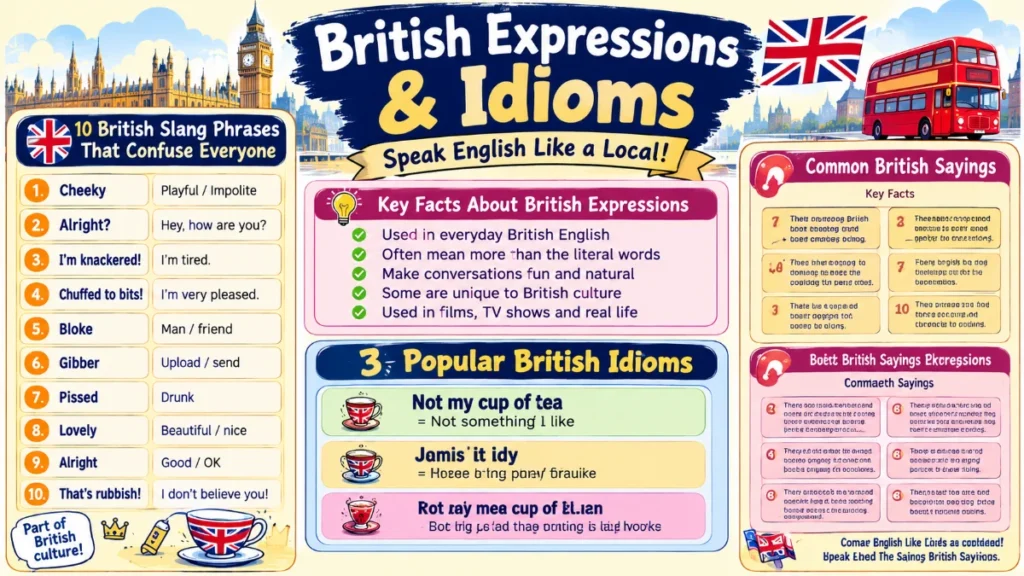
Have you ever understood every word a British speaker said but still had absolutely no idea what they meant? That’s the tricky—and fascinating—part of British English. Expressions such as “not my cup of tea,” “a piece of cake,” “under the weather,” and “cost an arm and a leg” can sound strange when taken literally, yet their intended meanings are perfectly clear to people familiar with the expressions.
Idioms are phrases whose overall meaning often cannot be worked out from the individual words, which is why learning them in context matters.
British expressions and idioms add personality, humor, emotion, and cultural flavor to everyday communication, appearing in conversations, British TV and films, books, workplaces, social media, and everyday writing. In this guide, you’ll discover common British expressions and idioms, their meanings, natural examples, origins where useful, and the situations in which they are actually used, helping you understand British English more naturally—even when the words seem to mean something completely different.
What Are British Expressions and Idioms?
A British expression is a commonly used phrase associated with British English. It can include an idiom, conversational phrase, slang expression, saying, or informal way of communicating an idea.
A British idiom is more specific. Cambridge defines an idiom as a fixed group of words whose meaning is different from the individual meanings of the words themselves.
For example:
- “Spill the beans” literally sounds like dropping beans.
- Its actual meaning is to reveal a secret.
That is an idiom.
By contrast, a phrase such as “Cheers!” can function as a common British expression without being used in exactly the same figurative way as an idiom.
British Expressions vs. British Idioms
| Term | What it means | Example |
|---|---|---|
| British expression | A commonly used British phrase | “Cheers!” |
| British idiom | A fixed phrase with a figurative meaning | “Spill the beans” |
| British slang | Informal vocabulary or expressions | “Mate” |
| British saying | A familiar proverb or traditional phrase | “The early bird catches the worm” |
30 Famous British Expressions and Idioms
To make these expressions easier to learn, each entry includes:
- Meaning
- Pronunciation
- Formality
- How British it sounds
- Natural example
- Common mistake
- Usage note
The goal isn’t just to tell you what an expression means. It’s to show you when and how a British speaker might actually use it.
Knackered
Meaning: Extremely tired or exhausted.
Pronunciation: NAK-erd
Formality: Informal
Britishness: ⭐⭐⭐⭐⭐
Frequency: Very common in casual speech
Example
“I’ve been working since seven this morning. I’m absolutely knackered.”
Natural dialogue
Sam: Fancy going out tonight?
Tom: Not a chance. I’m knackered.
Common mistake
Don’t use knackered in very formal writing when “exhausted” or “very tired” would be more appropriate.
Usage note
This is one of the most useful informal British expressions for describing tiredness.
Give It a Go
Meaning: Try something.
Pronunciation: giv it uh GOH
Formality: Informal
Britishness: ⭐⭐⭐⭐⭐
Frequency: Very common
Example
“I’ve never tried skiing, but I’ll give it a go.”
Natural dialogue
Aisha: Are you nervous about presenting?
Ben: A little.
Aisha: Just give it a go. You’ll be fine.
Common mistake
“Give it a go” means try it, not physically “go” somewhere.
Usage note
This is a particularly natural phrase when encouraging someone to try something new.
Not My Cup of Tea
Meaning: Something you don’t particularly like or enjoy.
Pronunciation: not my cup uh TEE
Formality: Informal/neutral
Britishness: ⭐⭐⭐⭐⭐
Frequency: Very common
Example
“Camping is not really my cup of tea.”
Natural dialogue
“Do you like horror films?”
“Not really. They’re not my cup of tea.”
Common mistake
It doesn’t necessarily mean you strongly hate something. It is often a polite way of expressing a preference.
Usage note
This is one of the classic British expressions for politely saying “I don’t like that.”
Chuffed to Bits
Meaning: Extremely pleased or delighted.
Pronunciation: CHUFT tuh BITS
Formality: Informal
Britishness: ⭐⭐⭐⭐⭐
Frequency: Common
Example
“She was chuffed to bits when she found out she’d got the job.”
Common mistake
“Chuffed” does not mean annoyed in this expression.
Usage note
Use it to express genuine happiness, satisfaction, or pride.
Bob’s Your Uncle
Meaning: The task is complete; it’s easy or straightforward.
Pronunciation: bobz yer UN-kul
Formality: Informal
Britishness: ⭐⭐⭐⭐⭐
Frequency: Common
Example
“Connect the cable, restart the computer, and Bob’s your uncle.”
Natural dialogue
“How do I make an account?”
“Enter your email, choose a password, and Bob’s your uncle.”
Common mistake
It has nothing to do with having an uncle named Bob.
Usage note
It is often used at the end of instructions to suggest that the final result is simple.
A Piece of Cake
Meaning: Very easy.
Pronunciation: uh PEES uhv CAKE
Formality: Informal
Britishness: ⭐⭐⭐
Frequency: Very common
Example
“The test was a piece of cake.”
Common mistake
Don’t use it only for food. Here, it means something is easy.
Usage note
This idiom is used in many varieties of English, so it is not exclusively British.
Keep Your Chin Up
Meaning: Stay positive or brave during a difficult time.
Pronunciation: keep yer chin UP
Formality: Informal/neutral
Britishness: ⭐⭐⭐
Frequency: Common
Example
“You didn’t get the job this time, but keep your chin up.”
Common mistake
The phrase is usually emotional encouragement, not a literal instruction about posture.
Usage note
It’s useful when comforting or encouraging someone.
On the Ball
Meaning: Alert, attentive, capable, or quick to react.
Pronunciation: on the BALL
Formality: Informal/neutral
Britishness: ⭐⭐⭐
Frequency: Common
Example
“You need to be on the ball during the meeting.”
Common mistake
It isn’t restricted to sports.
Usage note
This phrase can work in both workplace and everyday conversations.
Cost an Arm and a Leg
Meaning: Be extremely expensive.
Pronunciation: cost an arm and uh LEG
Formality: Informal
Britishness: ⭐⭐
Frequency: Common
Example
“That new laptop cost an arm and a leg.”
Common mistake
Don’t use it when something is merely a little expensive.
Usage note
This expression is widely understood outside Britain too.
Have a Butcher’s
Meaning: Have a look.
Pronunciation: hav uh BUT-chuz
Formality: Very informal
Britishness: ⭐⭐⭐⭐⭐
Frequency: Familiar, especially in informal British speech
Example
“Come and have a butcher’s at this.”
Common mistake
It does not mean visiting a butcher.
Usage note
This comes from Cockney rhyming slang: butcher’s hook → look.
Because rhyming slang is culturally specific, this expression may be unfamiliar to many English learners.
Take the Mickey
Meaning: Make fun of or tease someone.
Pronunciation: tayk the MICK-ee
Formality: Informal
Britishness: ⭐⭐⭐⭐⭐
Frequency: Common
Example
“Are you taking the Mickey out of me?”
Common mistake
You may see “take the mickey” or “take the Mickey.” Both refer to the same expression.
Usage note
Tone is important. Among friends it can be playful; in another situation, it can sound insulting.
A Storm in a Teacup
Meaning: A lot of fuss about a small problem.
Pronunciation: uh storm in uh TEE-cup
Formality: Informal/neutral
Britishness: ⭐⭐⭐⭐⭐
Frequency: Common
Example
“The argument was just a storm in a teacup.”
Common mistake
Don’t use it for a genuinely serious crisis.
Usage note
American English commonly uses “a tempest in a teapot” for the same general idea.
Spill the Beans
Meaning: Reveal a secret.
Pronunciation: spill the BEENZ
Formality: Informal
Britishness: ⭐⭐
Frequency: Common
Example
“Don’t spill the beans about the surprise.”
Natural dialogue
“Who told you about the party?”
“I can’t tell you. I promised not to spill the beans.”
Common mistake
It means reveal information, not simply talk a lot.
The Last Straw
Meaning: The final problem that makes a situation unbearable.
Pronunciation: the last STRAW
Formality: Neutral/informal
Britishness: ⭐⭐
Frequency: Common
Example
“His constant lateness was annoying, but missing the meeting was the last straw.”
Usage note
There is normally a series of problems, with the final one becoming the last straw.
Bite the Bullet
Meaning: Face something difficult or unpleasant with courage.
Pronunciation: bite the BUL-lit
Formality: Informal/neutral
Britishness: ⭐⭐
Frequency: Common
Example
“I hate going to the dentist, but I’ll bite the bullet.”
Common mistake
It does not literally refer to biting a bullet.
Usage note
This is shared across British and American English.
Pull Someone’s Leg
Meaning: Tease someone or joke by pretending something is true.
Pronunciation: pull sum-wunz LEG
Formality: Informal
Britishness: ⭐⭐
Frequency: Common
Example
“Relax, I’m just pulling your leg.”
Common mistake
It doesn’t mean seriously deceiving someone.
Usage note
The speaker normally expects the listener to understand that the claim is a joke.
Break the Ice
Meaning: Make people feel more comfortable in a new or awkward situation.
Pronunciation: brayk the ICE
Formality: Neutral
Britishness: ⭐⭐
Frequency: Very common
Example
“We played a quick game to break the ice.”
Usage note
You can use this for meetings, classrooms, parties, interviews, and introductions.
A Bit of a Stretch
Meaning: Somewhat exaggerated or difficult to believe.
Pronunciation: uh bit uhv uh STRETCH
Formality: Informal/neutral
Britishness: ⭐⭐⭐
Frequency: Common
Example
“Calling that tiny room a palace is a bit of a stretch.”
Natural dialogue
“He’s definitely the best player in the world.”
“That’s a bit of a stretch.”
Usage note
This is a useful, relatively polite way to disagree.
Keep Your Fingers Crossed
Meaning: Hope that something has a good outcome.
Pronunciation: keep yer FING-ers crossed
Formality: Informal
Britishness: ⭐⭐⭐
Frequency: Very common
Example
“I’ve applied for the job, so keep your fingers crossed.”
Common mistake
It expresses hope; it does not guarantee success.
Usage note
You can also simply say:
“Fingers crossed!”
Raining Cats and Dogs
Meaning: Raining very heavily.
Pronunciation: RAY-ning cats and dogs
Formality: Informal
Britishness: ⭐⭐⭐
Frequency: Familiar, but not necessarily the most natural modern choice
Example
“We couldn’t go for a walk because it was raining cats and dogs.”
Modern British usage note
This is a famous English idiom, but learners should not assume it is the phrase British speakers use most often today. In contemporary conversation, you may also hear:
- It’s absolutely pouring.
- It’s pouring down.
- It’s chucking it down. — very informal
This distinction matters because an expression can be famous without being the most frequent choice in everyday speech.
Cheers
Meaning: Depending on context, “cheers” can mean thank you, function as a friendly farewell, or be used when making a toast.
Formality: Informal
Britishness: ⭐⭐⭐⭐⭐
Frequency: Very common
Examples
“Cheers for helping me with that.”
“Right, I’ll see you tomorrow. Cheers!”
Common mistake
“Cheers” doesn’t always mean “thank you,” although that is one of its very common uses in British English.
Usage note
Context determines the meaning.
Fancy a Cuppa?
Meaning: Would you like a cup of tea?
Formality: Informal
Britishness: ⭐⭐⭐⭐⭐
Frequency: Common
Example
“I’m putting the kettle on. Fancy a cuppa?”
Vocabulary note
Cuppa is an informal form of cup of tea, although “cuppa” can sometimes refer more generally to a cup of tea or another hot drink depending on context.
Usage note
This is a great example of why British expressions often depend on everyday cultural context.
Sorted
Meaning: Fixed, arranged, organized, or successfully dealt with.
Formality: Informal
Britishness: ⭐⭐⭐⭐⭐
Frequency: Very common
Example
“Don’t worry about the tickets. It’s sorted.”
Natural dialogue
“Have you booked the hotel?”
“Yep, that’s sorted.”
Common mistake
Here, “sorted” does not simply mean putting objects into categories.
Usage note
This is particularly useful in everyday British conversation.
Dodgy
Meaning: Suspicious, unreliable, dishonest, poor-quality, or questionable.
Formality: Informal
Britishness: ⭐⭐⭐⭐⭐
Frequency: Very common
Examples
“That website looks dodgy.”
“My phone’s been making a dodgy noise.”
Usage note
The exact meaning depends on context. It can describe a suspicious person, unreliable object, questionable situation, or poor-quality product.
Mate
Meaning: Friend or informal way of addressing someone.
Formality: Informal
Britishness: ⭐⭐⭐⭐⭐
Frequency: Extremely common
Example
“Thanks, mate. I really appreciate it.”
Common mistake
It doesn’t always mean the speaker and listener are close friends.
Usage note
Like “buddy” or “man” in some contexts, mate can be used casually between people who aren’t close friends.
Brilliant
Meaning: Excellent, great, or very good.
Formality: Informal/neutral
Britishness: ⭐⭐⭐⭐⭐
Frequency: Very common
Example
“You got the tickets? Brilliant!”
Usage note
British speakers frequently use brilliant as an enthusiastic response even when they are not describing something literally “brilliant” in the intellectual sense.
Mind the Gap
Meaning: Be careful of the space between a train and the platform.
Formality: Neutral
Britishness: ⭐⭐⭐⭐⭐
Frequency: Very recognizable
Example
“Please mind the gap between the train and the platform.”
Usage note
This phrase is particularly associated with the London Underground and has become one of Britain’s best-known public-transport expressions.
Under the Weather
Meaning: Feeling slightly ill or unwell.
Formality: Informal/neutral
Britishness: ⭐⭐
Frequency: Common
Example
“I’m feeling a bit under the weather today.”
Common mistake
It doesn’t specifically mean that the weather is affecting you.
Usage note
This idiom is widely used beyond Britain too.
Over the Moon
Meaning: Extremely happy or delighted.
Formality: Informal
Britishness: ⭐⭐⭐⭐
Frequency: Common
Example
“She was over the moon when she received the news.”
Common mistake
It does not mean physically traveling above the moon.
Usage note
This is a useful British expression for describing strong happiness.
Throw a Spanner in the Works
Meaning: Cause a problem or interfere with a plan.
Formality: Informal
Britishness: ⭐⭐⭐⭐⭐
Frequency: Common
Example
“The cancelled flight really threw a spanner in the works.”
American equivalent
American English commonly uses:
“Throw a wrench in the works.”
Usage note
This is one of the clearest examples of a British/American vocabulary difference within a similar idiomatic expression.
American Idioms and Slang: Speak English Like a Local
British Expressions at a Glance
| Expression | Meaning | Formality | Britishness |
|---|---|---|---|
| Knackered | Extremely tired | Informal | ⭐⭐⭐⭐⭐ |
| Give it a go | Try it | Informal | ⭐⭐⭐⭐⭐ |
| Not my cup of tea | Not something I like | Informal | ⭐⭐⭐⭐⭐ |
| Chuffed to bits | Very pleased | Informal | ⭐⭐⭐⭐⭐ |
| Bob’s your uncle | It’s simple/done | Informal | ⭐⭐⭐⭐⭐ |
| Piece of cake | Very easy | Informal | ⭐⭐⭐ |
| Keep your chin up | Stay positive | Informal | ⭐⭐⭐ |
| On the ball | Alert/efficient | Neutral | ⭐⭐⭐ |
| Cost an arm and a leg | Very expensive | Informal | ⭐⭐ |
| Have a butcher’s | Have a look | Very informal | ⭐⭐⭐⭐⭐ |
| Take the Mickey | Tease someone | Informal | ⭐⭐⭐⭐⭐ |
| Storm in a teacup | Fuss over something minor | Informal | ⭐⭐⭐⭐⭐ |
| Spill the beans | Reveal a secret | Informal | ⭐⭐ |
| The last straw | Final unbearable problem | Neutral | ⭐⭐ |
| Bite the bullet | Face something difficult | Neutral | ⭐⭐ |
| Pull someone’s leg | Tease someone | Informal | ⭐⭐ |
| Break the ice | Make people comfortable | Neutral | ⭐⭐ |
| A bit of a stretch | Somewhat exaggerated | Informal | ⭐⭐⭐ |
| Cheers | Thanks/toast/farewell | Informal | ⭐⭐⭐⭐⭐ |
| Fancy a cuppa? | Want some tea? | Informal | ⭐⭐⭐⭐⭐ |
| Sorted | Taken care of | Informal | ⭐⭐⭐⭐⭐ |
| Dodgy | Suspicious/unreliable | Informal | ⭐⭐⭐⭐⭐ |
| Mate | Friend/casual address | Informal | ⭐⭐⭐⭐⭐ |
| Brilliant | Excellent/great | Informal | ⭐⭐⭐⭐⭐ |
| Mind the gap | Be careful | Neutral | ⭐⭐⭐⭐⭐ |
| Under the weather | Slightly ill | Neutral | ⭐⭐ |
| Over the moon | Extremely happy | Informal | ⭐⭐⭐⭐ |
| Throw a spanner in the works | Disrupt a plan | Informal | ⭐⭐⭐⭐⭐ |
10 British Expressions Beginners Should Learn First
If you’re new to British English, don’t try to memorize all 30 at once.
Start with these:
- Cheers — thanks / goodbye / toast
- Give it a go — try it
- Not my cup of tea — not something I like
- Knackered — extremely tired
- Brilliant — excellent
- Mate — friend / informal address
- Sorted — taken care of
- Fancy a cuppa? — want some tea?
- On the ball — alert and capable
- Keep your fingers crossed — hope for a good result
These give learners a useful mix of everyday vocabulary, conversational phrases, and idiomatic language.
British Expressions You May Hear in Real Conversations
Textbook English and conversational English are not always the same.
For example:
Textbook English:
“I am extremely tired.”
Natural informal British English:
“I’m absolutely knackered.”
Textbook English:
“Would you like a cup of tea?”
Natural British conversation:
“Fancy a cuppa?”
Textbook English:
“Don’t worry; everything has been arranged.”
Informal British English:
“Don’t worry. It’s sorted.”
Textbook English:
“I will attempt it.”
Natural British English:
“I’ll give it a go.”
Textbook English:
“I don’t particularly like it.”
Natural British English:
“It’s not really my cup of tea.”
This is why learning expressions in context is more useful than memorizing isolated definitions.
British Expressions by Difficulty
🟢 Beginner-Friendly
Start with:
- Cheers
- Mate
- Brilliant
- Give it a go
- Not my cup of tea
- Keep your fingers crossed
- Piece of cake
🟡 Intermediate
Try:
- Knackered
- Chuffed to bits
- Sorted
- Dodgy
- On the ball
- Over the moon
- A bit of a stretch
🔴 More Cultural or Informal
These require more attention to context:
- Have a butcher’s
- Take the Mickey
- Throw a spanner in the works
- Fancy a cuppa?
- A storm in a teacup
The last category isn’t necessarily “harder English.” The challenge is often knowing when the expression sounds natural and when it doesn’t.
British vs. American Expressions: What’s the Difference?
British and American English share many idioms, but everyday vocabulary can differ.
Here are a few useful comparisons:
| British English | American English | Meaning |
|---|---|---|
| Give it a go | Give it a try | Try something |
| Throw a spanner in the works | Throw a wrench in the works | Cause a problem |
| Have a butcher’s | Take a look | Look at something |
| Knackered | Exhausted / wiped out | Very tired |
| Cheers | Thanks | Thank you |
| Mate | Buddy / friend | Informal address |
Not every British expression has a completely different American equivalent. Many idioms, such as “spill the beans,” “break the ice,” and “bite the bullet,” are widely understood in both varieties.
The important point is that “British expression” does not automatically mean “phrase Americans never use.”
American Idioms Examples: 30+Phrases Americans Actually Use
Are These Expressions Used Everywhere in the UK?
Not necessarily.
British English includes many regional varieties, and expressions can vary according to:
- Region
- Age
- Social group
- Setting
- Generation
- Formality
- Personal preference
A phrase may be strongly associated with Britain without being used by every British person.
This is particularly important with slang and rhyming slang.
For example, “have a butcher’s” has a strong cultural connection to Cockney rhyming slang, whereas “cheers” is much more broadly recognizable in British English.
So don’t assume that every British speaker uses every expression on this list.
When Should You Use British Idioms?
British expressions are especially useful in:
- Casual conversations
- Friendly messages
- Everyday storytelling
- Travel conversations
- Informal workplace conversations
- English-learning practice
- Watching British television
- Understanding British podcasts and interviews
However, formal situations require judgment.
For example:
Casual:
“I’m absolutely knackered.”
More professional:
“I’m extremely tired after the long journey.”
Both communicate the same basic idea, but the register is different.
Cambridge’s learner resources explicitly distinguish spoken language and different levels of formality, which is why learning an expression’s register is just as important as learning its definition.
Common Mistakes English Learners Make With British Expressions
1. Translating Every Word Literally
If someone says:
“It’s not my cup of tea.”
Don’t imagine that they are discussing tea.
Understand the phrase as one unit:
Not my cup of tea = not something I like.
2. Using Informal Expressions in Formal Writing
Words such as:
knackered
dodgy
chuffed
mate
can sound too casual in academic or highly professional contexts.
3. Assuming Every Idiom Is Uniquely British
Some expressions are used across British and American English.
For example:
spill the beans
is not exclusively British.
Always distinguish widely used English idioms from expressions that are particularly characteristic of British English.
4. Using Slang Without Understanding the Tone
Some expressions can be friendly among friends but inappropriate with strangers.
“Mate” may sound warm and casual.
“Taking the Mickey” may be playful or insulting depending on tone and context.
Context matters.
5. Overusing Idioms
You don’t need an idiom in every sentence to sound British.
Natural English is usually a mixture of:
- ordinary vocabulary
- contractions
- conversational phrases
- idioms
- slang
- pauses and discourse markers
Using too many idioms can actually make your speech sound unnatural.
How to Learn British Expressions Naturally
Learn the Whole Phrase
Don’t memorize:
knackered = tired
Memorize:
I’m absolutely knackered after work.
Your brain learns the expression together with its natural context.
Learn the Register
Ask:
Is this formal, neutral, informal, slang, or humorous?
This prevents awkward usage.
Listen Before You Speak
Pay attention to how native speakers use expressions in:
- Interviews
- Podcasts
- Films
- TV shows
- Conversations
- Educational videos
Language-learning resources such as Cambridge’s learner dictionaries emphasize real examples and British pronunciation, which are particularly useful when learning expressions rather than isolated vocabulary.
Write Your Own Sentences
Take three expressions:
I’m knackered.
I’ll give it a go.
It’s not my cup of tea.
Then create situations from your own life.
This turns passive vocabulary into active vocabulary.
A 5-Minute British English Practice Challenge
Want to remember these expressions?
Try this today.
Step 1: Choose three
Pick:
- Knackered
- Give it a go
- Cheers
Step 2: Write one sentence for each
For example:
“I’m knackered after studying all afternoon.”
“I’ve never cooked this dish, but I’ll give it a go.”
“Cheers for helping me.”
Step 3: Say them aloud
Pay attention to pronunciation and rhythm.
Step 4: Use one naturally
Use at least one expression in a conversation or message.
Step 5: Learn three more tomorrow
Small, repeated practice is much more effective than trying to memorize a huge list in one sitting.
FAQ
What are the most common British expressions?
Common British expressions include “cheers,” “mate,” “knackered,” “give it a go,” “not my cup of tea,” “brilliant,” “sorted,” and “fancy a cuppa?” Many traditional idioms such as “spill the beans” and “break the ice” are also widely used in Britain.
What is the difference between a British expression and a British idiom?
A British expression is a broad term for a commonly used phrase in British English. An idiom is a specific type of expression whose meaning differs from the literal meanings of its individual words. For example, “spill the beans” means “reveal a secret.”
What are some British phrases Americans may not understand?
Expressions such as “have a butcher’s,” “chuffed to bits,” “knackered,” “give it a go,” and “throw a spanner in the works” may sound particularly British to American listeners. Some have recognizable American equivalents, while others depend heavily on British cultural context.
What is a very British way to say “I am tired”?
A common informal choice is:
“I’m knackered.”
It means “I’m extremely tired.”
For formal situations, use “I’m very tired” or “I’m exhausted” instead.
What does “Bob’s your uncle” mean?
“Bob’s your uncle” is an informal British expression meaning that something is simple, complete, or successfully achieved. It is often used after giving a short set of instructions.
What does “cheers” mean in British English?
Depending on context, “cheers” can mean thank you, be used when making a toast, or function as an informal farewell. Context determines which meaning is intended.
What is the most British idiom?
There isn’t one objectively “most British” idiom. Expressions such as “Bob’s your uncle,” “have a butcher’s,” “knackered,” “chuffed to bits,” and “throw a spanner in the works” have strong British associations, but British English varies by region, age, and context.
Keep building your idiom vocabulary: explore timeless phrases Shakespeare contributed to English, look up common idioms with clear meanings and examples, discover how idioms are translated between languages, or enjoy idioms from the world of Harry Potter.
Final Thoughts: Start Using British Expressions Today
British expressions and idioms can seem confusing at first because their literal words often tell you very little about their real meaning. Once you learn the expression as a complete phrase—and understand its tone, formality, and context—it becomes much easier to recognize and use naturally.
You don’t need to memorize all 30 today.
Start with these five:
Knackered → very tired
Give it a go → try it
Not my cup of tea → not something I like
Cheers → thanks / goodbye / toast
Sorted → taken care of
Then make one sentence with each.
The goal isn’t to force yourself to sound “more British.” It’s to understand real British English and communicate naturally when the situation calls for it.
Your challenge: Pick three expressions from this guide, write your own examples, say them aloud, and use one in a real conversation this week.

Emily Carter writes for Meaning Match about English idioms, student-friendly expressions, and language learning, using simple explanations and helpful examples.