Sometimes, two simple words can mean much more than they seem to say. 2 word idioms are short expressions whose meaning may not be obvious from the individual words, making them useful for everyday conversation, writing, captions, and English learning. However, not every two-word expression is technically an idiom.
Some, such as “hang out” and “show off,” are phrasal verbs, while other short expressions have a more clearly figurative meaning. Knowing this difference can help you understand these phrases and use them correctly instead of treating every two-word combination as an idiom.
For example, “hang out” means to spend time relaxing with someone, while “show off” means to deliberately attract attention by displaying a skill or possession. If you’re searching for 2 word idioms for school, conversation, writing, or vocabulary practice, this guide explains their meanings, differences, and natural uses with clear examples.
What Are 2 Word Idioms?
2 word idioms are short English expressions made from two words that can have a meaning beyond their individual words. From “give up” to “find out,” these compact expressions appear frequently in everyday conversations, messages, and informal writing.
There is one important distinction, though: many popular “2 word idioms” are technically phrasal verbs or fixed expressions, rather than traditional idioms. This guide includes common two-word expressions learners often search for as idioms and explains how to use them naturally.
Common 2 Word Idioms and Expressions
Calm Down
Meaning: To become less upset, angry, nervous, or excited.
Example sentences:
- “Take a breath and calm down.”
- “She calmed down after talking to her friend.”
Common mistake:
“Calm down” can sound impatient or dismissive when someone is genuinely upset.
Usage note:
Use it carefully with other people. A softer alternative is “Take a moment” or “Let’s take a breath.”
Give Up
Meaning: To stop trying, stop doing something, or surrender.
Example sentences:
- “Don’t give up on your goals.”
- “He gave up trying to repair the computer.”
Common mistake:
Don’t confuse give up with give in. Give up means to stop trying, while give in means to stop resisting or accept something after resistance.
Usage note:
“Give up” is extremely common in everyday English and can also refer to stopping a habit, such as smoking.
Find Out
Meaning: To discover or learn information.
Example sentences:
- “I need to find out what happened.”
- “She found out the truth yesterday.”
Common mistake:
The past form is found out, not “finded out.”
Usage note:
Use find out when you discover information rather than simply see or notice something.
Look Up
Meaning: To search for information in a dictionary, book, database, or online.
Example sentences:
- “Look up the word in a dictionary.”
- “I looked up the restaurant online.”
Common mistake:
“Look up” has several meanings. Context determines whether it means searching for information or looking toward a higher position.
Usage note:
Both look up the word and look the word up are possible in many contexts.
Break Down
Meaning: To stop functioning, become emotionally overwhelmed, or divide something into smaller parts.
Example sentences:
- “My car broke down on the way home.”
- “The teacher broke the difficult topic down into simple steps.”
Common mistake:
Don’t assume it always means something has physically broken.
Usage note:
Context is essential. A machine can break down, a person can break down, and information can be broken down into simpler parts.
Carry On
Meaning: To continue doing something.
Example sentences:
- “Please carry on with your work.”
- “She carried on studying despite the noise.”
Common mistake:
Don’t interpret it literally as physically carrying something.
Usage note:
“Carry on” is especially common in British English, although it is understood more widely.
Hard Idioms to Guess: 26+ Tricky Meanings
Hurry Up
Meaning: To do something more quickly or move faster.
Example sentences:
- “Hurry up, or we’ll miss the bus.”
- “We need to hurry up and finish.”
Common mistake:
Because it can sound impatient, avoid using it harshly with someone who is already under pressure.
Usage note:
For a more polite request, try “Could you hurry a little?”
Slow Down
Meaning: To reduce speed or do something at a slower pace.
Example sentences:
- “Slow down; you’re driving too fast.”
- “I need to slow down and think.”
Common mistake:
“Slow down” does not mean “stop.”
Usage note:
It can describe physical speed, speech, work, or the pace of an activity.
Hang On
Meaning: To wait briefly or hold something tightly.
Example sentences:
- “Hang on a second; I’ll be right back.”
- “Hang on to the railing.”
Common mistake:
The meaning changes with context.
Usage note:
In conversation, “Hang on!” commonly means “Wait!”
Cheer Up
Meaning: To become happier or help someone feel happier.
Example sentences:
- “Cheer up! Things may get better.”
- “I brought her some flowers to cheer her up.”
Common mistake:
Don’t automatically tell someone to “cheer up” when they are experiencing serious sadness or grief.
Usage note:
Tone and circumstances matter. Encouragement should be appropriate to the situation.
Wake Up
Meaning: To stop sleeping or, in some contexts, become aware of something.
Example sentences:
- “I wake up at seven every morning.”
- “Wake up and pay attention to what is happening.”
Common mistake:
Don’t confuse wake up with get up. Wake up means stop sleeping; get up means leave your bed or rise to your feet.
Usage note:
“Wake up” can have both literal and figurative uses.
Sit Down
Meaning: To move into a seated position.
Example sentences:
- “Please sit down.”
- “We sat down to discuss the problem.”
Common mistake:
Calling every two-word expression an idiom is inaccurate. Sit down is generally a phrasal verb with a mostly literal meaning.
Usage note:
This is a useful example of why the broad search term “2 word idioms” can include expressions that are technically phrasal verbs.
Stand Up
Meaning: To rise to your feet; in stand up for, it can mean defend someone or something.
Example sentences:
- “Please stand up when your name is called.”
- “She stood up for her friend.”
Common mistake:
Don’t confuse stand up with stand up for. Adding for changes the meaning.
Usage note:
The basic expression is generally literal, while stand up for has a figurative meaning.
Take Off
Meaning: To remove something, for an aircraft to leave the ground, or for something to become successful quickly.
Example sentences:
- “Take off your shoes.”
- “The plane took off on time.”
- “Her new business really took off.”
Common mistake:
Don’t assume “take off” has only one meaning.
Usage note:
This is a strong example of why context matters when learning two-word expressions.
Put Off
Meaning: To postpone something or cause someone to lose interest.
Example sentences:
- “Don’t put off your homework.”
- “The rude service put me off the restaurant.”
Common mistake:
Don’t confuse put off with put out, which has different meanings.
Usage note:
In formal writing, postpone may sometimes be clearer than “put off.”
Turn Up
Meaning: To increase something, especially volume or intensity; it can also mean arrive or appear.
Example sentences:
- “Turn up the music.”
- “He turned up late to the meeting.”
Common mistake:
Don’t assume it always refers to sound.
Usage note:
Context tells you whether turn up means increase, arrive, or appear.
Turn Down
Meaning: To reduce something or reject an offer or request.
Example sentences:
- “Please turn down the TV.”
- “She turned down the job offer.”
Common mistake:
“Turn down” does not always refer to volume.
Usage note:
It has a useful contrast with turn up: turn up the volume vs. turn down the volume.
Work Out
Meaning: To exercise, solve something, or develop successfully.
Example sentences:
- “I work out three times a week.”
- “We need to work out a solution.”
- “Everything worked out in the end.”
Common mistake:
“Work out” does not simply mean exercise.
Usage note:
Its meaning depends strongly on context, making it a useful expression to learn through complete sentences.
Back Up
Meaning: To make a duplicate copy of data, support someone, or move backward.
Example sentences:
- “Back up your files regularly.”
- “I’ll back you up if anyone asks.”
Common mistake:
Don’t assume it always means moving backward.
Usage note:
In technology, back up usually means creating a copy of important data.
Let Down
Meaning: To disappoint someone by failing to meet their expectations.
Example sentences:
- “I don’t want to let you down.”
- “The team let its supporters down.”
Common mistake:
Don’t confuse let down with put down. They have different meanings.
Usage note:
“Let someone down” is commonly used when someone fails to do what another person expected.
Are 2 Word Idioms the Same as Phrasal Verbs?
Not exactly.
The phrase “2 word idioms” is commonly used by learners and searchers as a broad term for short expressions. However, many examples in everyday lists are actually phrasal verbs.
A phrasal verb usually combines a verb with a particle, such as:
- give up
- find out
- look up
- break down
- put off
- work out
A traditional idiom is an expression whose overall meaning is not necessarily predictable from its individual words, such as “a piece of cake” meaning something easy.
So, if you’re studying English, it is useful to know both terms. You can still search for and learn “2 word idioms,” but recognizing the grammatical difference will make your English knowledge more accurate.
Common Mistakes With 2 Word Idioms
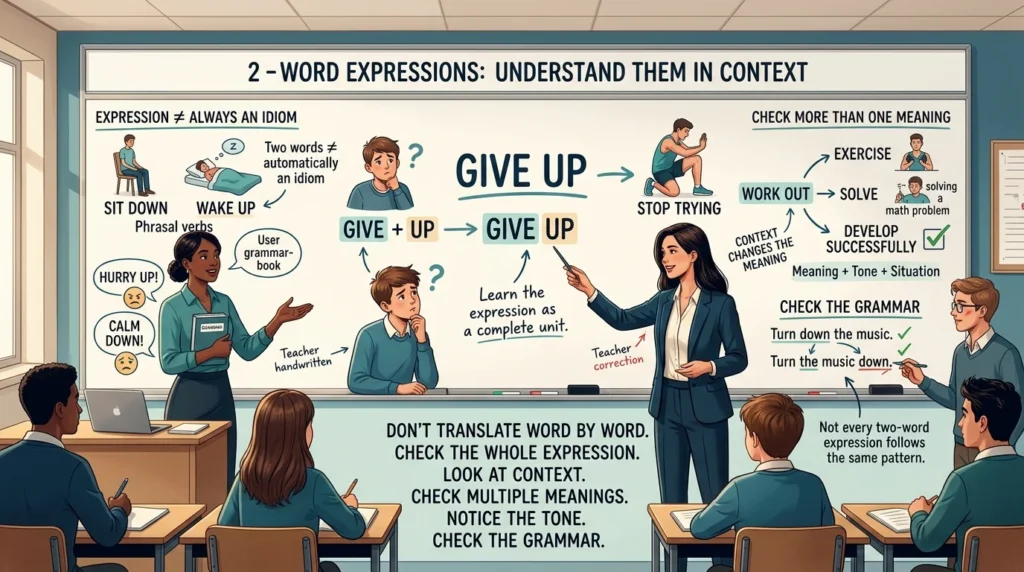
Don’t Translate Them Word for Word
The individual words don’t always tell you the complete meaning.
For example:
Give up → stop trying
Learning the expression as a complete unit is more effective than translating each word separately.
Don’t Assume Every Two-Word Phrase Is an Idiom
Expressions such as sit down and wake up are generally phrasal verbs rather than traditional idioms.
This distinction is especially useful for students who want to understand English grammar as well as vocabulary.
Don’t Learn Only One Meaning
Some expressions have several meanings.
For example:
Work out can mean:
- exercise
- solve something
- develop successfully
Always look at example sentences to understand the context.
Don’t Ignore Tone
Some expressions can sound stronger than they appear in writing.
For example:
“Hurry up!”
may sound impatient.
Similarly:
“Calm down!”
can sound dismissive if used at the wrong moment.
Check the Grammar
Some phrasal verbs can be separated:
Turn down the music.
Turn the music down.
Others have different patterns. Don’t assume that every two-word expression works in exactly the same way.
How to Learn 2 Word Idioms Naturally
You don’t need to memorize a huge list in one sitting. A simple routine can make these expressions easier to remember.
1. Learn a Few at a Time
Choose three to five expressions and focus on them for several days.
2. Learn Complete Sentences
Instead of memorizing:
Find out = discover
learn:
I’ll find out what time the store closes.
This shows you how the expression works naturally.
3. Create Your Own Examples
Write sentences about your actual life. Personal examples are easier to remember because they connect vocabulary with real situations.
4. Notice Them in Context
Look for these expressions in:
- conversations
- books
- podcasts
- movies
- news articles
- everyday messages
Seeing an expression repeatedly helps you recognize it naturally.
5. Practice Speaking
Say your examples aloud. Knowing the meaning is useful, but being able to produce the expression naturally is the real goal.
Hard Idioms Examples: 30+ Tricky Phrases With Meanings
How to Use 2 Word Expressions in Everyday English
Two-word expressions are especially useful in conversations because many of them are short and familiar.
For example:
At school:
“Please sit down.”
With a friend:
“Don’t give up.”
While studying:
“I’ll look up the answer.”
At work:
“Let’s work out a solution.”
When something goes wrong:
“My car broke down.”
The key is to choose expressions that fit the situation. Natural English is not about using as many idioms as possible. It is about choosing the right expression at the right time.
2 Word Idioms vs. Longer Idioms
Short expressions can be convenient in everyday speech, but length alone does not determine whether an expression is an idiom.
Compare:
- Give up → stop trying
- Work out → exercise, solve, or succeed
- A piece of cake → something very easy
- Bite the bullet → face something difficult or unpleasant
The important thing is to understand the expression’s meaning, grammar, tone, and context, rather than focusing only on the number of words.
FAQs About 2 Word Idioms
What are 2 word idioms?
2 word idioms is a common learner-friendly term for short two-word expressions. Many examples are technically phrasal verbs rather than traditional idioms.
What are some common 2 word idioms?
Common examples include give up, find out, calm down, look up, break down, cheer up, put off, work out, and let down.
Are all two-word expressions idioms?
No. Some are phrasal verbs, some are fixed expressions, and some are ordinary word combinations. The grammatical classification depends on how the expression functions and what it means.
Why should English learners study two-word expressions?
They occur frequently in everyday English and can help learners understand natural conversations, instructions, messages, and informal writing.
What is the best way to remember 2 word idioms?
Learn each expression in context. Read an example, create your own sentence, say it aloud, and review it regularly. This is usually more effective than memorizing isolated translations.
Conclusion
2 word idioms and related two-word expressions are useful parts of everyday English. Expressions such as give up, find out, calm down, work out, and let down can appear simple, but their meanings and grammatical patterns are worth learning in context.
Remember that many popular “2 word idioms” are technically phrasal verbs, and knowing that distinction can make your English learning more accurate. Start with a few expressions from this list, create your own sentences, and use them naturally in conversation. With regular practice, these short expressions will become much easier to recognize and use correctly.

Emily Carter writes for Meaning Match about English idioms, student-friendly expressions, and language learning, using simple explanations and helpful examples.