
Think you can figure out an idiom just by looking at the words? Hard idioms to guess are expressions whose literal wording gives little or no clue to their actual figurative meaning, making them tricky even for strong English learners.
Phrases such as “bite the bullet,” “burn the midnight oil,” “hit the nail on the head,” and “beat around the bush” can be difficult to understand if you take them literally. For example, “bite the bullet” has nothing to do with eating a piece of metal—it means to face a difficult or unpleasant situation with courage.
If you’re looking for hard idioms to guess for a quiz, classroom activity, English practice, or just a fun vocabulary challenge, this guide will put your skills to the test. You’ll find challenging idioms, clues, meanings, and clear examples to help you learn them.
Why Are Some English Idioms So Hard to Guess?
Imagine hearing someone say, “Don’t worry, I’m just pulling your leg.” You might wonder why someone’s leg suddenly became part of the conversation.
That’s the problem with idioms: the words may be familiar, but their combination can have a completely different meaning.
English learners often find idioms difficult because:
- The literal meaning can be misleading.
- Some expressions are strongly connected to culture or history.
- Idioms can have specific tones, from playful to serious.
- Changing even one word can make an expression sound unnatural.
- The correct meaning often depends on the situation.
The good news? You don’t have to memorize idioms word by word. Learn the whole expression in context, and it becomes much easier to recognize.
Hard Idioms to Guess in English
Barking Up the Wrong Tree
Can you guess it?
“If you think Sarah took your phone, you’re barking up the wrong tree.”
Literal meaning: A dog is barking at the wrong tree.
Idiomatic meaning: To pursue the wrong idea, person, or explanation.
Example:
“You’re barking up the wrong tree if you think I caused the problem.”
Common mistake: Learners sometimes use it simply to mean that someone is mistaken. It is more specific: the person is directing their suspicion, effort, or attention toward the wrong target.
Usage note: Informal and conversational.
Bite the Bullet
Can you guess it?
“I hate speaking in public, but I’ll have to bite the bullet and do it.”
Literal meaning: To bite a bullet.
Idiomatic meaning: To face something painful, difficult, or unpleasant with courage.
Example:
“I finally bit the bullet and apologized.”
Common mistake: It does not mean accepting every bad situation. Usually, there is a difficult action or experience that someone has decided to face.
Usage note: Informal and commonly used in conversation.
Spill the Beans
Can you guess it?
“We planned a surprise, but Tom spilled the beans.”
Literal meaning: To accidentally spill beans.
Idiomatic meaning: To reveal a secret.
Example:
“Don’t spill the beans about the birthday party.”
Common mistake: Don’t use it for sharing ordinary information. The expression normally involves information that was supposed to remain secret.
Usage note: Informal and especially natural in everyday conversation.
Once in a Blue Moon
Can you guess it?
“I eat fast food once in a blue moon.”
Literal meaning: Something happening during a blue moon.
Idiomatic meaning: Something that happens very rarely.
Example:
“We see our old classmates once in a blue moon.”
Common mistake: Don’t use it for something that happens occasionally or regularly. It emphasizes rarity.
Usage note: Informal and conversational.
The Ball Is in Your Court
Can you guess it?
“I’ve given you all the information. Now the ball is in your court.”
Literal meaning: A ball is on your side of a sports court.
Idiomatic meaning: It is now your responsibility to make the next decision or take the next action.
Example:
“I’ve made my offer, so the ball is in your court.”
Common mistake: Learners sometimes use it when nobody has actually been given responsibility for the next step.
Usage note: Conversational and useful in work, personal, and decision-making situations.
Beat Around the Bush
Can you guess it?
“Stop beating around the bush and tell me what happened.”
Literal meaning: To move or search around a bush without going directly to it.
Idiomatic meaning: To avoid saying something directly.
Example:
“She kept beating around the bush instead of answering my question.”
Common mistake: Don’t use it simply to mean “talk a lot.” The important idea is avoiding the main point.
Usage note: Informal; it can sound impatient when directed at someone.
Cut Corners
Can you guess it?
“The company cut corners to finish the project cheaply.”
Literal meaning: To cut across corners.
Idiomatic meaning: To take shortcuts by skipping proper steps, often to save time, money, or effort.
Example:
“Never cut corners when safety is involved.”
Common mistake: Cutting corners does not simply mean working efficiently. It usually suggests that an important standard or step was neglected.
Usage note: Often negative; suitable for everyday and workplace discussions.
Put All Your Eggs in One Basket
Can you guess it?
“Apply to several universities instead of putting all your eggs in one basket.”
Literal meaning: To put every egg into one basket.
Idiomatic meaning: To depend entirely on one option or opportunity.
Example:
“We shouldn’t put all our eggs in one basket by relying on one customer.”
Common mistake: It is about risk and dependence, not simply choosing one thing.
Usage note: Common in advice about money, business, education, and planning.
Let the Cat Out of the Bag
Can you guess it?
“Mia let the cat out of the bag about the wedding.”
Literal meaning: To release a cat from a bag.
Idiomatic meaning: To reveal a secret, usually accidentally or too early.
Example:
“I wasn’t supposed to know, but Jake let the cat out of the bag.”
Common mistake: Don’t confuse it with simply telling someone information. The information is normally something that was intended to be secret.
Usage note: Informal and conversational.
Go the Extra Mile
Can you guess it?
“Our teacher went the extra mile to help us prepare for the exam.”
Literal meaning: To travel one additional mile.
Idiomatic meaning: To make more effort than is normally expected.
Example:
“She always goes the extra mile for her customers.”
Common mistake: It doesn’t necessarily mean working longer. The key idea is extra effort or care.
Usage note: Usually positive and appropriate in professional as well as everyday contexts.
Burn the Midnight Oil
Can you guess it?
“I was burning the midnight oil to finish my assignment.”
Literal meaning: To burn oil late at night.
Idiomatic meaning: To work or study late into the night.
Example:
“The students burned the midnight oil before their final exams.”
Common mistake: Staying awake late for entertainment isn’t normally what this idiom emphasizes. It usually involves working or studying.
Usage note: Often used in academic and work-related situations.
Throw in the Towel
Can you guess it?
“After several failed attempts, he decided to throw in the towel.”
Literal meaning: To throw a towel.
Idiomatic meaning: To give up or stop trying.
Example:
“Don’t throw in the towel after one mistake.”
Common mistake: Don’t use it merely when someone pauses or takes a break. It implies giving up.
Usage note: Informal and often used to encourage persistence.
Hit the Nail on the Head
Can you guess it?
“You hit the nail on the head when you said communication was the problem.”
Literal meaning: To hit a nail exactly on its head.
Idiomatic meaning: To identify or describe something exactly.
Example:
“Her explanation hit the nail on the head.”
Common mistake: It is not just another way to say “you’re right.” It is especially useful when someone identifies the exact point or cause.
Usage note: Common and conversational.
Pull Someone’s Leg
Can you guess it?
“Relax! I’m only pulling your leg.”
Literal meaning: To physically pull someone’s leg.
Idiomatic meaning: To joke with someone or playfully trick them.
Example:
“I thought he was serious, but he was just pulling my leg.”
Common mistake: Don’t use it for a cruel or serious deception. The expression usually suggests playful teasing.
Usage note: Informal and often humorous.
Under the Weather
Can you guess it?
“I’m feeling a little under the weather today.”
Literal meaning: Being physically underneath the weather.
Idiomatic meaning: Feeling slightly ill or unwell.
Example:
“Sara stayed home because she was under the weather.”
Common mistake: It normally refers to physical unwellness, not simply feeling sad or having a bad day.
Usage note: Informal and common in everyday conversation.
Add Fuel to the Fire
Can you guess it?
“His angry comment only added fuel to the fire.”
Literal meaning: To put more fuel onto a fire.
Idiomatic meaning: To make an already difficult, angry, or tense situation worse.
Example:
“Don’t argue with him now; you’ll only add fuel to the fire.”
Common mistake: The situation should already contain a problem, conflict, or tension. Otherwise, the expression may not fit.
Usage note: Common in discussions about arguments and conflict.
A Blessing in Disguise
Can you guess it?
“Losing that job turned out to be a blessing in disguise.”
Literal meaning: A blessing hidden by a disguise.
Idiomatic meaning: Something that initially seems bad but later produces a positive result.
Example:
“Missing the flight was a blessing in disguise because it was later canceled.”
Common mistake: Don’t use it for something that is obviously good from the beginning. The important part is the unexpected positive outcome.
Usage note: Neutral to positive; useful when reflecting on unexpected outcomes.
Read Between the Lines
Can you guess it?
“If you read between the lines, you can tell that she’s disappointed.”
Literal meaning: To read the spaces between written lines.
Idiomatic meaning: To understand a hidden or indirect meaning.
Example:
“You need to read between the lines to understand his real message.”
Common mistake: It doesn’t mean reading more carefully in a literal sense. It refers to information that is implied rather than directly stated.
Usage note: Useful in conversations, writing, messages, and situations involving indirect communication.
Take It With a Grain of Salt
Can you guess it?
“I heard that rumor online, but I’d take it with a grain of salt.”
Literal meaning: To take something while holding a grain of salt.
Idiomatic meaning: To remain skeptical about something and not accept it as completely true.
Example:
“Take his promises with a grain of salt.”
Common mistake: It doesn’t mean rejecting something completely. You can consider the information while remaining cautious about its accuracy.
Usage note: Common in conversations about rumors, claims, advice, and unreliable information.
Have a Chip on Your Shoulder
Can you guess it?
“He has a chip on his shoulder about being overlooked for the promotion.”
Literal meaning: To carry a small piece of wood on your shoulder.
Idiomatic meaning: To have a persistent feeling of resentment or anger about something.
Example:
“She seems to have a chip on her shoulder about criticism.”
Common mistake: Don’t use it simply to describe someone who is angry once. It usually suggests a lasting grievance or resentment.
Usage note: Informal and often negative, so use it carefully when describing another person.
Weird Idioms in English: 30+ Unexpected Meanings
Quick Guide: Literal Meaning vs. Real Meaning
| Idiom | Real Meaning | Tone |
|---|---|---|
| Barking up the wrong tree | Pursuing the wrong idea | Informal |
| Bite the bullet | Face something difficult | Informal |
| Spill the beans | Reveal a secret | Informal |
| Once in a blue moon | Very rarely | Informal |
| The ball is in your court | Your turn to act or decide | Conversational |
| Cut corners | Take improper shortcuts | Neutral/negative |
| Go the extra mile | Make extra effort | Positive |
| Read between the lines | Understand an implied meaning | Neutral |
| Take it with a grain of salt | Remain skeptical | Conversational |
| Have a chip on your shoulder | Hold a lasting grievance | Informal/negative |
How to Guess a Difficult Idiom From Context
You won’t always know an idiom immediately. Instead of translating every word, try this simple method.
1. Read the Whole Sentence
The surrounding words often reveal the situation.
2. Ignore the Strange Literal Picture
If someone says “the ball is in your court,” don’t focus on the tennis ball. Ask what the person is expected to do next.
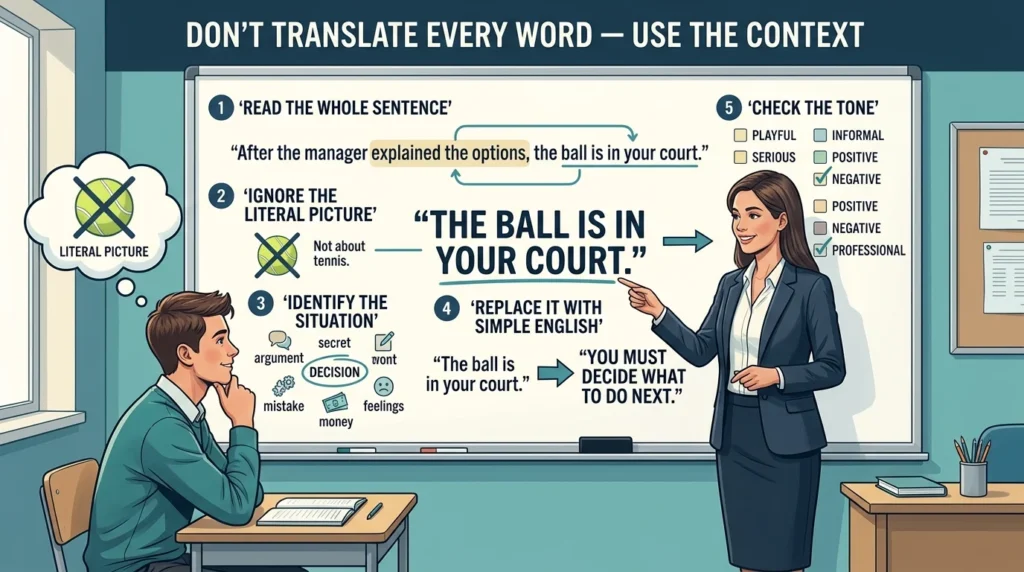
3. Identify the Situation
Is the sentence about:
- a secret?
- an argument?
- a difficult decision?
- a mistake?
- money?
- someone’s feelings?
- a rare event?
The situation narrows the possible meaning.
4. Replace the Idiom With Simple English
For example:
“She spilled the beans.”
Try:
“She ______ the secret.”
The missing idea becomes much easier to identify.
5. Check the Tone
Ask whether the expression sounds:
- playful
- informal
- serious
- positive
- negative
- professional
This helps you decide whether it fits your own sentence.
Common Mistakes English Learners Make With Idioms
Taking Every Idiom Literally
If your friend says:
“It’s a piece of cake.”
They probably mean something is easy—not that they are discussing dessert.
Changing the Fixed Expression
Idioms usually have established wording. Don’t casually replace words with synonyms.
For example:
The ball is in your court. ✓
Changing it to an unfamiliar version can make your English sound unnatural.
Using the Right Idiom in the Wrong Situation
Knowing the meaning isn’t enough. You also need to know when the expression fits.
For example, “break a leg” is traditionally used to wish someone good luck before a performance. It would be inappropriate in a conversation about an actual broken leg.
Ignoring Intensity
Some idioms are stronger than others.
Once in a blue moon means very rarely, while an expression meaning “sometimes” would describe a more frequent event.
Using Too Many Idioms
Idioms can make English lively, but using several in every sentence can sound forced. Choose expressions that genuinely fit the situation.
How to Remember Hard-to-Guess Idioms
The easiest method is to connect an idiom with a picture + situation + sentence.
For example:
Idiom: Bite the bullet
Situation: You must face something unpleasant.
Simple meaning: Face it bravely.
Practice sentence: “I hate presentations, but I’ll bite the bullet and give mine tomorrow.”
Do this with five idioms at a time instead of trying to memorize all 20 at once.
You can also test yourself by covering the meanings and trying to guess each idiom from its example sentence.
Crazy Idioms Phrases: 27+ Unusual Phrases With Unexpected Meanings
Frequently Asked Questions
What are hard idioms to guess?
Hard idioms to guess are expressions whose figurative meanings are difficult to understand from their individual words. “Barking up the wrong tree” and “have a chip on your shoulder” are good examples.
Why are some English idioms so confusing?
Their literal meanings often have little connection to their intended meanings. Learners must understand the expression as a whole and use context to identify its figurative meaning.
What is the best way to learn difficult idioms?
Learn each idiom with its meaning, a realistic situation, an example sentence, and its tone. Then try to guess the meaning before checking the answer.
Should I use idioms in formal English?
Some idioms work well in professional communication, while others are strongly informal. Check the tone and context before using one in academic or formal writing.
How can I tell what an unfamiliar idiom means?
Read the complete sentence, identify the situation, ignore the literal image, and try replacing the idiom with a simple phrase that fits the context.
Final Thoughts
The hardest English idioms are not necessarily the longest ones—they are the expressions whose literal words hide the real meaning. Instead of memorizing definitions mechanically, learn each idiom through context, tone, examples, and realistic situations.
Start with five expressions from this list. Hide their meanings, read the example sentences, and try to guess what each idiom means before revealing the answer. With regular practice, even confusing English expressions will start to feel natural.

Sophie Collins writes for Meaning Match about English idioms, American and British expressions, meanings, usage, and everyday language differences.