
Some English idioms are easy to understand, while others can leave you completely confused. Hard idioms examples are useful for learning expressions whose literal words do not reveal their real figurative meanings.
Phrases such as “bite the bullet,” “beat around the bush,” and “spill the beans” may sound strange at first, but their meanings become clear with the right context. For example, “bite the bullet” means to face something difficult, while “beat around the bush” means to avoid getting directly to the point.
These expressions can be especially challenging for English learners because you cannot always guess their meanings word for word. If you’re searching for hard idioms examples for schoolwork, English practice, quizzes, writing, or everyday conversation, this guide will help. You’ll learn difficult idioms with simple meanings, natural sentences, and clear examples.
Hard Idioms at a Glance
Here are 20 challenging but useful English idioms you may encounter in conversations, books, movies, school, or everyday writing.
| Idiom | Simple Meaning |
|---|---|
| Bite the bullet | Face something difficult |
| Bark up the wrong tree | Follow the wrong idea or person |
| Let the cat out of the bag | Reveal a secret |
| Read between the lines | Understand an unstated meaning |
| Miss the boat | Miss an opportunity |
| Jump the gun | Act too early |
| Spill the beans | Reveal secret information |
| Throw in the towel | Give up |
| Hit the nail on the head | Identify something exactly |
| Add fuel to the fire | Make a bad situation worse |
| Put all your eggs in one basket | Depend on one option |
| Move the goalposts | Unfairly change the rules |
| Split hairs | Argue about tiny differences |
| Take it with a grain of salt | Not completely believe something |
| Open a can of worms | Create many new problems |
| Steal someone’s thunder | Take attention or credit from someone |
| Throw down the gauntlet | Challenge someone |
| Go cold turkey | Stop something suddenly |
| Cut the Gordian knot | Solve a complicated problem decisively |
| A storm in a teacup | Make a big issue out of a small problem |
Bite the Bullet
Meaning: Accept and face something difficult or unpleasant.
Example:
I hate making phone calls, but I need to bite the bullet and call the doctor.
Common mistake: It does not simply mean “work hard.” It suggests facing something you would rather avoid.
Usage: Informal and common in everyday English.
Bark Up the Wrong Tree
Meaning: Pursue the wrong person, idea, or explanation.
Example:
If you think Sarah deleted the file, you’re barking up the wrong tree.
Why it’s tricky: The literal picture of a dog barking at a tree gives no obvious clue about the figurative meaning.
Usage: Informal; it can sound critical when telling someone they are mistaken.
Let the Cat Out of the Bag
Meaning: Accidentally reveal a secret.
Example:
Tom let the cat out of the bag about the surprise party.
Common mistake: It specifically involves revealing information that was supposed to remain secret.
Usage: Informal and often used in lighthearted situations.
Read Between the Lines
Meaning: Understand a hidden, implied, or unstated message.
Example:
If you read between the lines, the email sounds less friendly than it first appears.
Context clue: Look for information that is suggested rather than directly stated.
Usage: Common in both conversation and writing.
Miss the Boat
Meaning: Miss an opportunity because you acted too late.
Example:
We waited too long to apply and missed the boat.
Common mistake: It does not have to involve transportation.
Usage: Informal and useful when discussing deadlines or opportunities.
Jump the Gun
Meaning: Do something too early, before the right time.
Example:
We haven’t received the final approval, so don’t jump the gun and announce the project yet.
Common mistake: It does not simply mean making a mistake. Timing is the important idea.
Usage: Common in conversations about plans, decisions, and announcements.
Spill the Beans
Meaning: Reveal secret information.
Example:
I wanted to keep the gift secret, but my brother spilled the beans.
Difference from “let the cat out of the bag”: Both can mean revealing a secret, so they are often interchangeable. Spill the beans can sound especially natural when someone deliberately or accidentally gives away information.
Usage: Informal.
Throw in the Towel
Meaning: Give up or stop trying.
Example:
The first few attempts failed, but she refused to throw in the towel.
Common mistake: It does not mean simply taking a break.
Usage: Informal; often used when someone is close to giving up.
Hit the Nail on the Head
Meaning: Describe or identify something exactly.
Example:
You hit the nail on the head when you said poor communication caused the problem.
Common mistake: It means more than simply being correct. It often means identifying the exact point or cause.
Usage: Useful when agreeing with someone’s accurate observation.
Add Fuel to the Fire
Meaning: Make an already bad, tense, or angry situation worse.
Example:
His sarcastic comment only added fuel to the fire during the argument.
Common mistake: Don’t use it when a situation is improving.
Usage: Common when discussing arguments, conflicts, or problems.
Put All Your Eggs in One Basket
Meaning: Depend completely on one option and risk losing everything if it fails.
Example:
Apply to several universities instead of putting all your eggs in one basket.
Context clue: The idiom usually carries a warning about risk and having no backup plan.
Usage: Common in discussions about money, careers, education, and planning.
Move the Goalposts
Meaning: Change the rules, requirements, or conditions of a situation after someone has already started trying to meet them.
Example:
I completed every requirement, but the manager moved the goalposts and added two more.
Why it’s tricky: The expression comes from sports, but it is usually used figuratively.
Usage: Common in discussions about negotiations, expectations, and unfair conditions.
Split Hairs
Meaning: Argue about extremely small or unimportant differences.
Example:
We’re basically saying the same thing, so there’s no need to split hairs over one word.
Common mistake: It does not mean carefully analyzing an important distinction. It usually suggests that the distinction is unnecessarily minor.
Usage: Informal and sometimes slightly critical.
Take It With a Grain of Salt
Meaning: Do not completely believe or accept something as true.
Example:
Take online rumors with a grain of salt until you can verify the facts.
Common mistake: It does not mean rejecting something completely.
Usage: Useful when discussing rumors, claims, predictions, or questionable information.
Open a Can of Worms
Meaning: Create a complicated situation that leads to many additional problems or questions.
Example:
Asking about the missing money could open a can of worms.
Why it’s hard: The literal image of opening a container of worms does not clearly explain the figurative meaning.
Usage: Informal and often used as a warning.
Steal Someone’s Thunder
Meaning: Take attention, praise, or credit away from someone, often by announcing something first.
Example:
I was going to announce my promotion, but my colleague stole my thunder by telling everyone first.
Common mistake: It does not mean literally stealing something.
Usage: Usually informal and often used in social or workplace situations.
Throw Down the Gauntlet
Meaning: Issue a challenge or invite someone to compete.
Example:
By publicly questioning his record, the athlete threw down the gauntlet.
Why it’s difficult: The expression comes from an old tradition involving a glove or gauntlet, so its historical origin is not obvious to modern learners.
Usage: More dramatic and formal-sounding than many everyday idioms.
Go Cold Turkey
Meaning: Stop a habit or activity suddenly and completely.
Example:
She decided to go cold turkey and stop checking social media altogether.
Common mistake: It is not normally used for gradually reducing a habit.
Usage: Informal and especially common when discussing habits or addictions.
Cut the Gordian Knot
Meaning: Solve an extremely complicated problem with one bold or decisive action.
Example:
Instead of debating the issue for another month, the director cut the Gordian knot and chose a completely new approach.
Why it’s hard: This idiom comes from an ancient historical story, so its meaning is difficult to guess without context.
Usage: More literary or formal than everyday idioms such as “bite the bullet.”
A Storm in a Teacup
Meaning: A lot of anger, worry, or excitement about something that is actually small or unimportant.
Example:
Their argument looked serious online, but it was really a storm in a teacup.
American English: American English commonly uses “a tempest in a teapot” for a similar idea.
Usage: “A storm in a teacup” is especially associated with British English.
Hard Idioms to Guess: 26+ Tricky Meanings
Literal Meaning vs. Figurative Meaning
One of the easiest ways to understand hard idioms is to separate the literal picture from the real meaning.
| Idiom | Literal Picture | Figurative Meaning |
|---|---|---|
| Bark up the wrong tree | A dog barking at a tree | Pursue the wrong idea |
| Spill the beans | Beans being dropped | Reveal a secret |
| Jump the gun | Starting before a signal | Act too early |
| Open a can of worms | Opening a container of worms | Create more problems |
| Steal someone’s thunder | Taking someone’s thunder | Take attention or credit |
The strange literal picture is often the reason an idiom is memorable. Don’t try to force the literal words into the sentence. Instead, learn the whole expression as one unit.
How to Guess a Difficult Idiom From Context
You won’t always know an idiom immediately. Use these five steps before reaching for a dictionary.
1. Read the Whole Sentence
The surrounding words often reveal the meaning.
“We waited until Friday to apply, so we may have missed the boat.”
The phrase “waited until Friday” gives you a clue that the idiom relates to timing.
2. Ignore the Strange Literal Picture
If someone says:
“The ball is in your court.”
Don’t focus on the physical ball. Ask: Who needs to act or make a decision now?
3. Identify the Situation
Ask whether the sentence is about:
- a secret
- a mistake
- an opportunity
- an argument
- a difficult decision
- money
- responsibility
- a habit
The situation can reveal the idiom’s meaning.
4. Look for Clues Around the Idiom
Words before or after the expression may explain it indirectly.
5. Replace It With Simple English
Try replacing the idiom with an ordinary phrase.
“She bit the bullet and apologized.”
becomes:
“She finally faced the difficult situation and apologized.”
If the sentence still makes sense, you’ve probably understood the idiom.
Common Mistakes When Using Hard Idioms
Don’t Take Idioms Literally
If someone says “the ball is in your court,” they are usually talking about responsibility, not tennis.
Don’t Ignore Tone
Some idioms are friendly, while others can sound sarcastic or critical.
- Go the extra mile — usually positive
- Bark up the wrong tree — can sound critical
- When pigs fly — often humorous or sarcastic
- Split hairs — can sound dismissive
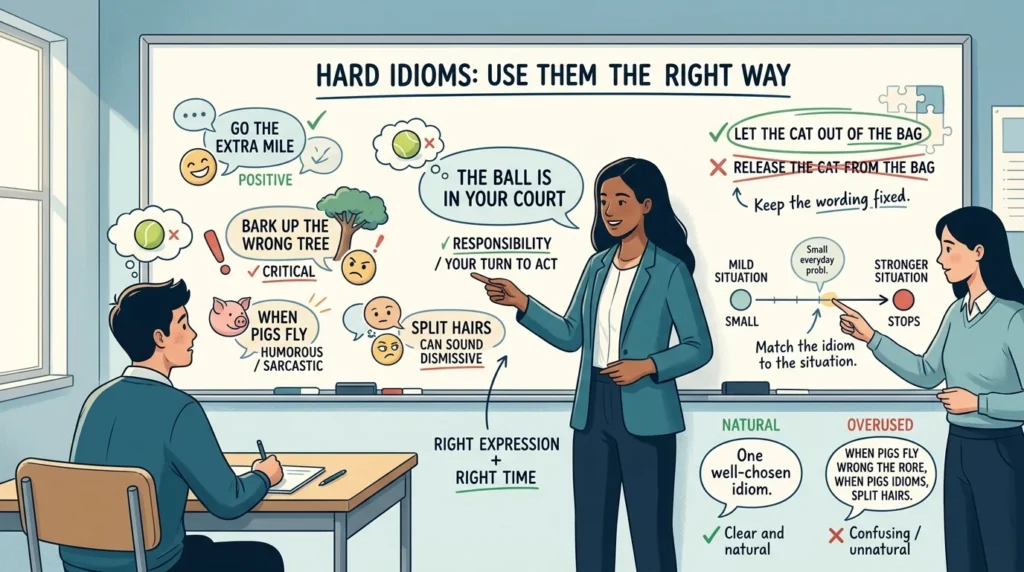
Don’t Change Fixed Expressions
Idioms normally have established wording.
Natural:
She let the cat out of the bag.
Unnatural:
She released the cat from the bag.
Changing the words can destroy the idiomatic meaning.
Don’t Use a Strong Idiom for a Mild Situation
Choose an expression that matches the situation and intensity. Not every idiom belongs in every sentence.
Don’t Overuse Idioms
Using an idiom in every sentence can make your writing sound unnatural. Good communication is about choosing the right expression at the right time.
Weird Idioms in English: 30+ Unexpected Meanings
How to Remember Difficult English Idioms
Instead of memorizing 20 definitions at once, learn each idiom through a situation.
Use a Mental Picture
For “barking up the wrong tree,” imagine a dog confidently barking at the wrong tree. Connect that picture with following the wrong idea.
Learn Related Idioms Together
Secrets:
- Spill the beans
- Let the cat out of the bag
Mistakes or wrong decisions:
- Bark up the wrong tree
- Jump the gun
- Miss the boat
Giving up or facing difficulty:
- Throw in the towel
- Bite the bullet
Grouping related expressions makes them easier to recall.
Create Your Own Sentence
Instead of memorizing:
Miss the boat = miss an opportunity
write:
“If I don’t submit my application tonight, I’ll miss the boat.”
A personal sentence gives the expression a real context.
Practice: Can You Guess the Idiom?
Complete each sentence with the correct idiom.
- We waited too long to buy the tickets, so we may have ______.
- Don’t believe every rumor you read online; take it ______.
- I know the exam looks scary, but just ______ and start studying.
- Don’t accuse Mark. You’re ______.
- Her comment made the argument worse and only ______.
Answers:
- missed the boat
- with a grain of salt
- bite the bullet
- barking up the wrong tree
- added fuel to the fire
Are Hard Idioms Worth Learning?
Yes—but you don’t need to memorize every unusual idiom you encounter.
Focus first on expressions that you are likely to see or hear in real conversations, books, movies, school, work, and online English. Learn the meaning, tone, and context together.
Rare idioms can be interesting, but useful idioms are more valuable when your goal is to communicate naturally.
Frequently Asked Questions
What are some hard idioms with examples?
Examples include bark up the wrong tree, jump the gun, move the goalposts, split hairs, open a can of worms, take it with a grain of salt, and throw down the gauntlet. Each has a figurative meaning that cannot always be guessed from its literal words.
Why are some English idioms so hard to understand?
Idioms can be difficult because their figurative meanings are different from their individual words. Historical references, cultural differences, fixed wording, and tone can make them even harder for learners.
How can I understand a difficult idiom without a dictionary?
Read the complete sentence, identify the situation, look for surrounding clues, ignore the literal picture, and try replacing the idiom with simple English. Context often gives you enough information to make a good guess.
What is the difference between a hard idiom and a difficult word?
A difficult word can often be understood from its definition or surrounding sentence. An idiom is harder because the whole expression has a meaning that may be completely different from its individual words.
Should English learners use difficult idioms?
Yes, when they understand the meaning and tone. Start with useful idioms that occur naturally in everyday English rather than trying to force complicated expressions into every conversation.
Final Thoughts
The hardest idioms are often the ones that create the strangest literal pictures. Instead of memorizing those pictures word by word, learn each expression through context, figurative meaning, tone, and a real sentence.
Start with a few useful expressions such as bite the bullet, bark up the wrong tree, read between the lines, miss the boat, and take it with a grain of salt. Then practice using them naturally.
The goal isn’t to sound complicated. It’s to understand what English speakers mean—and know when an idiom actually fits.

Emily Carter writes for Meaning Match about English idioms, student-friendly expressions, and language learning, using simple explanations and helpful examples.