
Why do some English expressions sound completely ridiculous when you picture them literally? Goofy idioms are funny, playful, or unusual expressions whose figurative meanings are very different from the images created by their words.
Phrases such as “spill the beans,” “pull someone’s leg,” “let the cat out of the bag,” and “when pigs fly” can sound absurd at first, but each has a specific meaning in everyday English. For example, “pull someone’s leg” means to joke with or tease someone, while “when pigs fly” describes something that is extremely unlikely to happen.
/The word “goofy” is descriptive here rather than a formal linguistic category, and not every funny phrase is technically an idiom. If you’re searching for goofy idioms for school, writing, conversations, captions, or simply for fun, this guide explains their meanings, examples, and natural uses so you can understand and use these amusing expressions correctly.
What Are Goofy Idioms?
“Goofy idioms” is an informal description, not a formal linguistic category. It generally refers to idioms that sound funny, strange, exaggerated, or amusing when understood literally.
Consider “When pigs fly.” The literal image is ridiculous: pigs flying through the air. The actual meaning is that something is extremely unlikely to happen.
That contrast between the literal image and the figurative meaning is what makes many idioms feel goofy.
Goofy idioms can help everyday English sound:
- More playful
- More expressive
- More memorable
- More conversational
- More humorous
However, an idiom does not have to describe something funny to feel goofy. “Break a leg,” for example, sounds strange literally, but its figurative meaning is simply “good luck.”
Why Do People Use Goofy Idioms?
People often use unusual idioms because they communicate an idea in a colorful way.
For example, instead of saying:
“Wait a moment.”
Someone might jokingly say:
“Hold your horses!”
Both communicate the idea of waiting, but the idiom creates a much more memorable picture.
These expressions are especially useful in:
- Friendly conversations
- Casual messages
- Personal stories
- Humorous writing
- Everyday English
- Informal social situations
The key is context. A playful idiom that works with a friend may sound inappropriate in a serious or formal situation.
Goofy Idioms You’ll Actually Want to Remember
Pull Someone’s Leg
Word-by-word meaning: Physically pull someone’s leg.
Idiomatic meaning: To tease or joke with someone.
Example:
“Don’t worry—I was just pulling your leg.”
Common mistake: Don’t use it to mean physically grabbing someone’s leg.
Usage note: Informal, playful, and usually friendly.
Spill the Beans
Word-by-word meaning: Accidentally spill beans.
Idiomatic meaning: Reveal secret information.
Example:
“Who spilled the beans about the surprise party?”
Common mistake: It doesn’t simply mean “tell someone something.” The information is usually supposed to be secret.
Usage note: Casual and useful when discussing secrets or surprises.
Let the Cat Out of the Bag
Word-by-word meaning: Release a cat from a bag.
Idiomatic meaning: Accidentally reveal a secret.
Example:
“Sam let the cat out of the bag about the birthday gift.”
Common mistake: Don’t use it for ordinary information that was never secret.
Usage note: Informal and especially natural around surprises.
Piece of Cake
Word-by-word meaning: A piece of cake.
Idiomatic meaning: Something very easy.
Example:
“The homework was a piece of cake.”
Common mistake: Don’t confuse the figurative meaning with describing actual food.
Usage note: Very common and casual.
When Pigs Fly
Word-by-word meaning: A time when pigs are flying.
Idiomatic meaning: Something will probably never happen.
Example:
“He’ll clean his room when pigs fly.”
Common mistake: Use it for something extremely unlikely, not merely something that might take a while.
Usage note: Often humorous, sarcastic, or teasing.
Hold Your Horses
Word-by-word meaning: Keep your horses under control.
Idiomatic meaning: Wait, slow down, or be patient.
Example:
“Hold your horses! We haven’t made a decision yet.”
Common mistake: It means “wait,” not literally “hold horses.”
Usage note: Informal and often playful.
It’s Raining Cats and Dogs
Word-by-word meaning: Cats and dogs are falling from the sky.
Idiomatic meaning: It is raining very heavily.
Example:
“Take an umbrella. It’s raining cats and dogs outside.”
Common mistake: It describes heavy rain, not ordinary rain.
Usage note: Colorful and familiar, although “raining heavily” may sound more natural in formal writing.
Break a Leg
Word-by-word meaning: Break someone’s leg.
Idiomatic meaning: A traditional way to wish someone good luck, especially before a performance.
Example:
“You’re performing tonight? Break a leg!”
Common mistake: Don’t interpret it as a genuine wish for injury.
Usage note: Commonly associated with theater and performances; informal.
Couch Potato
Word-by-word meaning: A potato sitting on a couch.
Idiomatic meaning: A person who spends a lot of time sitting around, especially watching television.
Example:
“I was a total couch potato last Sunday.”
Common mistake: It is usually playful, not a literal description.
Usage note: Informal and sometimes teasing, so use it with the right audience.
Have a Frog in Your Throat
Word-by-word meaning: A frog is inside your throat.
Idiomatic meaning: Your throat feels irritated or your voice is temporarily difficult to use.
Example:
“Sorry, I have a frog in my throat this morning.”
Common mistake: It does not specifically mean that someone is nervous.
Usage note: Playful and informal.
Cat Got Your Tongue?
Word-by-word meaning: A cat has taken your tongue.
Idiomatic meaning: Why are you unusually quiet or unable to respond?
Example:
“Cat got your tongue? You were talking a minute ago!”
Common mistake: It can sound impatient if used with someone who is genuinely uncomfortable.
Usage note: Casual, teasing, and best used with people you know.
Put a Sock in It
Word-by-word meaning: Put a sock inside something.
Idiomatic meaning: Be quiet or stop talking.
Example:
“Put a sock in it! I’m trying to concentrate.”
Common mistake: Don’t use this as a polite request in a professional setting.
Usage note: Very informal and potentially rude.
Barking Up the Wrong Tree
Word-by-word meaning: A dog is barking at the wrong tree.
Idiomatic meaning: Looking in the wrong place or pursuing the wrong idea or person.
Example:
“If you think I took your keys, you’re barking up the wrong tree.”
Common mistake: Don’t use it for every small mistake. It suggests that someone’s whole direction or assumption is wrong.
Usage note: Informal but widely understood.
Butterflies in Your Stomach
Word-by-word meaning: Butterflies are flying around inside your stomach.
Idiomatic meaning: A nervous or excited feeling in your stomach.
Example:
“I had butterflies in my stomach before my interview.”
Common mistake: It isn’t limited to fear. Excitement can cause butterflies too.
Usage note: Common in everyday English and suitable for many casual contexts.
Kick the Bucket
Word-by-word meaning: Kick a bucket.
Idiomatic meaning: An informal way to say that someone has died.
Example:
“The character kicks the bucket at the end of the movie.”
Common mistake: Avoid using it casually when someone has recently died; it can sound insensitive.
Usage note: Informal, blunt, and often humorous in fictional or joking contexts.
A Wild Goose Chase
Word-by-word meaning: Chasing a wild goose.
Idiomatic meaning: A pointless, confusing, or unsuccessful search.
Example:
“Looking for that missing document turned into a wild goose chase.”
Common mistake: A long search is not automatically a wild goose chase. The search usually leads nowhere useful.
Usage note: Informal and useful for frustrating searches.
2 Word Idioms: Meanings, Examples & Everyday Uses
Go Cold Turkey
Word-by-word meaning: Suddenly becoming a cold turkey.
Idiomatic meaning: Stop a habit or activity suddenly and completely.
Example:
“She went cold turkey and stopped checking social media.”
Common mistake: Don’t use it simply to mean “stop something.” The idea of sudden, complete stopping is important.
Usage note: Informal and commonly used when discussing habits.
Hit the Nail on the Head
Word-by-word meaning: Strike a nail directly on its head.
Idiomatic meaning: Identify or describe something exactly.
Example:
“You hit the nail on the head when you said we need better communication.”
Common mistake: It doesn’t simply mean someone said something good. It means they identified the point accurately.
Usage note: Common and more widely usable than many highly informal idioms.
Let the Chips Fall Where They May
Word-by-word meaning: Allow chips to fall wherever they land.
Idiomatic meaning: Accept whatever happens after taking action instead of trying to control the outcome.
Example:
“I’ve done everything I can, so I’ll let the chips fall where they may.”
Common mistake: Don’t use it simply to mean “wait.” It expresses acceptance of an uncertain result.
Usage note: Conversational and somewhat more reflective than many playful idioms.
Bite the Bullet
Word-by-word meaning: Bite a bullet.
Idiomatic meaning: Face something difficult or unpleasant with courage.
Example:
“I hate making phone calls, but I’ll bite the bullet and do it.”
Common mistake: It doesn’t mean enjoying a difficult task. It means accepting it and facing it.
Usage note: Informal and common in everyday conversation.
Literal vs. Figurative Meaning: Why These Idioms Sound Goofy
The easiest way to understand these expressions is to separate their literal image from their actual meaning.
| Idiom | Funny Literal Image | Figurative Meaning |
|---|---|---|
| Pull someone’s leg | Pulling a person’s leg | Tease or joke |
| Spill the beans | Beans falling everywhere | Reveal a secret |
| Piece of cake | Holding a cake | Something easy |
| When pigs fly | Flying pigs | Very unlikely |
| Hold your horses | Holding horses | Wait |
| Break a leg | Breaking a leg | Good luck |
| Couch potato | A potato on a sofa | A person who sits around |
| Barking up the wrong tree | Dog barking at a tree | Following the wrong idea |
This is also why learning the whole expression is more useful than translating each word separately.
Goofy Idioms vs. Phrasal Verbs
Not every unusual two-word expression is an idiom.
For example:
- Sit down → usually a phrasal verb with a fairly predictable meaning.
- Wake up → a phrasal verb.
- Spill the beans → an idiomatic expression because its overall meaning cannot be understood literally from “spill” and “beans.”
Understanding this difference can help English learners recognize how figurative language works.
Common Mistakes When Using Goofy Idioms
Don’t Translate Them Word for Word
If you hear “hold your horses,” don’t try to figure out why someone wants you to physically hold horses.
Learn it as one unit:
Hold your horses = Wait or slow down.
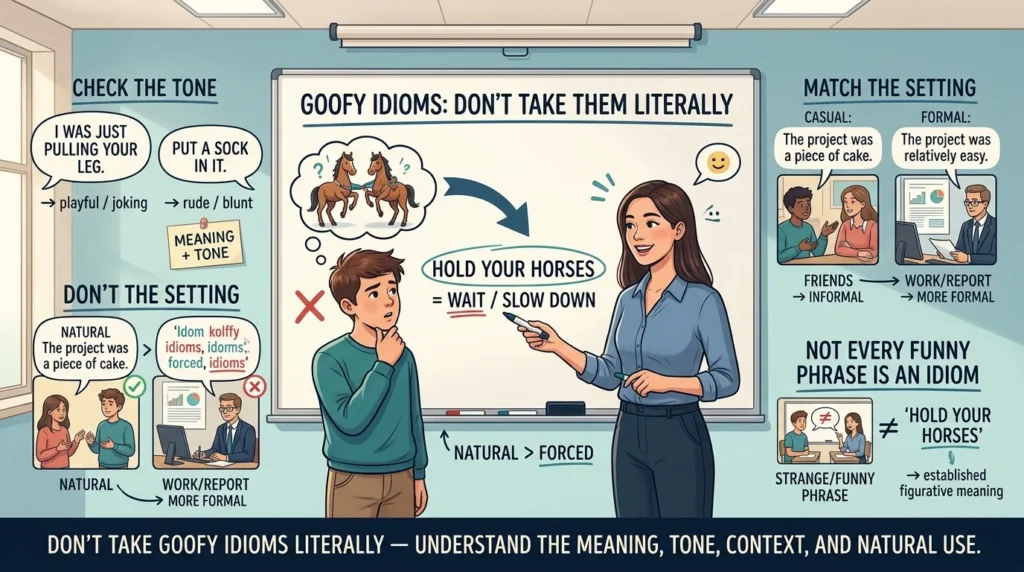
Don’t Ignore Tone
Some idioms are playful:
“I was just pulling your leg.”
Others can sound rude:
“Put a sock in it.”
Knowing the meaning isn’t enough. You also need to understand the speaker’s tone.
Don’t Use an Informal Idiom in Every Situation
A phrase that sounds natural with friends may not belong in a formal report or serious professional message.
For example:
“The project was a piece of cake.”
works well in casual conversation, while:
“The project was relatively easy.”
may be more appropriate in formal writing.
Don’t Overuse Idioms
Using an idiom in every sentence can make your English sound forced.
Natural English is usually better than trying to make every sentence colorful.
Don’t Confuse Idioms With Any Random Funny Phrase
An expression isn’t automatically an idiom just because it sounds strange.
The important feature is that the overall meaning is established and differs from the literal interpretation.
How to Learn Goofy Idioms Easily
Try this simple six-step method:
- Learn the figurative meaning.
- Picture the funny literal image.
- Read a natural example.
- Notice the tone and formality.
- Write your own sentence.
- Use it in a real conversation.
For example:
Before an exam:
“The test was a piece of cake.”
Before a performance:
“Break a leg!”
When a friend reveals a secret:
“You spilled the beans!”
Learning idioms through situations makes them easier to remember than memorizing a long vocabulary list.
When Should You Use Goofy Idioms?
Goofy and playful idioms are usually most natural in:
- Friendly conversations
- Casual texts
- Social media
- Personal stories
- Informal writing
- Everyday English
Use more care in:
- Academic assignments
- Legal documents
- Formal reports
- Serious announcements
- Sensitive conversations
When in doubt, consider who you’re talking to, what you’re discussing, and how formal the situation is.
Hard Idioms Examples: 30+ Tricky Phrases With Meanings
FAQs About Goofy Idioms
What are goofy idioms?
Goofy idioms are funny, silly, unusual, or exaggerated expressions whose figurative meanings differ from their literal words. Examples include “spill the beans” and “when pigs fly.”
What makes an idiom goofy or funny?
The literal mental picture often makes it feel goofy. Imagining flying pigs, a cat escaping from a bag, or someone holding horses creates a strange picture even though the actual meaning is completely different.
What are some examples of goofy idioms?
Popular examples include “pull someone’s leg,” “piece of cake,” “hold your horses,” “spill the beans,” “when pigs fly,” “couch potato,” and “barking up the wrong tree.”
Are goofy idioms appropriate in formal English?
Usually, they are better suited to casual or conversational English. Some common idioms can work in professional communication, but highly playful or rude expressions should be avoided in formal situations.
How can I remember goofy idioms?
Learn each idiom with its figurative meaning, imagine its unusual literal picture, and then create your own sentence. Practicing the expression in a realistic situation makes it easier to remember.
Conclusion
Goofy idioms can seem ridiculous when you take their words literally, but that is exactly what makes many of them memorable. “Spill the beans,” “hold your horses,” “when pigs fly,” and “barking up the wrong tree” all turn ordinary ideas into vivid expressions.
The goal isn’t to use as many idioms as possible. Instead, learn a few, understand their meaning, tone, and context, and practice using them naturally.
Pick three goofy idioms from this list today, create your own sentences, and try using one in a real conversation. That is how unusual expressions become natural English.

Daniel Mercer is a Meaning Match writer covering English idioms, vocabulary, expressions, and language usage with clear meanings and practical examples.