
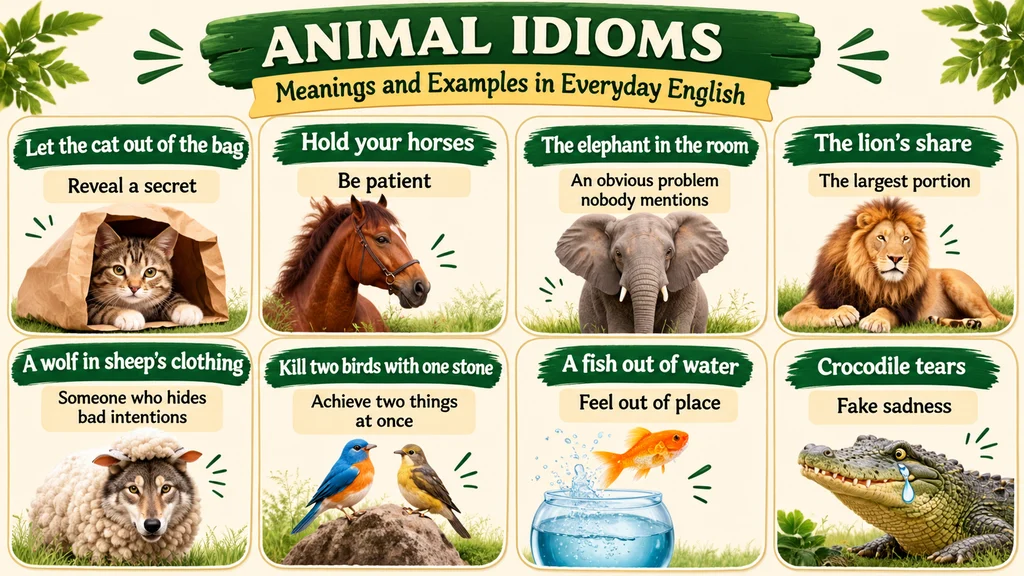
Why do English speakers talk about sleeping dogs, black sheep, and elephants in rooms when they are not talking about animals at all? These familiar expressions show how English uses animals to describe human behavior, difficult situations, and everyday experiences.
Dog and animal idioms are established expressions with meanings that often go beyond the literal words. For example, “let sleeping dogs lie” means avoid restarting an old problem, while “the black sheep of the family” describes someone viewed as different from the rest of their family.
Whether you are learning English, preparing for a school assignment, writing a story, or improving your everyday vocabulary, these expressions can help you understand figurative language and recognize how native speakers communicate ideas.
However, each idiom has its own meaning and appropriate context, so it is important not to interpret every phrase literally. In this guide, you’ll explore 50+ dog idioms and other popular animal-related expressions, with simple definitions, natural example sentences, and explanations organized by animal to make learning and revision easier.
What Are Animal Idioms?
Animal idioms make English more vivid by using animals to describe human behavior, feelings, and everyday situations. From barking up the wrong tree to letting the cat out of the bag, these expressions help you communicate ideas in memorable, natural ways.
For example, if someone reveals a surprise party before the big day, you can say they “let the cat out of the bag.” Understanding animal idioms helps you follow conversations, enjoy English stories, and express yourself more confidently.
Common Animal Idioms and Expressions
Let the Cat Out of the Bag
Meaning: To reveal a secret, either accidentally or intentionally.
Example sentences:
- Emma let the cat out of the bag about the surprise birthday party.
- Please don’t let the cat out of the bag before we announce our plans.
Common mistake: Using this expression for ordinary information that was never meant to be secret.
Usage tip: This informal idiom is especially useful when discussing surprises, confidential plans, or unexpected revelations.
A Dog-Eat-Dog World
Meaning: A highly competitive environment in which people may act selfishly to succeed.
Example sentences:
- The business world can be a dog-eat-dog world.
- She discovered that the industry was a dog-eat-dog world where everyone wanted to get ahead.
Common mistake: Using it for friendly competition where people respect and support one another.
Usage tip: This expression often describes cutthroat competition in business, careers, and other demanding environments. It has a negative tone.
Barking Up the Wrong Tree
Meaning: Blaming the wrong person, making an incorrect assumption, or pursuing the wrong solution.
Example sentences:
- If you think I broke your phone, you’re barking up the wrong tree.
- The detective realized he was barking up the wrong tree after discovering new evidence.
Common mistake: Confusing it with “beating around the bush.” Barking up the wrong tree means being mistaken; beating around the bush means avoiding the main point.
Usage tip: Use this informal idiom when someone has misunderstood a situation or is looking in the wrong direction for an answer.
Every Dog Has Its Day
Meaning: Everyone eventually gets a chance to succeed, enjoy recognition, or experience good fortune.
Example sentences:
- Don’t give up on your dreams. Every dog has its day.
- After years of rejection, he finally won the competition. Every dog has its day!
Common mistake: Treating it as a guarantee that success will come automatically.
Usage tip: This encouraging expression is commonly treated as a proverb rather than a strict idiom. Use it to motivate someone who is waiting for an opportunity.
Hold Your Horses
Meaning: Wait, slow down, or be patient before taking action.
Example sentences:
- Hold your horses! We haven’t received the final results yet.
- I know you’re excited about buying a house, but hold your horses until you check the budget.
Common mistake: Saying “hold your horse” when using the established expression in its usual form.
Usage tip: This informal expression can sound playful or impatient, depending on your tone. It is useful when someone is rushing into a decision.
As Busy as a Bee
Meaning: Extremely busy with work, tasks, or activities.
Example sentences:
- I’ve been as busy as a bee preparing for my final exams.
- Mom was as busy as a bee getting everything ready for the family gathering.
Common mistake: Forgetting the article in the standard expression: “as busy as a bee.”
Usage tip: This friendly, informal comparison works well in everyday conversation when describing someone who has many things to do.
The Elephant in the Room
Meaning: An obvious, important, or uncomfortable issue that people avoid discussing.
Example sentences:
- We need to address the elephant in the room: our falling sales.
- Nobody mentioned their disagreement, but it was the elephant in the room.
Common mistake: Using it for a minor problem that people have not noticed.
Usage tip: This expression works in personal conversations, meetings, and professional discussions when everyone knows an issue exists but nobody wants to bring it up.
Kill Two Birds with One Stone
Meaning: To accomplish two goals through a single action.
Example sentences:
- I listened to an educational podcast while exercising, killing two birds with one stone.
- We can visit Grandma and pick up the groceries on the same trip, killing two birds with one stone.
Common mistake: Using it when an action achieves only one goal.
Usage tip: This common idiom is useful when discussing efficiency. If you prefer gentler wording, say “achieve two goals at once.”
A Fish Out of Water
Meaning: Someone who feels uncomfortable or out of place in an unfamiliar situation.
Example sentences:
- I felt like a fish out of water at my first business conference.
- He was a fish out of water at the formal dinner because he had never attended one before.
Common mistake: Assuming that the expression simply means being new somewhere. It usually emphasizes discomfort or a sense of not belonging.
Usage tip: Use it when describing unfamiliar workplaces, social events, schools, or cultural settings.
Crocodile Tears
Meaning: An insincere display of sadness, regret, or sympathy.
Example sentences:
- His apology sounded like crocodile tears because he continued making the same hurtful jokes.
- She wasn’t convinced by his crocodile tears after the argument.
Common mistake: Calling someone’s tears crocodile tears merely because they are dramatic or emotional.
Usage tip: This expression suggests that someone’s feelings are fake, so use it cautiously. It is critical rather than neutral.
The Lion’s Share
Meaning: The largest portion of something, such as money, work, resources, or responsibility.
Example sentences:
- Sara did the lion’s share of the group project.
- Rent takes the lion’s share of our monthly expenses.
Common mistake: Using it to describe an equal or small portion.
Usage tip: This expression is suitable for everyday conversation and professional writing. It often highlights an unequal distribution of work or resources.
Let Sleeping Dogs Lie
Meaning: Avoid reopening an old disagreement or creating unnecessary trouble.
Example sentences:
- Their argument happened years ago, so I decided to let sleeping dogs lie.
- Bringing up that old mistake will only cause another argument. Let sleeping dogs lie.
Common mistake: Using it to justify ignoring serious problems that genuinely need to be addressed.
Usage tip: This idiom is useful when an old issue has been resolved and discussing it again would cause unnecessary conflict.
Work Like a Horse
Meaning: To work extremely hard, often for a long time.
Example sentences:
- My parents worked like horses to give us a better future.
- I’ve been working like a horse all week to finish the project.
Common mistake: Using it for a task that requires very little effort.
Usage tip: This informal expression emphasizes hard work and endurance. Depending on the context, it can express admiration or suggest that someone is overworked.
Straight from the Horse’s Mouth
Meaning: Information obtained directly from the original or most authoritative source.
Example sentences:
- I heard straight from the horse’s mouth that the company is opening a new office.
- Instead of believing rumors, get the information straight from the horse’s mouth.
Common mistake: Using it for information passed through several people.
Usage tip: This informal idiom emphasizes firsthand information. In formal writing, “directly from the source” may be more appropriate.
A Wolf in Sheep’s Clothing
Meaning: A harmful, dishonest, or dangerous person who appears harmless or trustworthy.
Example sentences:
- The scammer seemed friendly, but he was a wolf in sheep’s clothing.
- He pretended to be helpful while secretly trying to exploit the team—a wolf in sheep’s clothing.
Common mistake: Using it for someone whose harmful intentions are obvious from the beginning.
Usage tip: This expression warns about deception and hidden intentions. It is common in stories, advice, and discussions about trust.
When Pigs Fly
Meaning: Something that is extremely unlikely to happen or is considered impossible.
Example sentences:
- My brother will clean his room without being asked when pigs fly!
- She said her always-late friend would arrive early when pigs fly.
Common mistake: Using it for an event that is merely delayed.
Usage tip: This humorous, informal expression often communicates disbelief or sarcasm. Avoid it in serious situations where a respectful answer is needed.
Get Someone’s Goat
Meaning: To annoy or irritate someone.
Example sentences:
- It really gets my goat when people interrupt me.
- His habit of taking credit for other people’s work gets everyone’s goat.
Common mistake: Confusing it with “barking up the wrong tree,” which concerns being mistaken rather than being annoyed.
Usage tip: This informal idiom is useful for expressing irritation in everyday conversation. It is usually less harsh than directly insulting someone.
Take the Bull by the Horns
Meaning: To face a difficult situation directly and deal with it courageously.
Example sentences:
- I decided to take the bull by the horns and talk to my manager about the problem.
- Instead of avoiding her debt, she took the bull by the horns and created a repayment plan.
Common mistake: Using it for any ordinary task rather than a challenging situation that requires initiative or courage.
Usage tip: This expression has a positive, determined tone. Use it when someone confronts a problem instead of avoiding it.
A Little Bird Told Me
Meaning: A playful way of saying you heard something but do not want to reveal your source.
Example sentences:
- A little bird told me it’s your birthday tomorrow!
- “How did you know about my promotion?” “A little bird told me.”
Common mistake: Using it when you need to formally identify or credit the person who provided the information.
Usage tip: This informal expression adds mystery or humor to a conversation. Depending on the situation, it can sound teasing or evasive.
The Early Bird Catches the Worm
Meaning: People who act early or prepare ahead often gain an advantage.
Example sentences:
- Let’s arrive early to get the best seats. The early bird catches the worm.
- Maya applied for the scholarship before the deadline and secured an interview.
Common mistake: Assuming that waking up early guarantees success.
Usage tip: This familiar saying is a proverb rather than a strict idiom. It encourages preparation, initiative, and timely action.
Cat Idioms: 30+ Purrfect Phrases and Their Meanings
Dog Idioms vs. Other Animal Expressions
Animal expressions often describe similar situations in different ways. Understanding the distinctions helps you choose the right phrase.
| Expression | Main meaning | Best used when |
|---|---|---|
| A dog-eat-dog world | Fierce competition | Describing a cutthroat environment |
| Every dog has its day | Opportunity or good fortune | Encouraging someone |
| Let sleeping dogs lie | Avoiding unnecessary trouble | An old disagreement might resurface |
| Barking up the wrong tree | Being mistaken | Someone has the wrong explanation |
| Let the cat out of the bag | Revealing a secret | A surprise or secret is disclosed |
| As busy as a bee | Being very busy | Someone has many tasks |
| The elephant in the room | An ignored issue | Everyone avoids an obvious problem |
| A wolf in sheep’s clothing | Hidden danger | Someone disguises harmful intentions |
| Get someone’s goat | Causing irritation | Someone is getting on your nerves |
| Take the bull by the horns | Facing a challenge | Someone acts decisively |
How to Use Animal Idioms Naturally
Knowing an idiom’s meaning is only the beginning. To use it naturally, pay attention to the situation, tone, and intended message.
- Choose the right expression. Use “let the cat out of the bag” for a revealed secret, not ordinary information.
- Understand the tone. “When pigs fly” can sound sarcastic, while “every dog has its day” is encouraging.
- Learn complete phrases. Remember “hold your horses” rather than changing the wording unnecessarily.
- Practice with real situations. Write a sentence about school, work, or a conversation with a friend.
- Avoid overusing idioms. One well-chosen expression is often more effective than several in the same sentence.
- Know when to be formal. In a business report, “directly from the source” may be more suitable than “straight from the horse’s mouth.”

Quick Practice: Test Your Understanding
1. Your friend accidentally reveals a surprise party. Which expression fits?
- A. Hold your horses
- B. Let the cat out of the bag
- C. Work like a horse
Answer: B. “Let the cat out of the bag” means to reveal a secret.
2. Someone blames you for a mistake you did not make. What could you say?
- A. You’re barking up the wrong tree.
- B. Every dog has its day.
- C. When pigs fly.
Answer: A. “Barking up the wrong tree” means pursuing the wrong explanation or blaming the wrong person.
3. Fill in the blank: “I was nervous at my first conference. I felt like a _____.”
- A. wolf in sheep’s clothing
- B. fish out of water
- C. lion’s share
Answer: B. “A fish out of water” describes someone who feels uncomfortable or out of place.
4. Your colleague faces a difficult problem instead of avoiding it. Which expression best describes the action?
- A. Let sleeping dogs lie
- B. Take the bull by the horns
- C. Let the cat out of the bag
Answer: B. “Take the bull by the horns” means to confront a difficult situation directly.
Programming Idioms: 22+ Code Patterns Every Developer Should Know
Frequently Asked Questions
1. What are the most common dog idioms in English?
Popular dog idioms include “every dog has its day,” “a dog-eat-dog world,” “barking up the wrong tree,” and “let sleeping dogs lie.” They describe opportunity, competition, mistaken assumptions, and avoiding unnecessary trouble.
2. What are some popular animal idioms besides dog idioms?
Examples include “let the cat out of the bag,” “as busy as a bee,” “the elephant in the room,” “a fish out of water,” and “a wolf in sheep’s clothing.” Each expression communicates a figurative meaning beyond its literal words.
3. What is the difference between “let sleeping dogs lie” and “barking up the wrong tree”?
“Let sleeping dogs lie” means avoiding an old issue that could cause unnecessary trouble. “Barking up the wrong tree” means being mistaken about a person, cause, or solution. One advises leaving a matter alone; the other identifies a mistaken approach.
4. Are animal idioms appropriate for formal writing?
Some animal idioms are widely understood but remain conversational. In formal writing, phrases such as “directly from the source” may be preferable to “straight from the horse’s mouth.” Choose expressions that suit your audience and purpose.
5. How can I learn and remember animal idioms?
Learn each expression with its figurative meaning and a realistic example. Group similar expressions together, practice with short quizzes, and use one or two in your own sentences each day. Reviewing them in context makes their meanings easier to remember.
Conclusion
Animal idioms and proverbs make English more vivid, memorable, and natural. From “barking up the wrong tree” to “taking the bull by the horns,” these expressions help you describe everyday challenges, emotions, and relationships in fewer, more expressive words.
Start by choosing three expressions from this guide and writing your own sentences. Then listen for them in conversations, films, and books. With regular practice, you’ll become more confident understanding these phrases and using them in the right context.

Daniel Mercer is a Meaning Match writer covering English idioms, vocabulary, expressions, and language usage with clear meanings and practical examples.