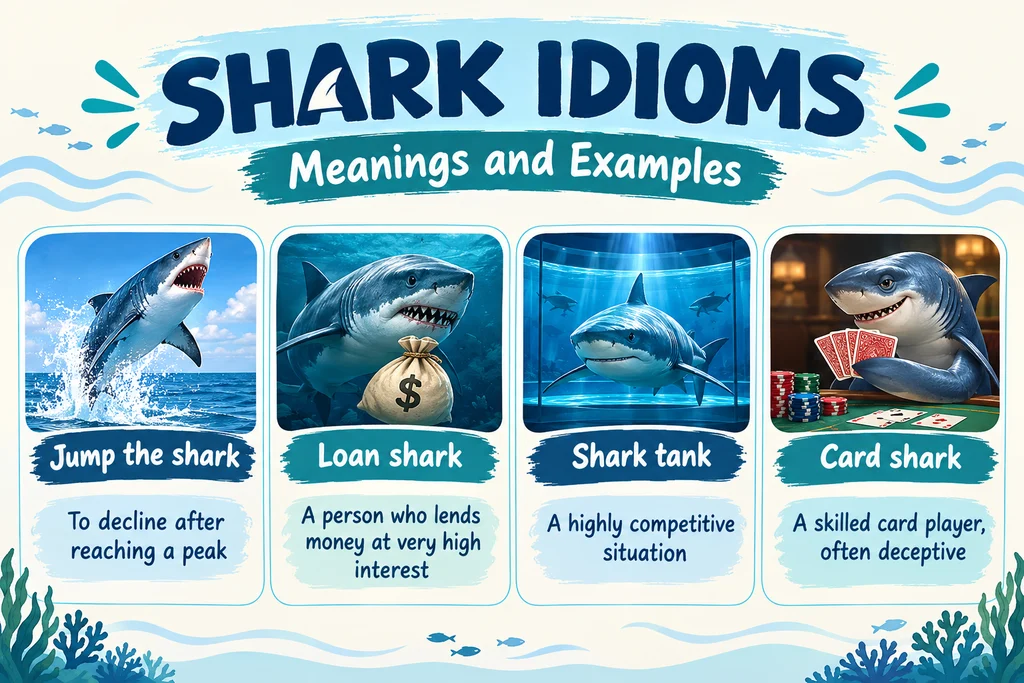
Sharks are known for their sharp teeth and powerful presence, so it is no surprise that shark-related expressions can suggest danger, greed, or ruthless behavior. Shark idioms and expressions use shark imagery to describe people, situations, or behaviors, often in a figurative way. For example, a loan shark is a person who lends money at extremely high interest rates, often using unfair or threatening methods to collect repayment. The expression swim with sharks can describe entering a risky environment where powerful or ruthless people may take advantage of you.
Understanding shark idioms can help you recognize figurative language in everyday conversations, books, and online content. However, not every phrase involving a shark is a true idiom: some are established expressions, while others are informal phrases or literal descriptions. In this guide, you’ll explore shark-related idioms and expressions, learn their meanings in simple English, and see practical example sentences that show how to use them naturally and accurately.
What Are Shark Idioms?
Shark idioms are expressions that use shark imagery to communicate a figurative meaning. Some are established idioms, while others are common metaphors or descriptive expressions. Related fish and water idioms can help learners understand similar ideas, but they are not necessarily shark-specific.
For example, “jump the shark” means that a show, trend, or idea has gone too far and begun losing its appeal. “Swim with sharks” means dealing with powerful or aggressive people in a challenging environment.
Shark Idioms and Related Expressions
Jump the Shark
Word-by-word meaning: To jump over a shark.
Figurative meaning: To reach a point when a show, trend, or idea becomes exaggerated or starts losing its original appeal.
Example sentences:
- The series jumped the shark when the main character became a secret agent.
- Fans felt the show had jumped the shark after its unbelievable finale.
Common error: Using it for every surprising event. It usually suggests that something has gone too far or declined in quality.
Usage note: This is an established idiom commonly used in discussions about television, entertainment, and popular culture.
Swim with Sharks
Word-by-word meaning: To swim alongside sharks.
Figurative meaning: To deal with powerful, aggressive, or potentially exploitative people.
Example sentences:
- You need confidence to swim with sharks in the business world.
- Her first negotiation taught her what it meant to swim with sharks.
Common error: Assuming it always refers to literal swimming or physical danger.
Usage note: This established expression is common in business, negotiations, and competitive situations.
Loan Shark
Word-by-word meaning: A lender described as a shark.
Figurative meaning: A predatory lender who charges extremely high interest or uses unfair or illegal collection practices.
Example sentences:
- He regretted borrowing money from a loan shark.
- The family avoided the loan shark after discovering the hidden charges.
Common error: Calling every lender with high interest rates a loan shark without considering the circumstances.
Usage note: This is an established term with a strongly negative meaning.
Throw Someone to the Sharks
Word-by-word meaning: To throw someone into water containing sharks.
Figurative meaning: To leave someone exposed to criticism, danger, or a difficult situation without support.
Example sentences:
- The manager threw the new employee to the sharks during the meeting.
- I felt my colleagues had thrown me to the sharks when they refused to help.
Common error: Confusing it with “swim with sharks.” The former emphasizes being left without protection; the latter emphasizes dealing with aggressive people.
Usage note: This expression is figurative and often appears in workplace or public-pressure situations.
Shark-Infested Waters
Word-by-word meaning: Water containing many sharks.
Figurative meaning: A risky, hostile, or highly competitive environment.
Example sentences:
- Entering that market without a plan is like sailing into shark-infested waters.
- The inexperienced negotiator found himself in shark-infested waters.
Common error: Assuming it must describe a real ocean.
Usage note: This is a familiar metaphorical expression used in business, politics, and negotiations.
The Sharks Are Circling
Word-by-word meaning: Sharks are moving around a target.
Figurative meaning: Aggressive people are waiting for an opportunity to exploit someone’s weakness.
Example sentences:
- When the company began losing money, the sharks were circling.
- The struggling business attracted competitors as the sharks started circling.
Common error: Treating the phrase as proof that someone has actually acted dishonestly.
Usage note: This common metaphor creates a sense of growing pressure or danger.
Smell Blood in the Water
Word-by-word meaning: To detect blood in the water.
Figurative meaning: To recognize another person’s weakness and become ready to take advantage of it.
Example sentences:
- The competitors smelled blood in the water after the company announced its losses.
- Critics smelled blood in the water when the politician made a serious mistake.
Common error: Assuming the expression is exclusively about sharks.
Usage note: This established idiom is common in business, sports, politics, and competitive situations.
Shark Tank
Word-by-word meaning: A tank containing sharks.
Figurative meaning: A demanding environment where people must defend their ideas or compete under pressure.
Example sentences:
- The tough interview felt like a shark tank.
- Presenting her idea to experienced investors was like entering a shark tank.
Common error: Assuming every use refers to the television show.
Usage note: The expression can be a metaphor for a competitive environment. Capitalized “Shark Tank” can refer to the TV program.
Shark Bait
Word-by-word meaning: Something used to attract sharks.
Figurative meaning: An informal, vivid description of someone who appears vulnerable or likely to become a target.
Example sentences:
- Without preparation, the rookie felt like shark bait during the debate.
- The small company feared it would become shark bait for larger competitors.
Common error: Treating it as a formal idiom suitable for every context.
Usage note: This is a context-dependent metaphor that can sound harsh or humorous.
A Feeding Frenzy
Word-by-word meaning: A period of intense feeding.
Figurative meaning: A burst of intense, often uncontrolled activity in which many people compete for something or pursue a target.
Example sentences:
- The limited-edition release triggered a buying frenzy.
- The scandal created a media feeding frenzy.
Common error: Assuming it must involve sharks or literal feeding.
Usage note: This established expression is often used in phrases such as “media feeding frenzy” and “buying frenzy.”
Like a Shark
Word-by-word meaning: In a manner resembling a shark.
Figurative meaning: Acting aggressively, persistently, or with intense focus while pursuing a goal.
Example sentences:
- She negotiated like a shark and refused to accept an unfair deal.
- He pursued new business opportunities like a shark.
Common error: Assuming it always means someone is intelligent or dishonest.
Usage note: This is a simile rather than a fixed idiom. The intended meaning depends on context.
Shark-Like Instincts
Word-by-word meaning: Instincts resembling those associated with sharks.
Figurative meaning: A strong ability to recognize opportunities, competition, or weaknesses quickly.
Example sentences:
- The negotiator’s shark-like instincts helped him spot a bad deal.
- She had shark-like instincts when identifying business opportunities.
Common error: Presenting the phrase as a standard idiom with one fixed meaning.
Usage note: This is a descriptive expression, often used metaphorically for aggressive or sharp business judgment.
A Bigger Fish to Fry
Word-by-word meaning: To have a larger fish to cook.
Idiomatic meaning: To have more important matters to deal with.
Example sentences:
- I cannot argue about every small detail; I have bigger fish to fry.
- The manager had bigger fish to fry than a minor scheduling issue.
Common error: Using it to describe someone who is dangerous or aggressive.
Usage note: This is an established fish-related idiom, not a shark-specific expression.
Plenty of Fish in the Sea
Word-by-word meaning: Many fish live in the sea.
Idiomatic meaning: There are other potential romantic partners or opportunities available.
Example sentences:
- Her friend reminded her that there were plenty of fish in the sea after the breakup.
- Losing one client is disappointing, but there are plenty of fish in the sea.
Common error: Confusing it with “swim with sharks,” which describes dealing with powerful or aggressive people.
Usage note: This established expression is often used to comfort someone after romantic disappointment.
Sink or Swim
Word-by-word meaning: To sink beneath the water or stay afloat by swimming.
Idiomatic meaning: To succeed or fail through your own efforts, especially in a challenging situation.
Example sentences:
- On her first day as manager, it was sink or swim.
- The new employee faced a sink-or-swim situation.
Common error: Assuming the expression specifically refers to sharks.
Usage note: This established idiom is common in work, education, and personal challenges.
In Deep Water
Word-by-word meaning: Being far down in deep water.
Idiomatic meaning: To be in trouble or facing a difficult situation.
Example sentences:
- He was in deep water after missing several important deadlines.
- The company found itself in deep water because of poor planning.
Common error: Using it to mean simply being busy. It usually suggests trouble or difficulty.
Usage note: This established idiom works in everyday conversation and informal writing.
Cat Idioms: 30+ Purrfect Phrases and Their Meanings
Keep Your Head Above Water
Word-by-word meaning: Keep your head high enough to breathe while in water.
Idiomatic meaning: To manage to survive or cope with difficulties, especially financial or personal pressure.
Example sentences:
- The small business is working hard to keep its head above water.
- With several bills due, she was struggling to keep her head above water.
Common error: Assuming it means achieving major success. It usually means managing to survive or cope.
Usage note: This established expression is especially common when discussing finances or overwhelming responsibilities.
Test the Waters
Word-by-word meaning: To check the water before entering it.
Idiomatic meaning: To try something cautiously before making a full commitment.
Example sentences:
- The company tested the waters before launching its new product nationwide.
- I took a short course to test the waters before changing careers.
Common error: Using it to describe making a final decision. The expression suggests an initial trial or cautious exploration.
Usage note: This established idiom is useful in business, careers, and everyday decision-making.
Make Waves
Word-by-word meaning: To create waves in water.
Idiomatic meaning: To attract attention, cause disruption, or challenge the usual way of doing things.
Example sentences:
- The new director made waves by changing the old policies.
- Her bold proposal made waves throughout the industry.
Common error: Assuming it always has a negative meaning. It can describe positive change as well as controversy.
Usage note: This established idiom is common in workplaces, social situations, and discussions about change.
Go with the Flow
Word-by-word meaning: To move along with a current.
Idiomatic meaning: To adapt to a situation instead of resisting every change.
Example sentences:
- We had no fixed plan, so we decided to go with the flow.
- He learned to go with the flow when unexpected changes occurred.
Common error: Assuming it means agreeing with everything. It usually means being flexible, not abandoning your judgment.
Usage note: This established idiom is informal and useful in everyday conversation.
Shark Idioms vs. Related Fish and Water Expressions
These expressions share similar imagery, but they do not all belong to the same category.
| Expression | Main meaning | Category |
|---|---|---|
| Jump the shark | Go too far and begin losing appeal | Established idiom |
| Swim with sharks | Deal with aggressive or powerful people | Established expression |
| Loan shark | Predatory lender | Established term |
| Smell blood in the water | Recognize weakness and exploit it | Established idiom |
| Shark-infested waters | A dangerous or competitive environment | Metaphor |
| Bigger fish to fry | Have more important matters | Fish-related idiom |
| Sink or swim | Succeed or fail through your own efforts | Water-related idiom |
| Test the waters | Try something cautiously | Water-related idiom |
The key difference is that some expressions specifically use shark imagery, while others use fish or water to communicate a broader idea.
Dog and Animal Idioms: Meanings and Real-Life Examples
How to Use Shark Idioms Naturally
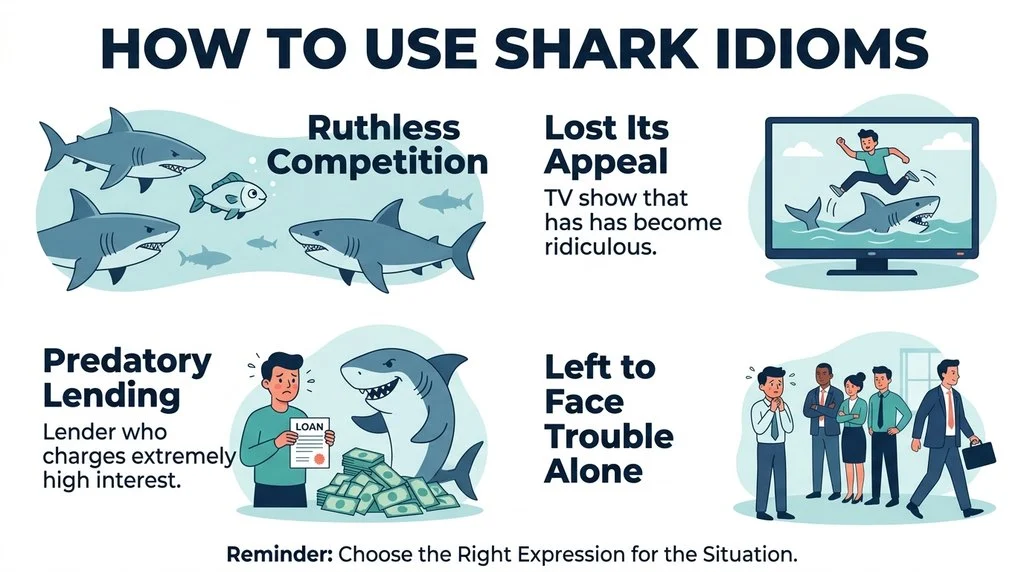
Choose an expression that matches the situation instead of forcing a shark reference into every sentence.
- For ruthless competition: “You need to learn to swim with sharks.”
- For a declining TV show: “The series jumped the shark in its final season.”
- For a predatory lender: “He discovered that he had borrowed money from a loan shark.”
- For someone abandoned during a difficult situation: “The manager threw her to the sharks.”
- For financial pressure: “The business is struggling to keep its head above water.”
Quick Tips for English Learners
- Learn each expression’s figurative meaning instead of translating it word by word.
- Pay attention to tone: “loan shark” is strongly negative, while “make waves” can be positive or negative.
- Remember that shark metaphors and established idioms are not always the same thing.
- Practise by writing original sentences and using the phrases in suitable contexts.
Frequently Asked Questions About Shark Idioms
1. What is the best-known shark idiom?
“Jump the shark” is one of the best-known shark idioms. It describes the point when a show, trend, or idea goes too far and starts losing its original appeal.
2. What does “swim with sharks” mean?
It means dealing with powerful, aggressive, or potentially exploitative people, particularly in competitive environments such as business or negotiations.
3. Is “loan shark” an idiom?
“Loan shark” is an established term for a predatory lender who charges extremely high interest or uses unfair collection practices. It is more precisely classified as a compound noun.
4. What is the difference between “swim with sharks” and “throw someone to the sharks”?
“Swim with sharks” means dealing with aggressive or powerful people. “Throw someone to the sharks” means leaving someone to face danger, criticism, or pressure without support.
5. Are all fish and water idioms shark idioms?
No. Expressions such as “bigger fish to fry,” “sink or swim,” and “test the waters” use fish or water imagery but do not specifically refer to sharks. They are useful related expressions, not shark-specific idioms.
Conclusion:
Shark idioms and related expressions can make your English more vivid when you understand their exact meanings. Start with “jump the shark,” “swim with sharks,” and “loan shark,” then practise using each in an original sentence.
Remember that some shark-related phrases are established idioms, while others are metaphors. Recognizing the difference will help you choose more natural wording in conversations, stories, and writing.

Emily Carter writes for Meaning Match about English idioms, student-friendly expressions, and language learning, using simple explanations and helpful examples.
Pingback: Bee Idioms: Meanings, Origins, and Real-Life Examples