Have you ever read an English story where a phrase seems confusing because its words do not mean exactly what they say? Books with idioms can help readers understand these expressions by showing how they are used in natural story contexts.
An idiom is a phrase whose meaning is different from the literal meaning of its individual words. For example, “a piece of cake” does not mean a slice of cake—it means something is very easy. Seeing idioms in stories, dialogue, and everyday situations can help students and English learners understand their meanings without simply memorizing word lists.
Whether you’re a student, teacher, parent, or English learner looking for useful books, this guide explores books that feature idioms and shows how these expressions are used in context. You’ll find book ideas, common idiom examples, and simple explanations to make unfamiliar phrases easier to understand and use.
What Are Books With Idioms?
If you are searching for books with idioms, this guide focuses on English idioms and figurative expressions connected with books, reading, pages, chapters, stories, and studying.
Not every expression below is a traditional idiom. Some are common figurative expressions, metaphors, or sayings that English speakers regularly use. Understanding that difference can help you use them more accurately.
Here are a few examples:
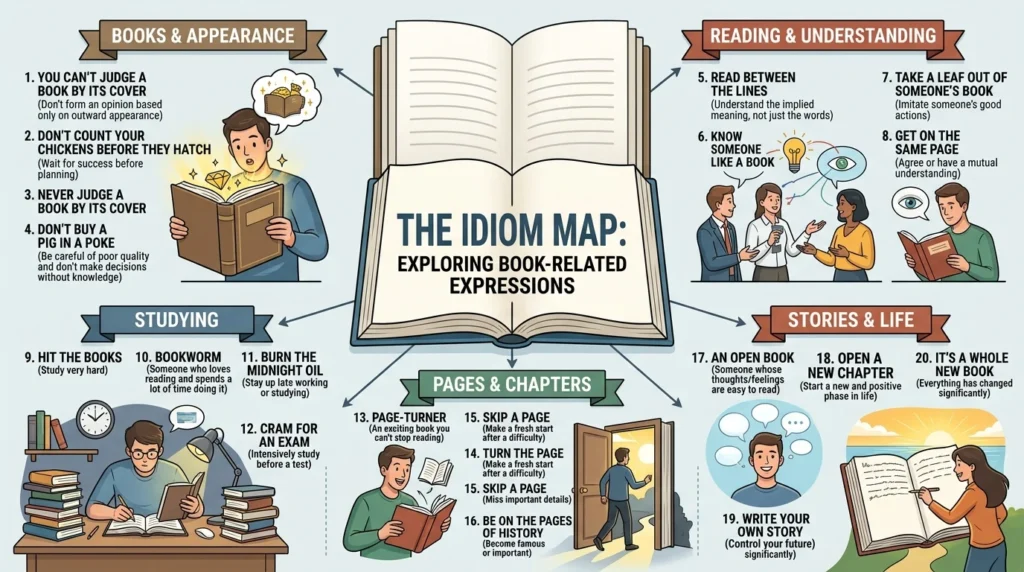
- Hit the books → study seriously
- Read between the lines → understand an implied meaning
- An open book → someone who is easy to understand
- Turn the page → move on from the past
- Open a new chapter → begin a new stage of life
- A page-turner → a very engaging book
These expressions are useful for English learners because they appear in conversations, books, classrooms, articles, and everyday writing.
Famous Book-Related Idioms and Expressions
You Can’t Judge a Book by Its Cover
Meaning: Do not judge a person or thing only by its appearance.
The expression compares a person’s or object’s outward appearance with a book’s cover. A plain-looking book may contain a wonderful story, just as someone who looks ordinary may have an interesting personality.
Example:
The restaurant looked tiny from outside, but the food was fantastic. You can’t judge a book by its cover.
Common mistake:
Using it only when talking about actual books.
Use it when:
You want to remind someone that appearances can be misleading.
Read Between the Lines
Meaning: Look for a hidden, implied, or unstated meaning.
This is one of the most useful reading-related idioms. It means understanding what someone suggests without saying it directly.
Example:
Read between the lines of her message, and you’ll realize that she is disappointed.
Wrong:
I read between the lines because the article was difficult to read.
Better:
You need to read between the lines to understand what he really meant.
Usage note:
Use it for conversations, emails, messages, books, articles, and other communication.
An Open Book
Meaning: A person who is very open and whose thoughts or feelings are easy to understand.
Example:
Maria is an open book. She always tells us exactly how she feels.
Common mistake:
Thinking it simply means that someone is reading a book.
Usage note:
This is usually informal and describes a person’s openness.
A Closed Book
Meaning: A person or subject that is difficult to understand or know about.
Example:
He is a closed book when it comes to his personal life.
Common mistake:
Confusing it with close the book on something, which means to bring something to an end.
Usage note:
It often suggests privacy, mystery, or something that remains unknown.
Read Someone Like a Book
Meaning: Understand someone’s thoughts, feelings, or intentions very easily.
Example:
My sister can read me like a book, so I can’t hide when I’m worried.
Wrong:
She read him like a book because she was reading his biography.
Better:
She read him like a book and immediately knew he was nervous.
Usage note:
This expression is normally used figuratively when talking about people.
Hit the Books
Meaning: Start studying seriously.
Example:
I have a math exam tomorrow, so I need to hit the books tonight.
Common mistake:
Taking hit literally.
Usage note:
This is an informal expression, especially common among students.
Crack a Book
Meaning: Open and read or study a book, often suggesting that someone has not studied much.
Example:
You won’t pass the exam if you don’t crack a book this weekend.
Common mistake:
Thinking crack means physically damaging the book.
Usage note:
This expression is informal and can sound teasing or critical.
Bookworm
Meaning: A person who loves reading and spends a lot of time with books.
Example:
My daughter is a real bookworm; she reads before going to bed every night.
Common mistake:
Assuming a bookworm must read a particular type of book.
Usage note:
This is a friendly, informal noun for an enthusiastic reader.
Book Smart
Meaning: Having strong academic or theoretical knowledge.
Example:
Jake is book smart and usually gets excellent grades.
Common mistake:
Assuming book-smart knowledge automatically means someone has strong practical skills.
Usage note:
Book smart is informal and is often contrasted with street smart.
By the Book
Meaning: According to established rules, instructions, or procedures.
Example:
Our manager does everything by the book.
Wrong:
She follows the book when she wants to relax.
Better:
She handles every workplace procedure by the book.
Usage note:
This expression is common in workplaces, official situations, and discussions about rules.
A Page-Turner
Meaning: A book that is so interesting or exciting that you want to keep reading.
Example:
That mystery novel was such a page-turner that I finished it in one night.
Common mistake:
Thinking a page-turner is simply a very long book.
Usage note:
Use it when praising a book for being engaging or exciting.
Turn the Page
Meaning: Leave a past situation behind and move forward.
Example:
I’ve learned from my mistakes, and now I’m ready to turn the page.
Common mistake:
Assuming it always refers to physically turning a page.
Usage note:
It is often used when discussing personal growth, difficult experiences, or change.
Open a New Chapter
Meaning: Begin a new stage or period in life.
Example:
Starting university was the beginning of a new chapter in her life.
Common mistake:
Using it for a situation that does not represent a meaningful change.
Usage note:
This is a common metaphorical expression, especially in personal and motivational language.
Close the Book on Something
Meaning: Bring a situation, investigation, disagreement, or period to an end.
Example:
After months of discussion, the two companies finally closed the book on the dispute.
Common mistake:
Confusing this with a closed book.
Remember:
- A closed book → difficult to understand or know
- Close the book on something → end something
A Chapter in Your Life
Meaning: A particular period or stage of someone’s life.
Example:
My years at university were an important chapter in my life.
Common mistake:
Using it to describe only one small event.
Usage note:
This is a metaphorical expression often used when reflecting on past experiences.
The Story of Your Life
Meaning: A humorous or sometimes sarcastic way of saying that a familiar situation happens to someone repeatedly.
Example:
“I forgot my umbrella again.”
“The story of your life!”
Common mistake:
Assuming it always means someone’s complete life story.
Usage note:
Tone matters. It is often playful or teasing rather than serious.
Write Your Own Story
Meaning: Take control of your choices and create your own path in life.
Example:
Don’t let other people’s expectations decide your future. Write your own story.
Usage note:
This is better described as a motivational figurative expression than a traditional idiom.
It is common in inspirational writing and conversations about personal choices.
Every Chapter Has an Ending
Meaning: Every stage or period eventually comes to an end.
Example:
Leaving school was emotional, but every chapter has an ending.
Usage note:
This is a figurative saying rather than a traditional fixed idiom. It is commonly used when talking about change, endings, and new beginnings.
Close the Chapter
Meaning: Bring a period, experience, or relationship to an end and move forward.
Example:
After leaving the company, she decided to close that chapter and focus on her future.
Common mistake:
Confusing close the chapter with physically finishing a chapter in a book.
Usage note:
It is generally figurative and often appears in personal or reflective contexts.
Don’t Write Yourself Off
Meaning: Do not decide that you are incapable of succeeding or that your chances are over.
Example:
You made one mistake, but don’t write yourself off. You can still improve.
Common mistake:
Thinking write off always has a literal writing-related meaning.
Usage note:
This is an idiomatic expression involving the verb write, although it is not specifically about books or reading.
Idioms Anchor Chart 3rd Grade: Make Tricky Idioms Easy
Quick Guide to Book-Related Idioms
| Expression | Simple Meaning | Typical Context |
|---|---|---|
| You can’t judge a book by its cover | Don’t judge by appearance | People and things |
| Read between the lines | Find an implied meaning | Communication |
| An open book | Easy to understand | Personality |
| A closed book | Difficult to understand | People or subjects |
| Read someone like a book | Understand someone easily | Relationships |
| Hit the books | Study seriously | School and exams |
| Crack a book | Start reading or studying | Informal study |
| Bookworm | Person who loves reading | Readers |
| Book smart | Academically knowledgeable | Education |
| By the book | Follow the rules | Work and procedures |
| Page-turner | Very engaging book | Reading |
| Turn the page | Move forward | Personal change |
| Open a new chapter | Start a new stage | Life experiences |
| Close the book on something | End something | Situations or disputes |
| A chapter in your life | A period of life | Reflection |
| Story of your life | Familiar repeated situation | Humor |
| Write your own story | Create your own path | Motivation |
| Every chapter has an ending | Every stage ends | Change |
| Close the chapter | End a period | Personal reflection |
| Don’t write yourself off | Don’t give up on yourself | Encouragement |
How to Use Book Idioms Naturally
Knowing a definition is not enough. The key is choosing an expression that actually fits the situation.
Match the Idiom to the Context
If you’re studying for an exam, say:
I need to hit the books.
If you’re trying to understand an indirect message, say:
Read between the lines.
If someone is starting university, a new job, or another major stage of life, you can say:
You’re opening a new chapter.
If someone recommends an exciting novel:
It’s a real page-turner.
This kind of context-based practice is more effective than memorizing isolated definitions.
Pay Attention to Formality
Some expressions are casual:
- hit the books
- crack a book
- bookworm
Others are suitable for more general or formal contexts:
- by the book
- read between the lines
Always consider your audience and situation.
Don’t Overuse Idioms
Idioms can make English expressive, but too many can make writing sound forced.
Less natural:
I hit the books, turned the page, opened a new chapter, and read between the lines all in one afternoon.
More natural:
I had an important exam, so I had to hit the books.
Use an idiom because it fits the meaning—not simply because you know it.
Common Mistakes With Book Idioms
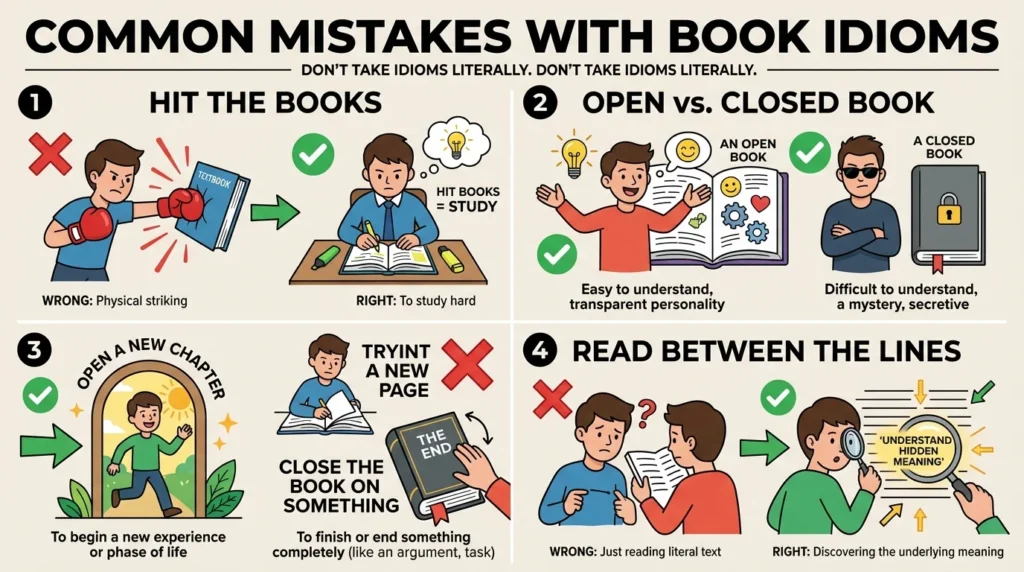
Taking Figurative Language Literally
When someone says:
I need to hit the books.
They mean study, not physically hit a textbook.
Confusing Similar Expressions
These expressions are easy to mix up:
- An open book → someone is easy to understand.
- A closed book → someone or something is difficult to understand.
- Open a new chapter → begin a new stage.
- Close the book on something → bring something to an end.
Changing Fixed Expressions
Many idioms have established wording.
Correct:
You can’t judge a book by its cover.
Avoid changing the expression unnecessarily, because the result may sound unnatural.
Using Informal Idioms in Formal Writing
Instead of:
I need to hit the books before the examination.
A formal academic sentence could simply say:
I need to study before the examination.
The idiom isn’t wrong; the register is different.
Why Learn Book-Related Idioms?
Learning these expressions can improve more than vocabulary. They help learners understand how English communicates ideas indirectly and creatively.
They can help you:
- Understand conversations more easily
- Recognize figurative language
- Improve reading comprehension
- Make everyday speech more natural
- Understand books and media
- Write more expressively
- Build confidence with English
The best method is simple: learn an idiom, understand its context, create your own sentence, and then use it naturally.
Fun with Idioms Worksheets: 28+ Ways to Learn Idioms
Frequently Asked Questions
What are some common books with idioms?
If by books with idioms you mean English expressions connected with books and reading, common examples include hit the books, read between the lines, bookworm, by the book, page-turner, turn the page, and open a new chapter.
What is the most famous book-related idiom?
“You can’t judge a book by its cover” is one of the best-known book-related sayings. It means that you should not judge a person or thing based only on appearance.
What does “read between the lines” mean?
“Read between the lines” means to look beyond the exact words and understand an implied or hidden message.
What does “hit the books” mean?
“Hit the books” is an informal expression meaning to study seriously, especially when preparing for an exam.
Is “bookworm” an idiom?
Bookworm is an idiomatic noun rather than a full idiomatic sentence. It describes someone who loves reading and spends a lot of time with books.
Final Thoughts
Book-related idioms show how creatively English uses familiar ideas such as books, pages, chapters, and stories to describe everyday life. Once you understand the figurative meaning, expressions like “hit the books,” “read between the lines,” “turn the page,” and “open a new chapter” become much easier to recognize and use.
Don’t try to memorize all 20 at once. Pick three today, write an original sentence for each, and use at least one in a real conversation or piece of writing. With regular practice, these expressions will move from something you recognize while reading to language you can use naturally yourself.

Sophie Collins writes for Meaning Match about English idioms, American and British expressions, meanings, usage, and everyday language differences.