
Have you ever heard someone say “it’s raining cats and dogs” and wondered how cats and dogs could possibly fall from the sky? That’s the fun—and sometimes confusing—part of learning idioms. An idiom is a phrase whose meaning is different from the literal meaning of its words.
An anchor chart about idioms for 3rd grade gives students a simple visual way to understand these unusual expressions, remember their meanings, and see how they work in sentences. For example, “a piece of cake” does not mean a slice of cake; it means something is very easy. A classroom anchor chart can help students compare literal and figurative meanings while building vocabulary and understanding common expressions.
Whether you’re a third-grade teacher, parent, or student, this guide provides kid-friendly idioms, simple meanings, and clear examples that make figurative language easier to understand and remember.
What Is an Idioms Anchor Chart for 3rd Grade?
An idioms anchor chart for 3rd grade is a classroom reference that teaches students how common expressions have both a literal interpretation and a figurative meaning.
A simple chart can follow this formula:
IDIOM → WHAT THE WORDS SAY → WHAT THE IDIOM REALLY MEANS → EXAMPLE
For example:
| Idiom | What the Words Say | What It Really Means | Example |
|---|---|---|---|
| A piece of cake | A piece of dessert | Something easy | The quiz was a piece of cake. |
| Spill the beans | Drop beans | Reveal a secret | Don’t spill the beans! |
| Hit the books | Hit books | Study | I need to hit the books. |
| Break the ice | Break frozen water | Make people comfortable | We played a game to break the ice. |
This format gives students a quick reference they can use during reading, writing, speaking, and classroom discussions.
What Is an Idiom?
An idiom is a common expression whose overall meaning is different from the literal meaning of its individual words.
Consider:
“Hold your horses!”
Taken literally, it sounds as if someone is asking you to physically hold horses.
But the idiomatic meaning is:
Wait or slow down.
That difference between the literal words and the intended meaning is what makes idioms interesting—and sometimes confusing for young readers.
Literal Meaning vs. Figurative Meaning
Students can remember the difference with two simple questions:
Literal meaning:
“What would these words mean if I took them exactly as written?”
Figurative meaning:
“What does the whole expression actually mean in this situation?”
For example:
Hit the books
- Literal: Physically hit some books.
- Figurative: Start studying.
This is one of the most important ideas to place on a 3rd grade idiom anchor chart.
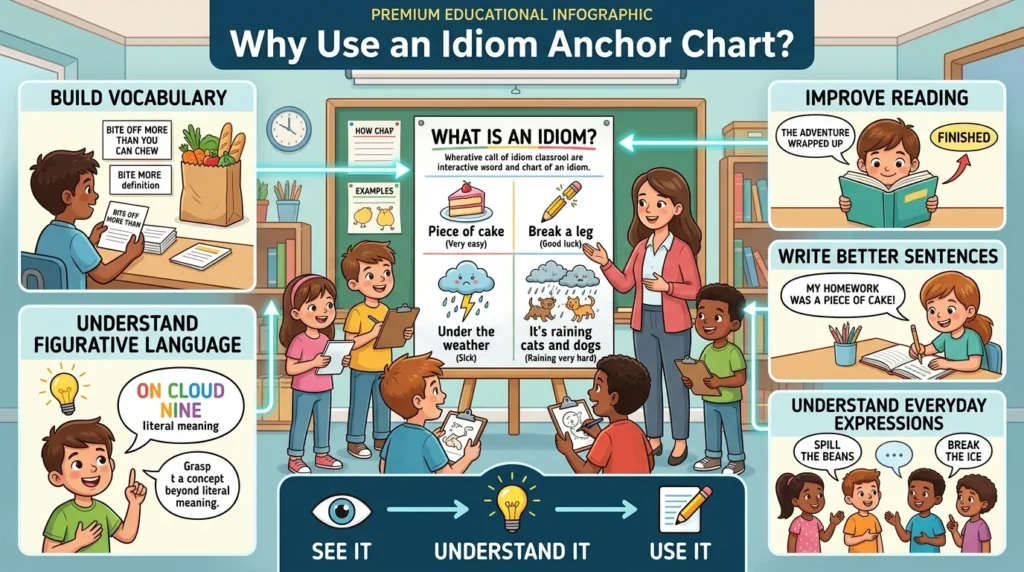
Why Use an Idiom Anchor Chart in 3rd Grade?
Third graders encounter figurative language in stories, conversations, classroom instructions, poems, and writing. An anchor chart gives them a visual reminder when an unfamiliar expression appears.
A useful chart can help students:
- Recognize common idioms while reading
- Understand figurative language
- Use context clues
- Expand vocabulary
- Improve reading comprehension
- Understand everyday expressions
- Write more naturally
- Explain literal and nonliteral meanings
- Create their own sentences
- Become more confident with unfamiliar phrases
Instead of asking students to memorize a long vocabulary list, you can keep the chart visible and return to it whenever an idiom appears.
What Should Be on a 3rd Grade Idiom Anchor Chart?
A strong classroom chart does not need to be crowded. The most useful information can fit into four simple parts.
1. The Idiom
Write the expression in large, easy-to-read letters.
A Piece of Cake
2. The Literal Idea
Explain what the words would suggest if taken literally.
A piece of dessert
3. The Figurative Meaning
Give students the short, kid-friendly meaning.
Something very easy
4. An Example Sentence
Show the expression in context.
The math problem was a piece of cake.
This four-part structure gives students enough information to understand and use the expression without overwhelming them.
The Best Idiom Anchor Chart Formula
If you want one simple format to repeat throughout the school year, use:
Idiom → Literal → Figurative → Example
For example:
SPILL THE BEANS
Literal: Drop beans
Figurative: Reveal a secret
Example: Don’t spill the beans about the surprise!
This consistent format helps students know exactly where to look for the information they need.
How to Make an Idiom Anchor Chart Step by Step
Creating a useful chart is easier when you build it around one clear learning goal.
Step 1: Choose a Small Group of Idioms
Start with five or fewer expressions.
Choose idioms that:
- Children are likely to hear
- Have clear meanings
- Can be illustrated easily
- Fit everyday situations
- Are appropriate for the classroom
You can add more expressions later.
Step 2: Introduce the Literal Meaning
Choose one idiom and ask students:
“If we took these words literally, what picture would we imagine?”
For “spill the beans,” students might imagine a bowl of beans falling onto the floor.
Let them discuss the funny literal picture.
Step 3: Reveal the Figurative Meaning
Explain that the phrase has another meaning when people use it in conversation.
Spill the beans = reveal a secret.
This is the moment when students connect literal and figurative language.
Step 4: Add a Real-Life Example
Use a situation students understand:
“Don’t tell Maya about her surprise birthday party. Don’t spill the beans!”
Now the idiom has a context rather than being just a definition.
Step 5: Let Students Create Their Own Sentences
Ask students to use the expression in a new sentence.
For example:
“My brother almost spilled the beans about my present.”
Step 6: Add a Picture
The picture can show either the literal interpretation, the figurative meaning, or both.
For “break the ice,” a split picture can show:
Literal: A child breaking ice
Figurative: Children meeting and talking
This makes the difference memorable.
Step 7: Keep the Chart Available
Don’t remove the chart after one lesson.
Use it during:
- Reading
- Writing
- Vocabulary practice
- Morning work
- Group activities
- Sentence writing
- Figurative-language review
The more often students use the chart, the more useful it becomes.
3 Ready-to-Use Idiom Anchor Chart Layouts
Different classrooms may benefit from different layouts.
Layout 1: Simple Two-Column Chart
This is ideal when students are just beginning to learn idioms.
| Idiom | Meaning |
|---|---|
| Piece of cake | Very easy |
| Spill the beans | Reveal a secret |
| Hit the books | Study |
| Break the ice | Make people comfortable |
This version is quick and uncluttered.
Layout 2: Literal vs. Figurative Chart
This is especially useful for teaching figurative language.
| Idiom | Literal Meaning | Figurative Meaning |
|---|---|---|
| Hold your horses | Hold horses | Wait |
| Hit the books | Hit books | Study |
| Break the ice | Break ice | Make people comfortable |
| On cloud nine | Be on a cloud | Be very happy |
This format directly teaches the main concept.
Layout 3: Student Practice Chart
This version encourages active participation.
| Idiom | Literal | Figurative Meaning | My Sentence |
|---|---|---|---|
| Piece of cake | Dessert | Very easy | __________ |
| Spill the beans | Drop beans | Reveal a secret | __________ |
| Hit the books | Hit books | Study | __________ |
| Break the ice | Break ice | Make people comfortable | __________ |
Students can complete the final column themselves.
Common Idioms for a 3rd Grade Anchor Chart
Here are 20 classroom-friendly expressions with simple explanations, examples, common errors, and usage notes.
A Piece of Cake
Word-by-word meaning:
A piece is a portion, and cake is a sweet baked food.
Idiomatic/figurative meaning:
Something is very easy.
Example sentence:
The spelling quiz was a piece of cake.
Common error:
Students may think the speaker is talking about food.
Usage note:
Use it when describing something that is easy to do.
Kid-friendly reminder:
Piece of cake = very easy.
Spill the Beans
Word-by-word meaning:
Spill means to drop or pour something, and beans are small edible seeds.
Idiomatic/figurative meaning:
To reveal a secret.
Example sentence:
Please don’t spill the beans about the surprise.
Common error:
Students may use the phrase when talking about actually dropping beans.
Usage note:
It usually refers to information that was supposed to remain secret.
Kid-friendly reminder:
Spill the beans = tell the secret.
Break the Ice
Word-by-word meaning:
Break means to separate or damage something, and ice is frozen water.
Idiomatic/figurative meaning:
To help people feel comfortable when they first meet.
Example sentence:
Our teacher played a funny game to break the ice.
Common error:
Students may think the expression is only about breaking actual ice.
Usage note:
It is useful when people are meeting or beginning a conversation.
Kid-friendly reminder:
Break the ice = make people comfortable.
Hold Your Horses
Word-by-word meaning:
Hold means keep or stop, and horses are animals.
Idiomatic/figurative meaning:
Wait or slow down.
Example sentence:
Hold your horses! We aren’t ready to leave yet.
Common error:
The phrase does not normally refer to physically holding horses.
Usage note:
It is informal and often sounds playful.
Kid-friendly reminder:
Hold your horses = wait!
Raining Cats and Dogs
Word-by-word meaning:
Raining means water is falling from clouds, while cats and dogs are animals.
Idiomatic/figurative meaning:
Raining very heavily.
Example sentence:
It was raining cats and dogs, so we stayed inside.
Common error:
The expression is not meant literally.
Usage note:
Use it for very heavy rain.
Kid-friendly reminder:
Raining cats and dogs = raining a lot.
Hit the Books
Word-by-word meaning:
Hit means strike, and books are reading materials.
Idiomatic/figurative meaning:
To start studying.
Example sentence:
I need to hit the books before tomorrow’s test.
Common error:
“Hit” should not be understood literally here.
Usage note:
It is an informal expression for studying.
Kid-friendly reminder:
Hit the books = study.
Under the Weather
Word-by-word meaning:
Under means below, and weather refers to conditions such as rain, wind, or sunshine.
Idiomatic/figurative meaning:
Feeling sick or unwell.
Example sentence:
Liam stayed home because he felt under the weather.
Common error:
The expression is not about standing underneath a cloud.
Usage note:
It is often used for feeling mildly sick.
Kid-friendly reminder:
Under the weather = not feeling well.
On Cloud Nine
Word-by-word meaning:
A cloud is in the sky, and nine is a number.
Idiomatic/figurative meaning:
Extremely happy.
Example sentence:
Ella was on cloud nine after winning the art contest.
Common error:
It does not mean someone is actually sitting on a cloud.
Usage note:
Use it for strong happiness or excitement.
Kid-friendly reminder:
On cloud nine = very happy.
When Pigs Fly
Word-by-word meaning:
Pigs are animals, and flying means moving through the air.
Idiomatic/figurative meaning:
Something is very unlikely to happen.
Example sentence:
My brother says he’ll clean my room when pigs fly.
Common error:
The phrase is not a prediction that pigs will really fly.
Usage note:
It is usually playful or humorous.
Kid-friendly reminder:
When pigs fly = probably never.
Let the Cat Out of the Bag
Word-by-word meaning:
A cat is an animal, and a bag is a container.
Idiomatic/figurative meaning:
To reveal a secret, often accidentally.
Example sentence:
I accidentally let the cat out of the bag about the surprise.
Common error:
It does not normally mean releasing a real cat.
Usage note:
Use it when someone gives away secret information.
Kid-friendly reminder:
Let the cat out of the bag = reveal a secret.
Cost an Arm and a Leg
Word-by-word meaning:
An arm and a leg are parts of the body.
Idiomatic/figurative meaning:
Something costs a lot of money.
Example sentence:
That new bicycle cost an arm and a leg.
Common error:
Students may interpret the expression literally.
Usage note:
It is an informal way to emphasize a very high price.
Kid-friendly reminder:
Cost an arm and a leg = very expensive.
In Hot Water
Word-by-word meaning:
Hot means having a high temperature, and water is a liquid.
Idiomatic/figurative meaning:
To be in trouble.
Example sentence:
Ben was in hot water after ignoring the classroom rule.
Common error:
The phrase is not necessarily about being in a bathtub.
Usage note:
Use it when someone has caused a problem or may face consequences.
Kid-friendly reminder:
In hot water = in trouble.
The Ball Is in Your Court
Word-by-word meaning:
A ball is used in sports, and a court is a playing area.
Idiomatic/figurative meaning:
It is your turn to make a decision or take action.
Example sentence:
I’ve shared my idea, so now the ball is in your court.
Common error:
The expression does not require an actual sports game.
Usage note:
Use it when the next step is someone else’s responsibility.
Kid-friendly reminder:
The ball is in your court = your turn to act.
Bite the Bullet
Word-by-word meaning:
Bite means use your teeth, and a bullet is a projectile.
Idiomatic/figurative meaning:
To face something difficult or unpleasant with courage.
Example sentence:
I didn’t want to clean my room, but I decided to bite the bullet and get started.
Common error:
Students should understand that this is figurative language.
Usage note:
When teaching young children, use safe everyday examples involving difficult tasks.
Kid-friendly reminder:
Bite the bullet = face something difficult.
Go the Extra Mile
Word-by-word meaning:
Extra means additional, and a mile is a unit of distance.
Idiomatic/figurative meaning:
To make an extra effort.
Example sentence:
Mia went the extra mile to make her science project special.
Common error:
It does not always involve literally walking farther.
Usage note:
It works well when discussing effort, kindness, or responsibility.
Kid-friendly reminder:
Go the extra mile = make extra effort.
Keep an Eye On
Word-by-word meaning:
An eye is used for seeing, and “keep an eye on” literally suggests watching something.
Idiomatic/figurative meaning:
To watch, monitor, or look after something.
Example sentence:
Please keep an eye on my backpack.
Common error:
Students may imagine putting an actual eye on an object.
Usage note:
This is a very common expression in everyday conversation.
Kid-friendly reminder:
Keep an eye on = watch.
A Fish Out of Water
Word-by-word meaning:
A fish is an animal that normally lives in water.
Idiomatic/figurative meaning:
A person who feels uncomfortable or out of place.
Example sentence:
I felt like a fish out of water at my first dance class.
Common error:
The expression can describe a person’s feelings, not just a fish.
Usage note:
Use familiar situations, such as joining a new group or trying a new activity.
Kid-friendly reminder:
A fish out of water = feeling out of place.
Practice Makes Perfect
Word-by-word meaning:
Practice means repeated effort, and perfect means without mistakes.
Idiomatic/figurative meaning:
Regular practice helps people improve.
Example sentence:
Keep practicing your multiplication facts—practice makes perfect.
Common error:
Students may think they must never make mistakes.
Usage note:
Use the expression to encourage effort and persistence.
Kid-friendly reminder:
Practice helps you improve.
Two Heads Are Better Than One
Word-by-word meaning:
Two heads represents two people’s minds or ideas.
Idiomatic/figurative meaning:
Working with another person can help solve a problem.
Example sentence:
Let’s solve the puzzle together. Two heads are better than one.
Common error:
The phrase is figurative, not about literally having two heads.
Usage note:
It is useful for lessons about teamwork.
Kid-friendly reminder:
Two people can work better together.
Don’t Put All Your Eggs in One Basket
Word-by-word meaning:
Eggs are placed inside a basket for carrying.
Idiomatic/figurative meaning:
Do not depend completely on one plan, choice, or opportunity.
Example sentence:
We made a backup plan because we didn’t want to put all our eggs in one basket.
Common error:
Students may focus only on the literal picture of eggs and a basket.
Usage note:
Use simple examples involving choices and backup plans.
Kid-friendly reminder:
Have more than one plan.
Fun with Idioms Worksheets: 28+ Ways to Learn Idioms
Interactive Idiom Anchor Chart Ideas
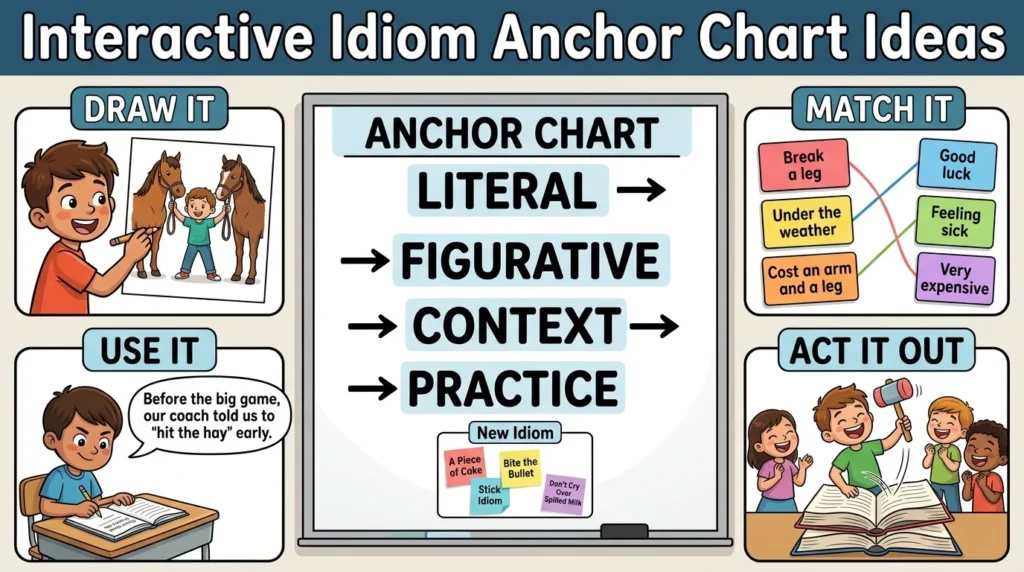
A chart becomes much more useful when students participate in building it.
Add Sticky-Note Examples
Give each student a sticky note and ask them to write one sentence using an idiom from the chart.
Place the sentence under the correct expression.
Add Student Drawings
Students can draw the literal meaning of an idiom.
For:
“Hold your horses”
they might draw a person holding horses.
Then underneath, they write:
Figurative meaning: Wait!
The funny contrast helps them remember the expression.
Create a “New Idiom” Corner
Leave one part of the chart blank.
Whenever students discover an idiom during reading or conversation, add it to the corner.
Use the same four questions:
- What is the idiom?
- What would it mean literally?
- What does it mean figuratively?
- Can we make a sentence?
Use Color-Coded Sections
A simple visual system can make the chart easier to scan:
Idiom → main expression
Literal → what the words say
Figurative → what the expression means
Example → how it is used
The goal is not decoration. The colors should help students find information quickly.
Student-Friendly Idiom Anchor Chart Template
Students can copy or complete this simple structure in their notebooks.
My Idiom
Idiom: __________________________
What the words say:
What it really means:
My sentence:
My picture:
🖼️ _______________________________
This turns the classroom chart into a personal vocabulary activity.
Fun Classroom Activities for Practicing Idioms
An anchor chart becomes more powerful when students use the expressions instead of simply reading them.
Idiom Charades
Write familiar idioms on cards.
One student chooses a card and acts out the literal meaning without saying the expression.
The class guesses the idiom and then explains the figurative meaning.
For example:
Hit the books
A student pretends to hit a book.
The class answers:
“Hit the books!”
Then everyone explains:
“It means to study.”
Literal or Figurative?
Read a sentence aloud.
Students decide whether the expression is being used literally or figuratively.
Example:
Dad put a piece of cake on my plate.
Answer: Literal.
Then:
The math homework was a piece of cake.
Answer: Figurative.
This teaches students that context matters.
Match the Idiom to Its Meaning
Create two sets of cards.
Set A: Idioms
- Break the ice
- Hit the books
- Spill the beans
- On cloud nine
Set B: Meanings
- Study
- Reveal a secret
- Make people comfortable
- Be very happy
Students match the pairs.
Finish the Sentence
Give students a sentence with a missing idiom.
The test was very easy. It was __________.
Students choose:
a piece of cake
Then ask them to explain why.
Draw the Idiom
Give students an idiom and ask them to create two small pictures:
Picture 1: Literal meaning
Picture 2: Figurative meaning
This works particularly well with:
- Spill the beans
- Break the ice
- Hold your horses
- Raining cats and dogs
- On cloud nine
Middle School Idioms: 25 Expressions Students Can Actually Use
Common Mistakes Students Make With Idioms
Taking Idioms Literally
This is one of the first challenges students encounter.
If they hear:
“It’s raining cats and dogs.”
They may picture animals falling from the sky.
Teach them to pause and ask:
“Does the literal meaning make sense here?”
If it does not, the expression may have a figurative meaning.
Changing the Words in an Idiom
Idioms usually have a conventional form.
For example:
❌ Spill the peas
✅ Spill the beans
❌ Hold your cows
✅ Hold your horses
❌ Break the water
✅ Break the ice
Changing an important word can make the expression incorrect or confusing.
Memorizing the Definition Without Learning the Context
Knowing that “spill the beans” means reveal a secret is useful.
But students should also understand when it sounds natural:
“Don’t spill the beans about the surprise.”
That is more useful than simply memorizing:
Spill the beans = reveal a secret.
Assuming Similar Idioms Mean Exactly the Same Thing
Some expressions overlap in meaning but are used differently.
For example:
Spill the beans → reveal a secret
Let the cat out of the bag → reveal a secret, often accidentally
Keep an eye on → watch or look after something
Students should learn both the meaning and the situation in which the expression naturally appears.
Using Too Many Idioms at Once
More is not always better.
Introducing five idioms and practicing them repeatedly can be more effective for young learners than presenting 20 expressions and expecting students to remember everything immediately.
The full list can remain on a classroom reference chart while the lesson focuses on a smaller group.
How to Help Students Use Idioms in Writing
After students understand several expressions, move from recognition to production.
Ask them to write a short paragraph containing two or three idioms.
For example:
I was on cloud nine when I won the spelling contest. My teacher said the final challenge would be a piece of cake. After school, I decided to hit the books for tomorrow’s test.
Then ask students to underline each idiom and write its figurative meaning beside it.
This helps connect vocabulary learning with writing practice.
How to Use Idioms During Reading
Idioms are excellent opportunities for teaching context clues.
When students encounter an unfamiliar expression, ask:
Question 1: What do the words literally say?
Example:
“The new student felt like a fish out of water.”
Question 2: Does the literal meaning make sense?
A person is not actually a fish.
Question 3: What clues does the sentence give us?
The word “felt” suggests an emotion or experience.
Question 4: What could the expression mean?
The student probably felt uncomfortable or out of place.
This teaches students how to work out meaning instead of immediately asking for a definition.
A Simple Weekly Idiom Routine
You can turn the chart into a five-day learning routine.
Monday: Introduce
Teach one or two new idioms.
Explain the literal and figurative meanings.
Tuesday: Illustrate
Students draw the literal meaning and discuss the figurative meaning.
Wednesday: Practice
Students complete matching, sorting, or sentence activities.
Thursday: Use
Students create original sentences or short paragraphs.
Friday: Review
Play a quick guessing game or ask students to explain the idioms without looking at the meanings.
This repeated exposure helps students move from recognizing an idiom to using it.
How to Keep an Idiom Anchor Chart From Becoming Cluttered
A common mistake is trying to put too much information on one poster.
Instead:
- Use short definitions.
- Use one example sentence.
- Add simple illustrations.
- Keep the same format for each idiom.
- Leave enough white space.
- Add new expressions gradually.
- Remove or rotate older examples when the chart becomes crowded.
- Use separate charts for different units if necessary.
Remember:
An anchor chart should help students find information, not make them search through it.
A Teacher-Friendly Idiom Chart Checklist
Before displaying your chart, check:
- Is the idiom clearly written?
- Is the figurative meaning easy for a third grader to understand?
- Is the literal meaning included when useful?
- Is there a short example sentence?
- Is the text large enough to read from across the classroom?
- Does the chart avoid unnecessary information?
- Can students use it independently?
- Does it connect to reading or writing?
- Are the examples appropriate for the students’ age?
- Is there room to add student-created examples?
If the answer is yes to most of these questions, the chart is likely serving its purpose as a classroom learning tool.
Frequently Asked Questions
What should a 3rd grade idiom anchor chart include?
A useful chart should include the idiom, its simple figurative meaning, and at least one example. Adding the literal interpretation makes the difference between literal and figurative language especially clear for young learners.
How do you make an idiom anchor chart for 3rd grade?
Start with a small group of familiar idioms. For each one, write the expression, explain what it would mean literally, give the figurative meaning, and add a short example sentence or picture. Leave room for students to contribute their own examples.
What are some easy idioms for 3rd graders?
Good starting choices include a piece of cake, break the ice, spill the beans, hit the books, hold your horses, on cloud nine, under the weather, and go the extra mile. Choose expressions students can understand through familiar situations.
Why are idiom anchor charts useful?
They give students a visual reference they can return to when they encounter figurative expressions in reading, writing, or conversation. The chart can also help students compare literal and figurative meanings.
How many idioms should I teach at one time?
There is no need to teach all 20 at once. Introduce a small number, practice them in different contexts, and gradually add new expressions. The goal is meaningful understanding rather than memorizing a long list.
How can I make idioms easier for children to understand?
Use pictures, funny literal interpretations, short definitions, real-life situations, and student-created sentences. Asking students whether a literal interpretation makes sense is also a useful way to guide them toward the figurative meaning.
Conclusion
A great idioms anchor chart for 3rd grade should do more than decorate the classroom wall. It should help students understand a key idea:
The words in an idiom may not tell you its real meaning.
Start with a few familiar expressions, show the literal and figurative meanings side by side, and give students plenty of opportunities to use each idiom in context.
Add drawings, student sentences, sticky-note examples, and quick classroom games as you go. Whether students are reading a story, writing a paragraph, or listening to everyday conversation, the chart can become a reliable reference they know how to use.
The simplest formula to remember is:
IDIOM → LITERAL MEANING → FIGURATIVE MEANING → REAL-LIFE EXAMPLE
Once students learn to make that connection, idioms become less confusing—and much more fun to learn.

Emily Carter writes for Meaning Match about English idioms, student-friendly expressions, and language learning, using simple explanations and helpful examples.