
Have you ever read an English phrase that sounded funny but made no sense when you took the words literally? Fun with idioms worksheets make these tricky expressions easier to understand while turning practice into an enjoyable learning activity. An idiom is a phrase whose meaning is different from the literal meaning of its individual words.
For example, “a piece of cake” does not mean a slice of cake—it means something is very easy. Worksheets can help learners practice idioms through matching activities, fill-in-the-blanks, sentence completion, quizzes, and other exercises. They also help students recognize common expressions, understand their meanings from context, and use them correctly in their own sentences.
Whether you’re a student, teacher, parent, or English learner, these worksheets provide a simple way to build vocabulary and practice everyday English. In this guide, you’ll find fun idiom worksheets, clear examples, and practical exercises to help you understand idioms, recognize them in context, and use them naturally.
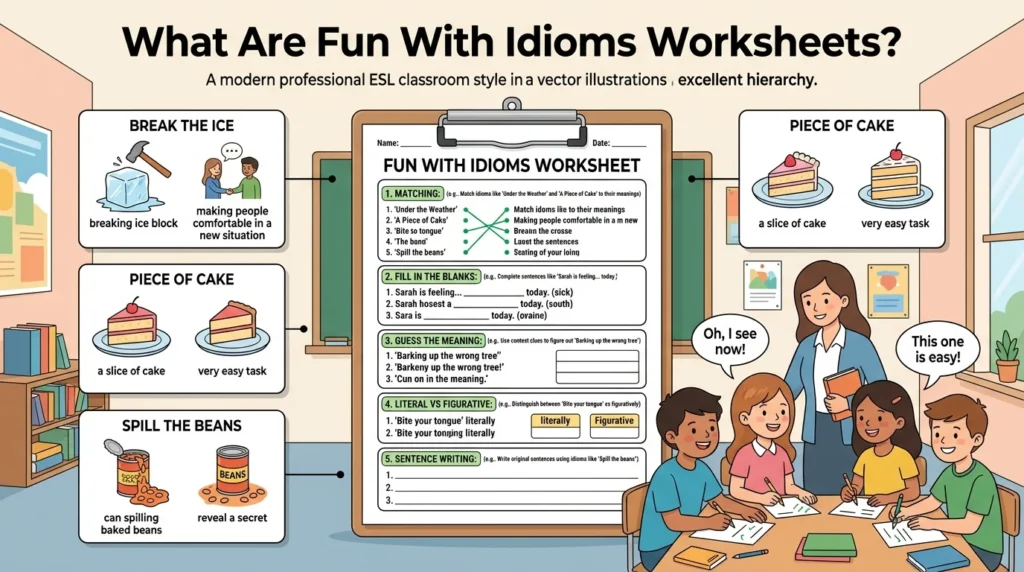
What Are Fun With Idioms Worksheets?
Fun with idioms worksheets are English-learning exercises that help students learn and practice idiomatic expressions in an interactive way.
Instead of presenting an idiom as a definition to memorize, a good worksheet gives learners opportunities to:
- Match idioms with meanings
- Complete sentences
- Choose the correct expression
- Guess an idiom from context
- Separate literal and figurative meanings
- Correct common mistakes
- Draw an idiom
- Write original sentences
- Complete short dialogues
- Use idioms in stories and conversations
These activities can work for classroom lessons, ESL/EFL practice, tutoring, homeschooling, homework, or independent study.
What Makes an Idiom Worksheet Effective?
A strong worksheet should move beyond recognition.
Students should ideally progress through four stages:
Recognize → Understand → Practice → Use
For example:
Idiom: Hit the books
Meaning: Start studying seriously
Context: I have an exam tomorrow, so I need to hit the books.
Practice: Choose the correct idiom.
Production: Write your own sentence.
This progression helps learners understand not only what an idiom means, but also when it sounds natural.
Ready-to-Use Fun Idioms Worksheet
The following activities can be used directly in a classroom, tutoring session, homework assignment, or self-study lesson.
Worksheet 1: Match the Idiom With Its Meaning
Instructions: Match each idiom with the correct meaning.
Idioms
- Break the ice
- Piece of cake
- Spill the beans
- Under the weather
- Hit the books
- Pull someone’s leg
- Go the extra mile
- Once in a blue moon
- Keep an eye on
- The ball is in your court
Meanings
A. Study seriously
B. Reveal a secret
C. Watch or monitor something
D. Make people feel more comfortable
E. Do more than expected
F. Something that is very easy
G. Feel slightly unwell
H. Tease or joke with someone
I. Something that happens very rarely
J. It is now your responsibility to take the next step
Answer Key
- D
- F
- B
- G
- A
- H
- E
- I
- C
- J
Worksheet 2: Fill in the Blanks
Instructions: Choose the best idiom from the word bank. Use each expression once.
Word Bank:
break the ice — hit the books — spill the beans — piece of cake — under the weather — go the extra mile — once in a blue moon — pull my leg
- I have an English exam tomorrow, so I need to __________ tonight.
- Don’t __________ about the surprise party.
- The teacher told a funny story to __________ on the first day of class.
- The homework was a __________.
- I stayed home because I was feeling __________.
- Our coach always __________ to help the team improve.
- I only eat at that expensive restaurant __________.
- Are you serious, or are you just __________?
Answer Key
- hit the books
- spill the beans
- break the ice
- piece of cake
- under the weather
- goes the extra mile
- once in a blue moon
- pulling my leg
Worksheet 3: Guess the Idiom From the Situation
Instructions: Read each situation and choose the idiom that best fits.
1. A new student joins the class. The teacher starts a funny game so everyone feels comfortable.
A. Spill the beans
B. Break the ice
C. Hit the books
D. Bite the bullet
Answer: Break the ice
2. Sara studied all evening because she has a difficult test tomorrow.
A. Hit the books
B. Pull her leg
C. Under the weather
D. When pigs fly
Answer: Hit the books
3. Ben accidentally tells his sister about her surprise birthday party.
A. Go the extra mile
B. Spill the beans
C. Piece of cake
D. Keep an eye on
Answer: Spill the beans
4. Ahmed says he will become a professional astronaut tomorrow without any training. His friend laughs.
A. When pigs fly
B. Break the ice
C. Cost an arm and a leg
D. Hit the nail on the head
Answer: When pigs fly
5. The task looked difficult, but Maria finished it very easily.
A. Under the weather
B. Piece of cake
C. Add fuel to the fire
D. Pull someone’s leg
Answer: Piece of cake
Worksheet 4: Literal or Figurative?
Instructions: Decide whether the idiom is being used literally or figuratively.
Example
The children broke the ice with a hammer.
Answer: Literal
The teacher told a joke to break the ice.
Answer: Figurative
Practice
- The boy hit the books with his hand.
- I need to hit the books before my exam.
- She spilled the beans onto the kitchen floor.
- He spilled the beans about the surprise.
- The cake was a piece of cake on the plate.
- The assignment was a piece of cake.
Answer Key
- Literal
- Figurative
- Literal
- Figurative
- Literal
- Figurative
This exercise helps students understand one of the most important features of idioms: the same words can have a literal meaning or an established figurative meaning depending on context.
Worksheet 5: Fix the Idiom
Instructions: Each sentence contains an incorrect idiom. Rewrite it correctly.
- Don’t spill the bean about the surprise.
- I need to hit a books tonight.
- She is feeling under a weather today.
- We broke ice when the new students arrived.
- He goes extra mile to help customers.
- I visit that place once on a blue moon.
Answer Key
- Don’t spill the beans about the surprise.
- I need to hit the books tonight.
- She is feeling under the weather today.
- We broke the ice when the new students arrived.
- He goes the extra mile to help customers.
- I visit that place once in a blue moon.
What Does This Teach?
Idioms are generally fixed expressions. Students should learn the expression as a complete phrase rather than replacing individual words with random synonyms.
Worksheet 6: Write Your Own Idiom Sentences
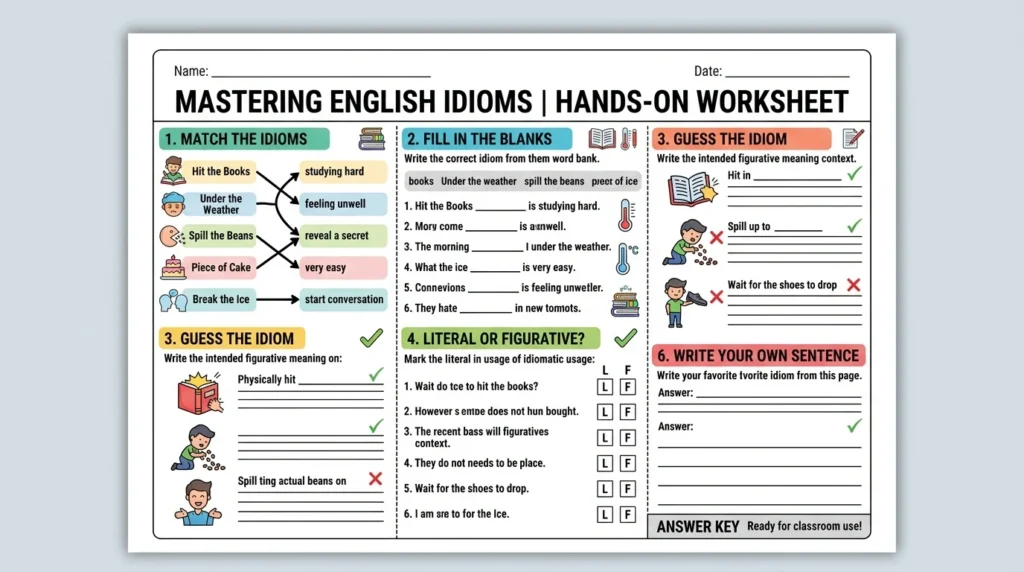
Instructions: Choose five idioms and write one original sentence for each.
| Idiom | Your Sentence |
|---|---|
| Break the ice | ______________________________ |
| Piece of cake | ______________________________ |
| Spill the beans | ______________________________ |
| Hit the books | ______________________________ |
| Go the extra mile | ______________________________ |
Challenge
Write a short paragraph using at least three idioms naturally.
Try not to force an idiom into a sentence where it does not belong.
Break the Ice
Word-by-word meaning: Break means separate or crack; ice means frozen water.
Idiomatic meaning: To make people feel more comfortable in a new or awkward situation.
Example:
The teacher played a quick game to break the ice.
Common error: Saying “break an ice.”
Correct: break the ice
Usage note: Usually informal and conversational. It works well for introductions, meetings, parties, and new groups.
Piece of Cake
Word-by-word meaning: A piece of cake is a portion of a dessert.
Idiomatic meaning: Something very easy.
Example:
The first exercise was a piece of cake.
Common error: Thinking the phrase must refer to food.
Usage note: Informal and common in everyday conversation.
Spill the Beans
Word-by-word meaning: Spill means accidentally pour something out; beans are edible seeds.
Idiomatic meaning: To reveal secret information.
Example:
Who spilled the beans about the surprise?
Common error: Using the singular “bean.”
Correct: spill the beans
Usage note: Informal. It is commonly used when someone reveals information that was supposed to remain secret.
Under the Weather
Word-by-word meaning: Under means below; weather refers to atmospheric conditions.
Idiomatic meaning: Feeling slightly ill or unwell.
Example:
I’m feeling under the weather, so I stayed home.
Common error: Using it simply to describe being outside during bad weather.
Usage note: Usually refers to feeling mildly unwell.
Hit the Books
Word-by-word meaning: Hit means strike; books are study materials.
Idiomatic meaning: To start studying seriously.
Example:
I have an exam tomorrow, so I need to hit the books.
Common error: Treating “hit” as a literal physical action.
Usage note: Informal and particularly useful when discussing school or exams.
Pull Someone’s Leg
Word-by-word meaning: Pull means tug; someone’s leg is a body part.
Idiomatic meaning: To tease or joke with someone by making them believe something untrue.
Example:
Don’t worry. I’m just pulling your leg.
Common error: Treating every lie as “pulling someone’s leg.”
Usage note: Usually playful. Tone and context matter.
Go the Extra Mile
Word-by-word meaning: Go means move; extra means additional; mile means a unit of distance.
Idiomatic meaning: To make more effort than expected.
Example:
The teacher went the extra mile to help her students.
Common error: Using it only for physical travel.
Usage note: Often used to praise someone’s additional effort.
Once in a Blue Moon
Word-by-word meaning: Once means one time; blue moon creates the literal image.
Idiomatic meaning: Very rarely.
Example:
I eat fast food once in a blue moon.
Common error: Using it for something that happens often.
Usage note: Informal and useful for describing rare events.
Keep an Eye On
Word-by-word meaning: Keep means continue to have; eye is the organ used for seeing.
Idiomatic meaning: To watch or monitor something carefully.
Example:
Can you keep an eye on my bag?
Common error: Saying “keep an eye at.”
Correct: keep an eye on
Usage note: Very common in everyday English.
The Ball Is in Your Court
Word-by-word meaning: Ball refers to a sports ball; court is the playing area.
Idiomatic meaning: It is now your responsibility to decide or take the next action.
Example:
I’ve explained everything, so the ball is in your court.
Common error: Using it when nobody has a next decision or action to make.
Usage note: Common in conversations about decisions, responsibilities, and negotiations.
Hit the Nail on the Head
Word-by-word meaning: Hit means strike; nail means a metal fastener; head is the top part of the nail.
Idiomatic meaning: To identify something exactly or make an accurate point.
Example:
You hit the nail on the head with that explanation.
Common error: Shortening the expression to “hit the nail” when the idiomatic meaning is intended.
Usage note: Useful when agreeing that someone’s explanation or observation is exactly right.
Cost an Arm and a Leg
Word-by-word meaning: An arm and a leg are body parts.
Idiomatic meaning: To be extremely expensive.
Example:
That car cost an arm and a leg.
Common error: Using the expression for something that is merely somewhat expensive.
Usage note: Informal and often humorous.
Add Fuel to the Fire
Word-by-word meaning: Fuel helps a fire burn; adding it makes the fire stronger.
Idiomatic meaning: To make an already difficult, angry, or tense situation worse.
Example:
His angry comment only added fuel to the fire.
Common error: Using it for solving a conflict.
Usage note: Often used with arguments, disagreements, and tense situations.
Go the Extra Mile
Word-by-word meaning: Extra means additional; a mile is a unit of distance.
Idiomatic meaning: To put in additional effort.
Example:
She always goes the extra mile for her students.
Common error: Confusing physical distance with figurative effort.
Usage note: Often expresses appreciation or praise.
When Pigs Fly
Word-by-word meaning: Pigs are animals; fly means move through the air.
Idiomatic meaning: Something is extremely unlikely or will probably never happen.
Example:
He’ll clean his room when pigs fly.
Common error: Using it for something merely unusual.
Usage note: Informal and humorous.
Let the Cat Out of the Bag
Word-by-word meaning: Let means allow; cat is an animal; bag is a container.
Idiomatic meaning: To reveal a secret, often accidentally.
Example:
Tom let the cat out of the bag about the party.
Common error: Changing “the cat” to another animal.
Usage note: Similar in meaning to spill the beans, although the exact context may differ.
Bite the Bullet
Word-by-word meaning: Bite means use your teeth; a bullet is ammunition.
Idiomatic meaning: To face something difficult or unpleasant with courage.
Example:
I didn’t want to make the call, but I bit the bullet.
Common error: Assuming the phrase describes a literal action.
Usage note: Often used when someone finally accepts an unpleasant task or situation.
A Blessing in Disguise
Word-by-word meaning: A blessing is something beneficial; a disguise hides an appearance.
Idiomatic meaning: Something that first seems bad but later produces a positive result.
Example:
Missing that flight turned out to be a blessing in disguise.
Common error: Using it for something that is obviously good from the beginning.
Usage note: The situation usually has an unexpected positive outcome.
Bark Up the Wrong Tree
Word-by-word meaning: Bark refers to a dog’s sound; a tree is a woody plant.
Idiomatic meaning: To pursue the wrong idea, person, or solution.
Example:
If you think I broke the vase, you’re barking up the wrong tree.
Common error: Using it without an incorrect assumption or direction.
Usage note: Informal and conversational.
Speak of the Devil
Word-by-word meaning: Speak means talk; devil refers to a traditional supernatural figure.
Idiomatic meaning: Said when the person being discussed unexpectedly appears.
Example:
Speak of the devil! We were just talking about you.
Common error: Assuming it must always be a serious or religious statement.
Usage note: Usually playful and conversational.
Middle School Idioms: 25 Expressions Students Can Actually Use
Fun Classroom Activities for Idiom Practice
Worksheets become even more effective when students get opportunities to speak, move, draw, and create.
Idiom Charades
Write idioms on small cards.
One student chooses a card and acts out the figurative meaning without speaking.
The class guesses the idiom.
For example:
Hit the books
The student can pretend to study intensely.
This works particularly well as a quick warm-up.
Draw the Idiom
Give students an idiom such as:
It’s raining cats and dogs.
Ask them to draw the literal image first.
Then ask:
What does it really mean?
This creates a memorable contrast between literal language and figurative language.
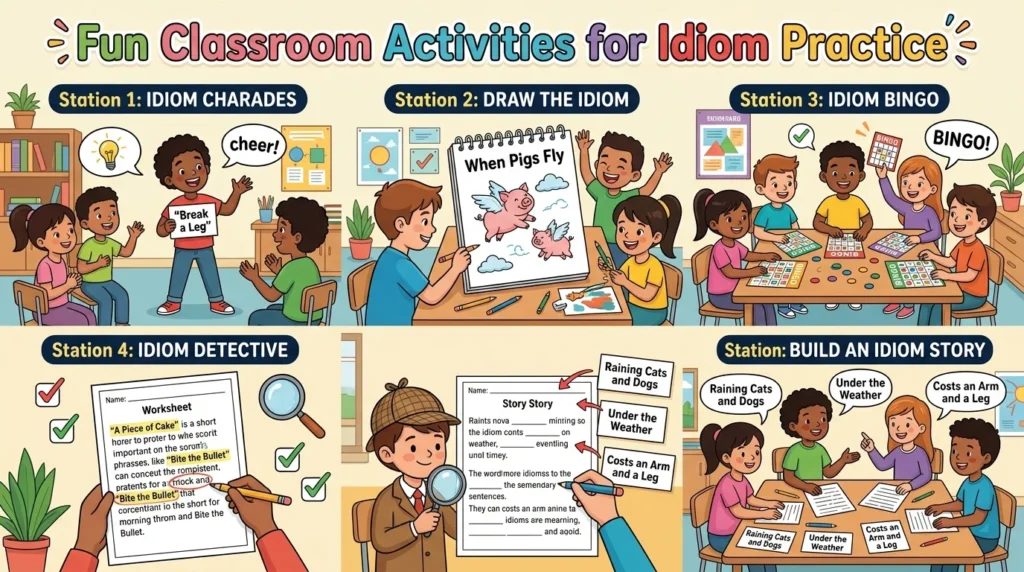
Idiom Bingo
Create bingo cards containing idioms.
Instead of calling the idiom itself, the teacher reads the meaning or a situation.
For example:
“This means something is very easy.”
Students look for:
Piece of cake
The first student to complete the required pattern calls out “Bingo!”
Idiom Detective
Give students a short paragraph containing several idioms.
Ask them to:
- Circle each idiom.
- Explain its meaning.
- Identify the context clue.
- Rewrite one sentence without the idiom.
This activity combines vocabulary, reading comprehension, and paraphrasing.
Build an Idiom Story
Give students three idioms.
For example:
- Hit the books
- Piece of cake
- Under the weather
Ask them to create a short story using all three naturally.
The goal is not simply to insert the expressions. Students must make each idiom fit the situation.
How to Make Idiom Worksheets More Fun
Add Pictures
Pictures can make abstract expressions easier to remember.
For example:
Spill the beans
Show beans literally spilling from a container, then place the figurative meaning beside the image:
Reveal a secret
This visual contrast makes the lesson memorable.
Add a Challenge Round
After the basic worksheet, give students a harder task:
Use three idioms in a six-sentence story.
This moves the learner from recognition to independent production.
Add Pair Work
One student reads the meaning.
The partner guesses the idiom.
Then they switch roles.
This turns a simple worksheet into a speaking activity.
Add Error Hunting
Give students five sentences containing incorrectly used idioms.
Their job is to find and correct each mistake.
This is especially useful because students learn that knowing an idiom’s definition is not enough; they must also know its form and context.
Idiom Tone and Usage: An Important Extra Skill
Learning an idiom does not mean students should use it everywhere.
Before using an expression, learners should consider:
- Is it informal or formal?
- Is it conversational?
- Is it humorous?
- Does the context support it?
- Is the expression being used correctly?
- Would ordinary wording be clearer?
For example:
Hit the books
works naturally in a casual conversation about studying.
In a highly formal academic sentence, a learner may prefer:
study seriously
The objective is not to make every sentence sound idiomatic. The objective is to help students choose language that fits the situation.
Common Mistakes Students Make With Idioms
Taking Idioms Literally
Students may think:
“Break the ice”
means physically breaking ice.
Teach them to ask:
Does the literal meaning make sense in this situation?
If not, the expression may have a figurative meaning.
Changing Words Inside the Idiom
Idioms are often fixed or semi-fixed expressions.
For example:
❌ Spill the bean
✅ Spill the beans
❌ Break an ice
✅ Break the ice
❌ Keep an eye at it
✅ Keep an eye on it
Learning the expression as a complete phrase helps prevent these errors.
Using the Right Idiom in the Wrong Context
A student may know that under the weather relates to feeling unwell but use it when talking about rainy weather.
Knowing the definition is only the first step.
The learner must also understand how the expression behaves in real sentences.
Overusing Idioms
A paragraph filled with idioms does not automatically sound more natural.
Good English combines idioms with ordinary vocabulary.
Students should use an idiom when it adds meaning, tone, or naturalness—not simply because they have learned it.
Mixing Two Idioms
Students sometimes combine expressions:
❌ “The ball is in your field.”
If they mean responsibility for the next step, the standard expression is:
✅ The ball is in your court.
Teaching idioms as complete expressions reduces this kind of mistake.
Idioms for 6th Graders: 24+ Easy Examples With Meanings
How to Adapt Fun Idiom Worksheets by Level
Beginner Learners
Focus on:
- Pictures
- Matching
- Multiple choice
- Simple definitions
- Short sentences
- Literal vs figurative meaning
Use familiar expressions and provide plenty of context.
Intermediate Learners
Add:
- Context clues
- Fill-in-the-blanks
- Error correction
- Dialogue completion
- Sentence writing
- Pair speaking
Ask students to explain why an idiom fits a sentence.
Advanced Learners
Use:
- Short stories
- Idiom paraphrasing
- Tone and register
- Idioms in conversations
- Writing challenges
- Context comparison
For example:
Rewrite the sentence without the idiom.
“The ball is in your court.”
Possible answer:
It is now your responsibility to decide what happens next.
This tests whether the student understands the actual meaning rather than simply recognizing the phrase.
A Simple 15-Minute Idiom Lesson Plan
Teachers who want a quick activity can use this structure.
Minutes 1–3: Introduce
Present three idioms with simple situations.
Minutes 4–6: Match
Students match the idioms with their meanings.
Minutes 7–9: Complete
Students fill in three contextual sentences.
Minutes 10–12: Speak
Students use the expressions in pairs.
Minutes 13–15: Create
Students write one original sentence using their favorite idiom.
This short sequence gives students exposure to meaning, context, recognition, and production without making the lesson feel repetitive.
Fun With Idioms Worksheets for Different Learning Settings
Classroom Use
Teachers can print the activities, divide students into pairs, and use the answer key for quick checking.
ESL or EFL Practice
Focus heavily on context and pronunciation. Have learners say each completed sentence aloud after finishing the written exercise.
Homeschool Learning
Parents can combine drawing, matching, and sentence-writing activities into one short lesson.
Homework
Use one worksheet for independent practice and ask students to write three original sentences afterward.
Self-Study
Learners can complete the exercises, check the answer key, and then create a personal idiom notebook containing:
- Idiom
- Meaning
- Example
- Similar expression
- Personal sentence
Frequently Asked Questions
What are fun with idioms worksheets?
Fun with idioms worksheets are interactive English exercises that help learners understand and practice idiomatic expressions through activities such as matching, fill-in-the-blanks, multiple choice, picture interpretation, error correction, and sentence writing.
What should an idiom worksheet include?
A useful worksheet can include the idiom, figurative meaning, contextual examples, matching exercises, sentence completion, error correction, and an opportunity for students to create their own sentences. An answer key is especially helpful for teachers and independent learners.
How do you make idioms fun for students?
Use pictures, guessing games, charades, bingo, drawing activities, pair work, short stories, and challenge rounds. Mixing written practice with speaking and visual activities keeps students actively involved.
Are idiom worksheets useful for ESL students?
Yes. Idiom worksheets can help ESL learners connect unfamiliar expressions with clear situations and examples. Activities that move from meaning to context and then to original sentences are particularly useful.
What are the best idioms for beginners?
Start with familiar expressions that have clear everyday uses, such as piece of cake, break the ice, hit the books, spill the beans, and under the weather. Once students understand the basic concept, introduce more context-dependent expressions.
How can students remember idioms?
Students can remember idioms more effectively by seeing them in context, connecting them with pictures, using them in personal sentences, saying them aloud, and reviewing them repeatedly rather than memorizing isolated definitions.
Conclusion
Learning idioms does not have to mean memorizing long lists of confusing expressions.
With fun with idioms worksheets, students can match meanings, complete sentences, solve context clues, correct mistakes, draw funny literal pictures, create stories, and practice real conversations.
The most effective approach is simple:
Understand the idiom → see it in context → practice it → use it yourself.
Start with five familiar expressions, complete the matching and fill-in-the-blank activities, and then challenge students to use three idioms in their own short story or conversation.
When learners understand not only what an idiom means, but also when, why, and how to use it, idioms stop feeling confusing and start becoming a natural part of everyday English.

Emily Carter writes for Meaning Match about English idioms, student-friendly expressions, and language learning, using simple explanations and helpful examples.