
Some English phrases are so vivid that you can almost picture them in your mind. Colorful idioms are imaginative, expressive phrases that make language more lively and memorable, often by using unusual images to communicate a figurative meaning.
Expressions such as “spill the beans,” “raining cats and dogs,” “paint the town red,” and “see red” may sound strange when taken literally, but each has a different meaning in everyday English. For example, “spill the beans” means to reveal a secret, while “paint the town red” means to go out and celebrate or enjoy yourself. The term “colorful idioms” is descriptive rather than a formal linguistic category, so it can include expressions that are funny, vivid, dramatic, or imaginative.
If you’re looking for colorful idioms for writing, schoolwork, conversations, captions, or English practice, this guide explains their meanings, examples, and natural uses so you can make your language more expressive.
What Are Colorful Idioms?
Colorful idioms are fixed English expressions that contain a color word but have a meaning beyond the literal color.
For example:
Once in a blue moon = very rarely
The expression does not mean that you regularly see a blue moon. Instead, it describes something that happens only occasionally or very rarely.
Colorful idioms are common in everyday conversations, stories, movies, journalism, and informal writing. Learning them can help you understand what English speakers mean when their words do not have a literal interpretation.
Quick Examples
| Colorful Idiom | Figurative Meaning |
|---|---|
| Green with envy | Very jealous |
| Caught red-handed | Caught doing something wrong |
| Once in a blue moon | Very rarely |
| Feeling blue | Feeling sad |
| White lie | A minor or socially motivated lie |
| Black sheep | A person who differs from a group |
| See red | Become extremely angry |
| Silver lining | A positive aspect of a difficult situation |
| Golden opportunity | A valuable chance |
| Give the green light | Give permission |
| In the red | Experiencing financial loss or debt |
| Paint the town red | Go out and celebrate |
| Roll out the red carpet | Give someone a special welcome |
| Tickled pink | Very pleased or amused |
| Pink slip | Notice of job loss |
| Gray area | An unclear situation |
| In black and white | Clearly written or documented |
| Out of the blue | Unexpectedly |
| Red tape | Excessive bureaucracy |
| White elephant | Something costly or burdensome but of little practical use |
Common Colorful Idioms
Green With Envy
Word-by-word meaning:
Green = a color; envy = wanting what someone else has.
Idiomatic meaning:
To be green with envy means to feel very jealous of another person’s success, possessions, appearance, or opportunities.
Examples:
- She was green with envy when her friend won the scholarship.
- He felt green with envy after seeing his colleague’s new car.
Common error:
Do not use this idiom simply because someone likes the color green.
Usage note:
It usually describes strong jealousy and is often conversational.
Caught Red-Handed
Word-by-word meaning:
Caught = discovered; red-handed = with evidence connected to wrongdoing.
Idiomatic meaning:
To be caught red-handed means to be discovered while doing something wrong.
Examples:
- The child was caught red-handed eating the cookies.
- The employee was caught red-handed taking money from the drawer.
Common error:
The person’s hands do not have to be literally red.
Usage note:
It can describe serious wrongdoing or harmless situations in a humorous way.
Once in a Blue Moon
Word-by-word meaning:
Once = one time; blue moon = an uncommon lunar event.
Idiomatic meaning:
Once in a blue moon means very rarely.
Examples:
- I eat fast food once in a blue moon.
- We see our old neighbors once in a blue moon.
Common error:
Do not use it for something that happens frequently.
Usage note:
This is a common informal expression for something that happens very infrequently.
Feeling Blue
Word-by-word meaning:
Feeling = experiencing an emotion; blue = a color.
Idiomatic meaning:
To be feeling blue means to feel sad or emotionally low.
Examples:
- I’m feeling blue today, so I’m going to take a quiet evening.
- She was feeling blue after saying goodbye to her friends.
Common error:
It normally describes sadness, not physical coldness.
Usage note:
It often refers to temporary sadness rather than a specific clinical condition.
White Lie
Word-by-word meaning:
White = a color; lie = an untrue statement.
Idiomatic meaning:
A white lie is a minor lie, often told to avoid hurting someone’s feelings or creating an uncomfortable situation.
Examples:
- I told a little white lie because I didn’t want to spoil the surprise.
- She told a white lie about liking the gift.
Common error:
Calling something a white lie does not automatically make it harmless or acceptable.
Usage note:
The expression describes how people commonly characterize a minor lie; whether the lie is actually harmless depends on the situation.
The Black Sheep
Word-by-word meaning:
Black = a color; sheep = a farm animal.
Idiomatic meaning:
The black sheep is a person who is noticeably different from the other members of a family or group.
Examples:
- He felt like the black sheep of his family because he chose a completely different career.
- She is the black sheep among her friends, but they still care about her.
Common error:
It does not necessarily mean the person is bad.
Usage note:
Context determines whether it sounds humorous, negative, or simply descriptive.
See Red
Word-by-word meaning:
See = perceive; red = a color.
Idiomatic meaning:
To see red means to become extremely angry.
Examples:
- She saw red when she discovered that someone had lied to her.
- He saw red after his car was damaged.
Common error:
Do not use it for mild annoyance. It suggests strong anger.
Usage note:
This is informal and expressive, so it works particularly well in conversation and storytelling.
A Silver Lining
Word-by-word meaning:
Silver = a shiny metal or color; lining = an edge or inner layer.
Idiomatic meaning:
A silver lining is a positive aspect of an otherwise difficult situation.
Examples:
- Losing the job was difficult, but finding a new career was the silver lining.
- The silver lining of the canceled trip was that we saved money.
Common error:
It does not mean the whole situation is positive.
Usage note:
The expression focuses on finding something hopeful within a difficult experience.
A Golden Opportunity
Word-by-word meaning:
Golden = valuable or resembling gold; opportunity = a favorable chance.
Idiomatic meaning:
A golden opportunity is an especially valuable or favorable chance.
Examples:
- The internship was a golden opportunity to gain experience.
- Don’t miss this golden opportunity to learn from an expert.
Common error:
Not every opportunity is necessarily a golden opportunity.
Usage note:
Use it when emphasizing that a chance is particularly valuable.
Give the Green Light
Word-by-word meaning:
Green = the color associated with permission in traffic signals; light = illumination.
Idiomatic meaning:
To give the green light means to give permission or approval for something to begin or continue.
Examples:
- The manager gave the green light to the new project.
- We are waiting for the school to give us the green light.
Common error:
It means approval, not simply switching on a green light.
Usage note:
This expression is common in business, workplaces, media, and everyday speech.
In the Red
Word-by-word meaning:
In = within; red = a color traditionally associated with negative financial figures.
Idiomatic meaning:
To be in the red means to be losing money, owing money, or operating with a negative financial balance, depending on context.
Examples:
- The company has been in the red for several months.
- After paying the bills, the business was still in the red.
Common error:
It does not simply mean being poor.
Usage note:
It is especially common when discussing businesses, budgets, accounts, and finances.
Paint the Town Red
Word-by-word meaning:
Paint = cover with color; town = a town or city; red = a color.
Idiomatic meaning:
To paint the town red means to go out and enjoy an exciting celebration or night of entertainment.
Examples:
- We finished our exams and decided to paint the town red.
- They painted the town red after winning the championship.
Common error:
It does not mean literally painting buildings.
Usage note:
This is playful and informal, so it is best suited to casual contexts.
Roll Out the Red Carpet
Word-by-word meaning:
Roll out = unfold; red = a color; carpet = a floor covering.
Idiomatic meaning:
To roll out the red carpet means to give someone an especially warm, impressive, or formal welcome.
Examples:
- The hotel rolled out the red carpet for the visiting guests.
- The organizers rolled out the red carpet for the award winner.
Common error:
The phrase can be figurative; an actual red carpet is not required.
Usage note:
It can describe both formal events and unusually generous treatment.
Tickled Pink
Word-by-word meaning:
Tickled = pleased or amused; pink = a color.
Idiomatic meaning:
To be tickled pink means to be extremely pleased, delighted, or amused.
Examples:
- Grandma was tickled pink when her grandchildren visited.
- She was tickled pink by the surprise party.
Common error:
It does not mean literally being tickled until your skin turns pink.
Usage note:
This is informal and has a cheerful, playful tone.
Get a Pink Slip
Word-by-word meaning:
Pink = a color; slip = a small piece of paper or notice.
Idiomatic meaning:
To get a pink slip means to lose your job or receive notice of termination.
Examples:
- Several workers got pink slips after the company downsized.
- He was worried that he might get a pink slip.
Common error:
It does not necessarily refer to an actual pink document today.
Usage note:
This is an informal employment expression, particularly associated with American English.
A Gray Area
Word-by-word meaning:
Gray = a color between black and white; area = a region or part.
Idiomatic meaning:
A gray area is a situation where the rules, answer, or distinction is unclear.
Examples:
- The new policy creates a gray area for remote workers.
- There is a gray area between helping someone and doing the work for them.
Common error:
Do not use it when something is clearly defined.
Usage note:
It is useful in discussions about rules, ethics, laws, policies, and complicated situations.
In Black and White
Word-by-word meaning:
Black and white = two contrasting colors.
Idiomatic meaning:
In black and white can mean something is clearly written or documented. It can also describe treating an issue as having only two simple sides.
Examples:
- I want the agreement in black and white before I sign it.
- The issue isn’t as black and white as it first appears.
Common error:
Do not assume it always means a document. Context determines the meaning.
Usage note:
This expression can work in both everyday and formal communication.
Out of the Blue
Word-by-word meaning:
Out of = coming from; blue = the blue sky.
Idiomatic meaning:
Out of the blue means unexpectedly or without warning.
Examples:
- My old school friend called me out of the blue.
- The job offer came completely out of the blue.
Common error:
The important idea is unexpectedness, not simply speed.
Usage note:
This is one of the most useful colorful idioms for everyday conversation.
Red Tape
Word-by-word meaning:
Red = a color; tape = material used for tying or attaching things.
Idiomatic meaning:
Red tape means excessive rules, paperwork, or bureaucracy that makes a process unnecessarily difficult or slow.
Examples:
- We had to deal with a lot of red tape before opening the business.
- Government red tape delayed the application.
Common error:
Ordinary paperwork is not necessarily red tape. The expression usually suggests unnecessary or burdensome procedures.
Usage note:
It is common when discussing government, organizations, regulations, and administration.
White Elephant
Word-by-word meaning:
White = a color; elephant = a large animal.
Idiomatic meaning:
A white elephant is something that is expensive or difficult to maintain but has little practical value or usefulness.
Examples:
- The unused stadium became a white elephant after the event ended.
- The expensive equipment turned into a white elephant because nobody used it.
Common error:
It does not simply mean something white or an actual elephant.
Usage note:
The expression is often used for expensive projects, buildings, or possessions that become burdens rather than useful assets.
Colorful Idioms by Color and Meaning
Grouping idioms by color makes them easier to remember.
| Color | Common Idea | Examples |
|---|---|---|
| Red | Anger, warning, celebration, bureaucracy | see red, red tape, paint the town red |
| Blue | Sadness, rarity, surprise | feeling blue, once in a blue moon, out of the blue |
| Green | Jealousy, permission | green with envy, green light |
| White | Minor dishonesty, impractical value | white lie, white elephant |
| Black | Difference, clear extremes | black sheep, black and white |
| Pink | Pleasure, employment | tickled pink, pink slip |
| Gold | Value | golden opportunity |
| Silver | Hope or benefit | silver lining |
| Gray | Uncertainty | gray area |
These associations are useful memory aids, but they are not universal rules. Color symbolism can vary between cultures and contexts, so it is better to learn each idiom as a complete fixed expression rather than guessing its meaning from the color alone.
How to Use Colorful Idioms Naturally
Knowing an idiom’s definition is not enough. You also need to know its tone, intensity, and context.
Match the Idiom to the Situation
Use an expression that actually matches your intended meaning.
- Something happens rarely → once in a blue moon
- Someone is very jealous → green with envy
- Something happens unexpectedly → out of the blue
- Someone becomes extremely angry → see red
- A situation is unclear → a gray area
Choosing an idiom just because it sounds interesting can make your sentence unnatural.
Consider Formality
Some colorful idioms are casual:
“Let’s paint the town red!”
Others can comfortably appear in professional or formal contexts:
“The policy creates a gray area.”
Always consider your audience before using a highly informal expression.
Pay Attention to Intensity
Idioms can express different levels of emotion.
Feeling blue usually suggests sadness.
See red suggests intense anger.
Using a strong idiom for a mild emotion can make your sentence sound exaggerated.
Don’t Overuse Idioms
Idioms make language interesting, but too many in one paragraph can make your writing sound forced.
Instead of filling every sentence with an expression, use an idiom when it adds meaning, personality, or clarity.
Soft Idioms: 32+ Gentle Expressions and Their Meanings
Common Mistakes With Colorful Idioms
Taking Idioms Literally
If someone says:
“I’m feeling blue.”
they normally mean they are sad, not that their skin has changed color.
The same principle applies to see red, white elephant, and caught red-handed.
Confusing Similar Expressions
Some idioms may appear related but communicate different ideas.
- Feeling blue → feeling sad
- Green with envy → feeling jealous
- See red → becoming very angry
- Out of the blue → happening unexpectedly
Learning these differences prevents incorrect substitutions.
Ignoring Tone
An expression such as paint the town red sounds playful and informal. It would usually be inappropriate in a serious academic sentence.
Likewise, yellow-bellied would sound old-fashioned or insulting in many modern contexts, which is why choosing current, useful idioms matters when building vocabulary.
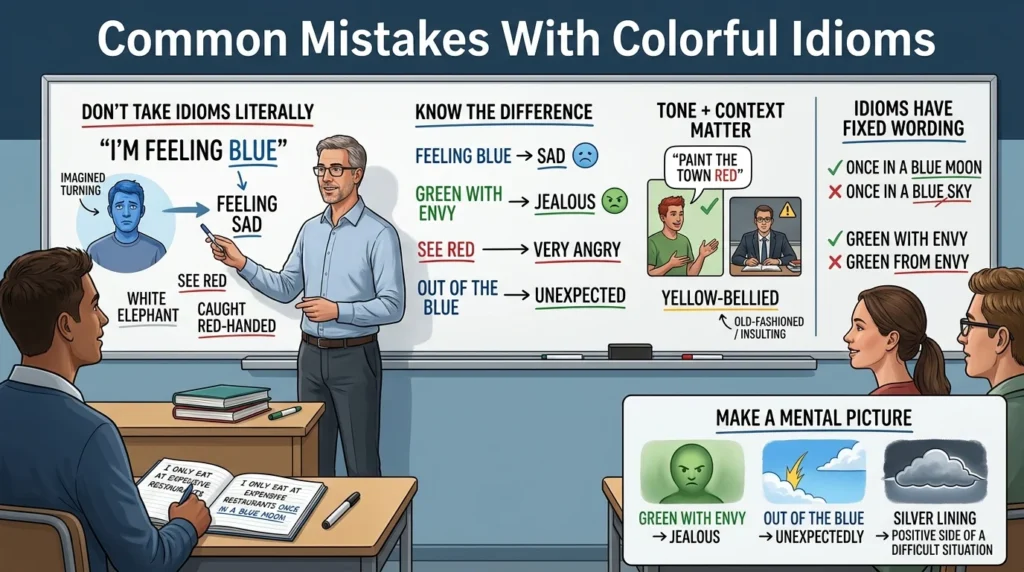
Changing Fixed Expressions
Idioms usually have established wording.
Correct:
Once in a blue moon
Not:
Once in a blue sky.
Correct:
Green with envy
Not:
Green from envy.
Learning the complete phrase helps you avoid these mistakes.
How to Remember Colorful Idioms
The easiest method is to connect an idiom with a mental picture.
Imagine someone turning green because they are jealous:
Green with envy = very jealous
Picture an unexpected phone call appearing from a clear blue sky:
Out of the blue = unexpectedly
Imagine a dark cloud with a bright edge:
Silver lining = something positive in a difficult situation
You can also create your own sentences. For example:
“I only eat at expensive restaurants once in a blue moon.”
Personal examples are often easier to remember than dictionary definitions.
Are Colorful Idioms Useful for English Learners?
Yes. They can help learners understand conversations, movies, books, social media, and everyday English more naturally.
The important thing is to learn meaning + context + tone, rather than memorizing isolated definitions.
For example:
Golden opportunity is useful when discussing a valuable chance.
Red tape is useful when talking about frustrating bureaucracy.
Gray area is useful when discussing uncertainty.
This approach helps you recognize idioms when reading and use them appropriately when speaking or writing.
Goofy Idioms: 30+ Unusual Phrases and What They Mean
Frequently Asked Questions About Colorful Idioms
What are colorful idioms?
Colorful idioms are fixed expressions that contain color words but have figurative meanings. Examples include green with envy, feeling blue, and out of the blue.
What are some common colorful idioms?
Common examples include once in a blue moon, white lie, green with envy, caught red-handed, see red, silver lining, golden opportunity, and out of the blue.
Why do English idioms use colors?
Colors can carry cultural and emotional associations, making them memorable ways to express ideas such as jealousy, sadness, anger, value, uncertainty, or surprise. However, these associations vary, so idioms should be learned as complete expressions.
Are colorful idioms formal or informal?
It depends on the expression. Gray area and red tape can be used in relatively formal contexts, while paint the town red and tickled pink are generally more informal.
How can I learn colorful idioms easily?
Start with five idioms, learn their meanings and tones, and write your own example sentences. Grouping them by color or meaning can also make them easier to remember.
Conclusion
Colorful idioms make English more expressive because a few simple words can communicate an entire idea, emotion, or situation. From green with envy and feeling blue to a silver lining and out of the blue, these expressions add personality to everyday communication.
You do not need to memorize all at once. Pick five, learn when they are appropriate, write your own examples, and try using them in real conversations or writing. Once those expressions become natural, add a few more—and your English vocabulary will become noticeably more colorful.

Clara Bennett writes for Meaning Match about English idioms, everyday expressions, meanings, and practical language usage, making phrases easy to understand.