
Ever wondered why “raining cats and dogs” has nothing to do with cats or dogs falling from the sky? Idioms with pictures and examples make these unusual English expressions easier to understand by connecting their strange literal images with their real figurative meanings.
Common phrases such as “break the ice,” “spill the beans,” “a piece of cake,” and “raining cats and dogs” can be confusing when you take the words literally. A picture helps you visualize the expression, while a clear example sentence shows how people actually use it in context. This makes idioms easier to understand, remember, and use naturally.
Whether you’re an English learner, student, teacher, or vocabulary enthusiast, visual examples can make learning these phrases more engaging. If you’re looking for idioms with pictures and examples, this guide brings together their meanings, visual explanations, and natural sentences in one easy-to-follow place.
What Are Idioms?
An idiom is a fixed expression whose overall meaning is different from the literal meaning of its individual words.
For example, “piece of cake” literally refers to a portion of cake, but its idiomatic meaning is something very easy.
Pictures are especially useful because they help learners make a connection between the words and the idea behind the expression.
Literal vs. Figurative Meaning
| Idiom | Literal picture | Figurative meaning |
|---|---|---|
| Break the ice | Breaking frozen ice | Make people comfortable |
| Spill the beans | Beans falling out | Reveal a secret |
| Piece of cake | A slice of cake | Something very easy |
| Get cold feet | Cold feet | Become nervous |
| Go the extra mile | Going beyond a mile | Make extra effort |
Remember: the picture shows the literal idea, but the context tells you the real meaning.
Idioms With Pictures and Examples at a Glance
| Idiom | Meaning | Example |
|---|---|---|
| Break the ice | Start a friendly conversation | I told a joke to break the ice. |
| Piece of cake | Very easy | The test was a piece of cake. |
| Spill the beans | Reveal a secret | Who spilled the beans? |
| Hit the nail on the head | Be exactly right | You hit the nail on the head. |
| Let the cat out of the bag | Reveal a secret | She let the cat out of the bag. |
| Once in a blue moon | Very rarely | We eat there once in a blue moon. |
| Under the weather | Feel unwell | I’m under the weather today. |
| Cost an arm and a leg | Be very expensive | The car cost an arm and a leg. |
| Bite the bullet | Face something difficult | I’ll bite the bullet and apologize. |
| A blessing in disguise | An unexpected benefit | Losing that job was a blessing in disguise. |
| Burn the midnight oil | Work late | She burned the midnight oil studying. |
| Call it a day | Stop working | Let’s call it a day. |
| Get cold feet | Become nervous | He got cold feet before the speech. |
| On the same page | Have the same understanding | Let’s make sure we’re on the same page. |
| Pull someone’s leg | Joke or tease | I’m just pulling your leg. |
| Go the extra mile | Make extra effort | She went the extra mile to help me. |
| Actions speak louder than words | Actions show more than promises | His actions speak louder than words. |
| The ball is in your court | It is your turn to act | I’ve made my offer; the ball is in your court. |
| See eye to eye | Agree | We don’t always see eye to eye. |
| When pigs fly | Almost never | He’ll clean his room when pigs fly. |
Break the Ice
Picture: Two people meet awkwardly with a block of ice between them. As they start talking and laughing, the ice cracks and melts.
Word-by-word meaning: Break = smash or separate; ice = frozen water.
Idiomatic meaning: To break the ice means to make people feel more relaxed and start a friendly interaction.
Example sentences:
- I told a funny story to break the ice.
- The teacher used a game to break the ice on the first day.
Common mistake: It does not simply mean starting any activity. It usually involves making a social situation more comfortable.
Usage note: Common in casual conversation, classrooms, meetings, and introductions.
Piece of Cake
Picture: A student finishes a difficult-looking task easily while a slice of cake sits beside a large check mark.
Word-by-word meaning: Piece = portion; cake = a sweet baked food.
Idiomatic meaning: Piece of cake means something is very easy.
Example sentences:
- The homework was a piece of cake.
- Don’t worry; this assignment will be a piece of cake.
Common mistake: It describes ease, not simply something enjoyable.
Usage note: Informal and common in everyday conversation.
Spill the Beans
Picture: A container tips over and beans spill onto a table while someone reveals a secret to surprised friends.
Word-by-word meaning: Spill = accidentally pour out; beans = edible seeds.
Idiomatic meaning: Spill the beans means to reveal secret or private information.
Example sentences:
- Who spilled the beans about the surprise?
- She accidentally spilled the beans about the party.
Common mistake: It is not normally used for sharing ordinary information.
Usage note: Informal and often suggests that something was supposed to remain secret.
Hit the Nail on the Head
Picture: One scene shows someone accurately hitting a nail; another shows a person giving the exact answer to a problem.
Word-by-word meaning: Hit = strike; nail = metal fastener; head = top part of the nail.
Idiomatic meaning: To hit the nail on the head means to identify or describe something exactly correctly.
Example sentences:
- You hit the nail on the head with that explanation.
- She hit the nail on the head when she identified the main problem.
Common mistake: It does not simply describe hammering a nail.
Usage note: Useful when agreeing with an accurate observation or answer.
Let the Cat Out of the Bag
Picture: A cat jumps out of a bag while a group of friends reacts to a secret being revealed.
Word-by-word meaning: Let = allow; cat = animal; out = outside; bag = container.
Idiomatic meaning: To let the cat out of the bag means to reveal a secret, often accidentally.
Example sentences:
- Tom let the cat out of the bag about the gift.
- I wasn’t supposed to tell her, but I let the cat out of the bag.
Common mistake: Don’t use it for simply giving someone information.
Usage note: Informal and similar in meaning to spill the beans.
Once in a Blue Moon
Picture: A rare blue moon appears over a quiet town, with a calendar showing only one highlighted occasion.
Word-by-word meaning: Once = one time; blue = a color; moon = Earth’s natural satellite.
Idiomatic meaning: Once in a blue moon means something happens very rarely.
Example sentences:
- I eat fast food once in a blue moon.
- We visit that restaurant only once in a blue moon.
Common mistake: It does not mean something happens regularly.
Usage note: Use it for unusual or infrequent events.
Under the Weather
Picture: A tired person stands beneath a rain cloud while the image explains that the person feels unwell.
Word-by-word meaning: Under = below; weather = atmospheric conditions.
Idiomatic meaning: Under the weather means feeling ill or unwell.
Example sentences:
- I’m feeling under the weather today.
- Sarah stayed home because she was under the weather.
Common mistake: It does not mean you are simply outside in bad weather.
Usage note: Usually informal and often refers to feeling mildly sick.
Cost an Arm and a Leg
Picture: A shopper looks shocked at an enormous price tag while cartoon arms and legs humorously represent the cost.
Word-by-word meaning: Cost = require payment; arm and leg = parts of the body.
Idiomatic meaning: Cost an arm and a leg means to be extremely expensive.
Example sentences:
- That phone cost an arm and a leg.
- The repairs cost us an arm and a leg.
Common mistake: Use it for something extremely expensive, not merely something slightly costly.
Usage note: Informal and often used humorously.
Bite the Bullet
Picture: A nervous person faces a difficult task while a visual bullet represents accepting the challenge.
Word-by-word meaning: Bite = use your teeth; bullet = projectile.
Idiomatic meaning: Bite the bullet means to face something difficult or unpleasant with courage.
Example sentences:
- I don’t like public speaking, but I’ll bite the bullet.
- She decided to bite the bullet and apologize.
Common mistake: It does not mean literally biting a bullet.
Usage note: Use it when someone accepts that a difficult situation must be dealt with.
A Blessing in Disguise
Picture: A person initially disappointed by an event later discovers that it led to a positive result.
Word-by-word meaning: Blessing = something beneficial; disguise = something that hides its true appearance.
Idiomatic meaning: A blessing in disguise is something that initially seems bad but later produces an unexpected benefit.
Example sentences:
- Missing the flight was a blessing in disguise.
- Losing that job turned out to be a blessing in disguise.
Common mistake: The expression needs an unexpected positive outcome.
Usage note: Often used when looking back at an unfortunate event from a different perspective.
Colorful Idioms: 30+ Lively Phrases and What They Mean
Burn the Midnight Oil
Picture: A student studies late at night beneath a desk lamp with books and a clock showing midnight.
Word-by-word meaning: Burn = use by fire; midnight = twelve at night; oil = liquid fuel.
Idiomatic meaning: Burn the midnight oil means to work or study late into the night.
Example sentences:
- I had to burn the midnight oil to finish my project.
- The students burned the midnight oil before their exams.
Common mistake: It specifically emphasizes working late, not merely staying awake.
Usage note: Common when discussing studying, deadlines, and late-night work.
Call It a Day
Picture: An office worker closes a laptop, checks the clock, and leaves after finishing the day’s work.
Word-by-word meaning: Call = name or declare; day = period of time.
Idiomatic meaning: Call it a day means to stop working for the day.
Example sentences:
- We’ve finished the important tasks, so let’s call it a day.
- I’m tired. I think I’ll call it a day.
Common mistake: It does not mean literally naming a day.
Usage note: Very common in informal workplace and everyday conversations.
Get Cold Feet
Picture: A nervous speaker has cartoonishly cold feet before walking onto a stage.
Word-by-word meaning: Get = become; cold = low in temperature; feet = body parts used for walking.
Idiomatic meaning: To get cold feet means to become nervous or afraid before doing something planned.
Example sentences:
- He got cold feet before his first performance.
- She almost entered the competition but got cold feet.
Common mistake: Don’t use it when someone’s feet are literally cold.
Usage note: Common before an important decision, event, or commitment.
On the Same Page
Picture: Two coworkers look at the same document with matching check marks, showing shared understanding.
Word-by-word meaning: On = positioned on; same = identical; page = sheet in a book or document.
Idiomatic meaning: To be on the same page means to have the same understanding, expectations, or goals.
Example sentences:
- Let’s make sure we’re on the same page.
- The team met to get everyone on the same page.
Common mistake: It does not have to involve a physical book or page.
Usage note: Especially common in teamwork, business, school, and planning.
Pull Someone’s Leg
Picture: Two friends laugh as one playfully pretends to pull the other’s leg.
Word-by-word meaning: Pull = tug; someone’s = belonging to a person; leg = body part.
Idiomatic meaning: To pull someone’s leg means to joke with or tease someone by making them believe something untrue.
Example sentences:
- Don’t worry—I’m just pulling your leg.
- I thought he was serious, but he was pulling my leg.
Common mistake: It normally refers to playful teasing, not physical pulling.
Usage note: Informal and usually friendly.
Go the Extra Mile
Picture: A runner continues beyond a finish line while another person makes extra effort to help someone.
Word-by-word meaning: Go = move; extra = additional; mile = unit of distance.
Idiomatic meaning: Go the extra mile means to make more effort than expected.
Example sentences:
- Our teacher always goes the extra mile to help students.
- She went the extra mile to make the event successful.
Common mistake: The important idea is extra effort, not physical distance.
Usage note: Useful for work, education, relationships, and customer service.
Actions Speak Louder Than Words
Picture: One person makes promises while another demonstrates care through helpful actions.
Word-by-word meaning: Actions = things people do; speak = communicate; louder = more strongly; words = language.
Idiomatic meaning: Actions speak louder than words means behavior can communicate intentions or feelings more strongly than promises.
Example sentences:
- He says he cares, but actions speak louder than words.
- She helped without making promises. Actions speak louder than words.
Common mistake: It does not mean words have no value.
Usage note: Useful when comparing what someone says with what they actually do.
The Ball Is in Your Court
Picture: Two tennis players stand on opposite sides of a court, with the ball clearly on one player’s side.
Word-by-word meaning: Ball = object used in sports; court = playing area.
Idiomatic meaning: The ball is in your court means it is now your responsibility to take the next step or make a decision.
Example sentences:
- I’ve sent the information, so the ball is in your court.
- We made our offer; the ball is in their court.
Common mistake: Use it when someone genuinely has the next decision or action.
Usage note: Common in discussions about plans, negotiations, decisions, and responsibilities.
See Eye to Eye
Picture: Two people discuss an issue face-to-face with matching opinions shown in their speech bubbles.
Word-by-word meaning: See = look; eye = organ used for seeing.
Idiomatic meaning: To see eye to eye means to agree with someone about an issue.
Example sentences:
- My brother and I don’t always see eye to eye.
- The managers finally saw eye to eye on the plan.
Common mistake: It does not simply mean looking directly at someone.
Usage note: Common when discussing opinions, disagreements, or decisions.
When Pigs Fly
Picture: A cartoon pig flies through the sky while someone reacts with disbelief.
Word-by-word meaning: When = at the time that; pigs = farm animals; fly = move through the air.
Idiomatic meaning: When pigs fly means something is extremely unlikely or almost impossible.
Example sentences:
- He’ll clean his room when pigs fly.
- “Will you lend me your car?” “Sure—when pigs fly!”
Common mistake: It is stronger than simply saying something is unlikely.
Usage note: Usually humorous or sarcastic, so consider the situation and your relationship with the listener.
How Pictures Help You Learn Idioms
A good picture does more than decorate an article. It gives you a memorable visual connection between the literal words and the figurative meaning.
For example, imagine “get cold feet” literally: someone standing with freezing feet. Then connect that picture to the actual meaning—becoming nervous before doing something.
Try this five-step method:
Look → Understand → Read → Create → Use
- Look at the idiom’s picture.
- Understand its figurative meaning.
- Read a natural example sentence.
- Create your own sentence.
- Use the idiom in a real conversation or piece of writing.
This is more effective than memorizing a long list of definitions without context.
Common Mistakes When Using Idioms
Don’t Take Idioms Literally
If someone says “Let’s break the ice,” they probably want to make a conversation more comfortable—not destroy a block of ice.
Don’t Treat Similar Idioms as Exact Synonyms
Some expressions share a general idea but are used differently.
- Spill the beans → reveal a secret
- Let the cat out of the bag → reveal a secret, often accidentally
- Pull someone’s leg → joke or tease
- When pigs fly → suggest something is extremely unlikely
Understanding these small differences makes your English sound more natural.
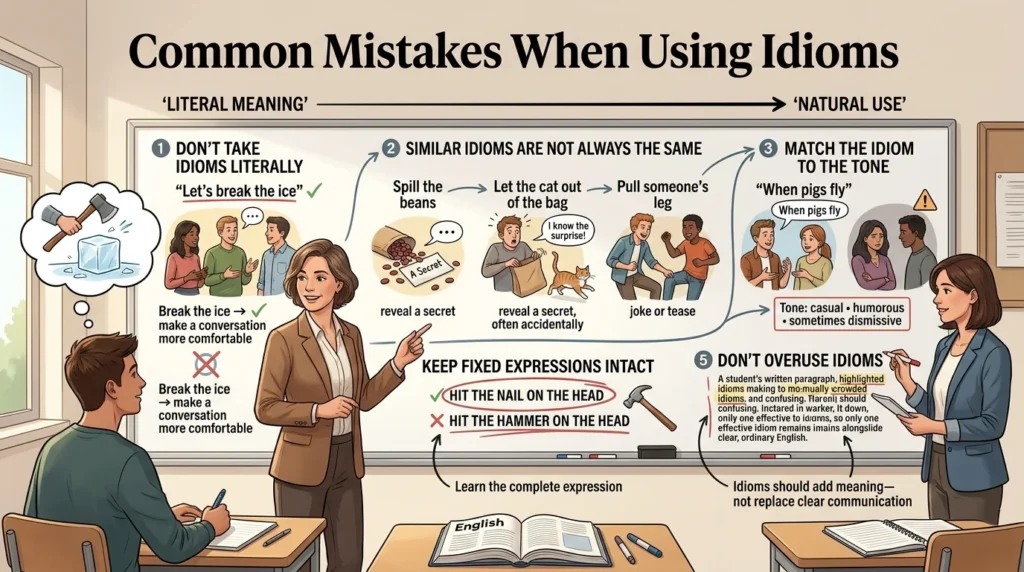
Match the Idiom to the Tone
Some idioms are casual, humorous, or sarcastic. “When pigs fly,” for example, may sound dismissive in a serious conversation.
Don’t Change Fixed Expressions
Idioms are generally fixed phrases.
Correct: hit the nail on the head
Incorrect: hit the hammer on the head
Learn the complete expression rather than changing individual words.
Don’t Overuse Idioms
Using an idiom in every sentence can make your writing sound unnatural. Choose an expression when it adds meaning, personality, or clarity.
Soft Idioms: 32+ Gentle Expressions and Their Meanings
How to Use English Idioms Naturally
You don’t need to memorize all 20 idioms at once. Choose five, learn their meanings, and write sentences about situations from your own life.
For example:
Idiom: Go the extra mile
Meaning: Make additional effort
Example: “My teacher went the extra mile to help me understand the lesson.”
Your sentence: “I went the extra mile to finish my project before the deadline.”
Also consider your audience. An idiom that sounds natural with friends may be too casual for a formal academic paper.
The goal isn’t to use more idioms. The goal is to use the right idiom in the right context.
Frequently Asked Questions
What are idioms with pictures and examples?
Idioms with pictures and examples are common English expressions explained through visual illustrations, figurative meanings, and real example sentences. The picture helps learners remember the expression, while the example shows how it works in context.
What are some common idioms with pictures and examples?
Some common examples include break the ice, piece of cake, spill the beans, get cold feet, under the weather, and go the extra mile. Each has a figurative meaning that differs from its literal words.
Why are pictures helpful for learning idioms?
Pictures create a visual association that can make unfamiliar expressions easier to remember. They are particularly useful when learners need to understand the difference between a literal image and a figurative meaning.
How can I remember English idioms easily?
Learn a small group at a time. Look at the picture, understand the figurative meaning, read an example, and then create your own sentence. Using the idiom in real communication can reinforce what you learned.
Can I use idioms in formal writing?
Some idioms can work in semi-formal writing, but many are conversational. In academic or highly formal writing, choose expressions carefully and make sure they suit your audience and purpose.
Conclusion
Learning idioms with pictures and examples is a practical way to understand figurative English without memorizing definitions in isolation. When you connect a visual image with the meaning, example, tone, and correct usage, each expression becomes easier to recognize and use.
Start with five idioms today. Look at their pictures, write your own examples, and use at least one in a real conversation. With regular practice, expressions such as break the ice, spill the beans, piece of cake, and go the extra mile can become a natural part of your English vocabulary.

Clara Bennett writes for Meaning Match about English idioms, everyday expressions, meanings, and practical language usage, making phrases easy to understand.