
Sometimes the way you say something matters just as much as what you say. Soft idioms are a useful way to describe gentle, calm, or less forceful expressions that can make English sound more relaxed and considerate.
Phrases such as “take it easy,” “keep your cool,” “go easy on someone,” and “give someone a break” can express relaxation, patience, self-control, or understanding, but they are not interchangeable. For example, “take it easy” can mean to relax or avoid doing too much, while “go easy on someone” suggests treating them less harshly.
The term “soft idioms” is descriptive rather than a formal linguistic category, so the expressions can vary in meaning and tone. If you’re searching for soft idioms for writing, conversations, captions, schoolwork, or English practice, this guide explains their meanings, contexts, and natural uses with clear examples.
What Are Soft Idioms?
The term “soft idioms” is not a formal linguistic category. It is a useful descriptive phrase for idiomatic expressions that can sound gentle, encouraging, positive, tactful, or less direct depending on the context.
For example:
“She’s going through a rough patch.”
Instead of directly saying:
“She’s having a difficult time.”
The idiom adds a softer, more conversational quality to the statement.
Soft or gentle expressions are particularly useful when talking about:
- Difficult periods
- Mild illness
- Feelings and emotions
- Personal problems
- Encouragement
- Past disagreements
- Sensitive situations
- Everyday conversations
However, an idiom is not automatically “soft” simply because it sounds friendly. Tone, context, and the speaker’s intention all matter.
Common Soft Idioms and Gentle Expressions
Under the Weather
Literal image:
Being “under the weather” suggests being affected by unpleasant weather.
Idiomatic meaning:
Feeling slightly sick, tired, or unwell.
Examples:
- “I’m feeling a little under the weather today.”
- “She stayed home because she was under the weather.”
Common error:
Don’t use it when you need to describe a serious medical condition precisely.
Usage note:
This is a casual expression for feeling generally unwell.
In conversation:
“Are you coming to dinner?”
“Probably not. I’m a little under the weather.”
Go Through a Rough Patch
Literal image:
A rough patch is an uneven or difficult section of a surface.
Idiomatic meaning:
To experience a difficult period in life, work, or a relationship.
Examples:
- “We’ve been going through a rough patch.”
- “He had a rough patch at work, but things are improving.”
Common error:
Don’t assume a rough patch means a permanent problem.
Usage note:
It is useful when describing temporary difficulties without making them sound hopeless.
Take It Easy
Literal image:
Doing something “easy” suggests avoiding unnecessary effort or pressure.
Idiomatic meaning:
Relax, slow down, or avoid overexerting yourself.
Examples:
- “You’ve been working all day. Take it easy tonight.”
- “The doctor told him to take it easy for a few days.”
Common error:
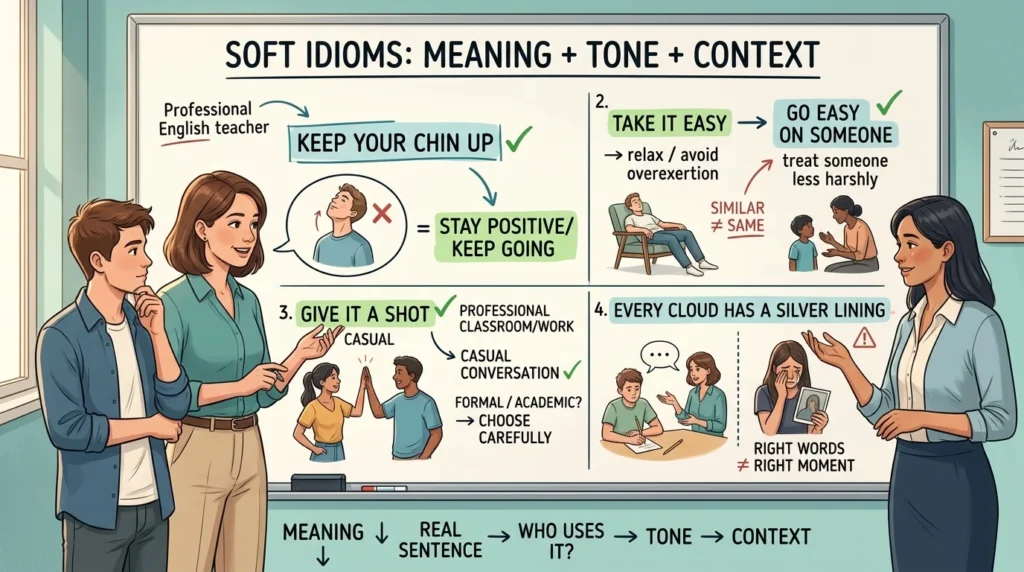
Take it easy can mean “relax,” while go easy on someone means “treat someone less harshly.”
Usage note:
It is informal and common in everyday conversation.
A Breath of Fresh Air
Literal image:
A breath of fresh air feels refreshing and pleasant.
Idiomatic meaning:
Someone or something that feels pleasantly new, refreshing, or different.
Examples:
- “Her positive attitude was a breath of fresh air.”
- “The new teacher is a breath of fresh air.”
Common error:
Don’t use it only for literal outdoor air when the figurative meaning is intended.
Usage note:
This is generally positive and works well for people, ideas, experiences, and changes.
Keep Your Chin Up
Literal image:
The expression pictures someone physically holding their chin high.
Idiomatic meaning:
Stay hopeful and positive during a difficult situation.
Examples:
- “Keep your chin up. You’re almost there.”
- “Her friends told her to keep her chin up after the setback.”
Common error:
It is not normally a literal instruction about your face.
Usage note:
This is a supportive, informal expression. It works especially well with friends and family.
On the Bright Side
Literal image:
A “bright side” represents something positive.
Idiomatic meaning:
To focus on a positive aspect of a disappointing or difficult situation.
Examples:
- “We missed the bus, but on the bright side, we got some exercise.”
- “On the bright side, the mistake helped us find the problem.”
Common error:
Don’t use it to dismiss someone’s serious feelings.
Usage note:
Acknowledge the difficulty first when someone is genuinely upset.
In Good Spirits
Literal image:
“Spirits” can refer to someone’s emotional state or mood.
Idiomatic meaning:
Feeling cheerful, positive, or reasonably happy.
Examples:
- “Despite the delay, everyone remained in good spirits.”
- “She was in good spirits after hearing the news.”
Common error:
In this expression, spirits refers to mood, not necessarily alcoholic drinks.
Usage note:
It can describe someone’s mood during a particular situation.
See the Light at the End of the Tunnel
Literal image:
A person inside a tunnel may eventually see light near its exit.
Idiomatic meaning:
To begin seeing signs that a difficult situation is approaching its end.
Examples:
- “After months of studying, I can finally see the light at the end of the tunnel.”
- “The project is almost finished, so we can see the light at the end of the tunnel.”
Common error:
Don’t use this expression when there is no difficult period being discussed.
Usage note:
It commonly communicates hope after a prolonged challenge.
Go With the Flow
Literal image:
Water naturally moves with its current.
Idiomatic meaning:
Accept circumstances and adapt instead of trying to control every detail.
Examples:
- “We don’t have a strict plan, so let’s go with the flow.”
- “She likes to go with the flow when traveling.”
Common error:
It doesn’t necessarily mean being careless or irresponsible.
Usage note:
This is casual and works well when talking about flexibility.
Every Cloud Has a Silver Lining
Literal image:
A cloud can appear to have a bright silver edge when light shines behind it.
Idiomatic meaning:
Even a difficult situation may contain something positive.
Examples:
- “Losing that opportunity was disappointing, but every cloud has a silver lining.”
- “The delay gave us more time to prepare—a silver lining after all.”
Common error:
Don’t use the expression to suggest that someone’s serious problem is unimportant.
Usage note:
It is best used when there is genuinely a positive aspect worth recognizing.
Give It a Shot
Literal image:
A “shot” can mean an attempt.
Idiomatic meaning:
Try something.
Examples:
- “I’ve never tried painting, but I’ll give it a shot.”
- “Why not give the new recipe a shot?”
Common error:
Don’t confuse this figurative use with the other meanings of shot, such as a medical injection.
Usage note:
This is casual and encouraging.
Mini-dialogue:
“I’m not sure I can do it.”
“Just give it a shot!”
Hang in There
Literal image:
The phrase suggests staying attached or holding on.
Idiomatic meaning:
Keep going and don’t give up during a difficult time.
Examples:
- “Hang in there. You’re almost finished.”
- “I know the course is difficult, but hang in there.”
Common error:
Don’t confuse it with a literal instruction to hang from something.
Usage note:
This is informal and commonly used to encourage someone.
Have a Heart of Gold
Literal image:
Gold symbolizes something valuable, while the heart represents kindness and emotion.
Idiomatic meaning:
To be extremely kind, generous, or caring.
Examples:
- “My grandmother has a heart of gold.”
- “He may seem quiet, but he has a heart of gold.”
Common error:
It describes someone’s character, not their physical heart.
Usage note:
This is a warm compliment and is generally positive.
Put Your Best Foot Forward
Literal image:
The expression imagines deliberately placing your best foot ahead.
Idiomatic meaning:
Make a good impression or present your best qualities.
Examples:
- “Put your best foot forward during the interview.”
- “She put her best foot forward on her first day at work.”
Common error:
The expression doesn’t literally mean that one foot is better than the other.
Usage note:
It is especially useful when discussing interviews, introductions, applications, or new opportunities.
Break the Ice
Literal image:
Breaking ice literally means cracking frozen water.
Idiomatic meaning:
To make people feel more comfortable when they first meet or when a social situation feels awkward.
Examples:
- “The teacher told a joke to break the ice.”
- “We played a quick game to break the ice.”
Common error:
Don’t use it for every conversation. The expression usually involves initial awkwardness, unfamiliarity, or social tension.
Usage note:
It is common in classrooms, workplaces, meetings, parties, and networking situations.
Have a Change of Heart
Literal image:
The phrase imagines the heart changing.
Idiomatic meaning:
To change your feelings, opinion, or decision about something.
Examples:
- “I was going to cancel, but I had a change of heart.”
- “She had a change of heart and decided to join us.”
Common error:
Don’t confuse it with a physical or medical meaning.
Usage note:
It often describes a meaningful change in someone’s attitude or decision.
Go Easy on Someone
Literal image:
“Go easy” suggests using less force or severity.
Idiomatic meaning:
Treat someone less harshly, severely, or critically.
Examples:
- “Go easy on him; it’s his first day.”
- “The teacher went easy on the students because the test was unusually difficult.”
Common error:
The correct construction is “go easy on someone,” not “go easy someone.”
Usage note:
This expression can apply to criticism, punishment, pressure, or expectations.
A Little Rough Around the Edges
Literal image:
Something rough around the edges has an unfinished or uneven surface.
Idiomatic meaning:
Someone or something has imperfections but may still have good qualities.
Examples:
- “The new employee is a little rough around the edges, but she’s hardworking.”
- “The presentation was rough around the edges but had some great ideas.”
Common error:
It does not necessarily mean someone or something is bad.
Usage note:
This expression can soften criticism by recognizing positive qualities as well.
Keep Something Under Your Hat
Literal image:
Something under your hat is hidden from view.
Idiomatic meaning:
Keep information secret or private.
Examples:
- “Keep this under your hat until we’re ready to announce it.”
- “I’ll tell you the plan, but keep it under your hat.”
Common error:
Don’t use it for information that is already widely known.
Usage note:
This is informal and often has a playful tone.
Water Under the Bridge
Literal image:
Water that has passed under a bridge cannot be brought back.
Idiomatic meaning:
A past disagreement, mistake, or problem that no longer needs to affect the present.
Examples:
- “We had an argument last year, but it’s water under the bridge now.”
- “I made a mistake, but it’s water under the bridge.”
Common error:
Don’t use it when the problem is still unresolved or actively causing conflict.
Usage note:
It often expresses acceptance, forgiveness, or a desire to move forward.
Mini-dialogue:
“Are you still upset about our argument?”
“No. It’s water under the bridge.”
How to Use Soft Idioms Naturally
Knowing an idiom’s definition is not enough. You also need to understand tone, context, audience, and intensity.
1. Match the Idiom to the Situation
Some expressions are strongly casual:
“Give it a shot.”
Others can sound more reflective:
“Every cloud has a silver lining.”
Think about the situation before choosing an expression.
2. Consider Your Relationship With the Listener
An informal idiom may work naturally with:
- Friends
- Family
- Classmates
- Close coworkers
A more formal workplace message, academic paper, or professional report may call for direct language instead.
3. Don’t Use a Gentle Expression to Minimize Serious Problems
Soft language should not make someone’s experience sound unimportant.
For example, telling someone facing a major personal crisis to “look on the bright side” immediately may sound dismissive.
A more empathetic approach is to acknowledge their feelings first.
4. Match the Strength of the Expression
Not every problem needs dramatic language.
For a mild difficulty:
“I’m going through a rough patch.”
For encouragement:
“Keep your chin up.”
For a past disagreement that has been resolved:
“It’s water under the bridge.”
The best idiom is the one that accurately matches the situation.
5. Don’t Force Idioms Into Every Sentence
Natural English does not require an idiom in every sentence. One well-chosen expression usually sounds better than several expressions packed together.
Goofy Idioms: 30+ Unusual Phrases and What They Mean
Soft Idioms vs. Direct Expressions
A soft idiom often communicates the same basic idea as a direct expression but adds imagery, tone, or emotional nuance.
| Soft idiom | Direct expression |
|---|---|
| Under the weather | Feeling slightly ill |
| Rough patch | Difficult period |
| Keep your chin up | Stay hopeful |
| Give it a shot | Try it |
| Hang in there | Don’t give up |
| Heart of gold | Very kind |
| Water under the bridge | A past issue |
| Go with the flow | Adapt to circumstances |
The direct expression is often clearer and more precise, while the idiom can sound more conversational and expressive.
Soft Idioms vs. Euphemisms
Soft idioms and euphemisms can overlap, but they are not the same thing.
A soft idiom is a figurative expression that may sound gentle or indirect.
A euphemism is a milder expression used instead of a more direct, unpleasant, or sensitive term.
For example:
- Soft idiom: “She’s going through a rough patch.”
- Euphemism: “He passed away.”
“Passed away” softens a sensitive subject, but it is not an idiom in the same way as “rough patch.”
Understanding this difference helps you choose the right expression for the situation.
Common Mistakes When Using Soft Idioms
Taking Idioms Literally
If someone says:
“Keep your chin up.”
They are normally offering encouragement, not giving instructions about your face.
Confusing Similar Expressions
Take it easy usually means relax or avoid overexertion.
Go easy on someone means treat that person less harshly.
They are related, but their grammatical structures and meanings differ.
Ignoring Tone and Formality
“Give it a shot” sounds natural in casual conversation but may be too informal for some professional or academic contexts.
Using an Idiom at the Wrong Emotional Moment
An expression can be gentle in one situation but insensitive in another.
For example, “Every cloud has a silver lining” may be encouraging after a small disappointment but inappropriate if someone is dealing with a serious loss.
Using an Idiom Without Understanding Its Context
Learning the definition is only half the job. Learn how the expression behaves in a real sentence, who normally uses it, and what emotional tone it carries.
Quick Guide: Which Soft Idiom Should You Use?
| Situation | Useful expression |
|---|---|
| You feel slightly sick | Under the weather |
| Someone is having a difficult period | Going through a rough patch |
| Someone needs to relax | Take it easy |
| You want to encourage someone | Keep your chin up |
| You want to focus on something positive | On the bright side |
| Someone needs encouragement to continue | Hang in there |
| You want to describe a kind person | Heart of gold |
| You want to encourage someone to try | Give it a shot |
| People feel awkward when meeting | Break the ice |
| An old disagreement no longer matters | Water under the bridge |
2 Word Idioms: Meanings, Examples & Everyday Uses
FAQs About Soft Idioms
What are soft idioms?
Soft idioms are gentle or indirect figurative expressions used to discuss feelings, difficulties, encouragement, and everyday situations without always sounding blunt. The term is descriptive rather than a formal linguistic category.
What are some examples of soft idioms?
Common examples include under the weather, rough patch, take it easy, keep your chin up, on the bright side, hang in there, heart of gold, and water under the bridge.
Are soft idioms always informal?
No. Many are conversational and informal, but the appropriate level of formality depends on the particular expression and context. In formal writing, a direct expression may sometimes be clearer.
Are soft idioms the same as euphemisms?
No. They can overlap, but a soft idiom is a figurative expression with a gentle or indirect effect, while a euphemism replaces a more direct expression with a milder one, often for sensitive subjects.
Can a soft idiom sound insensitive?
Yes. Context matters. Even a positive expression such as “look on the bright side” can sound dismissive if someone is experiencing serious emotional difficulty. Consider the person’s situation before using it.
Conclusion
Soft idioms can make everyday English sound more natural, expressive, supportive, and less blunt, but using them well requires more than memorizing definitions. You also need to understand their tone, context, level of formality, and emotional strength.
Start with two or three expressions that fit conversations you actually have. Practice them in your own sentences, pay attention to how native speakers use them, and gradually add more. The goal is not to use as many idioms as possible—it is to choose the right expression for the right situation.

Daniel Mercer is a Meaning Match writer covering English idioms, vocabulary, expressions, and language usage with clear meanings and practical examples.