
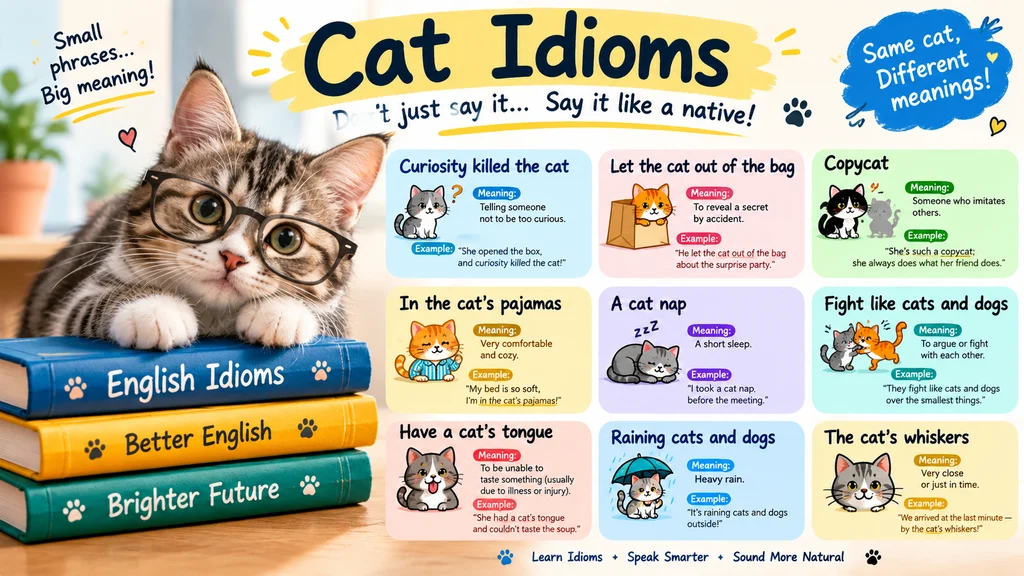
Have you ever heard someone say “let the cat out of the bag” and wondered why a cat was involved? English is full of expressions whose real meanings go beyond their literal words. Cat idioms are expressions that use the word cat to communicate an idea, feeling, or situation in a figurative way. For example, “let the cat out of the bag” means to reveal a secret, while “curiosity killed the cat” warns that being too curious can sometimes lead to trouble.
Learning cat idioms with meanings can help you understand everyday English, follow conversations more easily, and express your thoughts more naturally.
Whether you are an English learner, a student, a teacher, or a language enthusiast, this guide explores common cat idioms and related sayings in simple language. You’ll discover what each expression means, see practical example sentences, and learn how to use these phrases in the right context without confusing their literal and figurative meanings.
What Are Cat Idioms?
Cat idioms are figurative expressions that use cats, cat-related behavior, or familiar cat imagery to communicate ideas beyond their literal meanings. Some are traditional sayings, while others are informal expressions or compounds such as “copycat” and “cat nap.”
Learning these expressions helps you understand everyday conversations, recognize figurative language in books and movies, and make your English more natural. However, not every cat-related expression is technically an idiom, so the list below includes both idioms and commonly used expressions.
Popular Cat Idioms with Meanings
Curiosity Killed the Cat
Word-by-word meaning: Curiosity means a desire to know or discover something; killed means caused death.
Idiomatic meaning: Being excessively curious or taking unnecessary risks to discover something can lead to trouble.
Example sentences:
- Don’t open a suspicious email just to see what’s inside. Curiosity killed the cat!
- He kept investigating the private matter despite several warnings.
Common mistake: Don’t assume the expression means curiosity is always bad. Curiosity can encourage learning; the warning concerns potentially harmful or excessive curiosity.
Usage note: This familiar proverb is often used as a playful warning. A longer version sometimes adds, “but satisfaction brought it back.”

Let the Cat Out of the Bag
Word-by-word meaning: Let means allow, cat refers to the animal, and bag means a container.
Idiomatic meaning: To reveal a secret, often accidentally or before the intended time.
Example sentences:
- I accidentally let the cat out of the bag about her surprise birthday party.
- Please don’t let the cat out of the bag before we announce the engagement.
Common mistake: Don’t confuse revealing a secret with deliberately announcing information that everyone is already allowed to know.
Usage note: This is a widely understood expression in both American and British English. It works well for surprises, confidential plans, and unexpected revelations.
Cat Got Your Tongue?
Word-by-word meaning: The words refer to a cat supposedly having someone’s tongue.
Idiomatic meaning: A teasing question asked when someone is unusually quiet or unable to respond.
Example sentences:
- You’ve been quiet since the meeting started. Cat got your tongue?
- “Cat got your tongue?” Maya asked when her brother suddenly stopped talking.
Common mistake: It doesn’t literally refer to a cat taking someone’s tongue.
Usage note: This expression is informal and can sound impatient or mocking. Avoid using it when someone is upset, anxious, or genuinely struggling to speak.
When the Cat’s Away, the Mice Will Play
Word-by-word meaning: The cat is absent, leaving the mice free to move around.
Idiomatic meaning: People may ignore rules or behave differently when the person supervising them is away.
Example sentences:
- The children started playing video games when their parents left. When the cat’s away, the mice will play.
- The office became noticeably more relaxed while the strict manager was on vacation.
Common mistake: Don’t use it for every situation in which people have fun. It often implies that people are taking advantage of a lack of supervision.
Usage note: This traditional proverb works particularly well in humorous observations about schools, workplaces, and authority.
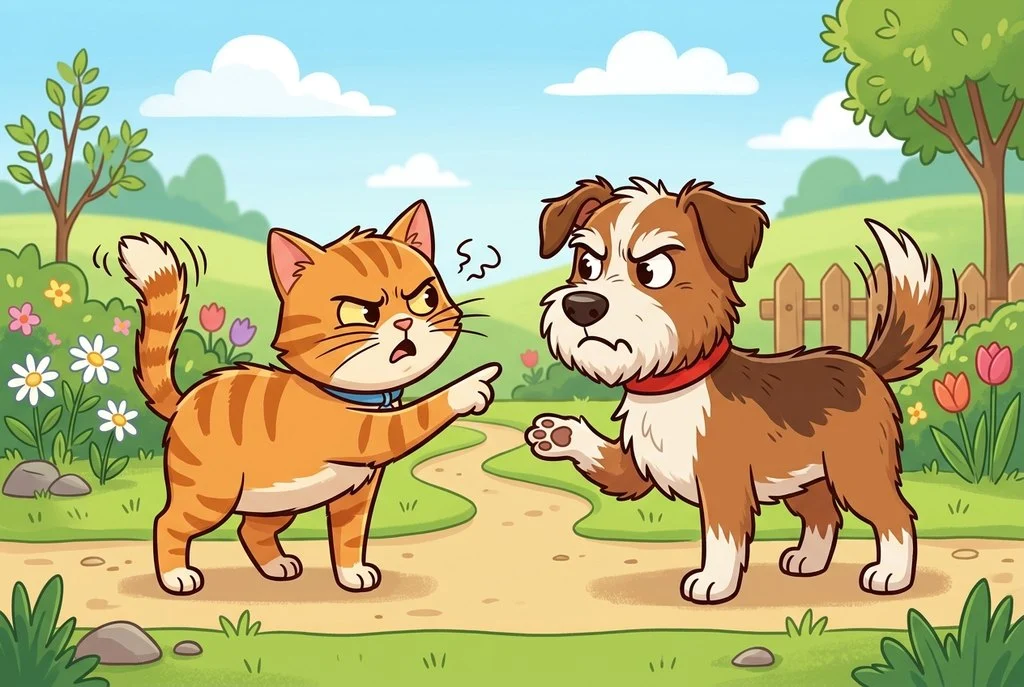
Fight Like Cats and Dogs
Word-by-word meaning: The expression compares people arguing with the stereotypical conflict between cats and dogs.
Idiomatic meaning: To argue or quarrel frequently and intensely.
Example sentences:
- My brothers fight like cats and dogs whenever they choose a movie.
- The two neighbors fight like cats and dogs over their shared driveway.
Common mistake: The idiom describes frequent conflict, not simply two people having one disagreement.
Usage note: It’s informal and commonly used to describe siblings, couples, friends, or colleagues who regularly clash.
Raining Cats and Dogs
Word-by-word meaning: The words describe cats and dogs supposedly falling from the sky.
Idiomatic meaning: Raining very heavily.
Example sentences:
- We stayed home because it was raining cats and dogs.
- Take an umbrella. It’s raining cats and dogs outside!
Common mistake: Don’t interpret the phrase literally or use it to describe light drizzle.
Usage note: This familiar, humorous expression is understood in both American and British English. “Pouring with rain” is another natural alternative, particularly in British English.
Look What the Cat Dragged In
Word-by-word meaning: The expression imagines a cat bringing something unexpected inside.
Idiomatic meaning: A humorous or insulting remark about someone who has just arrived, especially if they look untidy or appear unexpectedly.
Example sentences:
- Well, look what the cat dragged in! We haven’t seen you in weeks.
- “Look what the cat dragged in,” he joked when his friend arrived covered in mud.
Common mistake: Don’t assume it’s always a friendly greeting. The expression can criticize someone’s appearance or arrival.
Usage note: Use it with people who appreciate your humor. In professional or unfamiliar settings, a neutral greeting is safer.
Play Cat and Mouse
Word-by-word meaning: The expression refers to the relationship between a cat pursuing a mouse and the mouse trying to escape.
Idiomatic meaning: To repeatedly pursue, evade, trick, or outmaneuver someone.
Example sentences:
- The detective and the suspect played cat and mouse for weeks.
- The two companies played cat and mouse during the negotiations.
Common mistake: Don’t confuse this expression with “fight like cats and dogs.” Cat-and-mouse behavior involves pursuit and evasion rather than simply arguing.
Usage note: This idiom is useful in mysteries, investigations, competitions, and strategic situations.
Copycat
Word-by-word meaning: A compound word combining “copy” with “cat.”
Idiomatic meaning: A person who imitates another person’s behavior, style, ideas, or work.
Example sentences:
- My little brother is a copycat because he always imitates my dance moves.
- The designer accused a competitor of producing a copycat version of her product.
Common mistake: “Copycat” is normally a noun or adjective, not a standalone verb. Say “He’s a copycat” or “That’s a copycat design.”
Usage note: This expression is common in everyday English. It can be playful among friends or critical when originality matters.
Scaredy-Cat
Word-by-word meaning: “Scaredy” suggests being easily frightened, and “cat” completes the informal expression.
Idiomatic meaning: A person who gets frightened easily or avoids things because of fear.
Example sentences:
- Don’t be such a scaredy-cat! The harmless Halloween decorations won’t hurt you.
- I was a scaredy-cat about swimming until I learned how to float.
Common mistake: Don’t use this expression to dismiss a person’s genuine safety concerns or serious fears.
Usage note: It’s informal and often playful, particularly with children and friends. In sensitive situations, it can sound insulting.
Like Herding Cats
Word-by-word meaning: Herding means guiding a group, while cats are known for their independence.
Idiomatic meaning: Trying to organize people or things that are difficult to coordinate.
Example sentences:
- Getting eight busy volunteers to agree on a meeting time is like herding cats.
- Managing our group assignment felt like herding cats because everyone wanted to do something different.
Common mistake: The expression isn’t simply about gathering cats. It emphasizes the difficulty of coordination.
Usage note: Particularly useful when discussing teamwork, meetings, group projects, and complicated schedules. It’s common in informal workplace English.
Put the Cat Among the Pigeons
Word-by-word meaning: The image suggests a cat entering a group of pigeons and causing them to scatter.
Idiomatic meaning: To cause trouble, controversy, or a major disturbance by saying or doing something unexpected.
Example sentences:
- Her proposal to eliminate flexible working hours put the cat among the pigeons.
- He put the cat among the pigeons by challenging the team’s long-standing policy.
Common mistake: Don’t use it for every small disagreement. The expression suggests a noticeable disturbance.
Usage note: This expression is especially associated with British English. Depending on context, American speakers might say “stir up a hornet’s nest.”
Bell the Cat
Word-by-word meaning: To attach a bell to a cat so that its movements can be heard.
Idiomatic meaning: To undertake a risky task that would benefit everyone but that nobody wants to attempt.
Example sentences:
- Everyone complained about the unfair policy, but nobody wanted to challenge the director. Who would bell the cat?
- Someone needs to tell the team the uncomfortable truth, but who will bell the cat?
Common mistake: Don’t confuse “bell the cat” with “let the cat out of the bag.” One means undertake a risky responsibility; the other means reveal a secret.
Usage note: The expression is associated with a fable in which mice suggest attaching a bell to a cat but cannot find anyone willing to do it. It’s less common in everyday conversation than several expressions earlier in this list.
Fat Cat
Word-by-word meaning: Literally, a cat described as fat.
Idiomatic meaning: A wealthy or powerful person, often one perceived as enjoying excessive privilege or influence.
Example sentences:
- The article criticized corporate fat cats who benefited from the unfair deal.
- Protesters argued that political fat cats had too much influence.
Common mistake: The figurative expression usually concerns wealth or power, not a person’s physical appearance.
Usage note: It’s often critical and can sound politically charged. Use it carefully in professional writing.
Cool Cat
Word-by-word meaning: “Cool” means stylish, relaxed, or socially impressive in this expression.
Idiomatic meaning: A confident, fashionable, relaxed, or appealing person.
Example sentences:
- Everyone thought Nina was a cool cat because she stayed calm under pressure.
- He may look serious, but he’s a cool cat once you get to know him.
Common mistake: Don’t assume “cool” refers to temperature here.
Usage note: This is informal and can sound playful or old-fashioned. In modern conversation, “cool person” may sound more natural in some contexts.
Programming Idioms: 22+ Code Patterns Every Developer Should Know
Cat Nap
Word-by-word meaning: A cat nap is a short period of sleep.
Idiomatic meaning: A brief sleep taken to rest or regain energy.
Example sentences:
- I took a quick cat nap before finishing my assignment.
- She had a twenty-minute cat nap after lunch and felt refreshed.
Common mistake: A cat nap doesn’t have to happen at a particular time of day.
Usage note: This common expression is suitable for casual conversations about rest, tiredness, and busy schedules.
Grin Like a Cheshire Cat
Word-by-word meaning: To grin means to smile broadly. The Cheshire Cat is a fictional character known for its distinctive grin in Alice’s Adventures in Wonderland.
Idiomatic meaning: To smile very broadly, often because of happiness, satisfaction, or mischievous delight.
Example sentences:
- He was grinning like a Cheshire cat after receiving his exam results.
- She walked into the room grinning like a Cheshire cat because she’d won the competition.
Common mistake: The expression suggests an especially broad grin, not just an ordinary smile.
Usage note: It’s a colorful, playful expression. Use it when someone’s smile is particularly noticeable.
A Cat Has Nine Lives
Word-by-word meaning: The expression refers to the traditional belief that a cat has nine lives.
Idiomatic meaning: Someone repeatedly escapes danger or seems unusually lucky when facing risky situations.
Example sentences:
- That adventurous cat has nine lives; it has escaped several close calls.
- You have nine lives! That was an incredibly lucky escape.
Common mistake: Nine lives is a traditional saying, not a literal fact about cats.
Usage note: The phrase is often applied to people who repeatedly survive dangerous situations. Use it figuratively rather than as a factual claim.
All Cats Are Grey in the Dark
Word-by-word meaning: In darkness, cats of different colors may appear difficult to distinguish.
Idiomatic meaning: Differences that are noticeable under normal conditions can become less important or harder to recognize in certain circumstances.
Example sentences:
- In the dim light, the two fabrics looked almost identical. All cats are grey in the dark.
- The saying suggests that appearances can matter less when circumstances make differences difficult to see.
Common mistake: Don’t interpret the saying as claiming that everyone or everything is identical.
Usage note: This is a traditional saying that is less common in everyday conversation than “copycat” or “cat nap.” Explain its meaning if your audience may not recognize it.
Not Enough Room to Swing a Cat
Word-by-word meaning: The expression imagines having so little space that there isn’t enough room to swing a cat.
Idiomatic meaning: A place is extremely small or cramped.
Example sentences:
- Our hotel room was so tiny there wasn’t enough room to swing a cat.
- The kitchen looked stylish, but there wasn’t enough room to swing a cat.
Common mistake: The expression is figurative, not advice to swing or harm an animal.
Usage note: This expression is especially familiar in British English. In formal writing, “extremely cramped” or “very small” is often clearer.
Quick Comparison: Cat Idioms and Expressions
| Expression | Simple meaning | Typical context |
|---|---|---|
| Curiosity killed the cat | Risky curiosity can cause trouble | Warnings |
| Let the cat out of the bag | Reveal a secret | Surprises |
| Cat got your tongue? | Why are you silent? | Casual conversation |
| When the cat’s away, the mice will play | People misbehave without supervision | School or work |
| Fight like cats and dogs | Argue frequently | Relationships |
| Raining cats and dogs | Rain heavily | Weather |
| Look what the cat dragged in | Comment on someone’s arrival | Informal humor |
| Play cat and mouse | Pursue and evade | Strategy |
| Copycat | Someone who imitates | Behavior or creativity |
| Scaredy-cat | Easily frightened person | Fear |
| Like herding cats | Difficult to coordinate | Teamwork |
| Put the cat among the pigeons | Cause a disturbance | Controversy |
| Bell the cat | Take a risky responsibility | Difficult decisions |
| Fat cat | Wealthy or powerful person | Business or politics |
| Cool cat | Relaxed or stylish person | Informal conversation |
| Cat nap | Short sleep | Rest |
| Grin like a Cheshire cat | Smile broadly | Happiness |
| A cat has nine lives | Repeatedly escape danger | Luck |
| All cats are grey in the dark | Differences become less noticeable | Comparisons |
| Not enough room to swing a cat | Very cramped | Small spaces |
How to Use Cat Idioms Naturally
Knowing a definition is only the first step. You also need to understand the expression’s tone and the situations in which it sounds natural.
Choose the Right Expression for the Situation
- Revealing a secret: “I accidentally let the cat out of the bag.”
- Taking a short rest: “I’m going to take a cat nap.”
- Coordinating a difficult group: “Getting everyone organized is like herding cats.”
- Describing heavy rain: “It’s raining cats and dogs.”
- Describing frequent arguments: “Those two fight like cats and dogs.”
Understand the Tone Before Using an Idiom
Some expressions are friendly, while others can sound insulting or critical.
- Usually playful: “Cat nap,” “cool cat.”
- Potentially teasing: “Scaredy-cat,” “Cat got your tongue?”
- Potentially insulting or critical: “Look what the cat dragged in,” “fat cat.”
Tone and relationships matter. An expression that makes a close friend laugh might offend a stranger or colleague.
Distinguish Idioms, Proverbs, and Other Expressions
These terms are related but not identical:
- Idiom: A phrase whose intended meaning isn’t simply the sum of its words, such as “let the cat out of the bag.”
- Proverb: A traditional saying that communicates advice or a general lesson, such as “curiosity killed the cat.”
- Compound or informal expression: A word or phrase with a conventional meaning, such as “copycat” or “cat nap.”
In everyday conversation, people sometimes use “idioms” broadly for all three. Understanding the distinctions is useful for language learners.
Practice with Real-Life Examples
Choose three expressions and write sentences about your own experiences. Use “copycat” if someone imitates your style, “cat nap” if you take a short rest, or “like herding cats” when organizing a difficult group project.
Then look for these expressions in books, films, and conversations. Noticing how other people use them will help you understand their tone and context.
Sales Idioms: 23+ Expressions for Deals, Clients and Negotiation
Frequently Asked Questions About Cat Idioms
1. What are the most common cat idioms?
Widely recognized examples include “curiosity killed the cat,” “let the cat out of the bag,” “cat got your tongue?,” “raining cats and dogs,” and “when the cat’s away, the mice will play.”
2. What does “let the cat out of the bag” mean?
It means to reveal a secret, often accidentally or before the appropriate time. For example, telling someone about a surprise party before it happens lets the cat out of the bag.
3. What does “curiosity killed the cat” mean?
It warns that excessive curiosity or unnecessary investigation can lead to trouble. It doesn’t mean curiosity is always harmful; curiosity can also support learning and discovery.
4. Are cat idioms used in American and British English?
Many are understood in both varieties, including “copycat,” “cat nap,” and “let the cat out of the bag.” Others, such as “put the cat among the pigeons” and “not enough room to swing a cat,” are particularly associated with British English.
5. What is the difference between a cat idiom and a cat proverb?
An idiom is a conventional expression with a figurative meaning, such as “let the cat out of the bag.” A proverb is a traditional saying that communicates advice or a general lesson, such as “curiosity killed the cat.” Some cat-related expressions are compounds rather than either type.
Conclusion
Cat idioms and expressions make English more colorful, memorable, and expressive. Whether you’re revealing a secret with “let the cat out of the bag,” describing a short rest as a “cat nap,” or struggling to coordinate a group like you’re “herding cats,” each expression gives you another way to communicate naturally.
Start by choosing three expressions from this list and writing your own examples. Pay attention to tone, context, and regional differences, and practice using the expressions when they genuinely fit.
With regular practice, you’ll recognize more figurative language in everyday English and feel more confident using these expressions yourself.

Daniel Mercer is a Meaning Match writer covering English idioms, vocabulary, expressions, and language usage with clear meanings and practical examples.
Pingback: Shark Idioms: Meanings, Origins, and Examples