What does it mean to “draw the line” when nobody is holding a pencil? Draw idioms are idiomatic expressions and fixed phrases that use the word draw in meanings beyond its basic sense of making a picture or pulling something.
Expressions such as “draw the line,” “draw a blank,” “draw attention,” and “draw the short straw” are used in different situations and cannot always be understood literally. For example, “draw the line” means to set a limit, while “draw a blank” means to be unable to remember or think of something. Knowing these expressions can make figurative English easier to understand and help you choose natural phrases in conversation and writing.
If you’re searching for draw idioms for school, essays, vocabulary practice, or everyday English, this guide explains their meanings, contexts, and clear examples so you can understand how each expression is actually used.
What Are Draw Idioms?
The word draw has several meanings in English. It can mean to pull something, attract something, create a picture, reach a conclusion, or move closer. These different meanings have produced many useful idioms, fixed expressions, and collocations.
It’s also important to make one distinction: not every expression containing “draw” is technically an idiom. Some are traditional idioms, while others are common fixed expressions or collocations.
For example:
- Draw the line → set a boundary
- Draw a blank → fail to remember something
- Draw the short straw → get an undesirable choice
- Draw attention to → make something noticeable
- Draw a conclusion → reach a conclusion
- Draw inspiration from → get creative ideas from something
Learning these phrases in context is much more effective than memorizing definitions alone.
Common Draw Idioms & Expressions
Draw the Line
Meaning: To set a limit or decide what you will not accept.
Example sentences:
- I don’t mind helping, but I draw the line at doing everyone’s work.
- She drew the line when they started treating her unfairly.
Common mistake: Don’t use this expression simply to describe any physical line. In its idiomatic sense, it refers to a boundary or limit.
Usage note: This is one of the most useful idioms with draw in everyday English.
Draw a Blank
Meaning: To be unable to remember, find, or think of something.
Example sentences:
- I tried to remember his name, but I drew a blank.
- When the teacher asked me the question, I completely drew a blank.
Common mistake: It doesn’t mean that someone literally drew an empty picture.
Usage note: This is common in informal conversations when someone temporarily cannot remember something.
Draw the Short Straw
Meaning: To receive the least desirable task, choice, or situation, often by chance.
Example sentences:
- I drew the short straw and had to clean the kitchen.
- We drew the short straw and got the smallest room.
Common mistake: Don’t interpret it literally. The expression comes from the idea of choosing among straws of different lengths.
Usage note: It’s usually informal and is often used humorously.
Draw Attention to
Meaning: To make someone notice something.
Example sentences:
- The bright sign drew attention to the new store.
- She tried not to draw attention to her mistake.
Common mistake: Use draw attention to, not “draw attention on.”
Usage note: This is a common fixed expression rather than a traditional idiom. It works in both everyday and formal English.
Draw a Conclusion
Meaning: To reach a conclusion after considering facts or evidence.
Example sentences:
- We need more evidence before we draw a conclusion.
- The researchers drew the conclusion that the method was effective.
Common mistake: Draw a conclusion is more natural than “make a conclusion” in standard English.
Usage note: This expression is particularly common in academic, professional, and analytical writing.
Draw a Comparison
Meaning: To compare two or more people, things, or situations.
Example sentences:
- It is difficult to draw a comparison between the two paintings.
- Critics often draw comparisons between the two novels.
Common mistake: A comparison should involve things that have enough in common to be meaningfully compared.
Usage note: This is a useful collocation in essays, reviews, journalism, and academic writing.
Draw a Distinction
Meaning: To point out an important difference between two things.
Example sentences:
- We need to draw a distinction between facts and opinions.
- The teacher drew a distinction between formal and informal language.
Common mistake: It usually highlights a meaningful difference, rather than simply saying that two things are different.
Usage note: This expression is more formal than simply saying “show a difference.”
Draw Fire
Meaning: To attract criticism, attacks, or strong opposition.
Example sentences:
- The new policy drew fire from several organizations.
- His comments drew fire from angry customers.
Common mistake: Although draw fire can have a literal military meaning, it often means attracting criticism in modern non-military contexts.
Usage note: You’ll often see it in journalism, discussions of controversy, sports, and public debate.
Draw a Crowd
Meaning: To attract a large number of people.
Example sentences:
- The singer drew a huge crowd.
- The annual festival draws crowds from nearby towns.
Common mistake: The phrase doesn’t mean physically pulling people toward a place.
Usage note: Use it for performers, events, stores, attractions, and activities that attract visitors.
Draw Blood
Meaning: Literally, to cause bleeding; figuratively, in a competitive context, to land an effective attack or gain an advantage.
Example sentences:
- The sharp edge drew blood from his finger.
- The boxer finally drew blood in the third round.
Common mistake: Context matters because this expression can be completely literal.
Usage note: The figurative use is often found in competitive or confrontational situations.
Draw Even
Meaning: To reach the same score, level, or position as someone else.
Example sentences:
- The team scored twice and drew even with its opponent.
- She worked hard to draw even with the other students.
Common mistake: Don’t confuse draw even with draw a blank. They have completely different meanings.
Usage note: This expression is especially useful when talking about competition, scores, or progress.
Draw Near
Meaning: To approach in time or distance.
Example sentences:
- As winter draws near, the weather becomes colder.
- The deadline is drawing near.
Common mistake: Remember that draw near describes something approaching; it doesn’t mean “draw something nearby.”
Usage note: This expression can sound slightly more formal or literary than “get closer.”
Draw on Experience
Meaning: To use knowledge or skills gained through previous experience.
Example sentences:
- Good teachers draw on their experience when solving classroom problems.
- She drew on her experience as a designer to complete the project.
Common mistake: The standard expression is draw on experience.
Usage note: This phrase is especially useful in professional, academic, and workplace English.
Draw Strength From
Meaning: To gain emotional, mental, or practical support from someone or something.
Example sentences:
- She drew strength from her family during a difficult time.
- The team drew strength from its supporters.
Common mistake: Use draw strength from, not “draw strength of.”
Usage note: This expression commonly appears when discussing encouragement, resilience, relationships, or difficult experiences.
Draw Inspiration From
Meaning: To use someone or something as a source of creative ideas or motivation.
Example sentences:
- The artist drew inspiration from nature.
- Many writers draw inspiration from personal experiences.
Common mistake: The natural expression is draw inspiration from.
Usage note: This is especially common when discussing art, writing, music, design, and creativity.
Draw Someone Out
Meaning: To encourage a quiet, shy, or reluctant person to talk or reveal more.
Example sentences:
- The teacher asked gentle questions to draw the student out.
- Her friendly personality drew him out of his shell.
Common mistake: When this expression means encouraging someone to speak, the person being encouraged is the object: draw someone out.
Usage note: It is useful when talking about conversations, interviews, friendships, and social situations.
Draw a Line Between
Meaning: To make a clear distinction or boundary between two things.
Example sentences:
- It’s important to draw a line between work and personal life.
- The law draws a line between acceptable and unacceptable behavior.
Common mistake: Don’t use this expression when there is no meaningful difference or boundary.
Usage note: It can describe physical, social, ethical, or conceptual boundaries.
Draw to a Close
Meaning: To approach an ending.
Example sentences:
- The meeting is drawing to a close.
- As the year draws to a close, people begin making new plans.
Common mistake: Say draw to a close, not “draw at a close.”
Usage note: This expression is somewhat formal and works well in speeches, reports, articles, and announcements.
Draw Lots
Meaning: To make a random selection to decide who gets something or who performs a task.
Example sentences:
- We drew lots to decide who would go first.
- The players drew lots for their positions.
Common mistake: Don’t confuse draw lots with “draw a lot.” They have different meanings.
Usage note: This expression is useful when a fair random choice is needed.
Draw on Something
Meaning: To use a source of knowledge, information, money, or another resource.
Example sentences:
- The writer drew on several historical sources.
- The company had to draw on its savings.
Common mistake: The meaning depends on the object. Draw on experience means use previous knowledge, while draw on savings means use available money.
Usage note: This is a versatile fixed expression used in everyday, academic, and professional English.
Idioms Clipart: 24+ Fun Images to Explain English Idioms
Draw Idioms by Meaning
Grouping draw phrases by meaning can make them easier to remember.
Setting Limits and Making Distinctions
- Draw the line → set a boundary
- Draw a line between → separate or distinguish
- Draw a distinction → highlight an important difference
- Draw a comparison → compare two things
Attracting Attention or People
- Draw attention to → make something noticeable
- Draw a crowd → attract many people
- Draw fire → attract criticism or opposition
Thinking and Understanding
- Draw a blank → fail to remember
- Draw a conclusion → reach a conclusion
Using Experience or Support
- Draw on experience → use previous knowledge
- Draw strength from → gain support
- Draw inspiration from → gain creative ideas
- Draw on something → use an available resource
Time, Movement, and Ending
- Draw near → approach
- Draw to a close → approach an ending
This grouping also shows why the word draw appears in so many English expressions: its meanings extend far beyond making a picture.
Why Does “Draw” Appear in So Many English Expressions?
The basic idea behind draw often involves pulling, bringing, creating, separating, approaching, or obtaining something.
Consider these connections:
- Draw attention → bring attention toward something.
- Draw a crowd → attract people toward a place.
- Draw the line → create a boundary.
- Draw a conclusion → arrive at a conclusion from information.
- Draw inspiration from → obtain ideas from a source.
- Draw near → move closer.
- Draw a picture → create an image.
Once you understand these underlying meanings, unfamiliar idioms with draw become easier to understand from context.
How to Use Draw Idioms Naturally
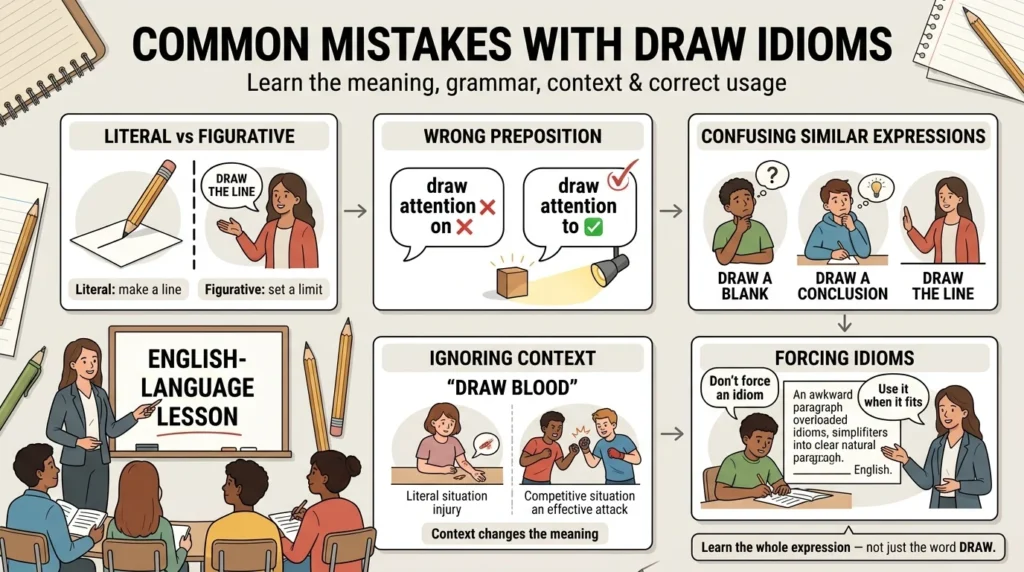
Learn the Whole Expression
Don’t memorize only the word draw. Learn the complete phrase:
- draw attention to
- draw inspiration from
- draw strength from
- draw a conclusion
- draw the line
The words that follow draw often determine the expression’s meaning.
Check the Preposition
Prepositions are particularly important:
- Draw attention to something
- Draw strength from something
- Draw inspiration from something
- Draw on experience
- Draw a line between two things
Changing the preposition can make an otherwise natural sentence sound incorrect.
Use Idioms in the Right Context
For example:
“I tried to remember the answer, but I drew a blank.”
This is natural because the speaker cannot remember something.
But:
“I drew a blank because the room was crowded.”
would usually require more context because draw a blank is specifically about failing to remember, find, or produce something.
Don’t Force an Idiom Into Every Sentence
Idioms make English more natural when they fit the situation. Using too many in a single paragraph can make your writing sound unnatural.
A good rule is simple: use an idiom because it expresses the idea well, not just because you know it.
Idioms With Pictures and Examples: 22+ Easy Idioms
Are All Expressions With “Draw” Idioms?
No. This is an important point for English learners.
Some are traditional idioms, such as:
- draw the line
- draw a blank
- draw the short straw
Others are fixed expressions or collocations, such as:
- draw attention to
- draw a conclusion
- draw a comparison
- draw inspiration from
They are all useful expressions to learn, but calling every phrase an “idiom” would not be technically precise.
FAQs About Draw Idioms
What are some common idioms with the word “draw”?
Common examples include draw the line, draw a blank, draw the short straw, draw fire, and draw someone out. English also has many common fixed expressions such as draw attention to and draw a conclusion.
What does “draw the line” mean?
Draw the line means to set a boundary or decide what you will not accept. For example, “I don’t mind helping, but I draw the line at doing everyone’s work.”
What does “draw a blank” mean?
Draw a blank means to be unable to remember, find, or think of something. For example, “I tried to remember her name, but I drew a blank.”
What does “draw the short straw” mean?
Draw the short straw means to get an undesirable task, choice, or situation, usually by chance. It is often used informally or humorously.
Are “draw attention to” and “draw a conclusion” idioms?
They are better described as common fixed expressions or collocations rather than traditional idioms. However, they are important phrases for English learners because they occur frequently in natural English.
Final Thoughts
Learning draw idioms and expressions becomes much easier when you connect each phrase with a real situation. Start with useful expressions such as draw the line, draw a blank, draw attention to, and draw inspiration from, then practice creating your own sentences.
For a quick challenge, write one sentence using each of these three expressions today:
- Draw the line
- Draw a blank
- Draw inspiration from
The more you see and use these phrases in real English, the more naturally they will become part of your vocabulary.

Sophie Collins writes for Meaning Match about English idioms, American and British expressions, meanings, usage, and everyday language differences.