What would “raining cats and dogs” look like if you pictured the words literally? Idioms clipart refers to simple illustrations that visually represent English idioms, helping readers see the unusual images behind expressions and understand their figurative meanings.
For example, a picture of cats and dogs falling from the sky can make “raining cats and dogs” memorable, even though the idiom actually means that it is raining heavily. Visuals can be especially useful when an idiom’s literal words seem confusing or have little connection to its real meaning.
They can also make worksheets, classroom activities, presentations, posters, blogs, and English-learning materials more engaging. Whether you’re a student, teacher, content creator, or English learner, the right illustration can make an unfamiliar expression easier to recognize and remember. If you’re searching for idioms clipart, this guide brings together visual ideas for common idioms along with their meanings and natural examples.
What Is Idioms Clipart?
Idioms clipart is a ready-made illustration, cartoon, graphic, or educational visual that represents an English idiom.
Because idioms are often figurative expressions, their individual words may not reveal the actual meaning. A picture can help learners understand the difference between what an idiom says literally and what it means in real communication.
For example:
- “Spill the beans” literally suggests dropping beans.
- Its figurative meaning is to reveal a secret.
- An effective illustration can show both ideas so the learner remembers the expression.
Good idiom clipart isn’t just decoration. It should help answer three questions:
- What does the expression literally suggest?
- What does it actually mean?
- When would someone naturally use it?
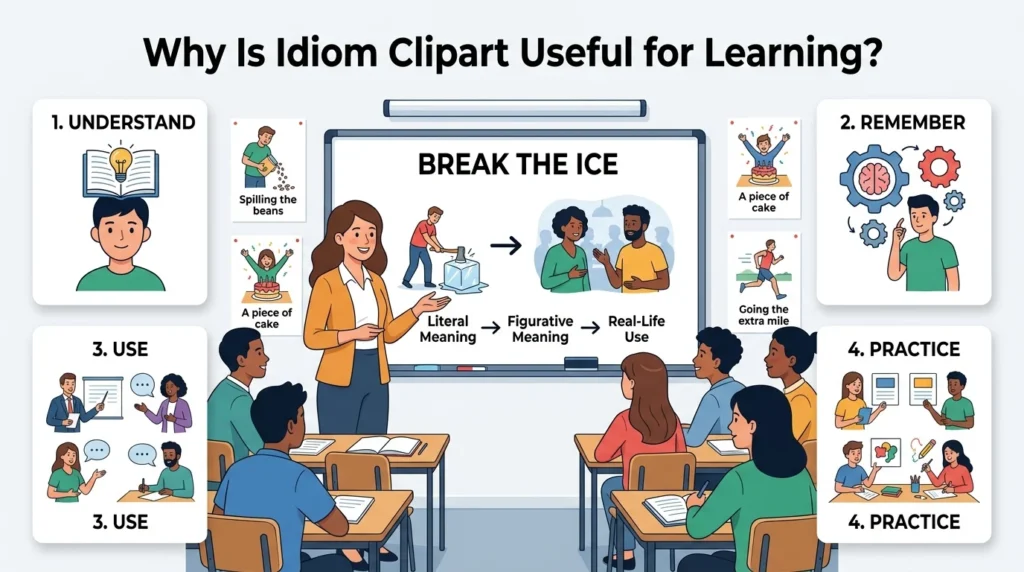
Why Is Idiom Clipart Useful for Learning?
English learners often struggle with idioms because they cannot always translate them word for word. Visual learning gives the brain another way to connect the expression with its meaning.
A useful idiom illustration can:
- make unfamiliar expressions memorable
- show literal and figurative meanings
- provide context
- make vocabulary lessons more engaging
- help students create sentences
- support speaking and writing practice
- make classroom materials easier to understand
For example, imagine a new student entering a quiet classroom. The teacher tells a funny joke, everyone laughs, and the students begin talking. That scene visually explains “break the ice” much better than a dictionary definition alone.
Common English Idioms With Visual Meaning
Break the Ice
Word-by-word meaning:
To break something made of ice.
Idiomatic meaning:
To make people feel more comfortable and begin a friendly interaction.
Example sentences:
- The teacher told a joke to break the ice.
- A simple introduction helped break the ice at the meeting.
Common error:
Don’t use it to mean physically breaking ice unless the context is literal.
Usage note:
It is common when people meet for the first time or when a situation feels awkward.
Visual idea:
Show two people standing awkwardly on opposite sides of a thin sheet of ice, followed by the ice breaking and the two people smiling and talking.
Spill the Beans
Word-by-word meaning:
To accidentally spill beans from a container.
Idiomatic meaning:
To reveal secret or private information.
Example sentences:
- Who spilled the beans about the surprise?
- I promised not to spill the beans.
Common error:
The expression normally has nothing to do with actual beans.
Usage note:
It is informal and works especially well in conversations about secrets.
Visual idea:
Show beans falling from a tipped container on one side and a person revealing a secret to a friend on the other.
Piece of Cake
Word-by-word meaning:
A portion of a cake.
Idiomatic meaning:
Something very easy to do.
Example sentences:
- The first exercise was a piece of cake.
- Once I understood the instructions, the test was a piece of cake.
Common error:
Don’t use it to describe actual cake unless the context clearly refers to food.
Usage note:
This is a casual expression for something easy.
Visual idea:
Show a student completing an easy task while a large slice of cake appears as a playful visual symbol.
Hit the Nail on the Head
Word-by-word meaning:
To strike the head of a nail accurately.
Idiomatic meaning:
To identify something exactly or express the correct point.
Example sentences:
- You hit the nail on the head with that explanation.
- Sara hit the nail on the head when she identified the real problem.
Common error:
Don’t use it simply to describe hammering a nail.
Usage note:
Use it when someone gets an answer, explanation, or observation exactly right.
Visual idea:
Show a person striking a nail precisely in the center while a speech bubble says, “Exactly!”
Under the Weather
Word-by-word meaning:
To be physically beneath the weather.
Idiomatic meaning:
To feel ill or unwell.
Example sentences:
- I’m feeling under the weather today.
- Jake stayed home because he was under the weather.
Common error:
It normally describes someone’s health or general condition, not simply being outside in bad weather.
Usage note:
It is an informal expression often used for minor illness.
Visual idea:
Show a person looking tired beneath a cloud while other people nearby are active and healthy.
Cost an Arm and a Leg
Word-by-word meaning:
An arm and a leg are body parts.
Idiomatic meaning:
To be extremely expensive.
Example sentences:
- That car cost an arm and a leg.
- The concert tickets cost an arm and a leg.
Common error:
Don’t interpret the expression literally.
Usage note:
It is informal and emphasizes a surprisingly high price.
Visual idea:
Show a shopper looking shocked at a huge price tag, with cartoon arms and legs used as humorous symbolic “payment.”
Once in a Blue Moon
Word-by-word meaning:
A moon that appears blue.
Idiomatic meaning:
Something that happens very rarely.
Example sentences:
- I eat dessert once in a blue moon.
- We visit that restaurant once in a blue moon.
Common error:
Don’t use it for something that happens regularly.
Usage note:
Use it when you want to emphasize rarity.
Visual idea:
Show a blue-colored moon appearing rarely on a calendar while most days remain empty.
Bite the Bullet
Word-by-word meaning:
To bite a bullet.
Idiomatic meaning:
To face something difficult or unpleasant with determination.
Example sentences:
- I was nervous, but I had to bite the bullet and give the presentation.
- She decided to bite the bullet and finish the difficult assignment.
Common error:
The expression does not normally refer to literally biting anything.
Usage note:
Use it when someone accepts that a difficult situation must be faced.
Visual idea:
Show a nervous student taking a deep breath before confidently stepping toward a difficult task, with the idiom represented symbolically rather than graphically.
Let the Cat Out of the Bag
Word-by-word meaning:
To allow a cat to escape from a bag.
Idiomatic meaning:
To accidentally reveal a secret.
Example sentences:
- Mia let the cat out of the bag about the party.
- I didn’t want anyone to know, but Tom let the cat out of the bag.
Common error:
Don’t use it as a literal expression unless you’re actually discussing a cat.
Usage note:
It is informal and often used for accidentally revealing surprises.
Visual idea:
Show a cat escaping from a bag on one side and a surprised person revealing a secret on the other.
A Blessing in Disguise
Word-by-word meaning:
A benefit hidden behind a disguise.
Idiomatic meaning:
Something that seems bad at first but eventually produces a positive result.
Example sentences:
- Missing the flight was a blessing in disguise because the storm delayed the next flight.
- Losing that opportunity became a blessing in disguise.
Common error:
Don’t use it for something that is obviously positive from the beginning.
Usage note:
The key idea is an unexpected benefit hidden inside a difficult situation.
Visual idea:
Show a disappointing event transforming into a positive opportunity, with a simple “hidden benefit” visual.
When Pigs Fly
Word-by-word meaning:
Pigs flying through the air.
Idiomatic meaning:
Something is extremely unlikely or probably will never happen.
Example sentences:
- He’ll clean his room when pigs fly.
- I’ll believe that when pigs fly!
Common error:
Don’t use it as a serious statement about actual animals.
Usage note:
It is humorous and can sound sarcastic.
Visual idea:
Show a surprised person looking at a flying pig while a calendar marks an impossible future event.
Kill Two Birds With One Stone
Word-by-word meaning:
Using one stone to hit two birds.
Idiomatic meaning:
To accomplish two goals with one action.
Example sentences:
- I killed two birds with one stone by exercising while walking to work.
- We can kill two birds with one stone by shopping and visiting Grandma today.
Common error:
Don’t use the phrase when only one goal is being achieved.
Usage note:
It describes an efficient action that solves two problems or achieves two objectives.
Visual idea:
Use a safe, non-graphic symbolic illustration of one action leading to two completed goals, rather than showing harm to animals.
The Ball Is in Your Court
Word-by-word meaning:
A ball is inside someone’s side of a sports court.
Idiomatic meaning:
It is now another person’s responsibility to act or make a decision.
Example sentences:
- I’ve sent the proposal. Now the ball is in your court.
- We made our offer, so the ball is in their court.
Common error:
Don’t use it when the other person has no action or decision to make.
Usage note:
It is common in professional, academic, and personal communication.
Visual idea:
Show two people on opposite sides of a tennis court, with the ball clearly resting on one person’s side and a decision document nearby.
Bite Off More Than You Can Chew
Word-by-word meaning:
Taking a bite that is too large to chew.
Idiomatic meaning:
To accept more work or responsibility than you can manage.
Example sentences:
- I bit off more than I could chew by taking four difficult courses.
- Don’t bite off more than you can chew.
Common error:
It normally refers to responsibilities, not actual eating.
Usage note:
It can be used as friendly advice.
Visual idea:
Show a student surrounded by too many books and assignments, with an oversized bite of food used as a playful metaphor.
Add Fuel to the Fire
Word-by-word meaning:
Adding fuel makes a fire burn more strongly.
Idiomatic meaning:
To make an existing problem, argument, or conflict worse.
Example sentences:
- His angry comment added fuel to the fire.
- Complaining during the argument only added fuel to the fire.
Common error:
There should already be a problem or tension for the idiom to make sense.
Usage note:
It is especially useful when describing conflict.
Visual idea:
Show a small argument represented by a controlled symbolic flame, with an additional piece of fuel making the situation visibly more intense.
Go the Extra Mile
Word-by-word meaning:
To travel an additional mile.
Idiomatic meaning:
To make an extra effort to help someone or achieve a goal.
Example sentences:
- The teacher went the extra mile to help her students.
- Good customer service means going the extra mile.
Common error:
The expression does not require actual physical travel.
Usage note:
It usually has a positive meaning and describes extra effort.
Visual idea:
Show a person reaching a finish line but continuing one additional mile to help another person.
On the Same Page
Word-by-word meaning:
Being on the same page of a book.
Idiomatic meaning:
Having the same understanding, expectations, or goals.
Example sentences:
- Let’s meet tomorrow so we’re on the same page.
- The whole team needs to be on the same page.
Common error:
It does not simply mean two people are reading the same book.
Usage note:
It is very common in workplaces, classrooms, and group projects.
Visual idea:
Show several students and a teacher looking at the same page containing matching goals and notes.
Pull Someone’s Leg
Word-by-word meaning:
To physically pull someone’s leg.
Idiomatic meaning:
To joke with or tease someone.
Example sentences:
- Don’t worry—I’m just pulling your leg.
- I thought he was serious, but he was pulling my leg.
Common error:
The phrase usually refers to joking, not physical pulling.
Usage note:
It is informal and works best in friendly situations.
Visual idea:
Show two friends laughing, with one playfully telling an obviously unbelievable story while the other realizes it’s a joke.
Keep an Eye On
Word-by-word meaning:
To keep an eye focused on something.
Idiomatic meaning:
To watch, monitor, or look after someone or something.
Example sentences:
- Can you keep an eye on my bag?
- Please keep an eye on the children.
Common error:
It does not mean staring continuously at something.
Usage note:
This is a very common everyday expression.
Visual idea:
Show a person casually watching a bag or supervising children while doing another simple task.
A Piece of the Pie
Word-by-word meaning:
A portion of a pie.
Idiomatic meaning:
A share of money, success, benefits, or an opportunity.
Example sentences:
- Everyone wants a piece of the pie when the business succeeds.
- The partnership gave both companies a piece of the pie.
Common error:
It does not necessarily refer to food.
Usage note:
It is often used in discussions about money, business, rewards, and opportunities.
Visual idea:
Show a pie divided into labeled shares such as “success,” “profit,” and “opportunity,” with different people receiving portions.
English Idioms With Pictures: Literal vs. Figurative Meaning
One of the most useful ways to study idioms is to compare the literal picture with the figurative situation.
| Idiom | Literal Picture | Figurative Meaning |
|---|---|---|
| Break the ice | Ice being broken | Start a friendly interaction |
| Spill the beans | Beans being spilled | Reveal a secret |
| Piece of cake | A slice of cake | Something easy |
| Under the weather | Person beneath a cloud | Feeling unwell |
| Hit the nail on the head | Nail being hit correctly | Be exactly right |
| Go the extra mile | Person traveling farther | Make extra effort |
This comparison is especially useful for students because it teaches them not to translate idioms word for word.
How to Use Idioms Clipart for Learning
You don’t need to simply look at an image and memorize the phrase. Turn each picture into a short learning activity.
For Students
Use idiom pictures to:
- guess the figurative meaning
- match phrases with illustrations
- explain literal versus figurative meaning
- create original sentences
- practice speaking with a partner
- make flashcards
- review difficult expressions
A simple method is:
See the picture → identify the idiom → explain the meaning → make your own sentence.
For Teachers
Teachers can display an illustration without giving students the answer first.
Ask:
- What do you see?
- What does the picture mean literally?
- Could this phrase have another meaning?
- What is the figurative meaning?
- Can you use it in a sentence?
- Is the expression formal, informal, humorous, or neutral?
This turns a static picture into a complete vocabulary activity.
Different Types of Idiom Clipart
Not every idiom image serves the same purpose.
Literal Idiom Clipart
Shows the words exactly as they sound.
Example: Beans literally spilling from a container.
Figurative Idiom Clipart
Shows what the expression means in real communication.
Example: Someone revealing a secret.
Literal-vs.-Figurative Clipart
Shows both meanings side by side. This is particularly useful for English learners.
Classroom Idiom Clipart
Uses clear educational illustrations, labels, arrows, and examples for lessons, worksheets, or presentations.
Printable Idiom Illustrations
Simple graphics can be used for flashcards, classroom displays, matching games, and vocabulary activities, provided the image license allows the intended use.
Idioms With Pictures and Examples: 22+ Easy Idioms
Common Mistakes When Using Idiom Clipart
Taking Every Idiom Literally
A picture of a cat leaving a bag may help you remember “let the cat out of the bag,” but the expression normally means to reveal a secret.
Ignoring Context
An image can explain an idea, but learners still need a real sentence to understand when the expression belongs in conversation.
Ignoring Tone
Some idioms are humorous, sarcastic, informal, or conversational. “When pigs fly”, for example, can sound playful or sarcastic.
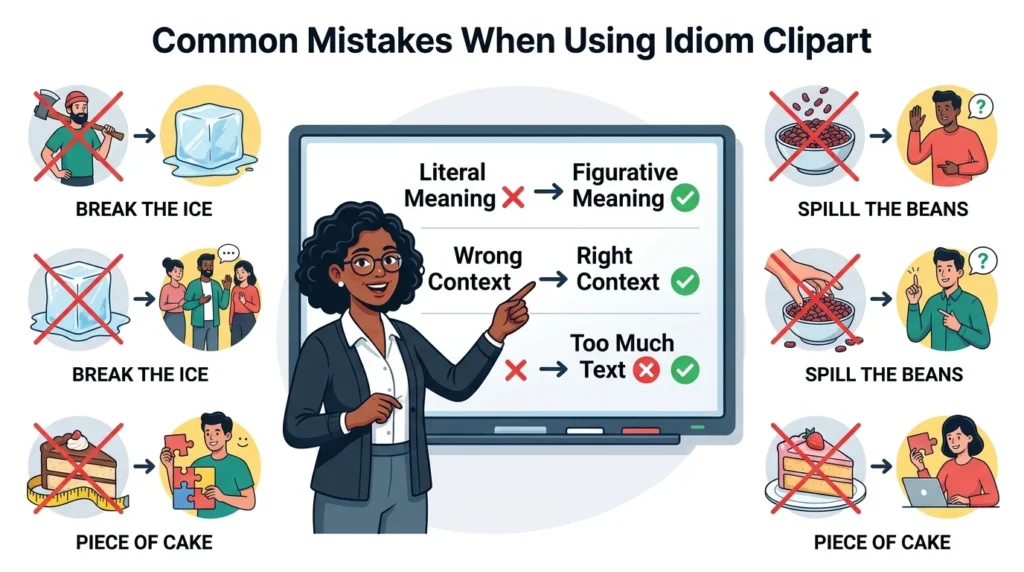
Changing Fixed Expressions
Many idioms have established wording.
- ✅ Break the ice
- ❌ Break the frozen water
Changing the expression can destroy its idiomatic meaning.
Using Too Many Idioms
Idioms add personality to English, but using one in every sentence can make writing sound unnatural. Choose an expression because it fits the situation—not simply because you know it.
How to Choose Good Idiom Clipart
A useful idiom illustration should be:
- Clear: The main idea should be immediately understandable.
- Relevant: The image should match the idiom.
- Educational: It should help explain meaning rather than merely decorate the page.
- Uncluttered: Too many objects can confuse learners.
- Contextual: A small scene can show when the expression is used.
- Readable: Labels should be easy to understand on mobile screens.
- Consistent: A collection should use a similar illustration style.
The best visual often combines a memorable literal image with a clear figurative context.
Idiom Clipart vs. Idiom Images: What’s the Difference?
The terms are sometimes used interchangeably, but there is a useful distinction.
Idiom images is a broad term for any visual representing an idiom, including photographs, illustrations, diagrams, and graphics.
Idiom clipart usually refers to ready-made graphic illustrations, often in a simple cartoon, vector, or educational style.
For learning purposes, the most useful image is not necessarily the most decorative one. It is the one that makes the idiom’s meaning and context easiest to understand.
Can You Use Any Clipart You Find Online?
No. An image appearing in search results is not automatically free to copy or publish.
Before using idiom clipart on a website, worksheet, presentation, or commercial project, check:
- who created it
- whether it has a reuse license
- whether attribution is required
- whether commercial use is allowed
- whether modification is allowed
If you are creating original illustrations or using properly licensed graphics, you have much clearer control over how the visual can be used.
FAQs About Idioms Clipart
What is idioms clipart?
Idioms clipart is a graphic or illustration designed to represent an English idiom. It can show the literal wording, figurative meaning, or both to make the expression easier to understand.
How do pictures help students learn idioms?
Pictures create a visual connection between an unfamiliar phrase and its meaning. When learners combine an image with a definition and example sentence, the expression can become easier to remember.
Should idiom clipart show literal or figurative meaning?
Either approach can work, but showing literal and figurative meanings together is particularly helpful because it teaches learners why the expression cannot always be understood word for word.
Can teachers use idiom clipart in English lessons?
Yes. Teachers can use illustrations for matching activities, vocabulary practice, speaking exercises, sentence writing, flashcards, and literal-versus-figurative meaning activities.
Is all idiom clipart free to use?
No. Clipart may be protected by copyright or subject to specific licensing conditions. Always check the creator’s usage terms before publishing, modifying, or commercially using an image.
Colorful Idioms: 30+ Lively Phrases and What They Mean
Final Thoughts
Learning idioms doesn’t have to mean memorizing long lists of unfamiliar phrases. Idioms clipart can make figurative language easier by connecting an expression with a memorable visual, a clear meaning, and a real-life situation.
Start with a few expressions such as “break the ice,” “spill the beans,” and “go the extra mile.” Look at the picture, identify the literal idea, learn the figurative meaning, and then create your own sentence.
The goal isn’t simply to recognize an idiom. It’s to understand what it means, when it fits, how it sounds, and how to use it naturally.

Daniel Mercer is a Meaning Match writer covering English idioms, vocabulary, expressions, and language usage with clear meanings and practical examples.