What does “draw the line” have to do with setting a boundary? Drawing idioms are drawing-related idioms and expressions that use ideas such as lines, pictures, or visual images to communicate meanings beyond their literal words.
Phrases such as “draw the line,” “draw a blank,” “connect the dots,” and “paint a picture” can sound literal at first, but their figurative meanings are different. For example, “draw the line” means to set a limit, while “draw a blank” means to be unable to remember or think of something. The phrase “drawing idioms” is descriptive rather than a formal linguistic category, so some examples are better described as related fixed expressions.
If you’re searching for drawing idioms for writing, schoolwork, creative projects, vocabulary practice, or English learning, this guide explains their meanings, contexts, and natural examples so you can understand and use them correctly.
What Are Drawing Idioms?
If someone tells you to “draw the line,” they probably aren’t asking you to pick up a pencil. Drawing idioms are English idioms and expressions built around the word draw, and many have meanings that go far beyond making a picture.
Drawing idioms usually refer to English idioms and expressions containing draw or drawing-related imagery. Common examples include draw the line, draw a blank, draw a conclusion, draw attention, draw the short straw, and go back to the drawing board. Their meanings are often figurative, so learning them in context is the easiest way to use them naturally.
English usage note: “Drawing idioms” can sometimes mean idioms about art or drawing. This guide focuses mainly on common idioms and expressions using “draw.”
Common Drawing Idioms and Expressions
Draw the Line
Meaning: To set a firm limit on what you will accept or do.
Example:
I don’t mind helping, but I draw the line at doing everyone’s work.
Common error:
Don’t confuse it with physically drawing a line when the context is figurative.
Usage note:
Tone: Neutral and common.
You can also say “draw the line at something.”
Draw a Blank
Meaning: To be unable to remember, find, or think of something.
Example:
I knew his name yesterday, but when she asked me today, I drew a blank.
Common error:
Say “draw a blank,” not “make a blank.”
Usage note:
Tone: Informal/casual.
It is especially useful when talking about forgotten names, answers, or information.
Draw Attention
Meaning: To make someone or something noticeable.
Example:
The bright sign drew attention to the new store.
Common error:
Avoid “draw attentions.” In this expression, attention is normally uncountable.
Usage note:
Tone: Neutral.
This expression works in everyday, professional, academic, and journalistic English.
Draw a Conclusion
Meaning: To reach a conclusion after considering facts, evidence, or information.
Example:
We need more evidence before we draw a conclusion.
Common error:
“Draw a conclusion” is more natural than “make a conclusion.”
Usage note:
Tone: Neutral to formal.
It is especially common in academic, scientific, and professional writing.
Draw a Distinction
Meaning: To clearly point out a difference between two things.
Example:
The teacher drew a distinction between fact and personal opinion.
Common error:
A distinction identifies a difference; it does not mean that two things have nothing in common.
Usage note:
Tone: Formal/academic.
This expression is useful in essays, discussions, law, and professional writing.
Draw a Comparison
Meaning: To compare two people, things, or situations by identifying similarities or differences.
Example:
The article draws a comparison between modern and traditional teaching methods.
Common error:
“Draw a comparison” does not mean that two things are identical.
Usage note:
Tone: Neutral to formal.
You will often see the plural “draw comparisons.”
Draw Someone Out
Meaning: To encourage a quiet, shy, or reluctant person to talk more freely.
Example:
The interviewer asked gentle questions to draw the student out.
Common error:
It means encouraging someone to talk, not simply asking them one question.
Usage note:
Tone: Neutral.
It is useful when discussing interviews, friendships, teaching, and conversations.
Draw a Crowd
Meaning: To attract a large number of people.
Example:
The street performer drew a huge crowd on Saturday.
Common error:
The expression means attract people, not make a drawing of a crowd.
Usage note:
Tone: Neutral and conversational.
It is commonly used for events, performers, restaurants, shops, and attractions.
Draw the Short Straw
Meaning: To be the person who receives an unpleasant or disadvantageous task or outcome.
Example:
I drew the short straw and had to clean the kitchen.
Common error:
It doesn’t necessarily describe something serious. It can be used humorously for a small inconvenience.
Usage note:
Tone: Informal.
The expression comes from choosing among straws, where the person selecting the short one gets the unwanted result.
Draw Inspiration From
Meaning: To get creative ideas, motivation, or influence from a person, place, experience, or thing.
Example:
The designer drew inspiration from traditional architecture.
Common error:
Use “draw inspiration from,” not “draw inspiration on.”
Usage note:
Tone: Neutral.
It is especially common in writing about art, design, literature, creativity, and personal experiences.
Draw on Something
Meaning: To use knowledge, experience, money, or another available resource.
Example:
She drew on her experience to solve the problem.
Common error:
Don’t confuse draw on with draw attention or draw a conclusion; they have different meanings.
Usage note:
Tone: Neutral to formal.
A common pattern is draw on experience, knowledge, resources, or memories.
Draw Near
Meaning: To approach or become closer, especially in time.
Example:
As the exam date drew near, the students studied harder.
Common error:
Don’t assume draw always means “make a picture.” Here it means “approach.”
Usage note:
Tone: Neutral to slightly literary.
“Approach” is often the simpler alternative in everyday English.
Draw Fire
Meaning: To attract criticism, opposition, or attacks.
Example:
The new proposal drew fire from several critics.
Common error:
In modern figurative use, draw fire can mean attracting criticism; it does not necessarily refer to literal gunfire.
Usage note:
Tone: Informal to journalistic.
It can sound stronger than simply saying “receive criticism.”
Draw First Blood
Meaning: To be the first person or side to gain an advantage or cause a setback during a conflict or competition.
Example:
The home team drew first blood with an early goal.
Common error:
The phrase is often figurative. It does not necessarily describe physical violence.
Usage note:
Tone: Informal, dramatic.
It commonly appears in sports, debates, competitions, and descriptions of rivalry.
Draw a Bead on Something
Meaning: To focus closely on a target, person, or objective.
Example:
The investigators began to draw a bead on the main problem.
Common error:
This is not a standard phrase for ordinary attention. It has a stronger “targeting” sense.
Usage note:
Tone: Informal and somewhat old-fashioned.
Because of its targeting imagery, choose it carefully in everyday writing.
Draw a Veil Over Something
Meaning: To avoid discussing or revealing something unpleasant, embarrassing, or sensitive.
Example:
The family preferred to draw a veil over the disagreement.
Common error:
It does not mean physically covering something with a curtain.
Usage note:
Tone: Formal/literary, especially British English.
For casual conversation, “avoid discussing it” is usually simpler.
Draw a Long Bow
Meaning: To make a claim that is difficult to believe or to exaggerate the truth.
Example:
Saying he finished the entire project in one hour is drawing a long bow.
Common error:
This expression is not as widely used in all varieties of English, so don’t assume every English speaker will recognize it immediately.
Usage note:
Tone: Informal; particularly associated with Australian and British usage.
Use “that’s a stretch” when you want a more widely understood alternative.
Draw Strength From Something
Meaning: To gain emotional or practical support from a person, experience, belief, or situation.
Example:
She drew strength from the support of her friends.
Common error:
Use “draw strength from,” not “draw strength on.”
Usage note:
Tone: Neutral.
This expression is common when discussing encouragement, difficult experiences, resilience, and support.
Draw Parallels
Meaning: To point out similarities between two people, events, ideas, or situations.
Example:
Historians often draw parallels between the two periods.
Common error:
Drawing parallels means identifying similarities; it does not mean saying two situations are exactly the same.
Usage note:
Tone: Neutral to formal.
It is particularly useful in essays, journalism, history, and analysis.
Go Back to the Drawing Board
Meaning: To start planning again because an original idea, design, or approach did not work.
Example:
Our first marketing plan failed, so we had to go back to the drawing board.
Common error:
Don’t normally use this for a tiny adjustment. It suggests reconsidering or redesigning the approach.
Usage note:
Tone: Neutral and widely understood.
It is common in business, engineering, design, school projects, and everyday conversation.
Drawing Idioms: Literal vs. Figurative Meaning
The word draw is unusually flexible in English. It can mean making an image, attracting something, reaching a result, using a resource, or approaching something.
| Expression | Literal idea | Figurative meaning |
|---|---|---|
| Draw the line | Make a line | Set a boundary |
| Draw a blank | Produce an empty result | Fail to remember/find something |
| Draw attention | Pull attention toward something | Make something noticeable |
| Draw a conclusion | Bring information toward a result | Reach a conclusion |
| Draw someone out | Bring something outward | Encourage someone to speak |
| Draw a crowd | Bring people together | Attract many people |
| Draw inspiration from | Take from a source | Gain creative influence |
| Draw on experience | Use a resource | Apply previous knowledge |
| Go back to the drawing board | Return to a planning surface | Start a plan again |
This literal-to-figurative connection is one reason drawing idioms can seem confusing at first.
Formal, Casual, and Literary Drawing Idioms
Not every expression is appropriate in every situation.
| Expression | Typical style |
|---|---|
| Draw a blank | Casual |
| Draw the short straw | Informal |
| Draw a crowd | Neutral |
| Draw the line | Neutral |
| Draw attention | Neutral |
| Draw a conclusion | Neutral/Formal |
| Draw a distinction | Formal |
| Draw parallels | Formal |
| Draw a veil over | Literary/Formal |
| Draw a long bow | Informal/Regional |
When speaking with friends, expressions such as draw a blank or draw the short straw can sound natural. In an academic essay, draw a conclusion, draw a distinction, or draw parallels may fit better.
Real-Life Examples of Drawing Idioms
Seeing an idiom in a realistic situation makes it easier to remember.
At Work
Your team creates a plan that doesn’t produce the expected results.
“We need to go back to the drawing board.”
At School
A teacher asks you a question, but you suddenly forget the answer.
“I completely drew a blank.”
With Friends
Someone keeps asking you to do things you don’t want to do.
“I don’t mind helping, but I draw the line at doing everything.”
In a Creative Project
An artist uses old buildings as inspiration.
“She drew inspiration from traditional architecture.”
During a Competition
One team scores first.
“The home team drew first blood.”
These situations connect the expression to an actual communicative purpose rather than asking you to memorize definitions in isolation.
Common Mistakes With Drawing Idioms
Because idioms have fixed patterns, changing one small word can make the sentence sound unnatural.
- ❌ Make a conclusion
✅ Draw a conclusion - ❌ Draw inspiration on nature
✅ Draw inspiration from nature - ❌ Make a blank
✅ Draw a blank - ❌ Draw attentions
✅ Draw attention - ❌ Draw strength on your family
✅ Draw strength from your family - ❌ Go back to drawing board
✅ Go back to the drawing board
The safest way to learn an idiom is to memorize its complete expression, including the prepositions and articles that normally accompany it.
Idioms Clipart: 24+ Fun Images to Explain English Idioms
How to Learn Drawing Idioms Faster
Don’t try to memorize all 20 expressions in one sitting. Group them according to their purpose.
For Limits and Boundaries
- Draw the line
For Thinking and Analysis
- Draw a conclusion
- Draw a distinction
- Draw a comparison
- Draw parallels
- Draw a blank
For Attraction
- Draw attention
- Draw a crowd
- Draw fire
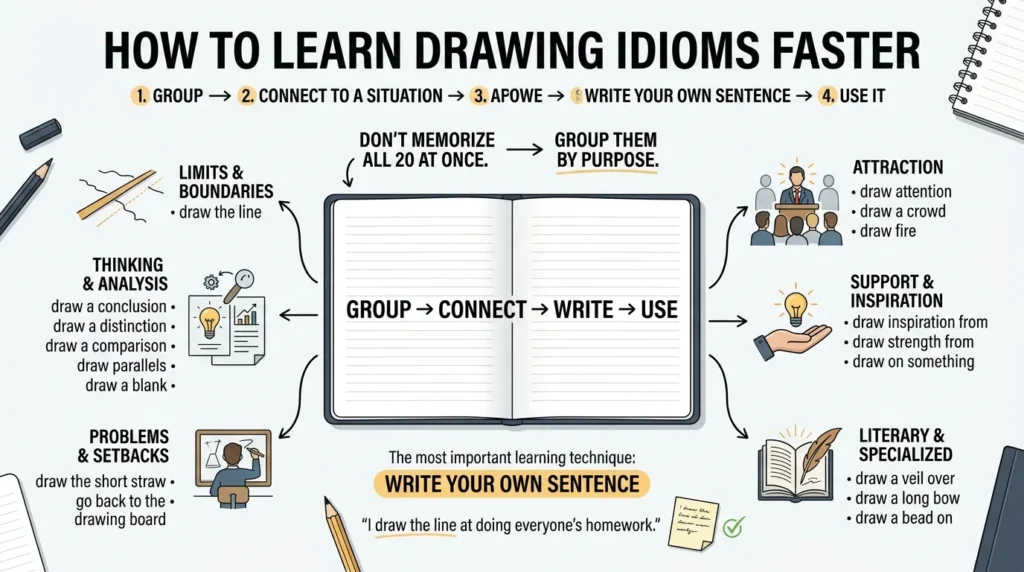
For Support and Inspiration
- Draw inspiration from
- Draw strength from
- Draw on something
For Problems and Setbacks
- Draw the short straw
- Go back to the drawing board
For More Literary or Specialized English
- Draw a veil over something
- Draw a long bow
- Draw a bead on something
Then write one sentence about your own life for each expression. Personal examples are generally easier to remember than dictionary definitions.
Soft Idioms: 32+ Gentle Expressions and Their Meanings
Are Drawing Idioms the Same as Idioms About Drawing?
Not exactly.
The phrase “drawing idioms” can be interpreted in two ways:
- Idioms containing the word “draw” — such as draw the line or draw a blank.
- Idioms specifically connected with art or drawing — expressions involving pictures, sketches, or artists.
This article focuses mainly on the first category because these expressions are useful for understanding everyday English.
FAQs About Drawing Idioms
What are drawing idioms?
Drawing idioms are English idioms and expressions that use draw or drawing-related imagery. Many have figurative meanings that are different from their literal meanings.
What is a common idiom with “draw”?
“Draw the line” is a widely used expression meaning to set a limit or establish something you will not accept.
What does “draw a blank” mean?
“Draw a blank” means to be unable to remember, find, or think of something, such as an answer or someone’s name.
What does “go back to the drawing board” mean?
It means to start planning or developing something again because the original approach did not work.
Are all expressions with “draw” idioms?
No. Some are ordinary combinations of words, some are phrasal verbs, and some are fixed idiomatic expressions. Context and figurative meaning help determine how an expression is being used.
Conclusion
Drawing idioms reveal just how many meanings the word draw can have in English. From setting a boundary with draw the line to forgetting an answer with draw a blank, these expressions can make your English more natural and expressive.
The best way to learn them is through context. Choose three expressions today, write a sentence connected to your own life, and try using at least one in conversation. Once you stop translating each word literally and start learning the expression as a complete phrase, drawing idioms become much easier to understand and remember.

Clara Bennett writes for Meaning Match about English idioms, everyday expressions, meanings, and practical language usage, making phrases easy to understand.