
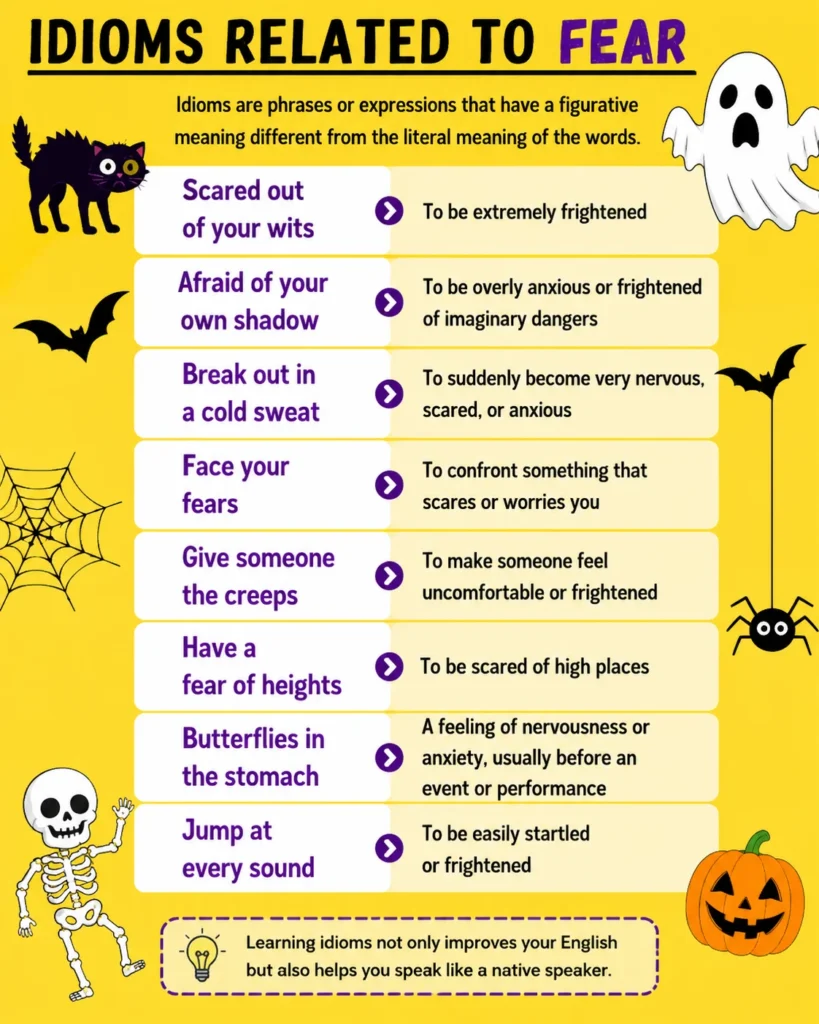
How can you describe fear without simply saying “I’m scared”? Fear idioms are fixed expressions that make feelings such as nervousness, fright, panic, and terror more vivid. Common examples include “scared stiff,” “shake in your boots,” “jump out of your skin,” and “heart in your mouth.”
If you’re searching for fear idioms, you probably want to know what each expression means, how strong the fear is, when it sounds natural, and how to use it correctly in a sentence. That can be tricky because idioms often mean something different from the literal words they contain. For example, “scared stiff” means extremely frightened—it does not mean that someone has literally become stiff.
Some expressions describe mild nervousness, while others suggest sudden fright, intense terror, panic, or ongoing worry. This guide covers common idioms for fear with clear meanings, natural examples, usage notes, and context, helping you choose the right expression for everyday conversation, storytelling, or writing.
What Are Fear Idioms?
Fear idioms are fixed or semi-fixed English expressions that communicate fear, nervousness, anxiety, suspense, surprise, or uneasiness in a more vivid way than ordinary vocabulary.
For example:
I was very scared.
can become:
I was scared stiff.
The second sentence creates a stronger mental picture and sounds more expressive in conversational English.
Language note: The list below includes both traditional idioms and widely used idiomatic expressions. Not every item is a strict idiom in the narrowest linguistic sense; some are adjectives or fixed expressions commonly used to describe fear.
Common Fear Idioms
Some of the most useful fear-related expressions in English are:
- Scared stiff — extremely frightened
- Scared to death — extremely frightened
- Jump out of your skin — become suddenly startled or frightened
- Give someone the creeps — make someone feel uneasy or slightly frightened
- Get cold feet — become nervous and lose courage
- Have butterflies in your stomach — feel nervous or excited
- Shake in your boots — be very frightened
- Make your blood run cold — cause extreme fear or horror
- Send shivers down your spine — cause a strong feeling of fear or excitement
- On edge — nervous, tense, or uneasy
- Lose your nerve — lose courage
- Petrified — extremely frightened
Fear Idioms by Intensity
Not every fear expression describes the same level of emotion. Choosing the right one makes your English more precise.
| Level | Expression | Meaning |
|---|---|---|
| Mild uneasiness | On edge | Tense or unable to relax |
| Mild nervousness | Butterflies in your stomach | Nervous or excited |
| Nervousness before action | Get cold feet | Lose courage |
| Sudden fright | Jump out of your skin | Become suddenly startled |
| Uneasiness | Give someone the creeps | Make someone feel uncomfortable |
| Strong fear | Shake in your boots | Be very frightened |
| Extreme fear | Scared stiff | Extremely frightened |
| Extreme fear | Scared to death | Extremely frightened |
| Extreme fear | Petrified | Extremely frightened |
| Horror | Make your blood run cold | Cause intense fear or horror |
This distinction is important because saying “I’m on edge” is not the same as saying “I’m petrified.”
Scared Stiff
Word-by-word meaning
Scared means frightened, while stiff can describe something rigid or unable to move easily.
Idiomatic meaning
Scared stiff means extremely frightened, often suggesting that fear makes someone feel frozen or unable to react.
Example sentences
- I was scared stiff when I heard footsteps outside.
- The horror movie left me scared stiff.
- She was scared stiff when the dog suddenly ran toward her.
Common error
❌ I was scared stiffness.
✅ I was scared stiff.
Usage note
This is an informal, vivid expression commonly used in conversation.
Scared to Death
Word-by-word meaning
The phrase combines scared with to death, creating an exaggerated image of extreme fear.
Idiomatic meaning
Scared to death means very or extremely frightened. It normally does not mean that the person is literally going to die.
Example sentences
- You scared me to death when you appeared behind me!
- I was scared to death during the storm.
- She was scared to death when she couldn’t find her phone in the dark.
Common error
❌ I scared to death.
✅ I was scared to death.
Usage note
Use it in informal conversations when you want to emphasize a strong emotional reaction.
Jump Out of Your Skin
Word-by-word meaning
The literal image suggests someone jumping so suddenly that they could leave their own skin.
Idiomatic meaning
To jump out of your skin means to become suddenly very startled or frightened.
Example sentences
- That loud bang nearly made me jump out of my skin.
- I jumped out of my skin when someone tapped my shoulder.
- The unexpected scream made everyone jump out of their skin.
Common error
❌ I jumped from my skin.
✅ I jumped out of my skin.
Usage note
This expression is best for sudden fright or surprise, rather than a long period of fear.
Give Someone the Creeps
Word-by-word meaning
The creeps describes an unpleasant, uneasy feeling.
Idiomatic meaning
If something gives you the creeps, it makes you feel uneasy, uncomfortable, or slightly frightened.
Example sentences
- That abandoned house gives me the creeps.
- Something about that empty hallway gives her the creeps.
- The strange painting gives me the creeps.
Common error
❌ That gives me creepy.
✅ That gives me the creeps.
Usage note
This expression usually describes an eerie or unsettling feeling, not necessarily serious danger.
Send Shivers Down Your Spine
Word-by-word meaning
Shivers are small trembles or chills, while the spine is the backbone.
Idiomatic meaning
To send shivers down your spine means to cause a powerful feeling of fear, excitement, or uneasiness.
Example sentences
- The ghost story sent shivers down my spine.
- That scream sent shivers down my spine.
- The sound of footsteps in the empty building sent shivers down her spine.
Common error
❌ It sent shivers on my spine.
✅ It sent shivers down my spine.
Usage note
This expression can describe something frightening, thrilling, or emotionally intense.
Make Your Blood Run Cold
Word-by-word meaning
The expression creates an image of someone’s blood becoming cold because of fear.
Idiomatic meaning
To make your blood run cold means to make you feel extremely frightened or horrified.
Example sentences
- The news made my blood run cold.
- His description of the accident made my blood run cold.
- The cry from the basement made her blood run cold.
Common error
❌ It made my blood cold run.
✅ It made my blood run cold.
Usage note
This is a dramatic expression and works particularly well for frightening or horrifying situations.
Have Butterflies in Your Stomach
Word-by-word meaning
The phrase creates a humorous image of butterflies moving around inside your stomach.
Idiomatic meaning
To have butterflies in your stomach means to feel nervous, excited, or anxious, especially before an important event.
Example sentences
- I always get butterflies in my stomach before an interview.
- She had butterflies in her stomach before going on stage.
- I had butterflies in my stomach before my first presentation.
Common error
❌ I have butterflies on my stomach.
✅ I have butterflies in my stomach.
Usage note
This expression does not always mean fear. It can describe positive excitement and nervous anticipation too.
Get Cold Feet
Word-by-word meaning
Cold feet literally refers to feet that feel cold.
Idiomatic meaning
To get cold feet means to become nervous or lose courage before doing something important or challenging.
Example sentences
- He got cold feet before giving his speech.
- She got cold feet and decided not to go on the roller coaster.
- I was ready to enter the competition, but I got cold feet.
Common error
❌ I got cold foot.
✅ I got cold feet.
Usage note
This expression focuses on losing confidence before taking action, rather than simply feeling afraid.
Shake in Your Boots
Word-by-word meaning
Shake means to tremble, while boots are footwear.
Idiomatic meaning
To shake in your boots means to be very frightened or nervous.
Example sentences
- The children were shaking in their boots during the thunderstorm.
- He was shaking in his boots before meeting the strict manager.
- I was shaking in my boots when I heard the alarm.
Common error
❌ Shake on your boots.
✅ Shake in your boots.
Usage note
This is informal and often has a dramatic or humorous tone.
Have Your Heart in Your Mouth
Word-by-word meaning
The expression creates the impossible image of your heart being in your mouth.
Idiomatic meaning
To have your heart in your mouth means to feel sudden fear, anxiety, or intense suspense.
Example sentences
- My heart was in my mouth when the car suddenly stopped.
- Her heart was in her mouth as she waited for the results.
- I had my heart in my mouth while watching the climber.
Common error
❌ My heart was on my mouth.
✅ My heart was in my mouth.
Usage note
This works especially well when describing a tense moment where you are waiting to see what happens.
Hair-Raising
Word-by-word meaning
Hair-raising literally suggests something that makes your hair stand up.
Idiomatic meaning
Hair-raising describes something extremely frightening, shocking, or thrilling.
Example sentences
- We had a hair-raising experience on the mountain.
- Driving through that storm was a hair-raising experience.
- The documentary contains some hair-raising stories.
Common error
❌ It was a hair raised experience.
✅ It was a hair-raising experience.
Usage note
Use hair-raising as a compound adjective before a noun.
Petrified
Word-by-word meaning
Petrified is related to the idea of something becoming stone-like.
Idiomatic meaning
When someone is petrified, they are extremely frightened.
Example sentences
- I was petrified when I heard the crash.
- She was petrified before speaking in front of hundreds of people.
- The child looked petrified during the storm.
Common error
❌ I was petrify.
✅ I was petrified.
Usage note
Petrified is stronger than nervous or worried and can describe intense fear.
Lose Your Nerve
Word-by-word meaning
Nerve can mean courage or confidence.
Idiomatic meaning
To lose your nerve means to lose courage because you suddenly become afraid or nervous.
Example sentences
- I was ready to jump, but I lost my nerve.
- She lost her nerve before stepping onto the stage.
- Don’t lose your nerve at the last minute.
Common error
❌ I lost my nerves.
✅ I lost my nerve.
Usage note
This expression focuses on losing courage at a critical moment.
On Edge
Word-by-word meaning
Being on an edge suggests being close to a boundary.
Idiomatic meaning
To be on edge means to feel nervous, tense, worried, or unable to relax.
Example sentences
- Everyone was on edge while waiting for the results.
- The strange noises kept me on edge.
- She has been on edge all morning.
Common error
❌ I am in edge.
✅ I am on edge.
Usage note
On edge usually describes tension or uneasiness rather than extreme terror.
A Bundle of Nerves
Word-by-word meaning
A bundle is a group of things gathered together, while nerves here refers to nervousness.
Idiomatic meaning
A bundle of nerves is someone who is extremely nervous or anxious.
Example sentences
- Before her interview, she was a bundle of nerves.
- I was a bundle of nerves before my exam.
- He looked like a bundle of nerves before the announcement.
Common error
❌ I was bundle of nerves.
✅ I was a bundle of nerves.
Usage note
This expression is generally about nervous anticipation, not extreme fear.
Scare the Living Daylights Out of Someone
Word-by-word meaning
The living daylights is a humorous expression used to intensify the idea of frightening someone.
Idiomatic meaning
To scare the living daylights out of someone means to frighten someone very badly.
Example sentences
- You scared the living daylights out of me!
- That sudden noise scared the living daylights out of everyone.
- The horror movie scared the living daylights out of him.
Common error
❌ You scared living daylight from me.
✅ You scared the living daylights out of me.
Usage note
This is strongly informal and is often used after a sudden scare.
Scare Someone Out of Their Wits
Word-by-word meaning
Wits refers to the ability to think clearly and use good judgment.
Idiomatic meaning
To scare someone out of their wits means to frighten them extremely badly.
Example sentences
- The sudden explosion scared me out of my wits.
- You scared her out of her wits by sneaking up behind her.
- The strange sound scared them out of their wits.
Common error
❌ He scared me from my wits.
✅ He scared me out of my wits.
Usage note
Change the possessive pronoun according to the person:
- me → my wits
- him → his wits
- her → her wits
- them → their wits
Afraid of Your Own Shadow
Word-by-word meaning
A shadow is the dark shape created when an object blocks light.
Idiomatic meaning
If someone is afraid of their own shadow, they are very easily frightened or nervous, sometimes even by harmless things.
Example sentences
- After watching too many horror movies, he was afraid of his own shadow.
- She was so nervous that she seemed afraid of her own shadow.
- Don’t be afraid of your own shadow; nothing is going to happen.
Common error
❌ Afraid from your own shadow.
✅ Afraid of your own shadow.
Usage note
This expression can be playful or slightly humorous. It often suggests that someone is easily scared, rather than facing a genuinely dangerous situation.
Tremble With Fear
Word-by-word meaning
Tremble means to shake slightly, while fear is the emotion caused by perceived danger or threat.
Idiomatic meaning
To tremble with fear means to shake physically because you are very frightened.
Example sentences
- The child was trembling with fear during the storm.
- He stood there trembling with fear.
- She was trembling with fear after hearing the crash.
Common error
❌ Trembling from fear in every context.
✅ Trembling with fear is the natural expression when emphasizing the emotion causing the shaking.
Usage note
Unlike highly figurative idioms, this expression is relatively direct and can work in both everyday and descriptive writing.
Frozen With Fear
Word-by-word meaning
Frozen literally means turned into ice or made unable to move.
Idiomatic meaning
To be frozen with fear means to become so frightened that you feel unable to move or react.
Example sentences
- I was frozen with fear when I saw the snake.
- The sudden noise left him frozen with fear.
- She stood frozen with fear at the doorway.
Common error
❌ I was frozen by fear in every situation.
✅ Frozen with fear is the common expression when fear is described as the cause of the reaction.
Usage note
This expression is especially useful when fear cause
s a freeze response rather than panic or immediate
movement.
Anger Idioms: 38+ Phrases to Express Anger
Ways to Say “I’m Scared” in English
If you want to avoid repeating “I’m scared,” choose an expression according to the situation.
| Instead of saying… | Try saying… | Best for |
|---|---|---|
| I’m very scared. | I’m scared stiff. | Extreme fear |
| I’m terrified. | I’m petrified. | Extreme fear |
| That frightened me suddenly. | I jumped out of my skin. | Sudden fright |
| I’m nervous. | I have butterflies in my stomach. | Nervous anticipation |
| I almost didn’t do it. | I got cold feet. | Losing courage |
| I’m tense. | I’m on edge. | Uneasiness |
| That feels creepy. | It gives me the creeps. | Eerie situations |
| I’m losing courage. | I’m losing my nerve. | Difficult action |
| I’m extremely nervous. | I’m a bundle of nerves. | Strong nervousness |
| I’m easily frightened. | I’m afraid of my own shadow. | Playful exaggeration |
Fear Idioms: Which One Should You Use?
Choosing the right expression depends on what caused the emotion and how strong it is.
If something suddenly scares you
Use:
- jump out of your skin
- scare the living daylights out of someone
- scare someone out of their wits
Example:
“You nearly made me jump out of my skin!”
If you are extremely frightened
Use:
- scared stiff
- scared to death
- petrified
- frozen with fear
Example:
“I was petrified when the lights suddenly went out.”
If you feel nervous before an event
Use:
- butterflies in your stomach
- a bundle of nerves
- on edge
Example:
“I had butterflies in my stomach before my interview.”
If you lose courage
Use:
- get cold feet
- lose your nerve
Example:
“I wanted to perform on stage, but I lost my nerve.”
If something feels creepy or disturbing
Use:
- give someone the creeps
- send shivers down your spine
- make your blood run cold
Example:
“That abandoned building gives me the creeps.”
Common Mistakes When Using Fear Idioms
Translating Every Word Literally
Idioms usually have meanings that cannot be understood by translating every word separately.
For example:
Get cold feet
doesn’t mean that your feet have physically become cold.
It means:
Become nervous or lose courage before doing something.
Learn the entire expression as one unit.
Changing the Fixed Wording
Many expressions have conventional wording.
❌ Jump from your skin
✅ Jump out of your skin
❌ Butterflies on my stomach
✅ Butterflies in my stomach
❌ In edge
✅ On edge
❌ Afraid from my own shadow
✅ Afraid of my own shadow
Small changes can make an otherwise understandable sentence sound unnatural.
Confusing Fear With Nervousness
This is one of the most important distinctions.
Petrified = extremely frightened.
Scared stiff = extremely frightened.
On edge = tense or uneasy.
Butterflies in your stomach = nervous or excited.
Get cold feet = lose courage before taking action.
Using these expressions according to their intensity makes your English more accurate.
Using Informal Idioms in Formal Writing
Many fear idioms sound natural in conversations but may be too casual for formal academic writing.
For example:
“The incident scared the living daylights out of me.”
sounds conversational.
A more formal version would be:
“The incident caused considerable fear.”
You don’t need to avoid idioms completely. Just match the expression to the situation.
Fear Idioms in Real-Life Situations
Understanding the situation can make these expressions much easier to remember.
Before a job interview
“I had butterflies in my stomach before the interview.”
Before doing something risky
“I wanted to try it, but I got cold feet.”
During a frightening movie
“That scene left me scared stiff.”
Hearing a sudden noise
“The bang made me jump out of my skin.”
Walking through an abandoned building
“That place gave me the creeps.”
Waiting for uncertain news
“Everyone was on edge while waiting for the results.”
These situations show why learning an idiom with context is more effective than memorizing a definition alone.
Idioms for Mad: 30+ Powerful Ways to Express Anger
Fear Idioms vs. Fear Vocabulary
Idioms are not always the best choice. Sometimes a simple word is clearer.
| Word | Meaning | Example |
|---|---|---|
| Afraid | Feeling fear | I am afraid of heights. |
| Scared | Frightened | The noise scared me. |
| Frightened | More formal than scared | She was frightened by the sound. |
| Nervous | Worried or uneasy | I feel nervous before exams. |
| Anxious | Worried or concerned | He felt anxious about the result. |
| Terrified | Extremely afraid | She was terrified during the storm. |
| Petrified | Extremely frightened | I was petrified when I saw it. |
| Uneasy | Slightly uncomfortable or worried | The situation made me uneasy. |
A useful rule
Use simple vocabulary when clarity matters and use idioms when you want your English to sound more expressive or conversational.
How to Learn Fear Idioms Effectively
You don’t need to memorize all 31 expressions at once. A better method is to learn them by emotion and situation.
Learn Five at a Time
Start with these five:
- Scared stiff
- Jump out of your skin
- Get cold feet
- Have butterflies in your stomach
- Give someone the creeps
Then create one sentence for each.
Learn the Whole Expression
Don’t memorize:
“cold = nervous”
Instead memorize:
Get cold feet = become nervous and lose courage before doing something.
This helps you remember the grammar and natural wording.
Connect Each Idiom to a Situation
Think about something you have experienced.
For example:
“I had butterflies in my stomach before my first presentation.”
That personal connection makes the expression easier to recall.
Practice Similar Expressions Together
Learn these as a group:
Extreme fear
- scared stiff
- scared to death
- petrified
- frozen with fear
Then learn:
Nervousness
- butterflies in your stomach
- on edge
- a bundle of nerves
- get cold feet
Grouping expressions by meaning makes them easier to compare and remember.
Quick Practice Quiz: Test Your Fear Idioms
Choose the best expression for each sentence.
1. I was very nervous before giving my first speech.
A. I was on edge
B. I had butterflies in my stomach
C. I was scared stiff
Answer: B — I had butterflies in my stomach.
2. The sudden scream frightened me so much that I jumped.
A. I got cold feet
B. I jumped out of my skin
C. I lost my nerve
Answer: B — I jumped out of my skin.
3. She wanted to go skydiving but became too nervous to do it.
A. She got cold feet
B. She gave me the creeps
C. She sent shivers down my spine
Answer: A — She got cold feet.
4. That abandoned house makes me feel very uneasy.
A. It gives me the creeps.
B. It scares me stiff.
C. I lose my nerve.
Answer: A — It gives me the creeps.
5. He was extremely frightened when he saw the accident.
A. He was on edge.
B. He was petrified.
C. He had butterflies in his stomach.
Answer: B — He was petrified.
Frequently Asked Questions About Fear Idioms
What are some common idioms for fear?
Common fear idioms and expressions include scared stiff, scared to death, jump out of your skin, give someone the creeps, get cold feet, shake in your boots, petrified, on edge, and have butterflies in your stomach.
What idiom means “very afraid”?
Scared stiff, scared to death, petrified, and frozen with fear can all describe someone who is extremely frightened. The best choice depends on the context and tone.
What is an idiom for sudden fear?
“Jump out of your skin” is a common expression for becoming suddenly frightened or startled.
For example:
“That noise made me jump out of my skin.”
What idiom means becoming nervous before doing something?
“Get cold feet” means becoming nervous or losing courage before doing something, particularly something important, challenging, or intimidating.
What is the difference between “scared stiff” and “petrified”?
Both describe extreme fear. Scared stiff is an informal idiomatic expression, while petrified is a common adjective meaning extremely frightened.
What does “have butterflies in your stomach” mean?
It means feeling nervous, excited, or anxious, especially before an important event such as an interview, exam, performance, or first meeting.
More Idioms for Nervousness
The idioms below focus specifically on nervousness and anxiety. They work well alongside the fear idioms above.
Shake Like a Leaf
Word-by-word meaning
A leaf can shake or tremble in the wind.
Idiomatic meaning
To shake like a leaf means to tremble noticeably because of fear, nervousness, or sometimes cold.
Example sentences
- I was shaking like a leaf before my speech.
- She was shaking like a leaf after the frightening experience.
- He started shaking like a leaf when he heard the noise.
Common error
❌ I was shaking like leaf.
✅ I was shaking like a leaf.
Usage note
Use this expression when nervousness or fear produces a visible physical reaction. It is informal and vivid.
Break Into a Cold Sweat
Word-by-word meaning
“Break into” can mean suddenly begin, while a cold sweat is sweating associated with fear, stress, or anxiety.
Idiomatic meaning
To break into a cold sweat means to suddenly become extremely nervous, frightened, or anxious.
Example sentences
- I broke into a cold sweat when I realized I had lost my passport.
- She broke into a cold sweat before the final interview.
- He broke into a cold sweat when he heard the alarm.
Common error
❌ I broke into cold sweat.
✅ I broke into a cold sweat.
Usage note
This is stronger than simply saying “I felt nervous.” It emphasizes a sudden and often physical reaction.
Sweat Bullets
Word-by-word meaning
Literally, “sweating bullets” creates an impossible image of someone producing bullets instead of sweat.
Idiomatic meaning
To sweat bullets means to feel extremely nervous, anxious, or stressed.
Example sentences
- I was sweating bullets while waiting for the exam results.
- He was sweating bullets before his presentation.
- She was sweating bullets when the manager called her into the office.
Common error
❌ I was sweating a bullet.
✅ I was sweating bullets.
Usage note
This is a vivid and informal expression. It is better suited to casual conversation than formal writing.
Have the Jitters
Word-by-word meaning
“Jitters” refers to nervousness, restlessness, or trembling.
Idiomatic meaning
To have the jitters means to feel nervous, restless, or anxious, usually before an important event.
Example sentences
- I always have the jitters before an exam.
- She had the jitters before her first television appearance.
- He started getting the jitters before the competition.
Common error
❌ I have a jitters.
✅ I have the jitters.
Usage note
This is especially natural for temporary nervousness before an event. It is informal and conversational.
Be Tongue-Tied
Word-by-word meaning
“Tongue-tied” creates the image of a tongue that cannot move freely.
Idiomatic meaning
To be tongue-tied means to have difficulty speaking because you are nervous, embarrassed, shy, or overwhelmed.
Example sentences
- I became tongue-tied when I met my favorite actor.
- She was so nervous that she became tongue-tied.
- He gets tongue-tied when speaking in front of a large audience.
Common error
❌ I was tongue tied.
✅ I was tongue-tied.
Usage note
Use this expression when nervousness affects your speech or ability to find words.
Keep Your Cool
Word-by-word meaning
“Cool” literally refers to a lower temperature.
Idiomatic meaning
To keep your cool means to remain calm and in control during a stressful, difficult, or emotional situation.
Example sentences
- I was nervous, but I managed to keep my cool.
- Try to keep your cool during the interview.
- She kept her cool despite the difficult questions.
Common error
❌ Keep your cold.
✅ Keep your cool.
Usage note
This expression is particularly useful when giving advice: “Stay calm and keep your cool.”
Bite Your Nails
Word-by-word meaning
To bite your nails literally means to put your fingernails between your teeth.
Idiomatic meaning
To bite your nails means to feel worried, nervous, or anxious, often while waiting for something. It can also describe the literal habit.
Example sentences
- I was biting my nails while waiting for the results.
- She bites her nails whenever she feels nervous.
- Everyone was biting their nails during the final minutes of the match.
Common error
❌ I was biting my nailses.
✅ I was biting my nails.
Usage note
Unlike many expressions on this list, this phrase can be literally true as well as figurative.
Be at Your Wits’ End
Word-by-word meaning
“Wits” refers to your ability to think, reason, or solve a problem.
Idiomatic meaning
To be at your wits’ end means to feel extremely worried, frustrated, or unable to figure out what to do next.
Example sentences
- I was at my wits’ end trying to solve the problem.
- She was at her wits’ end because nothing seemed to work.
- The parents were at their wits’ end after hours of searching.
Common error
❌ I am at my wit end.
✅ I am at my wits’ end.
Usage note
This describes frustration and worry when you don’t know what to do, rather than simple nervousness.
Walk on Eggshells
Word-by-word meaning
Walking on eggshells would require you to move very carefully so you do not break them.
Idiomatic meaning
To walk on eggshells means to behave very carefully because you are worried about upsetting someone or causing a problem.
Example sentences
- I feel like I’m walking on eggshells around my boss.
- Everyone was walking on eggshells after the argument.
- She walked on eggshells because she didn’t want to cause another disagreement.
Common error
❌ I am walking over eggshells.
✅ I am walking on eggshells.
Usage note
This expression is about social tension and caution, not simply feeling nervous.
Have a Lump in Your Throat
Word-by-word meaning
A lump is a small mass or rounded object.
Idiomatic meaning
To have a lump in your throat means to feel a strong emotion that makes speaking or swallowing feel difficult.
Example sentences
- I had a lump in my throat before saying goodbye.
- She had a lump in her throat as she walked onto the stage.
- He got a lump in his throat while talking about his family.
Common error
❌ I had a lump on my throat.
✅ I had a lump in my throat.
Usage note
This expression can describe nervousness, sadness, excitement, or another strong emotion. Context determines the meaning.
Quaking in Your Boots
Word-by-word meaning
“Quaking” means shaking or trembling, while boots are a type of footwear.
Idiomatic meaning
To be quaking in your boots means to be extremely frightened or nervous.
Example sentences
- I was quaking in my boots before the difficult interview.
- The students were quaking in their boots before the exam.
- He looked confident, but inside he was quaking in his boots.
Common error
❌ I was quaking in my boot.
✅ I was quaking in my boots.
Usage note
This is an informal, dramatic expression. It can also be used humorously.
Nervous vs. Anxious vs. Scared vs. Afraid
Nervous: usually describes worry or tension about something that is going to happen. (“I’m nervous about my interview.”)
Anxious: can mean worried or uneasy, often about an uncertain outcome. (“She felt anxious while waiting for the results.”)
Scared: usually refers to fear caused by something threatening or frightening. (“I was scared when I heard the noise.”)
Afraid: is a common way to describe fear and can also appear in polite expressions. (“I’m afraid I can’t help with that.”)
Key distinction: Nervousness = “What if something goes wrong?” Fear = “Something dangerous or frightening is happening.”
Fear idioms capture nervous moments — find steadiness in calm idioms and explore all feelings in emotional idioms. For low moments, see idioms about sadness, and for support, mental health idioms.
Final Thoughts
Fear can be expressed in many ways in English, and learning the right fear idioms can make your conversations more natural, vivid, and expressive. Instead of using “scared” for every situation, you can say you are petrified, on edge, scared stiff, or have butterflies in your stomach, depending on the emotion.
The best way to remember these expressions is to learn them in context. Pick five fear idioms today, write one sentence about your own experience with each, and use at least one in a real conversation.
Once expressions such as “jump out of your skin,” “get cold feet,” and “give me the creeps” become familiar, you’ll begin recognizing and using them naturally in everyday English.

Clara Bennett writes for Meaning Match about English idioms, everyday expressions, meanings, and practical language usage, making phrases easy to understand.