
Have you ever heard an English phrase that makes no sense when you take it literally? Flocabulary idioms can help learners explore these colorful expressions and understand the figurative meanings behind them.
An idiom is a phrase whose meaning is different from the literal meaning of its individual words. For example, “break the ice” does not mean physically breaking ice—it means helping people feel more comfortable in a new or awkward situation. Idioms are useful for students, teachers, and English learners because they make everyday language more expressive while building vocabulary and reading skills.
The phrase “Flocabulary idioms” refers to idiom-focused learning content associated with Flocabulary rather than a separate type of idiom. If you’re searching for Flocabulary idioms, this guide explains common idiomatic expressions, their simple meanings, natural examples, and how to understand them in context.
What Are Flocabulary Idioms?
Flocabulary idioms can be understood in the context of learning English idiomatic expressions through engaging, classroom-friendly vocabulary practice. Idioms are phrases whose real meaning is different from the literal meaning of their individual words.
For example, if someone says, “Break the ice,” they usually mean making people feel more comfortable—not smashing a block of ice. Learning idioms through context, examples, and visual associations can make these expressions much easier to understand and remember.
This guide covers famous English idioms, their meanings, everyday examples, common mistakes, and practical usage tips for students and English learners.
Famous Flocabulary Idioms and Their Meanings
Break the Ice
Meaning: To make people feel more comfortable when they first meet or start talking.
Example:
The teacher told a funny story to break the ice on the first day of class.
Common mistake: Don’t interpret it literally as breaking frozen water.
Usage note: This is useful for introductions, meetings, parties, and other social situations.
Piece of Cake
Meaning: Something that is very easy to do.
Example:
The homework was a piece of cake once I understood the instructions.
Common mistake: Don’t use it simply because something is enjoyable. The main idea is ease, not pleasure.
Usage note: This is an informal expression commonly used in everyday conversation.
Spill the Beans
Meaning: To reveal a secret or information that was meant to remain private.
Example:
Mia spilled the beans about the surprise party before everyone arrived.
Common mistake: The fixed expression is “spill the beans,” not “spill the bean.”
Usage note: It is informal and often suggests that someone revealed information accidentally or before the right time.
Hit the Nail on the Head
Meaning: To describe something exactly or identify the main point correctly.
Example:
You hit the nail on the head when you said the team needed better communication.
Common mistake: Don’t use it merely to mean that someone said something interesting. The idea is accuracy.
Usage note: It works well when agreeing with someone’s accurate observation.
Under the Weather
Meaning: To feel sick, tired, or generally unwell.
Example:
I’m feeling under the weather, so I’m going to rest tonight.
Common mistake: It does not normally mean simply being unhappy about bad weather.
Usage note: This is an informal expression for everyday conversation.
Cost an Arm and a Leg
Meaning: To be extremely expensive.
Example:
That designer bag cost an arm and a leg.
Common mistake: Don’t use it for something that is only slightly expensive.
Usage note: The phrase is deliberately exaggerated, so it is best suited to casual conversation.
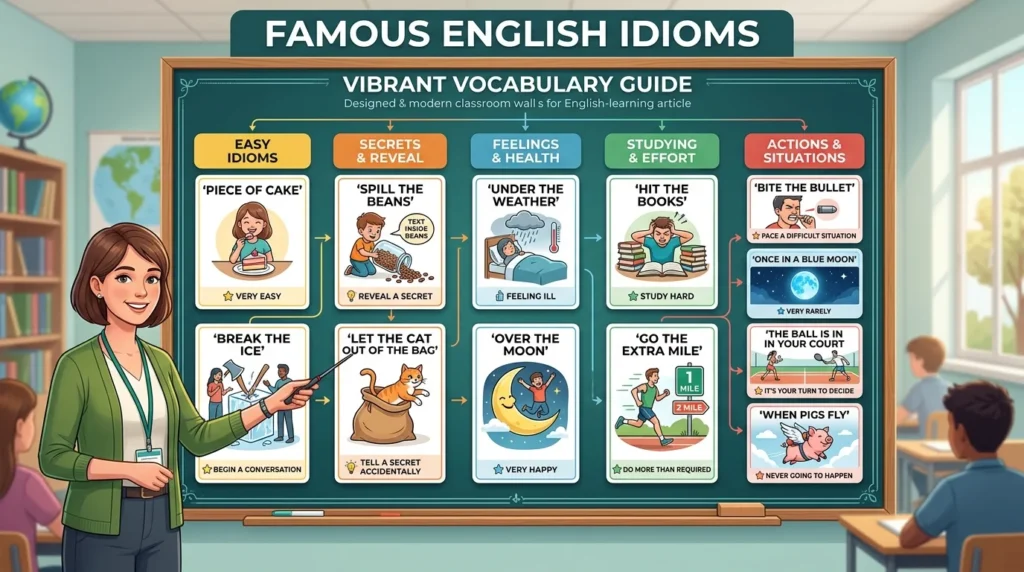
Once in a Blue Moon
Meaning: Something that happens very rarely.
Example:
I eat fast food once in a blue moon.
Common mistake: Don’t use it for something that happens regularly.
Usage note: It emphasizes rarity and is usually used in casual English.
Let the Cat Out of the Bag
Meaning: To reveal a secret, often accidentally.
Example:
Sam let the cat out of the bag when he mentioned the surprise gift.
Common mistake: Don’t confuse the expression with a literal situation involving an animal.
Usage note: It is similar to “spill the beans,” but context determines which expression sounds more natural.
Bite the Bullet
Meaning: To face a difficult or unpleasant situation with courage.
Example:
I didn’t want to make the phone call, but I decided to bite the bullet and do it.
Common mistake: It does not mean physically biting something.
Usage note: Use it when someone finally deals with something difficult instead of avoiding it.
Hit the Books
Meaning: To start studying seriously.
Example:
I have an exam tomorrow, so I need to hit the books tonight.
Common mistake: “Hit” does not have its physical meaning here.
Usage note: This informal expression is especially common in school and college contexts.
A Blessing in Disguise
Meaning: Something that initially seems bad but eventually produces a positive result.
Example:
Missing that flight turned out to be a blessing in disguise because I avoided the long delay.
Common mistake: Don’t use it for something that is obviously good from the beginning. There is usually an unexpected positive outcome after an initial problem.
Usage note: This expression is useful when looking back at a disappointing event that eventually had a benefit.
Call It a Day
Meaning: To stop working on something for the day.
Example:
We’ve finished the important tasks, so let’s call it a day.
Common mistake: It doesn’t necessarily mean the day has literally ended.
Usage note: It is common in workplaces, classrooms, and everyday conversations.
Pull Someone’s Leg
Meaning: To joke with or tease someone playfully.
Example:
Don’t worry—I’m just pulling your leg.
Common mistake: Don’t assume the phrase means someone is being deliberately cruel. Tone and context matter.
Usage note: It is informal and usually describes lighthearted teasing.
Go the Extra Mile
Meaning: To make more effort than is normally expected.
Example:
Our teacher went the extra mile to help us prepare for the exam.
Common mistake: Don’t use it when someone simply completes their basic responsibility.
Usage note: It often expresses appreciation for additional effort.
When Pigs Fly
Meaning: Something is extremely unlikely to happen or may never happen.
Example:
He says he’ll clean his room tomorrow—when pigs fly!
Common mistake: Don’t use this phrase for an ordinary future event.
Usage note: It is humorous and can sound sarcastic, so use it carefully in serious situations.
Keep an Eye On
Meaning: To watch, monitor, or take care of someone or something.
Example:
Could you keep an eye on my bag while I get some water?
Common mistake: Keep the expression in its standard form: “keep an eye on.”
Usage note: This is a very common everyday expression and can be used in both casual speech and many ordinary work situations.
Beat Around the Bush
Meaning: To avoid discussing the main topic directly.
Example:
Stop beating around the bush and tell me what happened.
Common mistake: Don’t use it simply because someone gives a long explanation. The important idea is avoiding the main point.
Usage note: It can sound impatient or critical, so consider your tone before using it.
The Ball Is in Your Court
Meaning: It is now your responsibility to take the next action or make the next decision.
Example:
I’ve sent you the proposal. The ball is in your court now.
Common mistake: It doesn’t necessarily refer to sports.
Usage note: This expression works well when discussing decisions, responsibilities, negotiations, or next steps.
Feeling Blue
Meaning: Feeling sad or unhappy.
Example:
I’ve been feeling blue since my best friend moved away.
Common mistake: Don’t assume that “blue” always represents sadness. Its meaning depends on the expression and context.
Usage note: This is an informal way to describe a low or sad mood.
Hold Your Horses
Meaning: Wait, slow down, or be patient.
Example:
Hold your horses! We haven’t checked all the details yet.
Common mistake: The phrase is informal and can sound impatient if spoken sharply.
Usage note: It is often playful when used among friends, but tone matters.
Idioms Lesson Plan: Easy Activities for Teaching Idioms
Literal vs. Figurative Meaning
One of the most important things to understand about idioms is that their literal words and figurative meanings are often different.
| Idiom | Literal idea | Figurative meaning |
|---|---|---|
| Piece of cake | A piece of dessert | Very easy |
| Break the ice | Break frozen water | Make people comfortable |
| Hit the books | Strike books | Study |
| Spill the beans | Pour out beans | Reveal a secret |
| Under the weather | Be beneath the weather | Feel unwell |
| Cost an arm and a leg | Lose body parts | Be extremely expensive |
This is why translating an idiom word for word can lead to confusion. Learn the whole expression and its context, rather than memorizing each word separately.
Common Mistakes Students Make With Idioms
Don’t Take Idioms Literally
If a friend says, “Let’s break the ice,” they probably want to make conversation more comfortable—not find a hammer and attack a frozen lake.
Don’t Treat Similar Idioms as Exact Synonyms
Some idioms have related meanings but are not interchangeable in every situation.
- Spill the beans → reveal a secret
- Let the cat out of the bag → reveal a secret, often accidentally
- Pull someone’s leg → joke or tease someone
Understanding these differences helps your English sound more natural.
Match the Idiom to the Tone
Some idioms are casual, humorous, or sarcastic.
For example, “when pigs fly” can sound playful or dismissive. It may be fine among friends but inappropriate when responding seriously to someone’s concern.
Learn the Fixed Expression
Idioms normally have established wording.
For example:
- Correct: spill the beans
- Incorrect: spill the bean
Changing a word can make the expression sound unnatural or change its meaning.
Don’t Overuse Idioms
Using an idiom in every sentence does not automatically make your English better. Choose an expression because it fits the situation, not simply because you know it.
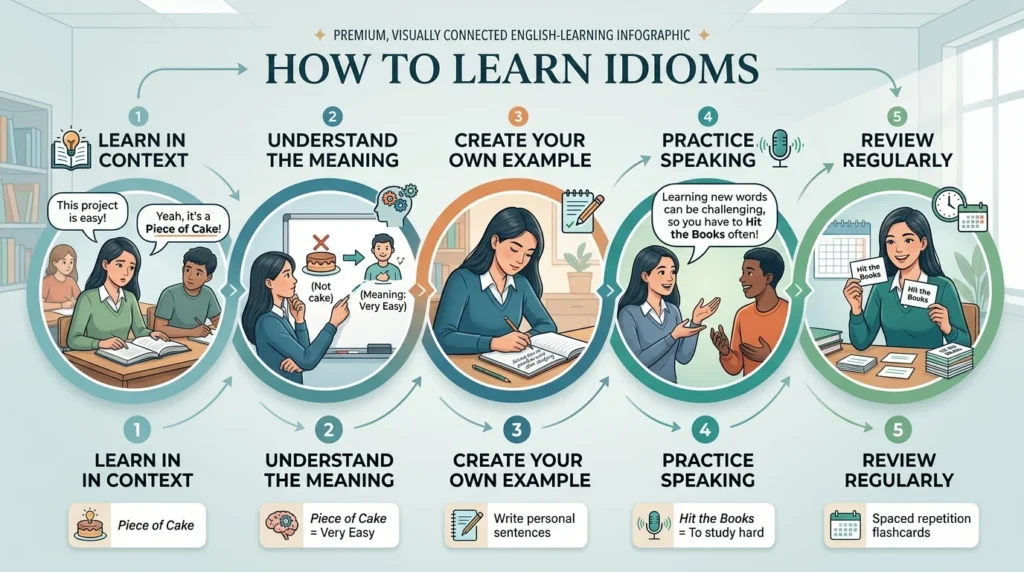
How to Learn Idioms Faster
A good way to remember idioms is to connect them with situations rather than memorizing isolated definitions.
1. Learn the Idiom in Context
Instead of memorizing only “hit the books = study,” imagine a student preparing for an exam.
2. Create a Personal Example
Write a sentence connected to your own life:
“I need to hit the books before Friday’s exam.”
Personal examples are easier to remember.
3. Learn the Tone
Ask whether the expression is:
- Formal
- Informal
- Humorous
- Sarcastic
- Neutral
This prevents you from using a casual expression in an unsuitable situation.
4. Compare Similar Expressions
Learning “spill the beans” alongside “let the cat out of the bag” helps you notice subtle differences instead of memorizing disconnected phrases.
5. Practice Speaking
Choose two idioms and use them naturally in conversation. Active use is more valuable than simply rereading a vocabulary list.
Halloween Idiom Costumes: 20+ Clever Ideas to Try
Quick Idiom Practice Quiz
Test yourself before moving on.
1. If a test is “a piece of cake,” what does that mean?
A. It is delicious.
B. It is very easy.
C. It is expensive.
2. If someone “spills the beans,” what have they done?
A. Revealed a secret.
B. Started cooking.
C. Made a mistake with food.
3. If “the ball is in your court,” what does it mean?
A. You are playing tennis.
B. You need to take the next action.
C. You lost something.
Answers:
1. B — Very easy
2. A — Revealed a secret
3. B — You need to take the next action
Why Idioms Matter for English Learners
Understanding common idioms can make everyday English easier to follow. You may encounter them in conversations, classrooms, books, movies, interviews, and online communication.
Learning idioms can help you:
- Understand figurative language
- Follow informal conversations
- Expand your vocabulary
- Recognize humor and sarcasm
- Speak more naturally
- Understand what speakers actually mean
You do not need to memorize hundreds of expressions at once. Start with a small group, understand their contexts, and gradually build your vocabulary.
Frequently Asked Questions About Flocabulary Idioms
What are Flocabulary idioms?
The phrase “Flocabulary idioms” can refer to learning idiomatic expressions through an engaging, educational approach associated with vocabulary instruction. Idioms themselves are fixed expressions whose figurative meanings differ from their literal meanings.
What is an easy idiom for beginners?
“Piece of cake” is a simple example because it means something is very easy and is commonly used in casual English.
Why are idioms difficult for English learners?
Idioms can be confusing because the individual words often do not reveal the actual meaning. For example, “hit the books” means to study, not physically hit books.
How can students memorize idioms?
Learn each idiom in context, create a personal example, notice its tone, compare it with similar expressions, and practice using it in conversation.
Can I use idioms in formal writing?
Some idioms can work in formal writing, but many are informal. Before using one, consider your audience, purpose, and tone. In academic or professional writing, a direct expression may sometimes be clearer.
Conclusion
Learning Flocabulary idioms can make English vocabulary practice more engaging, especially when expressions are learned through context, examples, and visual associations. Start with a few common phrases such as “break the ice,” “piece of cake,” and “hit the books,” rather than trying to memorize everything at once.
The real goal is not to fill your writing with idioms. It is to understand them accurately and use them naturally. Pick three idioms from this guide, create your own sentences, and practice them today. With regular exposure, expressions that once seemed confusing can become a natural part of your English vocabulary.

Clara Bennett writes for Meaning Match about English idioms, everyday expressions, meanings, and practical language usage, making phrases easy to understand.