
How do you teach students a phrase when its words do not mean exactly what they say? An idioms lesson plan is a structured classroom plan that helps students understand, recognize, and use idiomatic expressions in context.
Instead of asking students to memorize definitions, an effective lesson can introduce an idiom through a funny picture, short story, real-life situation, or classroom game. For example, students might explore “raining cats and dogs” and discover that it means raining heavily, not that cats and dogs are falling from the sky.
A well-planned lesson can then move from explanation to matching activities, sentence practice, role-play, group challenges, and a quick assessment. Whether you teach elementary, middle, or English language learners, this guide provides practical idiom activities, clear objectives, examples, and teaching ideas to help students understand figurative language and use idioms naturally.
Ready-to-Use Idioms Lesson Plan
Lesson Overview
| Category | Details |
|---|---|
| Topic | Common English Idioms |
| Lesson Length | 45 minutes |
| Level | Beginner to intermediate ESL/EFL |
| Age | Adaptable for children, teenagers, or adults |
| Main Skills | Vocabulary, speaking, reading, context |
| Target | 5–8 idioms in one lesson |
| Materials | Whiteboard, markers, idiom cards, worksheet |
| Assessment | Matching, context questions, speaking, exit ticket |
Learning Objectives
By the end of the lesson, students should be able to:
- identify common English idioms;
- explain their figurative meanings;
- distinguish literal meaning from idiomatic meaning;
- use several idioms in appropriate sentences;
- choose idioms that fit different situations;
- recognize when an idiom may sound too informal.
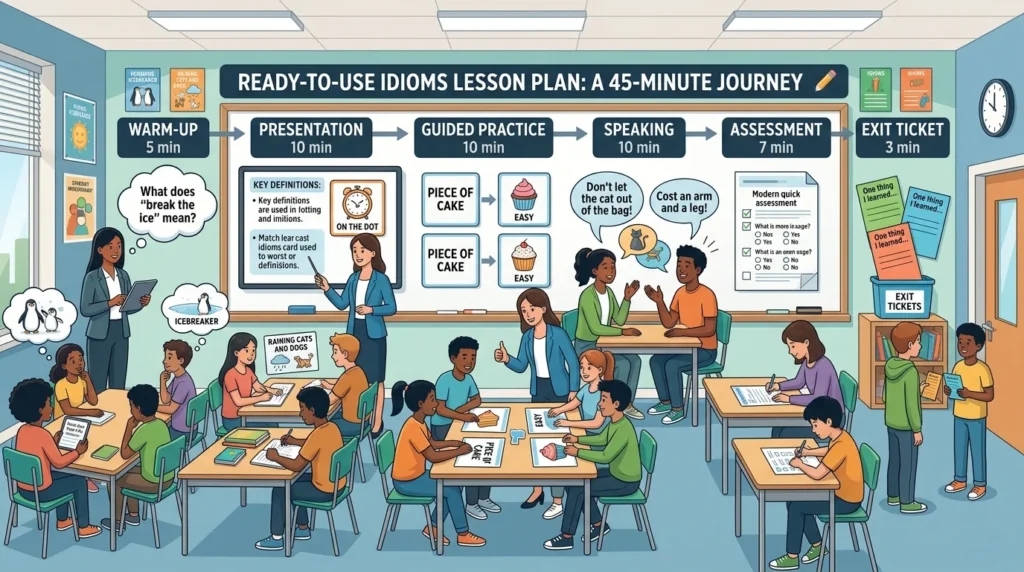
45-Minute Classroom Procedure
1. Warm-Up — 5 Minutes
Write this sentence on the board:
“The exam was a piece of cake.”
Ask students:
“Did the speaker actually eat cake?”
Let students guess what the sentence means.
Explain that English sometimes uses expressions where the intended meaning is different from the literal words. Tell students that these expressions are called idioms.
This creates curiosity before introducing definitions.
2. Presentation — 10 Minutes
Introduce five target idioms:
- piece of cake → very easy
- break the ice → make people feel more comfortable
- spill the beans → reveal a secret
- under the weather → feel unwell
- call it a day → stop working for the day
For each idiom, give:
- the expression;
- its figurative meaning;
- a short situation;
- one natural example sentence.
Avoid teaching too many new idioms at once. Five to eight expressions give students enough material to practice meaning and usage.
3. Guided Practice — 10 Minutes
Give students an idiom-matching activity.
Example:
| Idiom | Meaning |
|---|---|
| Piece of cake | Very easy |
| Spill the beans | Reveal a secret |
| Under the weather | Feel unwell |
| Break the ice | Make people comfortable |
| Call it a day | Stop working |
After students finish, discuss the answers together and ask them to explain why each idiom fits its meaning.
4. Speaking Practice — 10 Minutes
Put students into pairs.
Give each pair two or three situations.
Situation 1:
You meet a new classmate and want everyone to feel comfortable.
Possible idiom: Break the ice.
Situation 2:
Your friend tells you about a surprise party but asks you not to tell anyone.
Possible idiom: Spill the beans.
Situation 3:
You’ve studied for three hours and want to stop.
Possible idiom: Call it a day.
Students create short dialogues using the appropriate expressions.
5. Review and Assessment — 5 Minutes
Ask students:
- What does “piece of cake” mean?
- When would you say “under the weather”?
- Which idiom means “reveal a secret”?
- Can you use one idiom in your own sentence?
6. Exit Ticket — 5 Minutes
Before leaving, each student writes:
- one idiom;
- its figurative meaning;
- an original sentence using it.
Success check: A student demonstrates basic understanding when they can correctly explain the figurative meaning and use at least three target idioms appropriately.
Materials You Can Prepare Before Class
A simple idioms lesson does not require complicated resources.
Prepare:
- a whiteboard or projector;
- idiom cards;
- meaning cards;
- a short matching worksheet;
- situation cards;
- pens or pencils;
- exit tickets.
For younger learners, add pictures showing literal and figurative meanings.
Common Idioms for an Idioms Lesson Plan
You do not need to teach all 20 in one class. Use five to eight as the main lesson targets and keep the rest for review, homework, or future lessons.
Piece of Cake
Figurative meaning: Something very easy.
Example:
The homework was a piece of cake.
Common mistake: Students may interpret the phrase literally.
Usage note: Informal and common in everyday conversation.
Break the Ice
Figurative meaning: Make people feel more comfortable in a new or awkward situation.
Example:
The teacher told a joke to break the ice.
Common mistake: Using it for an ordinary conversation with no awkwardness or introduction involved.
Usage note: Useful for social and classroom situations.
Hit the Nail on the Head
Figurative meaning: Identify or describe something exactly.
Example:
You hit the nail on the head when you said we need more practice.
Common mistake: Shortening the fixed expression.
Usage note: Often used when agreeing with an accurate observation.
Spill the Beans
Figurative meaning: Reveal secret information.
Example:
Don’t spill the beans about the surprise party.
Common mistake: Treating it as a literal food-related expression.
Usage note: Informal and common in conversation.
Let the Cat Out of the Bag
Figurative meaning: Reveal a secret, often accidentally.
Example:
Tom let the cat out of the bag about the birthday surprise.
Common mistake: Using it when no secret is involved.
Usage note: Informal.
Under the Weather
Figurative meaning: Feel physically unwell.
Example:
I’m feeling under the weather today.
Common mistake: Using it simply to describe rainy weather.
Usage note: A common informal way to say someone feels sick.
Cost an Arm and a Leg
Figurative meaning: Be extremely expensive.
Example:
That car costs an arm and a leg.
Common mistake: Using it for something with an ordinary price.
Usage note: Useful when emphasizing a surprisingly high cost.
Once in a Blue Moon
Figurative meaning: Very rarely.
Example:
We eat at that restaurant once in a blue moon.
Common mistake: Confusing it with something that happens regularly.
Usage note: Useful for teaching frequency.
Bite the Bullet
Figurative meaning: Face a difficult or unpleasant situation with courage.
Example:
I was nervous about the presentation, but I bit the bullet and did it.
Common mistake: Assuming the phrase describes a literal action.
Usage note: Usually refers to accepting something difficult that must be done.
Call It a Day
Figurative meaning: Stop working on something for the day.
Example:
We’ve finished the main task, so let’s call it a day.
Common mistake: Thinking it means naming or announcing a day.
Usage note: Common in work and study contexts.
On the Same Page
Figurative meaning: Have the same understanding, expectations, or goals.
Example:
Let’s meet before the project starts so we’re on the same page.
Common mistake: Understanding it only as reading the same page.
Usage note: Particularly useful for school and workplace English.
Go the Extra Mile
Figurative meaning: Make additional effort.
Example:
Our teacher went the extra mile to help us understand the lesson.
Common mistake: Using it only to describe physical distance.
Usage note: Often expresses appreciation for extra effort.
Pull Someone’s Leg
Figurative meaning: Joke with or tease someone.
Example:
Relax, I’m just pulling your leg.
Common mistake: Taking the physical meaning literally.
Usage note: Informal and often playful.
Keep an Eye On
Figurative meaning: Watch or monitor something or someone.
Example:
Can you keep an eye on my bag?
Common mistake: Interpreting “eye” literally.
Usage note: Very common in everyday English.
A Blessing in Disguise
Figurative meaning: Something that seems negative at first but eventually produces a positive result.
Example:
Missing that bus was a blessing in disguise because I met an old friend.
Common mistake: Assuming every bad event automatically has a positive outcome.
Usage note: Use it when the unexpected positive result is clear.
Beat Around the Bush
Figurative meaning: Avoid discussing the main point directly.
Example:
Stop beating around the bush and tell me what happened.
Common mistake: Thinking it refers to physically walking around a bush.
Usage note: Often used when someone wants direct communication.
Bark Up the Wrong Tree
Figurative meaning: Pursue the wrong person, idea, or course of action.
Example:
If you think I took your book, you’re barking up the wrong tree.
Common mistake: Using it to describe every kind of mistake.
Usage note: Informal and useful in conversational English.
Hold Your Horses
Figurative meaning: Wait, slow down, or be patient.
Example:
Hold your horses! We haven’t finished yet.
Common mistake: Using it in a highly formal situation.
Usage note: Informal and sometimes playful.
Feeling Blue
Figurative meaning: Feeling sad.
Example:
She’s feeling blue because her friend moved away.
Common mistake: Using it automatically for every serious emotional situation.
Usage note: Generally informal and appropriate for ordinary sadness.
The Ball Is in Your Court
Figurative meaning: It is now someone else’s responsibility or turn to act.
Example:
I’ve sent the proposal, so the ball is in your court.
Common mistake: Using it when there is no expected action or decision from the other person.
Usage note: Useful for discussions about decisions, responsibilities, and next steps.
Halloween Idiom Costumes: 20+ Clever Ideas to Try
Fun Idiom Activities for Students
Idiom Matching Game
Create two sets of cards:
- idioms;
- meanings.
Students work individually or in pairs to match them.
For an extra challenge, add incorrect meanings and ask students to identify the distractors.
Idiom Charades
Give one student an idiom and ask them to act out its meaning while classmates guess.
This works especially well with expressions such as hold your horses, break the ice, and keep an eye on.
Complete the Sentence
Give students sentences with missing expressions:
- The test was a ______.
- Don’t ______ about the surprise.
- I’m feeling ______ today.
Students choose an appropriate idiom from a word bank.
Idiom Story Challenge
Give students five idioms and ask them to create a short story using all five.
This moves students beyond memorization and encourages meaningful language production.
Common Mistakes Students Make With Idioms
Taking Idioms Literally
If someone says:
“Break a leg!”
a learner may wonder why anyone would want another person to get injured.
Explain that the intended meaning depends on the expression and context.
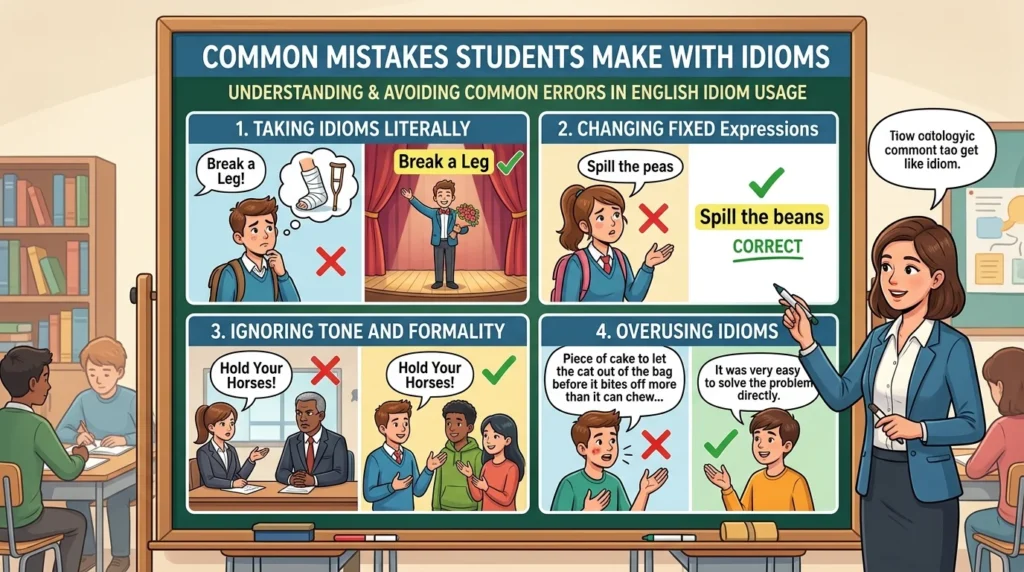
Changing Fixed Expressions
Idioms generally have established wording.
Correct: Spill the beans.
Incorrect: Spill the peas.
Students should learn the complete expression rather than freely replacing individual words.
Ignoring Tone and Formality
Not every idiom fits every situation.
For example, “Hold your horses” is informal and may sound playful or impatient depending on the speaker’s tone.
Ask students to consider:
- Who am I talking to?
- Is this a formal or casual situation?
- Could this expression sound humorous or rude?
- Would a simpler phrase be clearer?
Overusing Idioms
Fluent English does not mean putting an idiom into every sentence.
Teach students to use idioms when they naturally fit the context.
Idioms Lesson Plan for Different Learner Levels
Beginner Students
Use:
- 3–5 common idioms;
- pictures;
- simple definitions;
- matching tasks;
- sentence starters;
- repetition.
Give students a word bank rather than expecting them to produce everything independently.
Intermediate Students
Add:
- situation-based questions;
- short dialogues;
- role-play;
- tone and formality;
- error correction;
- original sentences.
Advanced Students
Challenge learners to:
- compare similar idioms;
- identify register and nuance;
- find idioms in authentic English;
- rewrite literal sentences using figurative language;
- create conversations or stories using several idioms.
Idioms for Kids With Pictures: 24+ Fun Examples
Differentiation for Mixed-Ability Classes
A single idioms lesson can work for students with different abilities.
For students who need extra support:
- provide pictures;
- reduce the number of target idioms;
- give sentence starters;
- provide a meaning word bank;
- pair them with supportive classmates.
For stronger students:
- remove the word bank;
- ask for original dialogues;
- compare two related expressions;
- explain why one idiom fits a situation better than another;
- identify whether an expression is formal, informal, or conversational.
This allows everyone to work toward the same lesson objective at an appropriate level.
Homework and Follow-Up Practice
Ask students to find three idioms outside the classroom.
They can find them in:
- a book;
- a TV show;
- a movie;
- a conversation;
- a news or online article.
For each idiom, students record:
- the expression;
- its meaning;
- the sentence or situation where they found it;
- their own example sentence.
In the next lesson, students can share one discovery with the class.
How to Check Idiom Understanding
Do not rely only on memorized definitions.
Use three levels of assessment:
Recognition:
Can the student identify the correct meaning?
Context:
Can the student choose an idiom that fits a situation?
Production:
Can the student use the idiom naturally in a sentence or conversation?
A student who can successfully complete all three has a stronger practical understanding of the expression.
Frequently Asked Questions About Idioms Lesson Plans
What is an idioms lesson plan?
An idioms lesson plan is a structured guide for teaching learners how to understand, recognize, and use idiomatic expressions in context.
How many idioms should I teach in one lesson?
Five to eight idioms are often easier to teach effectively in one lesson than a very large list. The appropriate number depends on students’ level, age, lesson length, and previous knowledge.
What is the best way to teach idioms?
Teach idioms through context, situations, examples, and active practice. Students should learn the figurative meaning as well as when and how the expression is naturally used.
How can I make an idiom lesson more engaging?
Use matching games, charades, role-play, sentence challenges, short dialogues, and story-building. Activities give students opportunities to use idioms rather than simply memorize definitions.
Should students use idioms in formal writing?
It depends on the expression and context. Many everyday idioms are informal or conversational, so students should learn to consider audience, purpose, tone, and register before using them in formal writing.
Conclusion
A successful idioms lesson plan should help students do more than memorize unusual phrases. They should understand the difference between literal and figurative meaning, recognize idioms in context, and know when an expression sounds natural.
Start with five to eight useful idioms, introduce them through realistic situations, give students plenty of guided practice, and finish with speaking or writing activities. Then reinforce learning through homework and real-world examples.
The goal is simple: teach fewer idioms well, give students meaningful practice, and help them use figurative English naturally and confidently.

Sophie Collins writes for Meaning Match about English idioms, American and British expressions, meanings, usage, and everyday language differences.