
Want a Halloween costume that makes people laugh and think twice? Idioms Halloween costumes turn familiar English expressions into funny, creative outfits by bringing their literal words to life. Instead of dressing as a typical ghost or witch, you could become a “piece of cake,” dress as a flying pig for “when pigs fly,” or create a cat-and-bag costume for “let the cat out of the bag.” The fun comes from the contrast between the silly costume and the idiom’s actual figurative meaning.
These ideas can work for kids, teens, adults, couples, friends, classroom activities, or group costumes, and many can be made with simple DIY materials. If you’re searching for idioms Halloween costumes, this guide brings together funny, clever, and creative ideas based on idioms and related expressions, along with their meanings and easy costume concepts to help you find an idea that stands out.
What Are Idiom Halloween Costumes?
Idioms Halloween costumes turn the literal words of an English expression into a fun, recognizable outfit. Think of a giant slice of cake for “piece of cake,” a pig with wings for “when pigs fly,” or beans spilling from a bowl for “spill the beans.”
The trick is simple: show the literal meaning so people can guess the figurative meaning. That makes these costumes perfect for Halloween parties, school activities, teachers, students, friends, and anyone who wants a costume with a clever language-learning twist.
Why Are Idiom Halloween Costumes So Fun?
Unlike an ordinary costume, an idiom-based outfit gives people something to figure out. It combines humor, creativity, and figurative language in one idea.
A good idiom costume usually has three parts:
- The idiom — the expression you want to represent
- The literal visual — objects that show the words
- The figurative explanation — what the idiom actually means
For example, “hold your horses” does not normally mean physically holding horses. It means wait or slow down. A cowboy outfit holding toy horses makes the joke immediately visible.
This also makes idiom costumes useful for English learners because the costume connects the expression with a memorable visual.
Idiom Halloween Costumes at a Glance
| Idiom | Figurative meaning | Easy costume clue | Best for |
|---|---|---|---|
| Spill the beans | Reveal a secret | Bowl of beans | Solo/school |
| Piece of cake | Very easy | Cake slice | Solo |
| Break the ice | Make people comfortable | Ice block | Friends/school |
| Under the weather | Feel unwell | Clouds + umbrella | Solo |
| Elephant in the room | Obvious ignored issue | Elephant + room | Groups |
| When pigs fly | Very unlikely | Pig + wings | Solo |
| Cost an arm and a leg | Very expensive | Fake limbs + price tags | Funny parties |
| Hit the nail on the head | Be exactly right | Hammer + nail | School |
| Couch potato | Inactive person | Potato + couch | Solo |
| Raining cats and dogs | Heavy rain | Umbrella + animals | Friends |
| Butterflies in my stomach | Nervous/excited | Butterflies + stomach | Solo |
| Let the cat out of the bag | Reveal a secret | Cat + bag | Solo |
| Hold your horses | Wait/slow down | Toy horses | Cowboy theme |
| On cloud nine | Extremely happy | Cloud + 9 | Solo |
| Bite the bullet | Face difficulty | Cartoon bullet | Funny costume |
| Kick the bucket | Die | Bucket + cartoon foot | Adult parties |
| Go the extra mile | Make extra effort | Road + mile sign | School/work |
| Barking up the wrong tree | Follow the wrong lead | Dog + tree | Friends |
| Pull someone’s leg | Joke with someone | Fake leg | Couples/friends |
| Keep your chin up | Stay positive | Raised chin | School |
Spill the Beans
Literal meaning: Spill a container of beans.
Figurative meaning: Reveal a secret or confidential information.
Costume idea: Wear an apron, carry a bowl of beans, and let some beans appear to have spilled. Add a small “SECRET!” sign.
Example: “Don’t spill the beans about the surprise party.”
Common mistake: The idiom is about revealing information, not simply dropping food.
Usage tip: It is informal and works well in casual conversations.
DIY difficulty: Easy — bowl + dried beans + apron.
Piece of Cake
Literal meaning: A slice or piece of cake.
Figurative meaning: Something that is very easy.
Costume idea: Make a large cardboard cake slice and wear it like a sandwich board. Add “Very Easy!” underneath the idiom.
Example: “The homework was a piece of cake.”
Common mistake: It describes ease, not simply something delicious or enjoyable.
Usage tip: This is a common informal expression.
DIY difficulty: Very easy.
Break the Ice
Literal meaning: Break a block of ice.
Figurative meaning: Make people feel more comfortable in a new or awkward situation.
Costume idea: Use cardboard “ice” pieces around a blue outfit and carry a toy hammer.
Example: “The teacher told a joke to break the ice.”
Common mistake: The idiom is not simply about breaking something.
Usage tip: It is useful for meetings, introductions, parties, and new social situations.
DIY difficulty: Easy.
Under the Weather
Literal meaning: Being physically underneath clouds or weather.
Figurative meaning: Feeling sick or unwell.
Costume idea: Wear pajamas or a cozy outfit, carry an umbrella, and attach a large cloud above your head.
Example: “I’m feeling under the weather today.”
Common mistake: It usually refers to feeling unwell, not literally being outside during bad weather.
Usage tip: It often describes mild or temporary illness.
DIY difficulty: Easy.
The Elephant in the Room
Literal meaning: An elephant standing inside a room.
Figurative meaning: An obvious problem or subject that everyone notices but avoids discussing.
Costume idea: Wear elephant ears or an elephant costume while standing inside a cardboard “room.”
Example: “The money problem was the elephant in the room.”
Common mistake: It does not simply mean “a big problem.” The important idea is that people are avoiding an obvious issue.
Usage tip: This expression is often used in serious conversations, so the costume works best when the visual joke is clearly playful.
DIY difficulty: Medium.
When Pigs Fly
Literal meaning: A pig flying through the air.
Figurative meaning: Something is extremely unlikely to happen.
Costume idea: Wear pig ears and a snout with lightweight cardboard wings.
Example: “He’ll clean his room when pigs fly.”
Common mistake: Use it for something considered highly unlikely, not merely difficult.
Usage tip: It is humorous and informal.
DIY difficulty: Very easy.
Cost an Arm and a Leg
Literal meaning: Paying with an arm and a leg.
Figurative meaning: Something is extremely expensive.
Costume idea: Use harmless cardboard or fabric fake limbs with oversized price tags.
Example: “That new phone cost an arm and a leg.”
Common mistake: Don’t use it for something that is only slightly expensive.
Usage tip: Keep the costume cartoonish rather than realistic.
DIY difficulty: Medium.
Hit the Nail on the Head
Literal meaning: Hitting a nail with a hammer.
Figurative meaning: Being exactly right or identifying something accurately.
Costume idea: Wear a construction helmet and carry a toy hammer with a large cardboard nail.
Example: “You hit the nail on the head.”
Common mistake: The idiom means being correct, not simply hitting a nail.
Usage tip: It is useful when agreeing with an accurate observation.
DIY difficulty: Easy.
Couch Potato
Literal meaning: A potato sitting on a couch.
Figurative meaning: A person who spends a lot of time sitting around, often watching television.
Costume idea: Wear brown clothing or a potato costume and carry a cushion or sit in a small chair.
Example: “I was a couch potato all weekend.”
Common mistake: It is not a literal description of a vegetable.
Usage tip: This is casual and humorous.
DIY difficulty: Easy.
Raining Cats and Dogs
Literal meaning: Cats and dogs falling from the sky.
Figurative meaning: Raining very heavily.
Costume idea: Carry an umbrella with lightweight toy or cardboard cats and dogs attached underneath.
Example: “It was raining cats and dogs yesterday.”
Common mistake: It describes heavy rain, not just ordinary rainfall.
Usage tip: It is playful and especially effective as a visual costume.
DIY difficulty: Medium.
Butterflies in My Stomach
Literal meaning: Butterflies flying around inside someone’s stomach.
Figurative meaning: Feeling nervous or excited, especially before an important event.
Costume idea: Wear a shirt decorated with butterflies and create a stomach-shaped panel showing butterflies inside.
Example: “I had butterflies in my stomach before my presentation.”
Common mistake: The expression usually describes emotions, not an actual stomach condition.
Usage tip: Context can show whether the feeling is nervousness, excitement, or both.
DIY difficulty: Easy.
Let the Cat Out of the Bag
Literal meaning: A cat escaping from a bag.
Figurative meaning: Reveal a secret, often accidentally.
Costume idea: Carry a large bag with a toy cat popping out and add an “Oops!” sign.
Example: “She let the cat out of the bag about the surprise.”
Common mistake: It is not simply about a cat being outside a bag.
Usage tip: The expression often suggests that information was revealed unintentionally.
DIY difficulty: Easy.
Hold Your Horses
Literal meaning: Physically holding horses.
Figurative meaning: Wait, slow down, or be patient.
Costume idea: Wear a cowboy or cowgirl outfit and hold toy horses with a large “WAIT!” sign.
Example: “Hold your horses! We haven’t finished yet.”
Common mistake: It does not necessarily mean stopping forever; it often means slowing down before acting.
Usage tip: Informal and often playful.
DIY difficulty: Easy.
On Cloud Nine
Literal meaning: Sitting or floating on cloud number nine.
Figurative meaning: Extremely happy.
Costume idea: Create a fluffy cloud costume with a large number 9 attached.
Example: “She was on cloud nine after winning the competition.”
Common mistake: It describes strong happiness rather than simply feeling calm.
Usage tip: Great for cheerful, colorful costumes.
DIY difficulty: Easy.
Bite the Bullet
Literal meaning: Biting a bullet.
Figurative meaning: Face a difficult or unpleasant situation with courage.
Costume idea: Use a large, clearly cartoon-style cardboard bullet as a prop rather than anything realistic.
Example: “I hate public speaking, but I’ll bite the bullet.”
Common mistake: It does not mean agreeing with everything or giving up.
Usage tip: Best used in casual contexts where the figurative meaning is clear.
DIY difficulty: Easy.
Kick the Bucket
Literal meaning: Kicking a bucket.
Figurative meaning: An informal expression meaning to die.
Costume idea: Use a cartoon bucket and a large cardboard foot for a clearly humorous visual.
Example: “The old character in the story finally kicked the bucket.”
Common mistake: Avoid using this expression casually when discussing someone’s recent real-life death because it can sound insensitive.
Usage tip: Better suited to humorous or adult settings than serious situations.
DIY difficulty: Very easy.
Go the Extra Mile
Literal meaning: Traveling one additional mile.
Figurative meaning: Make extra effort to help or achieve something.
Costume idea: Wear running clothes and carry a road sign saying “1 Extra Mile.”
Example: “She went the extra mile to help her students.”
Common mistake: It does not require physical travel.
Usage tip: Particularly useful in school, workplace, and customer-service contexts.
DIY difficulty: Easy.
Barking Up the Wrong Tree
Literal meaning: A dog barking at the wrong tree.
Figurative meaning: Following the wrong idea, person, or course of action.
Costume idea: Wear dog ears and stand beside a cardboard tree with a large question mark.
Example: “If you think I took your book, you’re barking up the wrong tree.”
Common mistake: It means more than simply making a mistake; the effort is directed toward the wrong target.
Usage tip: Often used when correcting someone’s assumption.
DIY difficulty: Easy.
Pull Someone’s Leg
Literal meaning: Pulling another person’s leg.
Figurative meaning: Joke with or tease someone playfully.
Costume idea: Create an oversized cardboard leg and have one person pretend to pull it.
Example: “Don’t worry—I’m just pulling your leg.”
Common mistake: It usually means playful teasing, not serious deception.
Usage tip: Excellent for friends or couples costumes.
DIY difficulty: Easy.
Keep Your Chin Up
Literal meaning: Holding your chin in a raised position.
Figurative meaning: Stay positive and hopeful during a difficult situation.
Costume idea: Wear a shirt with a large cardboard chin pointing upward and a sign saying “Stay Positive!”
Example: “Keep your chin up; things will get better.”
Common mistake: The expression is about staying hopeful, not just physical posture.
Usage tip: It works particularly well for encouraging, school-friendly costumes.
DIY difficulty: Very easy.
Idioms for Kids With Pictures: 24+ Fun Examples
Easy Last-Minute Idiom Halloween Costumes
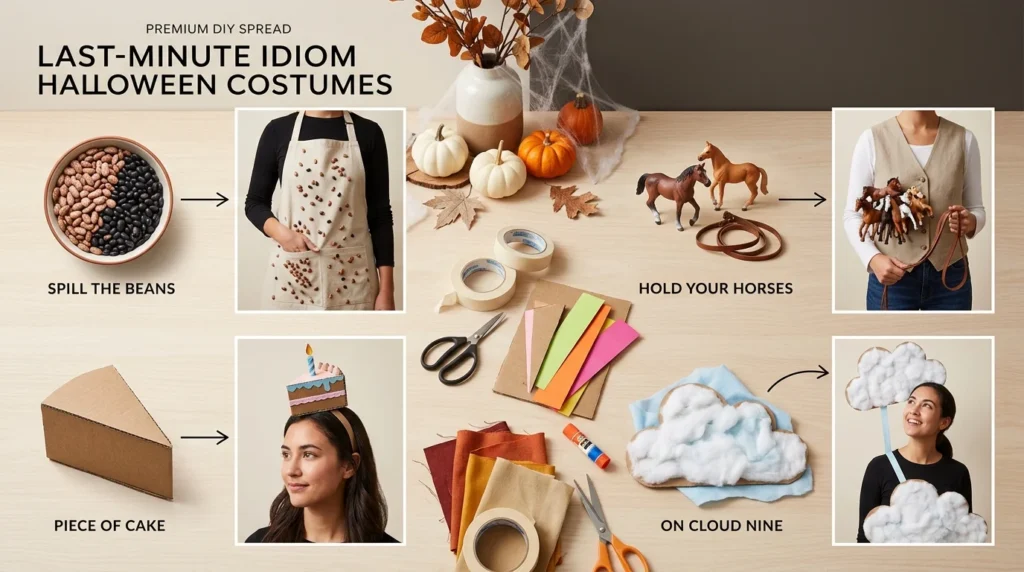
Don’t have time to build an elaborate costume? You can create several of these with things you already have at home.
10-Minute Ideas
- Piece of Cake: Make a cake slice from cardboard.
- Hold Your Horses: Use toy horses or horse pictures.
- When Pigs Fly: Add paper wings to a pig mask.
- Spill the Beans: Carry a bowl of beans.
- On Cloud Nine: Use cotton or paper to make a cloud and add “9.”
- Keep Your Chin Up: Add a cardboard chin to a plain shirt.
The formula is simple:
Household object + literal idiom clue + small meaning card = quick costume.
How to Make an Idiom Costume at Home
You don’t need expensive Halloween supplies. Follow these steps:
- Choose a familiar idiom.
- Write down its literal objects.
- Find household items that represent those objects.
- Make one large visual clue.
- Add the idiom’s name on a card if people may not recognize it.
- Add the figurative meaning for a school or educational event.
- Keep the design simple enough to understand at a glance.
The strongest costumes usually communicate the joke in just a few seconds.
Best Idiom Costumes for School, Friends, Couples, and Groups
For Students
Choose simple, safe ideas such as:
- Piece of Cake
- Break the Ice
- Hold Your Horses
- On Cloud Nine
- Keep Your Chin Up
These can also become classroom activities where students explain the figurative meaning.
For Couples
Try:
- Pull Someone’s Leg
- Break the Ice
- Raining Cats and Dogs
- Barking Up the Wrong Tree
Two-person costumes work best when each person represents a different part of the expression.
For Friends or Groups
Good group concepts include:
- The Elephant in the Room
- Raining Cats and Dogs
- Cost an Arm and a Leg
- Barking Up the Wrong Tree
Give every person one recognizable part of the idiom so the whole group tells the joke together.
Turn Halloween Into an Idiom Learning Activity
Teachers can make these costumes educational as well as entertaining.
Try an Idiom Costume Challenge:
- Give each student an idiom.
- Ask them to create its literal meaning as a costume.
- Let classmates guess the expression.
- Ask the student to explain its figurative meaning.
- Have them use it in an original sentence.
This teaches literal meaning, figurative meaning, context, and real-world usage without turning Halloween into a traditional vocabulary lesson.
Illustrated Idioms: 30+ Expressions You Can See and Understand
Common Mistakes When Using Idiom Costumes
Don’t Confuse Literal and Figurative Meaning
The costume should normally represent the literal words, while the explanation gives the figurative meaning.
Don’t Choose an Idiom Nobody Can Recognize
A very obscure expression may make the guessing game frustrating. Familiar expressions usually work better for parties and classrooms.
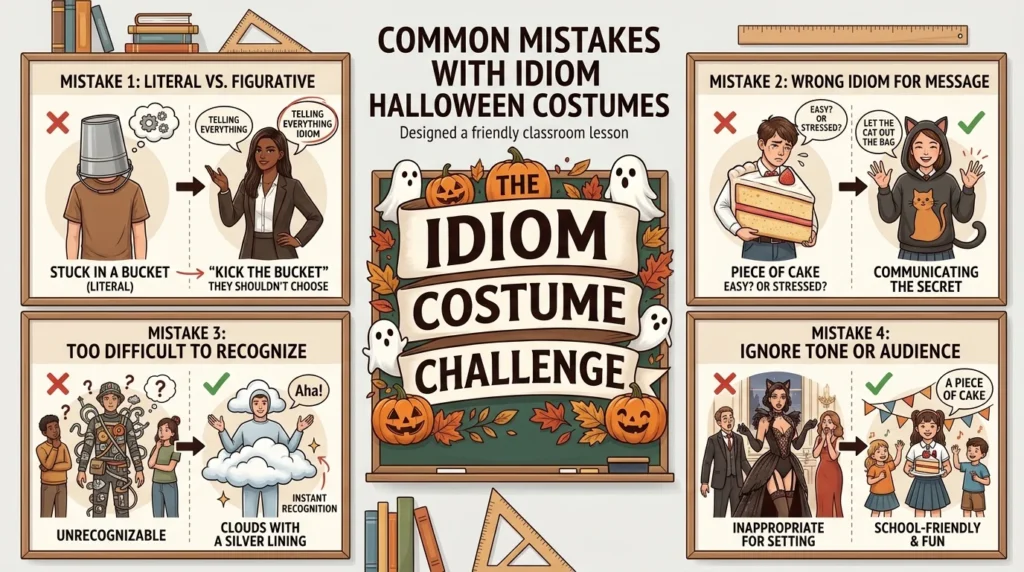
Don’t Forget Context
An idiom can be funny in one situation but inappropriate in another. For example, “kick the bucket” is informal and can sound insensitive when discussing real bereavement.
Don’t Make the Costume Too Complicated
Too many props can hide the main idea. One strong visual clue is usually better than ten small ones.
Don’t Treat Related Idioms as Identical
Some expressions share an idea but aren’t interchangeable. “Spill the beans” and “let the cat out of the bag” can both mean revealing a secret, but the second often suggests that the secret was revealed accidentally.
Frequently Asked Questions
What are idiom Halloween costumes?
Idiom Halloween costumes are outfits inspired by English idiomatic expressions. They usually show the literal meaning of an idiom while the expression itself has a different figurative meaning.
What is the easiest idiom costume to make?
Piece of Cake, Spill the Beans, Hold Your Horses, When Pigs Fly, and On Cloud Nine are among the easiest because their literal meanings can be represented with simple household objects or cardboard props.
What are good idiom costumes for school?
School-friendly choices include Break the Ice, Piece of Cake, Hold Your Horses, Go the Extra Mile, Butterflies in My Stomach, and Keep Your Chin Up. They also provide opportunities to explain figurative language.
What are some last-minute DIY idiom costumes?
Try Spill the Beans, Piece of Cake, Hold Your Horses, When Pigs Fly, or On Cloud Nine. Most can be created quickly with cardboard, paper, clothing, and household objects.
Can idiom costumes work for couples or groups?
Yes. Expressions such as Pull Someone’s Leg, Raining Cats and Dogs, Barking Up the Wrong Tree, and The Elephant in the Room can be divided between two or more people.
Conclusion
The best idiom Halloween costumes combine a familiar expression, one clever visual idea, and a clear explanation. You don’t need an expensive outfit or complicated decorations—cardboard, paper, household objects, and a little creativity can be enough.
Choose an idiom, turn its literal words into a costume, and let people guess what it means. Whether you’re dressing up for school, a party, an office event, or a night with friends, an idiom-inspired costume can make Halloween both funny and memorable.
Pick your favorite expression, make the literal meaning visible, and let the costume tell the story.

Daniel Mercer is a Meaning Match writer covering English idioms, vocabulary, expressions, and language usage with clear meanings and practical examples.