
Why do students sometimes understand every word in a sentence but still have no idea what the sentence means? Teaching English idioms can be challenging because idioms often have meanings that cannot be understood by translating each word literally.
Effective idiom teaching helps students connect the figurative meaning with the right context, examples, and everyday situations. For example, when teaching “break the ice,” students need to learn that it means helping people feel more comfortable in a new or awkward situation—not physically breaking ice. Using short stories, pictures, conversations, matching activities, and real-life examples can make idioms easier to understand and remember.
It is also important to teach students when and how an idiom is naturally used, because some expressions are informal or context-specific. If you’re looking for ways of teaching English idioms, this guide explains practical strategies, classroom activities, examples, and simple techniques that can make idiom learning more engaging and meaningful.
What Are English Idioms?
An English idiom is a fixed or established expression whose overall meaning cannot always be understood by interpreting each word literally.
For example:
“The exam was a piece of cake.”
The speaker is not talking about eating cake. “A piece of cake” means that something was very easy.
This difference between the literal words and the intended meaning is one of the main reasons idioms can be difficult for English learners.
When teaching an idiom, students should understand four things:
- What the words literally suggest
- What the whole expression actually means
- When people naturally use it
- What tone or level of formality it carries
The goal is not simply to make students memorize a definition. The goal is to help them recognize, understand, and appropriately use the expression.
Why Are English Idioms Difficult to Teach?
Idioms can be confusing even when students know every individual word in the expression.
Idioms Are Not Usually Literal
A learner who knows the words spill and beans may still not understand:
“Don’t spill the beans.”
The individual vocabulary is familiar, but the combined meaning is different.
Direct Translation Can Cause Problems
An idiom may not have an exact equivalent in another language. Even when a similar expression exists, the meaning, tone, or usage may differ.
Context Changes Understanding
Students need to see how an idiom functions inside a real sentence or conversation.
Compare:
“I’m under the weather.”
with:
“We sat under the weather shelter.”
The same individual words can appear in completely different situations, but only the first example uses the idiom.
Idioms Have Different Tones
Some expressions sound friendly, some informal, some humorous, and some more appropriate for professional conversation.
Students therefore need to learn meaning and usage together.
Learners May Know an Idiom but Avoid Using It
Understanding an expression when reading or listening does not automatically mean students can produce it naturally.
That is why good idiom lessons should move through several stages:
recognition → understanding → controlled practice → communication → review
How to Teach English Idioms Effectively
A strong idiom lesson does not begin with a long vocabulary list. Start with a situation and allow students to discover the meaning.
1. Start With a Realistic Context
Give students a short situation before explaining the idiom.
For example:
Sara has an important presentation tomorrow. She has practiced several times, but now she is becoming nervous and thinking about canceling it.
Then introduce:
“Sara is getting cold feet.”
Ask:
What do you think “getting cold feet” means here?
This gives students a reason to think about the expression instead of immediately memorizing a definition.
2. Let Students Guess the Meaning
Encourage learners to use:
- surrounding words
- the situation
- emotions
- cause and effect
- previous knowledge
- visual clues
They do not have to guess perfectly.
The important part is learning that context can provide clues about unfamiliar figurative language.
3. Explain Literal and Figurative Meaning
Once students have guessed, show both meanings.
Idiom: Get cold feet
Literal: Feet becoming physically cold.
Figurative: Becoming nervous or losing confidence before an important event.
This simple comparison helps students understand why the expression should not be interpreted word by word.
4. Teach the Expression as a Whole
Idioms are often best remembered as complete language units.
Instead of teaching:
cold = low temperature
feet = body parts
teach:
get cold feet = become nervous before doing something
Students should also notice the grammatical form:
- I got cold feet.
- She is getting cold feet.
- He got cold feet before the interview.

5. Explain Tone and Register
Tell students how the expression sounds.
For example:
Hold your horses is informal and playful.
The ball is in your court can work in conversational and some professional contexts, but it can sound direct depending on the situation.
This prevents students from using every idiom in every type of communication.
6. Give Natural Examples
Use examples connected to situations students understand.
Instead of:
“John used an idiom.”
Use:
“I studied for three hours, so I’m going to call it a day.”
Natural examples show students what real usage looks like.
7. Give Controlled Practice
Before asking students to have a free conversation, give them manageable exercises.
For example:
Choose the correct idiom:
Maria was nervous before her speech and almost canceled it. She ______.
a. spilled the beans
b. got cold feet
c. called it a day
Answer: got cold feet
8. Move to Communication
Once students understand the expression, ask them to create their own sentences, dialogues, stories, or role-plays.
This is where passive knowledge can become active language.
9. Review the Idiom Later
Don’t teach an idiom once and immediately forget it.
Bring it back during:
- reading
- speaking
- writing
- warm-up activities
- quizzes
- classroom conversations
Repeated exposure helps students recognize expressions more easily.
Most Famous English Idioms to Teach
The following idioms cover common situations involving ease, emotions, communication, decisions, relationships, work, and everyday life.
A Piece of Cake
Word-by-word meaning:
A piece is a portion, while cake is a baked sweet food.
Idiomatic/figurative meaning:
Something that is very easy.
Example sentences:
- The first exercise was a piece of cake.
- Once you understand the rules, the game is a piece of cake.
Common error:
Students sometimes use this expression to mean something is delicious. The idiom describes ease, not taste.
Usage note:
It is informal and common in everyday conversation.
Teaching idea:
Ask students to name something they find extremely easy and describe it as a piece of cake.
Break the Ice
Word-by-word meaning:
To break ice means to crack or separate frozen water.
Idiomatic/figurative meaning:
To make people feel more comfortable in a new or awkward social situation.
Example sentences:
- The teacher told a funny story to break the ice.
- We played a short game to break the ice.
Common error:
Students may understand it as literally breaking ice.
Usage note:
It is useful when discussing introductions, meetings, parties, classrooms, and new groups.
Teaching idea:
Ask students what activity they could use to break the ice on the first day of class.
Hit the Nail on the Head
Word-by-word meaning:
To hit a nail means to strike it, usually with a tool.
Idiomatic/figurative meaning:
To identify something exactly or describe the main point correctly.
Example sentences:
- You hit the nail on the head when you said practice was the problem.
- Her explanation hit the nail on the head.
Common error:
Do not use it simply whenever someone physically hits an object.
Usage note:
It is often used when agreeing with an accurate observation.
Teaching idea:
Give students three possible explanations for a problem and ask which one hits the nail on the head.
Spill the Beans
Word-by-word meaning:
To spill beans means to accidentally drop or pour them out.
Idiomatic/figurative meaning:
To reveal secret information.
Example sentences:
- Don’t spill the beans about the surprise.
- Liam spilled the beans before the announcement.
Common error:
“Pour the beans” is not the normal expression when you mean “reveal a secret.”
Usage note:
It is informal and can sound playful.
Teaching idea:
Create a pretend surprise and ask students to role-play someone trying not to spill the beans.
Once in a Blue Moon
Word-by-word meaning:
Once means one time, blue is a color, and moon refers to Earth’s moon.
Idiomatic/figurative meaning:
Something that happens very rarely.
Example sentences:
- I eat fast food once in a blue moon.
- We see our old neighbors once in a blue moon.
Common error:
Do not use it for something that happens frequently.
Usage note:
It emphasizes rarity.
Teaching idea:
Ask students to describe three things they do once in a blue moon.
Under the Weather
Word-by-word meaning:
Under means beneath something, while weather refers to atmospheric conditions.
Idiomatic/figurative meaning:
Feeling sick, tired, or generally unwell.
Example sentences:
- I’m feeling under the weather today.
- She stayed home because she was under the weather.
Common error:
It normally does not mean simply being outside in bad weather.
Usage note:
It is informal and commonly used in conversation.
Teaching idea:
Give students several health-related situations and ask which person might be under the weather.
Let the Cat Out of the Bag
Word-by-word meaning:
A cat is an animal, and a bag is a container.
Idiomatic/figurative meaning:
To reveal a secret, often accidentally.
Example sentences:
- Maya let the cat out of the bag about the party.
- I didn’t mean to let the cat out of the bag.
Common error:
The expression usually suggests revealing information that was supposed to remain secret.
Usage note:
It is informal.
Teaching idea:
Give pairs a fictional secret and ask one student to accidentally reveal it using the idiom.
Cost an Arm and a Leg
Word-by-word meaning:
An arm and a leg are parts of the human body.
Idiomatic/figurative meaning:
To be extremely expensive.
Example sentences:
- That car cost an arm and a leg.
- The repairs cost us an arm and a leg.
Common error:
The expression is figurative; it does not describe a literal payment.
Usage note:
It is informal and often intentionally exaggerated.
Teaching idea:
Show students pictures of inexpensive and expensive items and ask which one might cost an arm and a leg.
Bite the Bullet
Word-by-word meaning:
To bite means to use the teeth, while a bullet is ammunition.
Idiomatic/figurative meaning:
To face something difficult or unpleasant with courage.
Example sentences:
- I was nervous about the presentation, but I decided to bite the bullet.
- She bit the bullet and apologized.
Common error:
It does not simply mean “try something.”
Usage note:
It usually suggests accepting or facing something unpleasant.
Teaching idea:
Ask students to describe a difficult task they eventually decided to face.
Call It a Day
Word-by-word meaning:
Call can mean declare or decide, while day refers to a period of time.
Idiomatic/figurative meaning:
To stop working on something for the day.
Example sentences:
- We’ve finished the important tasks, so let’s call it a day.
- After studying for hours, I decided to call it a day.
Common error:
It does not necessarily mean that the entire day has ended.
Usage note:
It is common in work and study situations.
Teaching idea:
Ask students to create a sentence about when they would call it a day while studying.
Go the Extra Mile
Word-by-word meaning:
An extra mile is additional distance beyond what was expected.
Idiomatic/figurative meaning:
To make more effort than is normally expected.
Example sentences:
- The teacher went the extra mile to help the students.
- She always goes the extra mile for her customers.
Common error:
Do not use it for ordinary effort. The expression emphasizes additional effort.
Usage note:
It can describe dedication, service, kindness, or hard work.
Teaching idea:
Ask students to describe a time when someone went the extra mile for them.
Keep an Eye On
Word-by-word meaning:
To keep an eye on something literally suggests watching it.
Idiomatic/figurative meaning:
To watch, monitor, or pay attention to something.
Example sentences:
- Please keep an eye on my bag.
- The teacher asked us to keep an eye on the clock.
Common error:
Students may misunderstand the expression if they focus only on the literal image.
Usage note:
It is extremely useful in everyday communication.
Teaching idea:
Give students classroom objects and ask them to make requests using keep an eye on.
Feeling Blue
Word-by-word meaning:
Blue is a color.
Idiomatic/figurative meaning:
Feeling sad or unhappy.
Example sentences:
- I’m feeling blue because my friend moved away.
- She was feeling blue after missing the event.
Common error:
Students should not assume that every use of “blue” relates to sadness.
Usage note:
It is informal and often describes temporary sadness.
Teaching idea:
Discuss situations that might make someone feel blue, while reminding students that people experience emotions differently.
Barking Up the Wrong Tree
Word-by-word meaning:
A dog may bark at a tree while chasing or looking for something.
Idiomatic/figurative meaning:
To follow the wrong idea, target the wrong person, or pursue the wrong approach.
Example sentences:
- If you think I took your notebook, you’re barking up the wrong tree.
- You’re barking up the wrong tree if you expect me to know the answer.
Common error:
It is more specific than simply saying someone made a mistake.
Usage note:
It is informal and often used to correct an incorrect assumption.
Teaching idea:
Give students mystery situations and ask them to identify who is barking up the wrong tree.
Hold Your Horses
Word-by-word meaning:
To hold horses literally means to restrain or stop them.
Idiomatic/figurative meaning:
Wait, slow down, or be patient.
Example sentences:
- Hold your horses! We haven’t finished yet.
- Hold your horses before you make a decision.
Common error:
It can sound too informal in formal situations.
Usage note:
It is playful and conversational.
Teaching idea:
Give students situations where someone is rushing and ask them to respond with “Hold your horses!”
Get Cold Feet
Word-by-word meaning:
Cold feet are feet with a low temperature.
Idiomatic/figurative meaning:
To become nervous or lose confidence before an important event or decision.
Example sentences:
- He got cold feet before the competition.
- I was ready to perform, but I got cold feet.
Common error:
It should not normally be interpreted as a statement about physical temperature.
Usage note:
It often appears before presentations, performances, major decisions, or other important events.
Teaching idea:
Ask students whether they have ever felt nervous before an important event.
On the Same Page
Word-by-word meaning:
People on the same page are literally looking at the same page.
Idiomatic/figurative meaning:
To have the same understanding, expectations, or goals.
Example sentences:
- Let’s meet so we’re on the same page.
- The whole team needs to be on the same page.
Common error:
The expression does not require people to be reading the same physical page.
Usage note:
It is useful in classrooms, workplaces, group projects, and meetings.
Teaching idea:
Give students a group project and ask what they need to do to stay on the same page.
The Ball Is in Your Court
Word-by-word meaning:
A ball is literally in someone’s court during a sports game.
Idiomatic/figurative meaning:
It is now someone’s responsibility or turn to take action.
Example sentences:
- I’ve given you all the information; the ball is in your court.
- We made our offer, so the ball is in their court.
Common error:
Do not use it simply to describe a literal sports situation when teaching the figurative meaning.
Usage note:
It can sound direct, so students should consider the relationship and situation.
Teaching idea:
Create decision-making scenarios and ask students who has the ball in their court.
Keep Your Chin Up
Word-by-word meaning:
The chin is the lower part of the face; keeping it up literally means raising it.
Idiomatic/figurative meaning:
To remain hopeful and positive during a difficult situation.
Example sentences:
- Keep your chin up; you’ll have another opportunity.
- I know the result was disappointing, but keep your chin up.
Common error:
It is primarily an expression of encouragement, not an instruction about posture.
Usage note:
It is friendly and supportive.
Teaching idea:
Give students short disappointing situations and ask them to respond with an encouraging sentence.
Out of the Blue
Word-by-word meaning:
The literal phrase refers to something coming from a blue area or space.
Idiomatic/figurative meaning:
Something happens unexpectedly or without warning.
Example sentences:
- She called me out of the blue.
- Out of the blue, we received an invitation.
Common error:
It should not be confused with something that merely happens quickly. The idea is unexpectedness.
Usage note:
It commonly describes unexpected calls, messages, visits, events, or news.
Teaching idea:
Ask students to create a short story beginning with:
“Out of the blue, my phone rang…”
Flocabulary Idioms: 23+ Expressions With Meanings and Examples
How to Teach Idioms by Theme
Teaching related idioms together can make lessons easier to organize and gives learners useful connections between expressions.
Idioms About Communication
- Break the ice
- Spill the beans
- Let the cat out of the bag
- Hit the nail on the head
Idioms About Emotions
- Feeling blue
- Get cold feet
- Keep your chin up
Idioms About Work and Effort
- Go the extra mile
- Call it a day
- A piece of cake
Idioms About Decisions and Responsibility
- Bite the bullet
- The ball is in your court
- On the same page
Idioms About Time and Frequency
- Once in a blue moon
- Out of the blue
Grouping expressions this way can help teachers build lessons around a meaningful topic rather than presenting unrelated vocabulary.
How to Teach Literal vs. Figurative Meaning
One of the most useful techniques is to place the two meanings side by side.
| Idiom | Literal Picture | Figurative Meaning |
|---|---|---|
| A piece of cake | A slice of cake | Very easy |
| Break the ice | Cracking ice | Make people comfortable |
| Spill the beans | Beans falling out | Reveal a secret |
| Get cold feet | Cold feet | Become nervous |
| Hold your horses | Holding horses | Wait or slow down |
| Cost an arm and a leg | Losing body parts | Very expensive |
Ask students:
What would this phrase mean literally?
Then ask:
What does the speaker actually mean?
This turns an abstract language concept into something visual and memorable.
Classroom Activities for Teaching English Idioms
A good idiom lesson should give students opportunities to see, hear, discuss, manipulate, and use the expressions.
Idiom Matching
Prepare two sets of cards:
- idioms
- meanings
Mix them and ask students to match each expression with its correct meaning.
For an extra challenge, add several incorrect meanings.
Literal or Figurative?
Read sentences aloud.
Students hold up:
L = Literal
or
F = Figurative
For example:
“The glass is under the table.”
Literal
“I’m feeling under the weather.”
Figurative
This helps students notice the difference quickly.
Draw the Idiom
Give each student an idiom.
Ask them to draw its literal meaning.
Then ask them to write the actual figurative meaning underneath.
For example:
Hold your horses
Students can draw someone literally holding horses, then write:
Meaning: Wait or slow down.
The contrast makes the expression memorable.
Idiom Charades
Students act out an idiom without saying the words.
The class guesses:
- the idiom
- its figurative meaning
- a sentence using it
Finish the Dialogue
Give students an incomplete conversation.
A: “Are you ready to perform?”
B: “I was ready, but now I’m ______.”
Students choose:
getting cold feet
This teaches usage rather than simple definition recall.
Idiom Role-Play
Give pairs a situation and one or two target idioms.
For example:
Situation: Two classmates are preparing a group project.
Target idioms:
- on the same page
- go the extra mile
Students create and perform a short conversation.
Idiom Detective
Give students a short paragraph containing several idioms.
Ask them to:
- underline each idiom
- identify its meaning
- find context clues
- explain whether it is formal or informal
- create a new sentence
Idiom Story Challenge
Give students three idioms.
For example:
- spill the beans
- call it a day
- out of the blue
Students write a short story using all three correctly.
This tests whether they understand the expressions well enough to use them naturally.
Idioms Lesson Plan: Easy Activities for Teaching Idioms
A 30-Minute English Idiom Lesson Plan
Teachers can use this simple structure for a short lesson.
Minutes 1–5: Introduce the Situation
Present a short story or dialogue containing one or two target idioms.
Don’t explain the meaning immediately.
Minutes 6–10: Guess the Meaning
Ask students:
- What might this phrase mean?
- Which words give you clues?
- Is the meaning literal or figurative?
Minutes 11–15: Explain
Reveal:
- literal meaning
- figurative meaning
- grammar/form
- pronunciation
- tone
- appropriate context
Minutes 16–20: Controlled Practice
Use:
- matching
- multiple choice
- sentence completion
- error correction
Minutes 21–26: Speaking Practice
Put students into pairs.
Ask them to create a short dialogue using the target idiom.
Minutes 27–30: Review
Ask students to explain the idiom without looking at their notes.
Finish with one quick question:
“When could you naturally use this idiom?”
This final step checks whether students understand the expression rather than simply recognizing it.
How to Assess Idiom Learning
Knowing an idiom means more than memorizing its definition.
A useful assessment should check whether students can recognize, explain, and use the expression.
Meaning Matching
Can the student connect the idiom to its correct meaning?
Context Questions
Can the student understand the idiom when it appears in a paragraph?
Error Correction
Can the student identify an incorrect use?
For example:
“I ate three slices of pizza, so the pizza was a piece of cake.”
The student should recognize that piece of cake does not mean delicious food in this context.
Sentence Creation
Ask students to create an original sentence.
Dialogue Completion
Remove an idiom from a conversation and ask students to choose the best expression.
Role-Play
Give students a situation and ask them to use a target idiom naturally.
Exit Ticket
Before leaving class, ask students to write:
- one idiom they learned
- its meaning
- one original sentence
This provides a quick picture of understanding.
Common Mistakes When Teaching English Idioms
Teaching Too Many Idioms at Once
A huge list can overwhelm learners.
Start with a manageable number and provide enough practice before introducing more.
Giving Definitions Without Context
A definition tells students what an expression means, but not necessarily how or when to use it.
Always provide a realistic example.
Teaching Only the Literal Meaning
The funny literal image can help students remember an idiom, but teachers must clearly connect it to the figurative meaning.
Ignoring Tone
An informal expression may sound unnatural in a formal presentation or academic sentence.
Ignoring Grammar
Students should learn the expression in its natural grammatical pattern.
For example:
She got cold feet.
He is getting cold feet.
rather than memorizing only:
cold feet = nervous
Treating Similar Idioms as Exact Synonyms
Expressions can overlap in meaning without being interchangeable.
For example:
feeling blue describes sadness, while keep your chin up encourages someone to remain hopeful.
Correcting Every Mistake Too Quickly
If students are speaking, teachers should allow them to communicate before interrupting every sentence.
For fluency activities, note recurring problems and discuss them afterward.
Encouraging Idiom Overuse
Students do not need an idiom in every sentence.
Natural communication is more important than using as many idioms as possible.
Teaching English Idioms to ESL and EFL Learners
The exact teaching approach can depend on the learners’ environment and goals.
ESL Learners
Students living or studying in an English-speaking environment may encounter idioms naturally in:
- conversations
- workplaces
- schools
- entertainment
- public communication
For these learners, understanding idioms they hear can be especially useful.
EFL Learners
Students learning English where it is not the main language may have fewer opportunities to hear idioms naturally.
Teachers can therefore create more simulated situations through:
- dialogues
- role-plays
- stories
- listening practice
- classroom conversations
- short videos or transcripts
- reading activities
In both settings, students benefit from learning when an idiom is appropriate, not simply what it means.
When Should Students Avoid Using Idioms?
Learning idioms does not mean students should use them everywhere.
A straightforward sentence is sometimes clearer.
For example:
Informal conversation:
“The test was a piece of cake.”
More direct/formal writing:
“The test was very easy.”
Students should consider:
- Who is listening?
- What is the purpose?
- Is the situation formal or informal?
- Will the audience understand the expression?
- Does the idiom make the message clearer?
The goal is appropriate communication, not maximum idiom use.
How to Make English Idioms Easier to Remember
Connect Idioms to Images
A visual representation can make an unusual expression easier to recall.
Connect Idioms to Personal Experiences
Ask students:
“When did you last get cold feet?”
Personal connections give learners a reason to remember the expression.
Use Idioms in Stories
A short story gives an idiom emotional and situational context.
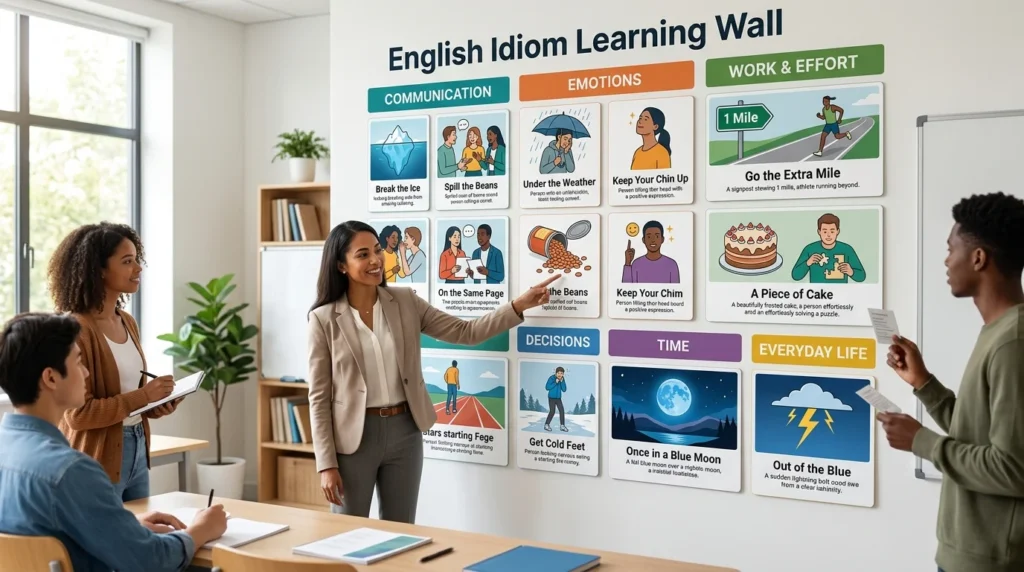
Create an Idiom Wall
Keep a classroom display containing:
Idiom → Meaning → Example → Student sentence
Add new expressions gradually.
Review Old Idioms
Begin new lessons with a two-minute review of previously learned expressions.
Encourage Natural Repetition
Use target idioms naturally during classroom conversations when appropriate.
A Simple Formula for Every Idiom Lesson
Teachers can use this five-part formula:
CONTEXT → MEANING → TONE → PRACTICE → USE
Context
Show where the idiom appears.
Meaning
Explain the figurative meaning.
Tone
Explain whether it is informal, neutral, playful, encouraging, direct, or otherwise marked.
Practice
Give controlled exercises.
Use
Ask students to use the expression in a meaningful conversation or piece of writing.
This approach keeps the lesson focused without reducing idioms to vocabulary flashcards.
Frequently Asked Questions About Teaching English Idioms
How do you teach English idioms effectively?
Teach idioms through realistic contexts rather than isolated definitions. Introduce the situation, let students infer the meaning, explain the literal and figurative meanings, discuss tone, provide examples, and then give students opportunities to use the idiom in conversation.
What is the best way to explain an idiom to English learners?
Start with a familiar situation and show the idiom in a complete sentence. Then explain the figurative meaning and compare it with the literal meaning. Finally, demonstrate how the expression changes across different contexts.
How many idioms should students learn at one time?
The ideal number depends on the students, lesson length, and difficulty of the expressions. It is generally more useful to teach a manageable group thoroughly than to introduce a large list without enough practice and review.
Should students use idioms in formal writing?
Not necessarily. Students should first consider audience, purpose, and tone. Some idioms are natural in conversation but may be less appropriate when a formal, precise expression is required.
What are some easy English idioms for beginners?
Useful starting points include a piece of cake, break the ice, call it a day, keep an eye on, under the weather, and on the same page. Teachers can introduce them through familiar everyday situations.
Final Thoughts on Teaching English Idioms
Teaching English idioms becomes much more effective when students learn expressions as meaningful chunks of communication, not as random vocabulary items. The strongest lessons connect an idiom to a situation, reveal its figurative meaning, explain its tone, demonstrate natural usage, and give learners repeated opportunities to practice it.
Start small. Choose a few useful idioms, introduce them through context, let students discover the meaning, practice them through activities, and bring them back in later conversations and lessons.
Most importantly, teach students that successful English is not about using the largest number of idioms. It is about understanding what people mean and choosing language that fits the situation.
When learners can recognize an idiom, explain it, understand its tone, and use it naturally when appropriate, they have moved beyond memorization and toward real communicative confidence.

Daniel Mercer is a Meaning Match writer covering English idioms, vocabulary, expressions, and language usage with clear meanings and practical examples.