
Have you ever read a sentence that made perfect sense word by word but still seemed confusing? You may have come across an idiom. Idioms for 6th graders are expressions whose real meanings are different from the literal meanings of their words.
For example, “break the ice” does not mean smashing frozen water—it means making people feel more comfortable in a new or awkward situation. Learning idioms can help sixth graders understand books, conversations, stories, and everyday English more easily while building stronger vocabulary and writing skills. Some idioms are funny, some are surprising, and others can be tricky to understand without context.
Whether you’re a student, parent, or teacher, this guide includes useful idioms with simple meanings and clear example sentences. You’ll learn what each expression means, how it is used, and how to recognize its figurative meaning in context.
What Are Idioms?
An idiom is a group of words that has a meaning different from what the individual words seem to say.
Imagine your friend says:
“The science test was a piece of cake!”
They are not saying the test was made of cake. They mean the test was very easy.
That is the fun part of idioms: the words create a picture in your mind, but the expression has a different figurative meaning.
Why Should 6th Graders Learn Idioms?
Learning idioms can help students:
- Understand conversations more easily
- Improve reading comprehension
- Recognize figurative language
- Understand stories, movies, and books
- Build vocabulary
- Make creative writing more interesting
- Speak more naturally
- Use context clues to understand unfamiliar expressions
The easiest way to learn an idiom is to remember the whole expression, its real meaning, and an example sentence together.
Easy and Popular Idioms for 6th Graders
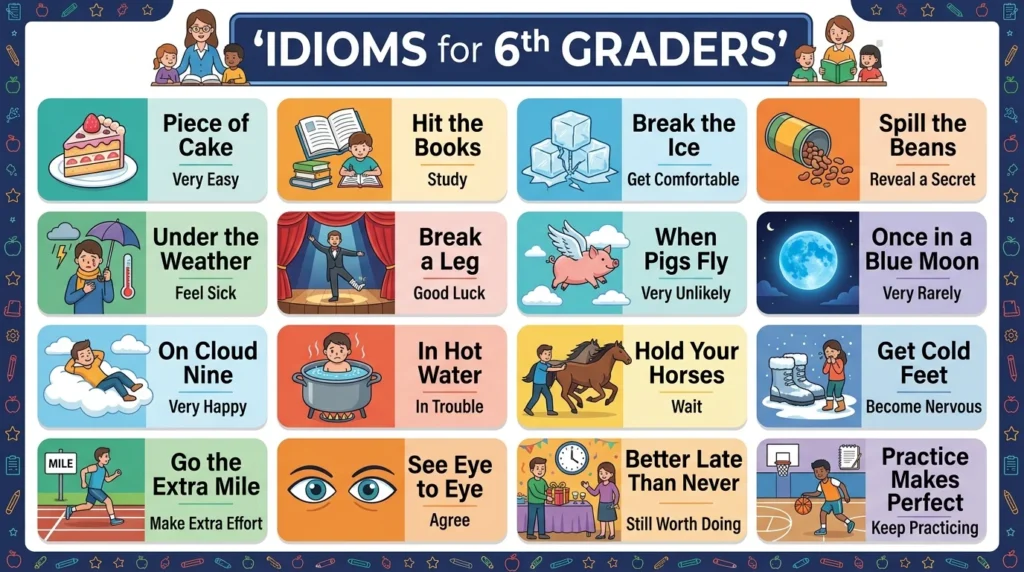
Here are 20 useful idioms that students can encounter in school, conversations, stories, and everyday English.
Piece of Cake
Word-by-word meaning: A piece of cake is a portion of a cake.
Idiomatic meaning: Something that is very easy.
Example sentences:
- The spelling quiz was a piece of cake.
- After practicing the dance, it was a piece of cake.
Common mistake: Don’t use it only when talking about dessert.
Usage note: This is an informal expression commonly used in everyday conversation.
Hit the Books
Word-by-word meaning: To physically hit books.
Idiomatic meaning: To study seriously.
Example sentences:
- I have a test tomorrow, so I need to hit the books.
- After dinner, Maya hit the books for her history exam.
Common mistake: The expression does not mean touching, carrying, or hitting a textbook.
Usage note: This casual idiom is especially easy for students to remember because it relates to studying.
Break the Ice
Word-by-word meaning: To break a piece of ice.
Idiomatic meaning: To make people feel more comfortable when they first meet.
Example sentences:
- Our teacher played a quick game to break the ice.
- I told a joke to break the ice with my new classmates.
Common mistake: Don’t use it only for actual ice.
Usage note: It is useful when describing a first meeting or an awkward beginning.
Spill the Beans
Word-by-word meaning: To spill beans from a container.
Idiomatic meaning: To reveal a secret or important information.
Example sentences:
- Don’t spill the beans about the surprise party.
- Ali spilled the beans and told everyone about the class trip.
Common mistake: Keep the expression as spill the beans, not “spill the bean.”
Usage note: It is informal and often used when someone reveals something they were supposed to keep secret.
Under the Weather
Word-by-word meaning: Being physically underneath the weather.
Idiomatic meaning: Feeling sick or unwell.
Example sentences:
- I stayed home because I was feeling under the weather.
- Emma looked under the weather after missing a night’s sleep.
Common mistake: It does not describe someone’s physical location.
Usage note: It is generally used for feeling mildly ill or unwell.
Break a Leg
Word-by-word meaning: To break someone’s leg.
Idiomatic meaning: A traditional way of wishing someone good luck, especially before a performance.
Example sentences:
- “Your school play starts tonight. Break a leg!”
- “Good luck at the talent show!” “Thanks!”
Common mistake: It is not a wish for someone to get hurt.
Usage note: You will often hear this expression before plays, performances, or similar events.
When Pigs Fly
Word-by-word meaning: At a time when pigs can fly.
Idiomatic meaning: Something is extremely unlikely to happen.
Example sentences:
- He says he’ll clean his room every day—when pigs fly!
- I’ll believe that story when pigs fly.
Common mistake: Don’t use it simply to mean “later.”
Usage note: This humorous idiom is often used when someone doubts that something will happen.
Let the Cat Out of the Bag
Word-by-word meaning: To let a cat escape from a bag.
Idiomatic meaning: To reveal a secret, often accidentally.
Example sentences:
- Josh let the cat out of the bag about the surprise.
- I wasn’t supposed to tell her, but I let the cat out of the bag.
Common mistake: Don’t confuse its figurative meaning with an actual cat.
Usage note: Use it in informal situations when someone reveals secret information.
Once in a Blue Moon
Word-by-word meaning: Something happening during a blue moon.
Idiomatic meaning: Something that happens very rarely.
Example sentences:
- We eat at that restaurant once in a blue moon.
- I play that old video game once in a blue moon.
Common mistake: It does not mean “every month.”
Usage note: Use it when something happens only occasionally.
On Cloud Nine
Word-by-word meaning: Being on a cloud in the sky.
Idiomatic meaning: Feeling extremely happy or excited.
Example sentences:
- I was on cloud nine after winning the art contest.
- Sara was on cloud nine when her team won.
Common mistake: Don’t use it to describe someone who is sad or worried.
Usage note: It is a cheerful expression for a very happy mood.
In Hot Water
Word-by-word meaning: Being in hot water.
Idiomatic meaning: Being in trouble.
Example sentences:
- I was in hot water after forgetting my homework.
- Leo got in hot water for breaking the classroom rule.
Common mistake: The idiom is about trouble, not temperature.
Usage note: It is an informal expression often used in everyday conversations.
Hold Your Horses
Word-by-word meaning: To hold horses.
Idiomatic meaning: Wait, slow down, or be patient.
Example sentences:
- Hold your horses! We haven’t decided yet.
- Hold your horses and let me explain what happened.
Common mistake: It does not require actual horses.
Usage note: This playful expression is informal and can be useful when someone is rushing.
Get Cold Feet
Word-by-word meaning: To suddenly have cold feet.
Idiomatic meaning: To become nervous or afraid before doing something.
Example sentences:
- I almost got cold feet before going on stage.
- Don’t get cold feet before the competition.
Common mistake: Don’t use it merely because someone’s feet are physically cold.
Usage note: It usually describes nervousness before an important event or decision.
Go the Extra Mile
Word-by-word meaning: To travel one additional mile.
Idiomatic meaning: To make extra effort to achieve something or help someone.
Example sentences:
- Our teacher went the extra mile to help us understand the lesson.
- I decided to go the extra mile and practice before the competition.
Common mistake: It doesn’t always involve physically traveling farther.
Usage note: This expression is useful when talking about effort, kindness, or dedication.
The Ball Is in Your Court
Word-by-word meaning: A ball is on your side of a sports court.
Idiomatic meaning: It is now your responsibility to decide or take action.
Example sentences:
- I’ve explained your choices. Now the ball is in your court.
- I finished my part of the project, so the ball is in your court.
Common mistake: It is not limited to sports.
Usage note: This idiom is useful when responsibility for the next step has moved to another person.
See Eye to Eye
Word-by-word meaning: Two people looking directly into each other’s eyes.
Idiomatic meaning: To agree with someone.
Example sentences:
- My sister and I don’t always see eye to eye.
- The students finally saw eye to eye about the project.
Common mistake: It does not simply mean making eye contact.
Usage note: Use it when discussing agreement or disagreement.
Better Late Than Never
Word-by-word meaning: Being late is better than never arriving or doing something.
Idiomatic meaning: Doing something late is better than not doing it at all.
Example sentences:
- I finally started reading the book—better late than never!
- He apologized the next day, but better late than never.
Common mistake: It does not mean being late is always acceptable.
Usage note: This expression is useful when something happens later than expected but is still worthwhile.
Don’t Judge a Book by Its Cover
Word-by-word meaning: Don’t decide what a book is like only by looking at its cover.
Idiomatic meaning: Don’t judge someone or something based only on appearance.
Example sentences:
- The quiet student was an excellent storyteller. Don’t judge a book by its cover.
- The old-looking restaurant served amazing food.
Common mistake: The expression is about making judgments from appearances, not only about books.
Usage note: It is especially useful when discussing first impressions.
Practice Makes Perfect
Word-by-word meaning: Repeated practice leads toward perfection.
Idiomatic meaning: Regular practice helps you improve a skill.
Example sentences:
- Keep practicing your spelling. Practice makes perfect.
- I couldn’t play the song at first, but practice makes perfect.
Common mistake: It should not be understood as a guarantee of literal perfection.
Usage note: This familiar expression works well when encouraging someone to keep practicing.
Actions Speak Louder Than Words
Word-by-word meaning: Actions are louder than spoken words.
Idiomatic meaning: What someone does can show their intentions or feelings more clearly than what they say.
Example sentences:
- He said he would help, but then he stayed late to clean up. Actions speak louder than words.
- She showed her kindness by helping the new student.
Common mistake: It doesn’t mean physical actions literally make more noise than words.
Usage note: Use it when someone’s behavior provides stronger evidence than their promises.
Teaching English Idioms: Practical Ways to Make Them Stick
Literal vs. Figurative Meaning: A Quick Guide
Understanding the difference between literal meaning and figurative meaning makes idioms much easier.
| Idiom | Literal picture | Figurative meaning |
|---|---|---|
| Piece of cake | A slice of cake | Very easy |
| Hit the books | Hitting books | Study |
| Break the ice | Breaking ice | Make people comfortable |
| Spill the beans | Beans falling out | Reveal a secret |
| Under the weather | Under the sky | Feeling sick |
| On cloud nine | Sitting on a cloud | Extremely happy |
| Hold your horses | Holding horses | Wait |
| Get cold feet | Cold feet | Become nervous |
| In hot water | Sitting in hot water | Be in trouble |
| When pigs fly | Pigs flying | Very unlikely |
Remember: The literal picture can help you remember an idiom, but the context tells you its real meaning.
How to Use Idioms Correctly
Knowing an idiom is not enough. You also need to know when it fits.
Learn the Whole Expression
Treat an idiom as one complete phrase.
For example:
- ✅ Spill the beans
- ❌ Spill the bean
Learning the complete expression helps you avoid changing important words.
Check the Context
Ask yourself:
“Does this idiom make sense in this situation?”
For example:
“I was nervous before my first speech and got cold feet.”
The context makes the meaning clear: the speaker became nervous.
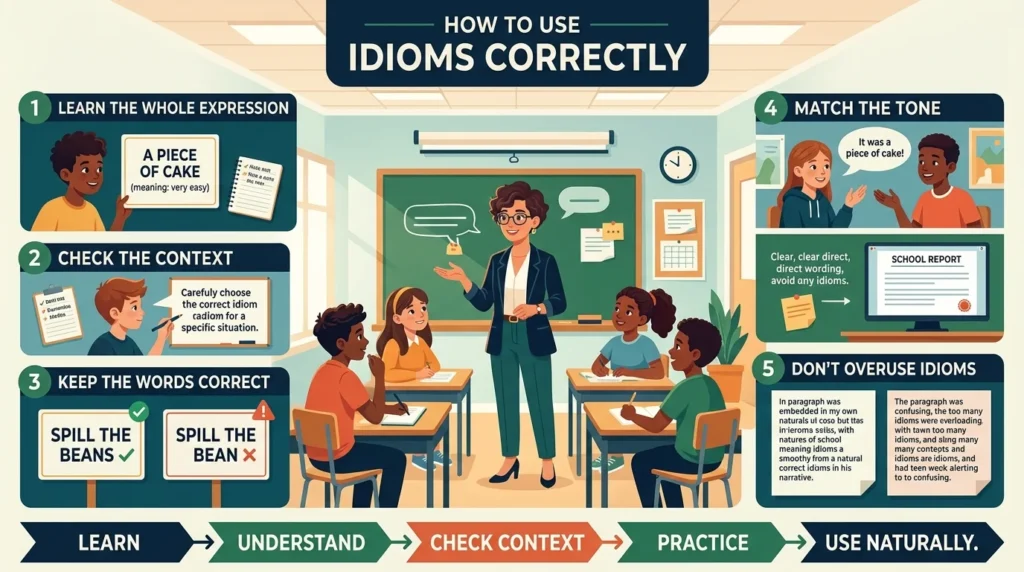
Match the Tone
Some idioms are casual and work especially well in conversations.
For example:
“That homework was a piece of cake!”
sounds natural in a conversation with a friend.
For a formal school report, however, simply saying:
“The assignment was easy.”
may be clearer.
Don’t Overuse Idioms
One well-chosen idiom can make writing lively. Too many can make a paragraph confusing.
Instead of putting an idiom in every sentence, use one when it adds meaning or personality.
Idioms for Speaking vs. School Writing
Idioms can be useful in many situations, but context matters.
| Situation | Idioms |
|---|---|
| Talking with friends | ✅ Often useful |
| Personal stories | ✅ Often useful |
| Creative writing | ✅ Can add personality |
| Casual messages | ✅ Usually fine |
| Formal reports | ⚠️ Use carefully |
| Scientific explanations | ⚠️ Clear language is usually better |
If your teacher asks you to demonstrate figurative language, an idiom can be a great choice. If the assignment requires a formal explanation, direct wording may be more appropriate.
10 Idioms to Learn First
Trying to memorize 20 expressions at once can feel like too much. Start with these 10:
- Piece of cake — very easy
- Hit the books — study
- Break the ice — make people comfortable
- Spill the beans — reveal a secret
- Under the weather — feel sick
- When pigs fly — very unlikely
- Once in a blue moon — very rarely
- On cloud nine — extremely happy
- Hold your horses — wait
- Get cold feet — become nervous
Once these feel familiar, add the other ten.
Easy Ways to Practice Idioms
You don’t need to memorize a huge list. Try these simple activities.
Draw It
Draw the literal meaning of an idiom.
For example, draw someone literally “hitting” a pile of books.
Then write:
Hit the books = study.
Write It
Choose three idioms and write one original sentence for each.
Read It
Look for idioms in stories, novels, classroom passages, or conversations. Use the surrounding words as context clues.
Say It
Use one idiom naturally in a conversation with a friend or family member.
Practice With Friends
One student gives an idiom, and another explains its figurative meaning or creates a sentence.
Idioms for 3rd Grade: 30+ Easy Examples Kids Can Understand
A Quick Classroom Idiom Activity
Teachers, parents, and tutors can turn idiom practice into a five-minute game.
Step 1: Write five idioms on the board.
Step 2: Give students the figurative meanings separately.
Step 3: Ask students to match each idiom with its meaning.
Step 4: Have each student choose one idiom and create a sentence.
Step 5: Ask volunteers to explain why their sentence fits the idiom.
This activity helps students move from recognizing an idiom → understanding it → using it.
Idiom Challenge
See how many you can complete without looking at the answers.
- If a test is very easy, it is a __________.
- If you need to study, you should __________.
- If someone reveals a secret, they __________.
- If something happens very rarely, it happens __________.
- If someone is extremely happy, they are __________.
- If someone is in trouble, they are __________.
- If someone becomes nervous before an event, they __________.
- If you want someone to wait, you can say __________.
- If something is extremely unlikely, it will happen __________.
- If two people agree, they __________.
Answers
- piece of cake
- hit the books
- spill the beans
- once in a blue moon
- on cloud nine
- in hot water
- get cold feet
- hold your horses
- when pigs fly
- see eye to eye
Frequently Asked Questions About Idioms for 6th Graders
What are 10 easy idioms for 6th graders?
Ten easy choices are piece of cake, hit the books, break the ice, spill the beans, under the weather, when pigs fly, once in a blue moon, on cloud nine, hold your horses, and get cold feet.
What is an idiom example for a sixth grader?
“The math homework was a piece of cake” is a simple example. The phrase does not mean the homework was made of cake. It means the homework was very easy.
Why should 6th graders learn idioms?
Idioms help students understand figurative language in conversations, books, stories, movies, and classroom activities. They can also make creative writing and everyday speech more expressive.
How do you explain an idiom to a child?
Explain the literal picture first, then explain the figurative meaning, and finally give an easy sentence. For example, “spill the beans” literally describes beans falling out, but figuratively it means to reveal a secret.
How can 6th graders learn idioms easily?
Start with five or ten common expressions instead of trying to memorize a large list. Connect each idiom with its meaning, an example, and a picture, then practice using it in your own sentences.
Conclusion: Start Using Idioms Today
Learning idioms for 6th graders becomes much easier when you stop trying to memorize words separately and start learning each expression as a complete idea.
Begin with five easy idioms, learn their figurative meanings, and create your own sentences. Then challenge yourself to recognize those expressions when you read or hear English.
Choose three idioms from this guide today, write one sentence for each, and try using one naturally in a conversation this week. That’s how unfamiliar expressions become part of your everyday English.

Emily Carter writes for Meaning Match about English idioms, student-friendly expressions, and language learning, using simple explanations and helpful examples.