
Have you ever read an English phrase that sounded strange because its words did not seem to match what the sentence was really saying? That’s the tricky part about idioms. Middle school idioms are expressions whose figurative meanings are different from the literal meanings of their words.
For example, “hit the nail on the head” does not mean hitting a nail—it means getting something exactly right. Learning idioms can help middle school students understand novels, classroom conversations, stories, and everyday English while building stronger vocabulary and writing skills. Some idioms are funny and easy to understand, while others become clear only when you look at the surrounding context.
Whether you’re a student, teacher, or parent, this guide features useful idioms with simple meanings and clear examples. You’ll learn what each expression means, how it works in context, and how to use it naturally in your own writing and conversations.
Common Middle School Idioms Students Should Know
Break the Ice
Word-by-word meaning: To break ice literally means to crack or destroy frozen water.
Idiomatic meaning: To make people feel more relaxed when they meet or begin a conversation.
Example sentences:
- Our teacher told a joke to break the ice on the first day of school.
- I asked my new classmate about her favorite book to break the ice.
Common error: Don’t use “break the ice” when you simply mean breaking actual ice.
Usage note: This is an informal, friendly expression often used when a situation feels awkward or unfamiliar.
Context: Meeting new classmates, starting a group activity, or beginning a conversation.
Piece of Cake
Word-by-word meaning: A piece of cake is one portion of a cake.
Idiomatic meaning: Something that is very easy.
Example sentences:
- The first question was a piece of cake.
- Once I understood the formula, the homework was a piece of cake.
Common error: “Piece of cake” means easy only when it is being used figuratively.
Usage note: This is casual and works especially well in everyday conversation.
Context: Tests, homework, games, chores, or simple tasks.
Hit the Books
Word-by-word meaning: Literally, “hit” means strike and “books” refers to books.
Idiomatic meaning: To study seriously or spend time studying.
Example sentences:
- I have a history test tomorrow, so I need to hit the books tonight.
- After practice, Maya went home to hit the books.
Common error: The correct idiom is “hit the books,” not “hit the book,” when referring generally to studying.
Usage note: This is an informal expression commonly used by students.
Context: Exams, homework, revision, and school projects.
On the Same Page
Word-by-word meaning: Two people can literally be on the same page of a book.
Idiomatic meaning: To have the same understanding, expectations, or plan.
Example sentences:
- Before starting our project, we made sure everyone was on the same page.
- Let’s discuss the instructions so we’re all on the same page.
Common error: It does not necessarily mean that everyone is physically reading the same page.
Usage note: This expression is useful when a group needs shared understanding.
Context: Group projects, classroom instructions, plans, and teamwork.
Under the Weather
Word-by-word meaning: Literally, something can be beneath the weather.
Idiomatic meaning: To feel sick or unwell.
Example sentences:
- I stayed home because I was feeling under the weather.
- Liam looked under the weather during class.
Common error: Use it to describe a person’s health or how they feel, not an ordinary object.
Usage note: This is a casual expression for feeling slightly ill.
Context: School, home, conversations with friends, or describing how someone feels.
Spill the Beans
Word-by-word meaning: To spill beans means to accidentally scatter them.
Idiomatic meaning: To reveal a secret or confidential information.
Example sentences:
- Don’t spill the beans about the surprise party.
- My brother spilled the beans about my birthday gift.
Common error: The fixed expression is “spill the beans,” not “spill the bean.”
Usage note: It is informal and often suggests that information was revealed when it was supposed to remain secret.
Context: Surprises, secrets, school events, and conversations with friends.
Cost an Arm and a Leg
Word-by-word meaning: An arm and a leg are body parts.
Idiomatic meaning: To be extremely expensive.
Example sentences:
- That new laptop cost an arm and a leg.
- The concert tickets cost my parents an arm and a leg.
Common error: This is an exaggeration, not a literal reference to body parts.
Usage note: The expression is informal and intentionally exaggerates a high price.
Context: Shopping, technology, travel, tickets, and expensive items.
Once in a Blue Moon
Word-by-word meaning: A blue moon sounds like a moon that is blue.
Idiomatic meaning: Something that happens very rarely.
Example sentences:
- I eat fast food once in a blue moon.
- We go to that restaurant once in a blue moon.
Common error: Don’t use it for something that happens frequently.
Usage note: Use this expression when an event is unusual or infrequent.
Context: Habits, visits, activities, and rare events.
Keep an Eye On
Word-by-word meaning: Literally, this sounds like placing an eye on something.
Idiomatic meaning: To watch, monitor, or pay attention to someone or something.
Example sentences:
- Can you keep an eye on my backpack?
- The teacher asked us to keep an eye on the time.
Common error: Remember the usual structure: keep an eye on + person or thing.
Usage note: This is a very common everyday expression.
Context: Watching belongings, supervising something, or monitoring a situation.
A Blessing in Disguise
Word-by-word meaning: A blessing is something beneficial, while a disguise hides someone’s true appearance.
Idiomatic meaning: Something that first seems bad or disappointing but eventually produces a good result.
Example sentences:
- Missing the bus was a blessing in disguise because I met an old friend while waiting for the next one.
- Losing the competition became a blessing in disguise because it motivated me to practice harder.
Common error: Don’t use this expression simply to describe something good. There should usually be an unexpected positive outcome.
Usage note: It is useful when a disappointing event later turns out to be beneficial.
Context: Mistakes, disappointments, unexpected opportunities, and life experiences.
Bite the Bullet
Word-by-word meaning: Literally, biting a bullet would mean holding one between your teeth.
Idiomatic meaning: To face something difficult or unpleasant with courage.
Example sentences:
- I was nervous about giving my speech, but I decided to bite the bullet.
- Maya bit the bullet and apologized to her friend.
Common error: The phrase is normally figurative, not a literal instruction.
Usage note: This is informal and is often used when someone finally deals with a difficult task.
Context: Presentations, difficult conversations, challenging tasks, or decisions.
Go the Extra Mile
Word-by-word meaning: To go an extra mile means to travel farther than necessary.
Idiomatic meaning: To make more effort than expected.
Example sentences:
- Our teacher went the extra mile to help us understand the lesson.
- I went the extra mile and added extra research to my project.
Common error: It does not have to involve actual walking or traveling.
Usage note: Use it when someone does more than what is normally expected.
Context: School projects, helping others, teamwork, and achieving goals.
Pull Someone’s Leg
Word-by-word meaning: Literally, to pull someone’s leg means to tug their leg.
Idiomatic meaning: To joke with someone or tease them playfully.
Example sentences:
- Don’t worry—I was just pulling your leg.
- I thought Jake was serious, but he was pulling my leg.
Common error: It does not mean physically pulling someone’s leg when used as an idiom.
Usage note: This is generally playful and informal, but make sure the other person understands that you are joking.
Context: Friendly conversations and harmless jokes.
Call It a Day
Word-by-word meaning: Literally, the phrase sounds like giving something the name “a day.”
Idiomatic meaning: To stop working or finish an activity for the day.
Example sentences:
- We’ve finished most of the project, so let’s call it a day.
- After studying for three hours, I decided to call it a day.
Common error: It does not mean naming a particular day.
Usage note: This is a casual expression used when ending work or an activity.
Context: Homework, projects, studying, work, and activities.
In Hot Water
Word-by-word meaning: Literally, someone or something can be in hot water.
Idiomatic meaning: To be in trouble.
Example sentences:
- Jack was in hot water after forgetting his assignment again.
- I knew I would be in hot water if I missed the deadline.
Common error: Don’t confuse the figurative expression with literally being in hot water.
Usage note: It often describes trouble caused by a mistake or poor decision.
Context: School rules, missed deadlines, mistakes, and problems.
Get Cold Feet
Word-by-word meaning: Literally, cold feet are feet that feel cold.
Idiomatic meaning: To become nervous or afraid before doing something.
Example sentences:
- I wanted to perform on stage, but I got cold feet.
- Sara got cold feet before presenting her project to the class.
Common error: Simply having cold feet because of the weather is not the idiomatic use.
Usage note: Use it when someone becomes nervous before an important event or action.
Context: Performances, presentations, competitions, speeches, or new challenges.
The Ball Is in Your Court
Word-by-word meaning: In a sport such as tennis, the ball can literally be on one player’s side of the court.
Idiomatic meaning: It is now your responsibility or turn to take action or make a decision.
Example sentences:
- I’ve shared my idea, so the ball is in your court now.
- We sent the application; the ball is in their court.
Common error: This expression is not limited to sports.
Usage note: It is conversational and often used when responsibility for the next step has moved to another person.
Context: Group decisions, plans, invitations, requests, and responsibilities.
Let the Cat Out of the Bag
Word-by-word meaning: Literally, a cat can escape from a bag.
Idiomatic meaning: To reveal a secret, often accidentally.
Example sentences:
- I didn’t want to tell him, but my sister let the cat out of the bag.
- Ben let the cat out of the bag about the class surprise.
Common error: Don’t confuse the idiom with a literal situation involving a cat.
Usage note: This informal expression is often used when someone accidentally reveals information.
Context: Surprises, secrets, announcements, and private information.
Hang in There
Word-by-word meaning: Literally, “hang in there” can suggest hanging onto something.
Idiomatic meaning: Keep going and don’t give up during a difficult situation.
Example sentences:
- Hang in there! You’ll finish the project soon.
- The test was difficult, but my friend told me to hang in there.
Common error: It usually expresses encouragement rather than a literal physical action.
Usage note: This is a friendly, supportive expression.
Context: Difficult homework, exams, competitions, setbacks, and challenging situations.
Learn the Ropes
Word-by-word meaning: Literally, ropes can be used for climbing or other physical tasks.
Idiomatic meaning: To learn how to do something or understand how a new situation works.
Example sentences:
- It took me a week to learn the ropes at my new school.
- Our older teammate helped us learn the ropes before the competition.
Common error: It usually refers to learning how something works, not learning about actual ropes.
Usage note: This expression is useful when someone is new to a place, activity, job, or skill.
Context: New schools, clubs, sports, projects, activities, and responsibilities.
Idioms for 6th Graders: 24+ Easy Examples With Meanings
Literal vs. Figurative Meaning: A Quick Guide
One of the easiest ways to understand idioms is to compare what the words literally say with what the expression actually means.
| Idiom | Literal Idea | Figurative Meaning |
|---|---|---|
| Break the ice | Crack frozen water | Make people comfortable |
| Hit the books | Strike books | Study |
| Spill the beans | Drop beans | Reveal a secret |
| Get cold feet | Have cold feet | Become nervous |
| In hot water | Be in hot water | Be in trouble |
| Piece of cake | A piece of dessert | Something easy |
| Hang in there | Hang from something | Don’t give up |
The key lesson is simple: don’t translate every word separately. Learn the meaning of the whole expression.
Why Should Middle School Students Learn Idioms?
Idioms help students understand English as it is actually used. They can appear in conversations, stories, novels, movies, classroom discussions, and informal writing.
Learning common English idioms can help students:
- Understand figurative language
- Follow conversations more easily
- Expand vocabulary
- Improve reading comprehension
- Make everyday speech more natural
- Add variety to appropriate writing
- Understand jokes and cultural references
The goal isn’t to use an idiom in every sentence. The goal is to recognize it quickly and know when it fits.
How to Use Idioms Correctly
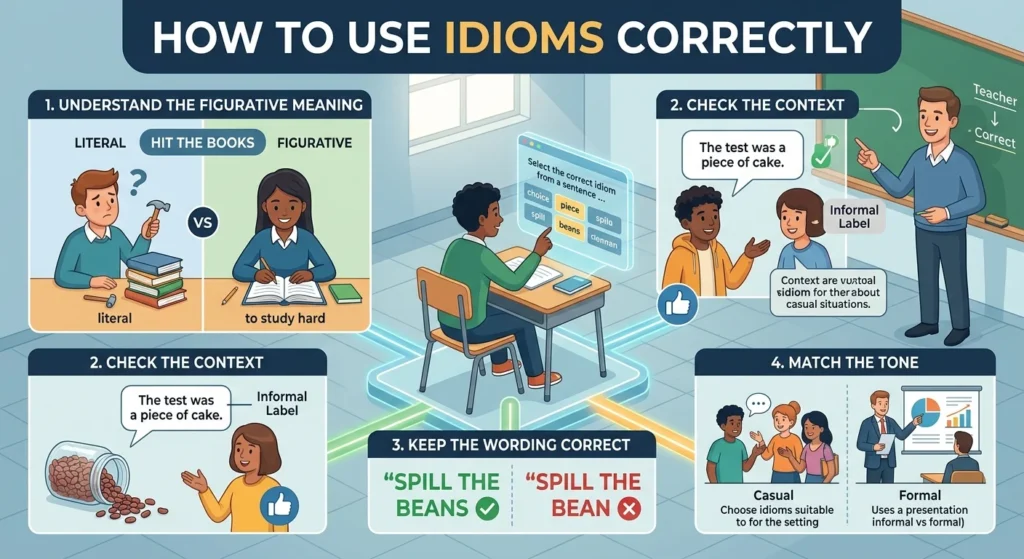
1. Learn the Whole Expression
Don’t memorize only individual words. Learn the complete idiom, its meaning, and an example sentence.
2. Check the Context
Ask yourself whether the expression fits the situation.
“Piece of cake” works naturally in a conversation about an easy test, but a formal report might simply say “The test was easy.”
3. Keep the Wording Correct
Idioms often have fixed wording.
❌ Spill the bean
✅ Spill the beans
❌ Hit the textbook
✅ Hit the books
❌ On same page
✅ On the same page
4. Understand the Register
Many idioms are informal or conversational. They are excellent for dialogue and everyday speech, but formal school writing may sometimes call for clearer, more direct wording.
5. Don’t Overuse Idioms
One well-chosen idiom can make a sentence lively. Too many can make writing confusing or unnatural.
Common Mistakes Students Make With Idioms
Taking Idioms Literally
If someone says, “Break the ice,” they probably mean “start a comfortable conversation,” not “find some frozen water and break it.”
Changing Fixed Expressions
Idioms usually have established wording. Changing one important word can make the expression incorrect or unnatural.
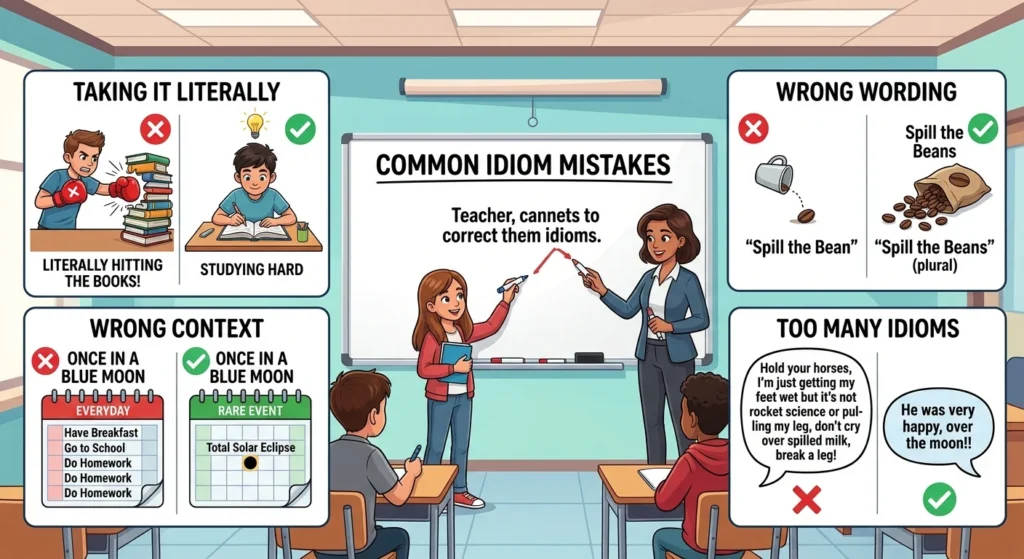
Using an Idiom in the Wrong Situation
“Once in a blue moon” means rarely, so it would not fit a sentence about something that happens every day.
Ignoring Tone
Some idioms sound casual. Before using one in an assignment, consider whether your teacher expects formal or conversational language.
Using Too Many Idioms
Idioms are most effective when they fit naturally. Clear language should remain the priority.
Fun Ways to Practice Middle School Idioms
Idiom Charades
Write idioms on cards and have students act them out while classmates guess the expression.
Literal vs. Figurative Drawing
Draw the literal meaning of “spill the beans” first, then illustrate its real meaning: revealing a secret.
Idiom Matching
Create two sets of cards—one with idioms and one with meanings. Students match the correct pairs.
Meaning → Situation → Sentence
For every new idiom, follow this simple method:
Idiom: Hit the books
Meaning: Study hard
Situation: You have a test tomorrow.
Sentence: “I need to hit the books tonight.”
This method turns memorization into practical language practice.
Quick Middle School Idiom Quiz
Choose the best idiom for each sentence.
1. I was nervous before my speech and almost ______.
A. spilled the beans
B. got cold feet
C. called it a day
2. Please don’t ______ about the surprise.
A. spill the beans
B. hit the books
C. go the extra mile
3. We need to study tonight because we have a test tomorrow.
A. Break the ice
B. Hit the books
C. Pull someone’s leg
4. The homework was extremely easy.
A. A piece of cake
B. In hot water
C. Under the weather
5. I’ve explained my idea, so ______ now.
A. the ball is in your court
B. I got cold feet
C. I’m under the weather
Answers:
- B — got cold feet
- A — spill the beans
- B — hit the books
- A — a piece of cake
- A — the ball is in your court
Idioms for 3rd Grade: 30+ Easy Examples Kids Can Understand
FAQs About Middle School Idioms
What is an idiom in simple words?
An idiom is a common expression whose overall meaning is different from the literal meanings of its individual words. For example, “piece of cake” means something is easy.
What are some easy idioms for middle school students?
Easy examples include piece of cake, hit the books, break the ice, hang in there, keep an eye on, and call it a day.
Why should middle school students learn idioms?
Idioms help students understand everyday English, figurative language, conversations, books, and other real-world language more easily.
Can students use idioms in school writing?
Yes, but context matters. Idioms can work well in creative writing, dialogue, personal writing, and informal assignments. More formal academic writing may require direct and precise language.
How can students memorize idioms quickly?
Learn each idiom with its meaning, connect it to a realistic situation, create an original sentence, and use it in conversation. Repeated exposure makes idioms easier to remember.
Conclusion
Learning middle school idioms doesn’t have to feel like memorizing a long vocabulary list. Start with a few expressions, understand their figurative meanings, notice how people use them, and create your own sentences.
Try choosing three idioms from this guide today. Use one in a conversation, write another in your notebook, and teach the third to a friend. The more you practice idioms in real situations, the more naturally they will become part of your English.

Clara Bennett writes for Meaning Match about English idioms, everyday expressions, meanings, and practical language usage, making phrases easy to understand.