Why does “raining cats and dogs” become easier to remember when you can actually picture it? Illustration idioms are idioms and related expressions that can be represented with visual images to make their figurative meanings easier to understand and remember.
Phrases such as “spill the beans,” “break the ice,” “hit the nail on the head,” and “raining cats and dogs” create vivid mental pictures even though their actual meanings are not literal. For example, “spill the beans” means to reveal a secret, while “break the ice” means to make people feel more comfortable in a new or awkward situation. “Illustration idioms” is a descriptive term rather than a formal linguistic category; it simply refers to idioms that work well with visual explanations.
If you’re looking for illustration idioms for teaching, worksheets, school projects, presentations, or English learning, you’ll find clear visual ideas, simple meanings, and natural examples to make these expressions easier to understand and use.
What Are Illustration Idioms?
Illustration idioms is a useful category for describing idiomatic and figurative English expressions built around visual imagery such as drawing, painting, pictures, and colors. The term is not a formal linguistic category with one universally agreed list.
Some expressions in this article are traditional idioms, while others are established figurative expressions or common collocations. They are grouped together because they use visual language to communicate an idea.
For example:
- Draw the line → set a boundary
- Paint a picture → describe something vividly
- See the big picture → understand the overall situation
- Paint yourself into a corner → create a difficult situation for yourself
- Color outside the lines → think or act creatively
This combination of literal imagery and figurative meaning is what makes these expressions memorable.
Common Illustration Idioms and Visual Expressions
Paint a Picture
Word-by-word meaning:
To create an image using paint.
Idiomatic/figurative meaning:
To describe a person, situation, or event so clearly that someone can imagine it.
Example sentences:
- The journalist painted a picture of life in the small town.
- Her story painted a vivid picture of what happened.
Common error:
Don’t assume this expression refers only to physical artwork.
Usage note:
The phrase is common in conversation, storytelling, journalism, and descriptive writing.
Paint a Rosy Picture
Word-by-word meaning:
To paint a picture that looks pleasant or positive.
Idiomatic/figurative meaning:
To describe a situation as better, easier, or more successful than it really is.
Example sentences:
- The advertisement painted a rosy picture of retirement.
- The report painted a rosy picture of the company’s future.
Common error:
It often carries the suggestion that the description is overly optimistic, so don’t use it automatically as a compliment.
Usage note:
Useful when discussing reports, expectations, advertisements, or someone’s optimistic description of a situation.
Draw the Line
Word-by-word meaning:
To make a line with a pen or pencil.
Idiomatic/figurative meaning:
To establish a boundary or decide what you will not accept.
Example sentences:
- I don’t mind helping, but I draw the line at doing everyone’s work.
- She is willing to compromise, but she draws the line at dishonesty.
Common error:
The common structure is draw the line at something.
Usage note:
This is useful when talking about personal boundaries, rules, or limits.
Draw a Conclusion
Word-by-word meaning:
To “draw” something toward a final point.
Idiomatic/figurative meaning:
To reach a conclusion after examining facts or evidence.
Example sentences:
- We can’t draw a conclusion from one small study.
- After reviewing the evidence, the researchers drew a conclusion.
Common error:
Use draw a conclusion, not an invented combination such as “paint a conclusion.”
Usage note:
This expression is especially common in academic, analytical, and professional writing.
Draw a Blank
Word-by-word meaning:
To produce or see something empty.
Idiomatic/figurative meaning:
To be unable to remember or think of something.
Example sentences:
- I drew a blank when she asked me for his name.
- I’m drawing a blank right now. Give me a minute.
Common error:
It doesn’t mean literally drawing an empty picture.
Usage note:
This is informal and particularly natural in everyday conversation.
Draw Attention
Word-by-word meaning:
To pull attention toward something.
Idiomatic/figurative meaning:
To make something noticeable.
Example sentences:
- The bright sign draws attention to the entrance.
- Her unusual design drew everyone’s attention.
Common error:
The common structure is draw attention to something, not “draw attention on something.”
Usage note:
Although figurative, this is more accurately described as a common collocation than a traditional idiom.
Draw a Distinction
Word-by-word meaning:
To create a separation between two things.
Idiomatic/figurative meaning:
To identify an important difference between two people, ideas, or things.
Example sentences:
- The professor drew a distinction between facts and opinions.
- We need to draw a distinction between confidence and arrogance.
Common error:
Use between when identifying the two things being distinguished.
Usage note:
This expression has a formal, analytical tone and works well in essays and professional writing.
Draw Parallels
Word-by-word meaning:
To draw lines that run in the same direction.
Idiomatic/figurative meaning:
To point out similarities between different people, events, ideas, or situations.
Example sentences:
- Critics often draw parallels between the two films.
- Historians have drawn parallels between the two periods.
Common error:
Don’t use “draw parallels to” when between is the natural choice for comparing two things.
Usage note:
This expression is especially common in academic writing, criticism, journalism, and analysis.
Draw Inspiration From
Word-by-word meaning:
To draw something toward yourself.
Idiomatic/figurative meaning:
To get ideas, motivation, or creative influence from a person, place, experience, or thing.
Example sentences:
- The artist drew inspiration from nature.
- Many writers draw inspiration from personal experiences.
Common error:
Use from, not “draw inspiration of.”
Usage note:
The standard pattern is draw inspiration from + source.
Draw a Crowd
Word-by-word meaning:
To pull a crowd toward something.
Idiomatic/figurative meaning:
To attract many people.
Example sentences:
- The street performer drew a large crowd.
- The festival draws crowds every summer.
Common error:
It refers to attracting people, not sketching them.
Usage note:
Common in discussions of concerts, festivals, performers, shops, and public events.
Draw Fire
Word-by-word meaning:
To pull fire toward something.
Idiomatic/figurative meaning:
To attract strong criticism or opposition.
Example sentences:
- The proposal drew fire from environmental groups.
- His comments drew heavy fire from critics.
Common error:
In this context, “fire” is usually figurative and means criticism or opposition.
Usage note:
This expression is more dramatic and is often found in journalism or public commentary.
Paint With a Broad Brush
Word-by-word meaning:
To paint using a wide brush.
Idiomatic/figurative meaning:
To describe a group or situation too generally while ignoring important differences.
Example sentences:
- The article paints students with a broad brush.
- We shouldn’t paint every customer with a broad brush.
Common error:
The expression often implies oversimplification, so it should not be used simply to mean “describe.”
Usage note:
Useful when discussing stereotypes, generalizations, or overly broad descriptions.
Paint Yourself Into a Corner
Word-by-word meaning:
To paint yourself into a corner and leave yourself with nowhere to step.
Idiomatic/figurative meaning:
To create a difficult situation for yourself through your own decisions or actions.
Example sentences:
- By making so many promises, the manager painted himself into a corner.
- She painted herself into a corner by rejecting every alternative.
Common error:
The expression refers to limiting your own options, not simply being in a difficult situation caused by someone else.
Usage note:
It is useful when someone’s previous choices make it difficult to change course.
Paint the Town Red
Word-by-word meaning:
To paint a town using red paint.
Idiomatic/figurative meaning:
To go out and have an energetic, enjoyable time, especially by celebrating or partying.
Example sentences:
- We finished our exams and decided to paint the town red.
- They went downtown to paint the town red.
Common error:
It doesn’t mean literally painting buildings red.
Usage note:
This is informal and usually suggests a lively night out or celebration.
A Picture Is Worth a Thousand Words
Word-by-word meaning:
A picture can communicate the amount of information represented by many words.
Idiomatic/figurative meaning:
A visual image can sometimes communicate an idea more effectively than a lengthy explanation.
Example sentences:
- Instead of describing the damage, she showed us a photograph. A picture is worth a thousand words.
- The before-and-after image explains everything—a picture is worth a thousand words.
Common error:
The “thousand” is figurative; it isn’t a literal measurement.
Usage note:
This expression works particularly well when an image makes something immediately understandable.
See the Big Picture
Word-by-word meaning:
To look at the entire picture instead of one small part.
Idiomatic/figurative meaning:
To understand the overall situation rather than becoming focused on individual details.
Example sentences:
- Don’t worry about one small mistake; see the big picture.
- Good planners need to see the big picture.
Common error:
Don’t confuse understanding the overall situation with simply looking at a large photograph.
Usage note:
Very common in work, education, planning, leadership, and everyday conversation.
Get the Picture
Word-by-word meaning:
To receive or understand a picture.
Idiomatic/figurative meaning:
To understand what someone is explaining or implying.
Example sentences:
- I’ve explained the situation. Do you get the picture?
- Once she explained the problem, I got the picture.
Common error:
Context matters because the phrase can also have a literal meaning involving a photograph.
Usage note:
This is an informal conversational expression.
Picture-Perfect
Word-by-word meaning:
Something that looks perfect enough to appear in a picture.
Idiomatic/figurative meaning:
Extremely attractive, ideal, or visually beautiful.
Example sentences:
- We stayed in a picture-perfect village.
- The beach looked picture-perfect at sunset.
Common error:
When used before a noun, it is normally written with a hyphen: picture-perfect village.
Usage note:
Common in travel, photography, lifestyle, and descriptive writing.
Color Outside the Lines
Word-by-word meaning:
To color beyond the boundaries of a drawing.
Idiomatic/figurative meaning:
To think creatively, challenge conventions, or approach something in an unconventional way.
Example sentences:
- The designer isn’t afraid to color outside the lines.
- Sometimes creative solutions require us to color outside the lines.
Common error:
The expression usually refers to creativity or unconventional thinking, not children’s coloring.
Usage note:
It often has a positive tone when describing innovation and originality.
Picture This
Word-by-word meaning:
Imagine or visualize this picture.
Idiomatic/figurative meaning:
Imagine a particular situation or scene.
Example sentences:
- Picture this: you’re walking along a quiet beach at sunset.
- Picture this: you arrive at work and discover that the entire building is empty.
Common error:
It is normally used to introduce a situation that the listener should imagine, rather than as a literal request for a photograph.
Usage note:
This is conversational and useful for storytelling, explanations, advertisements, and creative writing.
Drawing Idioms: 23+Common Idioms and Expressions With “Draw”
Illustration Idioms by Category
Grouping these expressions makes them easier to remember.
Drawing-Related Expressions
- Draw the line → set a boundary
- Draw a blank → fail to remember
- Draw attention → make something noticeable
- Draw a conclusion → reach a conclusion
- Draw a distinction → show a difference
- Draw parallels → identify similarities
Painting-Related Expressions
- Paint a picture → describe vividly
- Paint a rosy picture → describe something too positively
- Paint with a broad brush → generalize
- Paint yourself into a corner → limit your own choices
- Paint the town red → celebrate or have a lively time
Picture-Related Expressions
- A picture is worth a thousand words → an image can communicate powerfully
- See the big picture → understand the whole situation
- Get the picture → understand
- Picture-perfect → extremely attractive
- Picture this → imagine a situation
Color-Related Expression
- Color outside the lines → think creatively or unconventionally
How to Use Illustration Idioms Naturally
Knowing an idiom’s definition isn’t enough. You also need to know its grammar, tone, and context.
Learn the Complete Pattern
Memorize the expression with its usual preposition:
- draw the line at something
- draw attention to something
- draw inspiration from something
- draw a distinction between A and B
- draw parallels between A and B
- paint a picture of something
Learning the whole pattern helps prevent grammar mistakes.
Match the Idiom to the Situation
Some expressions are casual:
“Do you get the picture?”
Others are more formal:
“The researchers drew a conclusion from the findings.”
And some are strongly figurative:
“She painted herself into a corner.”
Using an expression that matches the situation makes your English sound more natural.
Practice With Real-Life Situations
At school:
You can’t remember an answer → “I’m drawing a blank.”
At work:
Your manager focuses on one small problem instead of the overall goal → “We need to see the big picture.”
In conversation:
You’re explaining a complicated event → “Let me paint a picture of what happened.”
During a creative project:
You want to try an unusual approach → “Let’s color outside the lines.”
Common Mistakes With Illustration Idioms
Taking an Idiom Literally
If someone says:
“I draw the line at that.”
They usually mean “That is my limit,” not that they are physically drawing a line.
Using the Wrong Preposition
Fixed expressions often require particular prepositions:
- draw attention to
- draw inspiration from
- draw a distinction between
- draw parallels between
- paint a picture of
- draw the line at
Changing these unnecessarily can make your sentence sound unnatural.
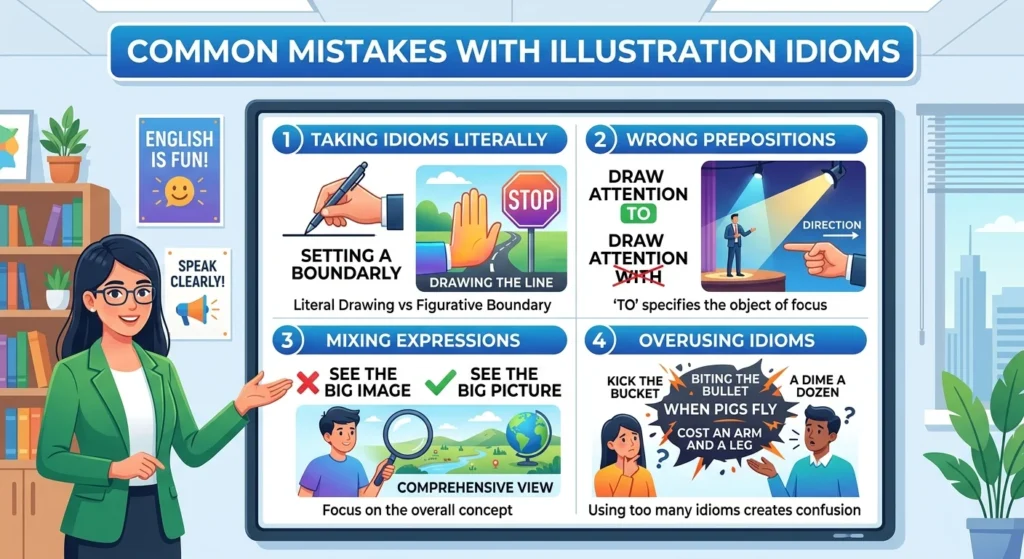
Mixing Different Expressions
Don’t combine parts of different expressions.
Use:
See the big picture.
Not:
“See the big image.”
Use:
Draw a conclusion.
Not:
“Paint a conclusion.”
Overusing Idioms
Idioms can make language vivid, but too many can make writing sound forced.
Instead of putting three or four idioms into every paragraph, choose the one that communicates your idea most naturally.
Colorful Idioms: 30+ Lively Phrases and What They Mean
Why Are Illustration Idioms So Memorable?
Visual expressions are memorable because they turn abstract ideas into mental pictures.
For example, “paint yourself into a corner” gives you an immediate image of someone accidentally blocking their own escape. That visual idea makes the figurative meaning—creating a problem through your own choices—easier to remember.
Similarly:
- Draw the line → imagine a boundary.
- See the big picture → imagine stepping back to view everything.
- Draw a blank → imagine an empty space where an answer should be.
- Color outside the lines → imagine ignoring the usual boundaries.
The stronger the mental image, the easier an expression can be to recall and use.
Illustration Idioms vs. Related Visual Expressions
Not every item in this list is a strict traditional idiom. English also uses collocations, compounds, and figurative phrases that rely on visual imagery.
For example:
| Type | Example | Meaning |
|---|---|---|
| Idiomatic expression | Draw the line | Set a boundary |
| Idiomatic expression | Paint yourself into a corner | Limit your own choices |
| Figurative expression | Paint a picture | Describe vividly |
| Collocation | Draw attention | Make something noticeable |
| Compound adjective | Picture-perfect | Extremely attractive |
| Proverbial expression | A picture is worth a thousand words | Images can communicate effectively |
This distinction is useful for learners because it shows how English creates meaning in different ways—not every figurative expression has to fit one strict linguistic category.
FAQs About Illustration Idioms
What are illustration idioms?
Illustration idioms are a practical group of idiomatic and figurative English expressions that use visual ideas such as drawing, painting, pictures, and colors to communicate nonliteral meanings.
What is a common illustration idiom?
“Draw the line” is a common example. It means to establish a limit or boundary.
What is an idiom about pictures?
Several expressions are connected with pictures, including “see the big picture,” “get the picture,” “picture this,” “picture-perfect,” and “a picture is worth a thousand words.”
What is an idiom about drawing?
Common drawing-related expressions include “draw the line,” “draw a blank,” “draw attention,” “draw a conclusion,” and “draw parallels.”
How can I learn illustration idioms faster?
Group expressions by imagery—drawing, painting, pictures, and colors—then create one sentence from your own life for each expression. Using them in context is more effective than memorizing definitions alone.
Conclusion
Illustration idioms and visual expressions make English more vivid because they turn abstract ideas into memorable mental images. From “draw the line” and “draw a blank” to “paint yourself into a corner,” “see the big picture,” and “color outside the lines,” these expressions can make everyday English more natural and expressive.
Don’t try to memorize all 20 at once. Choose five, learn their complete sentence patterns, and write examples connected to your own life. Once those feel natural, add another five and start using them in real conversations and writing.

Daniel Mercer is a Meaning Match writer covering English idioms, vocabulary, expressions, and language usage with clear meanings and practical examples.