
Why would anyone “let the cat out of the bag” or say it is “raining cats and dogs”? English idioms can sound very funny when children imagine their words literally. Idioms for kids with pictures make these expressions easier and more fun to understand because children can see the silly image first and then learn the real meaning.
An idiom is a phrase whose meaning is different from the literal meaning of its individual words. For example, “a piece of cake” does not mean a slice of dessert—it means something is very easy. Pictures can make these unusual expressions easier to remember, while simple examples show children how to use them naturally.
Whether you’re a parent, teacher, student, or English learner, this guide features kid-friendly idioms with pictures, simple meanings, and clear example sentences to make learning English more enjoyable.
What Are Idioms for Kids?
Idioms for kids pictures are visual examples that help children understand common expressions by showing their literal and figurative meanings. For example, “when pigs fly” does not mean pigs can really fly—it means something is very unlikely to happen.
Pictures make these funny expressions easier to understand and remember. Below are 20 kid-friendly idioms with simple meanings, picture ideas, examples, and mistakes to avoid.
Why Do Kids Learn Idioms Better With Pictures?
Idioms can be confusing because their words often do not mean exactly what they seem to say. A child hearing “hit the books” might imagine someone hitting a textbook, when the speaker really means “study.”
A picture can make that difference obvious.
Visual idiom activities can help children:
- Understand literal and figurative language
- Remember unusual expressions
- Learn new vocabulary in context
- Recognize idioms while reading
- Use expressions naturally in conversation
- Avoid common mistakes
A Simple Way to Understand an Idiom
Think of every idiom as having two meanings:
Literal meaning → What the words seem to say
Figurative meaning → What the speaker actually means
For example:
“When pigs fly”
🐷 Literal: A pig flying through the sky
💡 Figurative: Something that is extremely unlikely
This simple comparison is one of the easiest ways to teach idioms to children.
Idioms for Kids With Pictures and Meanings
The following picture-friendly idioms are suitable for elementary students, parents, teachers, and English learners.
A Piece of Cake
Picture idea: Show a child easily solving a simple puzzle beside a slice of cake.
Word-by-word meaning: A piece of cake is a slice of cake.
Figurative meaning: Something is very easy.
Example:
“The spelling test was a piece of cake.”
Common error: Don’t use this idiom simply to say that something tastes good.
Usage note: Use it for an easy task or activity.
Break a Leg
Picture idea: Show a child preparing to perform on stage, alongside a small crossed-out picture of a broken leg.
Word-by-word meaning: The words sound as if someone is being told to break a leg.
Figurative meaning: Good luck, especially before a performance.
Example:
“Your school play starts soon. Break a leg!”
Common error: It is not an instruction to hurt yourself.
Usage note: This is an informal expression often used before performances.
It’s Raining Cats and Dogs
Picture idea: Show heavy rain outside with funny cartoon cats and dogs appearing in the sky.
Word-by-word meaning: Cats and dogs seem to be falling from the sky.
Figurative meaning: It is raining very heavily.
Example:
“Take an umbrella. It’s raining cats and dogs!”
Common error: Don’t use it for light rain.
Usage note: Its silly mental picture makes this a memorable idiom for children.
Hold Your Horses
Picture idea: Show a child saying “Wait!” while friendly horses stand nearby.
Word-by-word meaning: Hold or stop horses.
Figurative meaning: Wait, slow down, or be patient.
Example:
“Hold your horses! We haven’t finished packing yet.”
Common error: It does not mean someone is literally holding horses.
Usage note: This informal expression can be playful when asking someone to slow down.
Spill the Beans
Picture idea: Show beans falling from a tipped bowl beside two children talking about a secret.
Word-by-word meaning: Beans are accidentally spilled.
Figurative meaning: To reveal a secret.
Example:
“Who spilled the beans about the surprise party?”
Common error: Don’t confuse the idiom with actually dropping food.
Usage note: It can describe revealing information that was supposed to stay secret.
Hit the Books
Picture idea: Show a child studying at a desk beside a book with a playful “Not literally!” symbol.
Word-by-word meaning: The phrase sounds like hitting books.
Figurative meaning: To study seriously.
Example:
“I have a test tomorrow, so I need to hit the books.”
Common error: It doesn’t mean hitting or damaging books.
Usage note: This is a common informal expression about studying.
Under the Weather
Picture idea: Show a child feeling sick beneath a rainy cloud.
Word-by-word meaning: Someone is underneath the weather.
Figurative meaning: Feeling sick or unwell.
Example:
“Lena stayed home because she was under the weather.”
Common error: It does not describe someone’s physical location.
Usage note: This is a gentle, informal way to say someone doesn’t feel well.
When Pigs Fly
Picture idea: Show a cartoon pig flying through the sky with a child looking surprised.
Word-by-word meaning: A pig is flying.
Figurative meaning: Something is extremely unlikely to happen.
Example:
“Will my brother clean my room for me?”
“Sure—when pigs fly!”
Common error: Don’t use it simply to mean “later.”
Usage note: It is usually humorous or playful.
Let the Cat Out of the Bag
Picture idea: Show a cat escaping from a bag beside a child accidentally revealing a surprise.
Word-by-word meaning: A cat comes out of a bag.
Figurative meaning: To reveal a secret, often accidentally.
Example:
“Sam let the cat out of the bag about the birthday surprise.”
Common error: It doesn’t refer only to releasing a real cat.
Usage note: It has a similar meaning to spill the beans.
Keep an Eye On
Picture idea: Show a child watching a backpack while a large friendly cartoon eye appears as a visual clue.
Word-by-word meaning: The words sound like putting an eye on something.
Figurative meaning: To watch or look after something carefully.
Example:
“Please keep an eye on my bag.”
Common error: The expression is not literal.
Usage note: This is a very common everyday expression.
Feeling Blue
Picture idea: Show a child looking sad with a small blue cloud, while clearly showing that the child is not actually turning blue.
Word-by-word meaning: The word “blue” refers to a color.
Figurative meaning: Feeling sad or unhappy.
Example:
“Mia was feeling blue because her friend moved away.”
Common error: It does not mean someone’s skin or clothes are blue.
Usage note: Use it for feelings of sadness, usually in informal situations.
On Cloud Nine
Picture idea: Show a very happy child surrounded by clouds after winning a school prize.
Word-by-word meaning: Someone is sitting on a cloud.
Figurative meaning: Feeling extremely happy.
Example:
“Ella was on cloud nine after winning the art contest.”
Common error: It does not literally mean sitting in the sky.
Usage note: Use it to describe strong happiness or excitement.
Cool as a Cucumber
Picture idea: Show a calm child giving a presentation while classmates look nervous, with a cucumber as a funny visual clue.
Word-by-word meaning: A cucumber is cool and fresh.
Figurative meaning: Very calm, especially in a stressful situation.
Example:
“Everyone was nervous, but Noah was cool as a cucumber.”
Common error: It doesn’t mean that someone is physically cold.
Usage note: This playful idiom is easy to visualize.
The Ball Is in Your Court
Picture idea: Show two children on opposite sides of a tennis court, with the ball on one child’s side and a decision symbol.
Word-by-word meaning: The ball is physically on your side of a court.
Figurative meaning: It is your turn to act or make a decision.
Example:
“I gave you all the information. Now the ball is in your court.”
Common error: It doesn’t necessarily mean a real sports game is happening.
Usage note: Use it when responsibility for the next step belongs to someone else.
Go the Extra Mile
Picture idea: Show a child helping a classmate with homework after already finishing their own work, with a small road marked “extra mile.”
Word-by-word meaning: Walk one additional mile.
Figurative meaning: Make an extra effort.
Example:
“Our teacher went the extra mile to help us understand the lesson.”
Common error: It doesn’t require physically walking another mile.
Usage note: Use it when someone does more than expected.
In Hot Water
Picture idea: Show a child worried beside a bathtub filled with water, while a school mistake appears on a paper to show the figurative meaning.
Word-by-word meaning: Being in hot water.
Figurative meaning: Being in trouble.
Example:
“Ben was in hot water after forgetting his homework.”
Common error: It doesn’t necessarily mean someone is actually in water.
Usage note: This informal expression is often used for everyday trouble.
Get Cold Feet
Picture idea: Show a child about to walk onto a stage, looking nervous, with funny cold-looking feet as a visual clue.
Word-by-word meaning: Having cold feet.
Figurative meaning: Becoming nervous or afraid before doing something.
Example:
“I wanted to give my speech, but I got cold feet.”
Common error: Having physically cold feet is not the idiomatic meaning.
Usage note: Use it when someone suddenly loses confidence before an important action.
Cost an Arm and a Leg
Picture idea: Show a child looking surprised at the price of an expensive bicycle, with cartoon arms and legs crossed out to show the phrase is not literal.
Word-by-word meaning: The words sound like someone is paying with body parts.
Figurative meaning: Something is extremely expensive.
Example:
“That new bicycle cost an arm and a leg.”
Common error: It doesn’t literally involve giving away body parts.
Usage note: This is an informal way to emphasize a very high price.
Bite the Bullet
Picture idea: Show a child bravely starting a difficult homework task while a crossed-out bullet appears only as a visual “not literal” clue.
Word-by-word meaning: The phrase sounds like biting a bullet.
Figurative meaning: Face something difficult or unpleasant with courage.
Example:
“I don’t enjoy cleaning my room, but I’ll bite the bullet and finish it.”
Common error: Never interpret the expression as a literal instruction.
Usage note: It is best explained to older children because the literal image may be confusing.
A Storm in a Teacup
Picture idea: Show a tiny teacup containing a cartoon storm beside children worrying about a very small problem.
Word-by-word meaning: A storm appears inside a teacup.
Figurative meaning: A lot of worry or excitement about a small problem.
Example:
“The argument was just a storm in a teacup.”
Common error: It does not describe real weather.
Usage note: This expression helps children understand how a small issue can sometimes seem much bigger than it really is.
Illustrated Idioms: 30+ Expressions You Can See and Understand
Quick Picture Chart: Idioms at a Glance
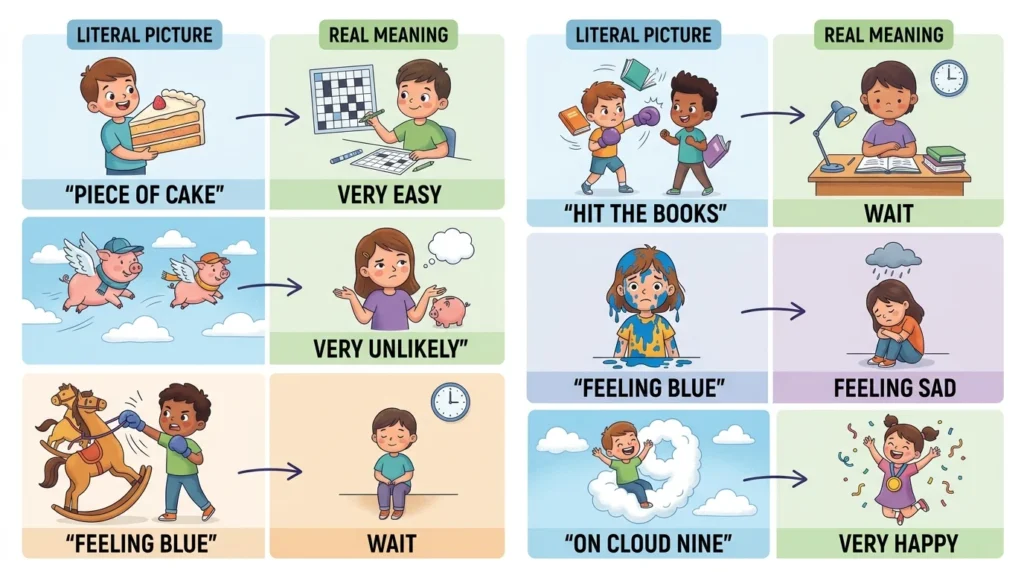
| Idiom | Simple Meaning | Picture Cue |
|---|---|---|
| A piece of cake | Very easy | Cake + easy task |
| Break a leg | Good luck | Stage performance |
| Raining cats and dogs | Heavy rain | Cats, dogs + rain |
| Hold your horses | Wait | Horses + “Wait!” |
| Spill the beans | Reveal a secret | Spilled beans + secret |
| Hit the books | Study | Child + books |
| Under the weather | Feel sick | Sick child + cloud |
| When pigs fly | Very unlikely | Flying pig |
| Feeling blue | Feeling sad | Sad child + blue cloud |
| On cloud nine | Very happy | Happy child + clouds |
How Teachers and Parents Can Use Idiom Pictures
Picture-based idiom activities can turn vocabulary practice into a simple game.
Try These Activities
1. Match the Picture
Give children several idiom pictures and meaning cards. Ask them to match each picture with the correct meaning.
2. Draw the Literal Meaning
Ask children to draw a funny literal picture of an idiom such as “when pigs fly.”
3. Explain the Real Meaning
After drawing the literal picture, have children explain what the expression actually means.
4. Make a Sentence
Give each child an idiom and ask them to create a sentence using it correctly.
5. Act It Out
Children can act out an idiom while classmates guess the expression.
6. Create Classroom Cards
Print or draw idiom cards and place them around the classroom for regular vocabulary practice.
These activities work especially well for elementary English lessons, ESL practice, homeschooling, and family learning.
Common Mistakes Kids Make With Idioms
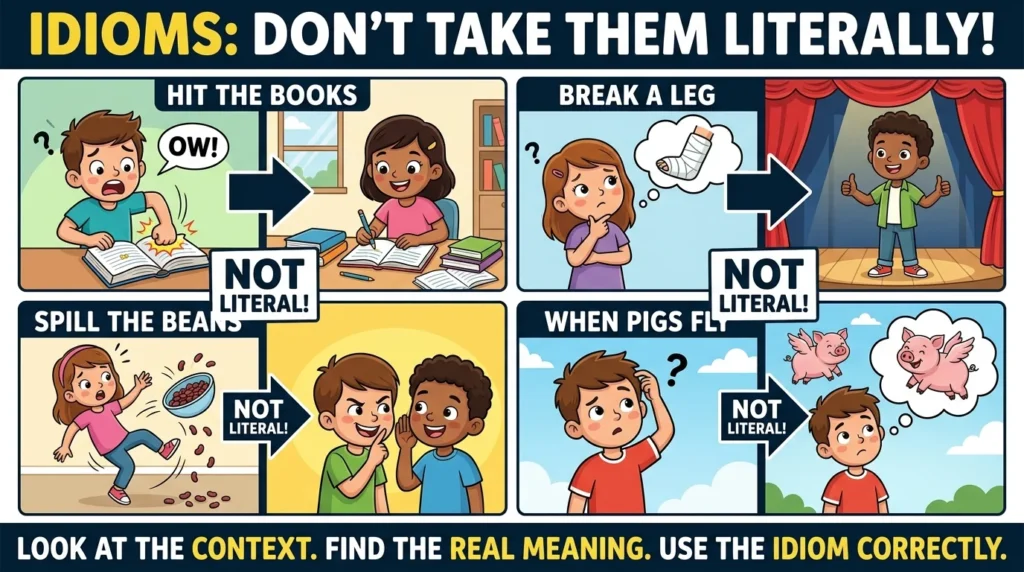
Taking Idioms Literally
The biggest mistake is assuming every word has its ordinary meaning.
If someone says “hit the books,” they are talking about studying—not attacking a book.
Using the Wrong Idiom
Children should learn that each expression fits particular situations.
- Break a leg → before a performance
- Hit the books → when studying
- Feeling blue → when feeling sad
- Hold your horses → when asking someone to wait
Confusing Similar Expressions
Spill the beans and let the cat out of the bag both relate to revealing secrets, but children should still learn each expression as its own phrase.
Ignoring Tone
Many idioms are informal and playful. They may sound natural in a conversation with friends but may not be suitable for every formal piece of writing.
Using Too Many Idioms
One or two well-chosen idioms can make writing interesting. Filling every sentence with idioms can make language sound unnatural.
Printable Idiom Picture Ideas for Kids
If you’re creating classroom resources or worksheets, turn these expressions into simple picture cards.
Each card can include:
Front:
🖼️ A literal picture
Idiom: “When Pigs Fly”
Back:
Meaning: Something very unlikely
Example: “I’ll clean your room when pigs fly!”
Other useful printable formats include:
- Idiom matching cards
- Literal vs. figurative worksheets
- Picture-and-meaning puzzles
- Classroom posters
- Idiom flashcards
- Fill-in-the-blank activities
- Draw-the-idiom worksheets
The goal is not simply to memorize an expression. Children should learn what it means, when to use it, and how it sounds in a real sentence.
Drawing Idioms: 23+Common Idioms and Expressions With “Draw”
Frequently Asked Questions
What are idioms for kids?
Idioms for kids are common expressions explained in simple language so children can understand their figurative meanings. Examples include “a piece of cake,” “break a leg,” and “when pigs fly.”
Why are pictures useful for teaching idioms?
Pictures help children see the difference between an idiom’s literal wording and its real meaning. Funny visual examples can also make unfamiliar expressions easier to remember.
What is an easy idiom for a child to learn?
“A piece of cake” is an easy starting point because children can understand the literal picture of cake while learning that the expression means something is very easy.
How can I teach idioms with pictures?
Show the literal picture first, ask the child what they see, explain the figurative meaning, and then create a simple sentence together. Matching games, drawing activities, flashcards, and acting games can make practice more engaging.
Should children take idioms literally?
No. Most idioms have a figurative meaning that is different from the literal meaning of the words. Context helps children understand what the speaker really means.
Conclusion: Make Idioms Easy and Fun
Learning idioms becomes much easier when children can see the difference between the words and the real meaning. That’s why idiom pictures are useful for classrooms, homework, reading practice, ESL lessons, and family activities.
Start with five easy expressions such as “a piece of cake,” “break a leg,” “hit the books,” “when pigs fly,” and “spill the beans.” Draw the literal meaning, explain the figurative meaning, and create one sentence for each.
With regular practice, children can move from simply recognizing funny expressions to using idioms naturally and confidently in everyday English.

Sophie Collins writes for Meaning Match about English idioms, American and British expressions, meanings, usage, and everyday language differences.